
FAT-330 · Lesson 11 of 12 · 20 min
Handover: documentation, training and the owner's responsibilities
A fire alarm that works on handover day and is misunderstood the day after is a system in trouble. Dana Whitcombe will run the north wing for years; her maintenance staff will silence its troubles, its security officers will read its annunciator, and its nurses will hear its signals. None of them took part in the verification. 'Handover is where all our knowledge has to pass to people who weren't here,' Gerry tells Sasha. 'If we do it badly, the first nuisance alarm undoes three weeks of work.' This lesson covers what the owner receives, how the people who will live with the system are trained, the owner's duties from the first day, and how later changes are verified.
The documents the owner receives
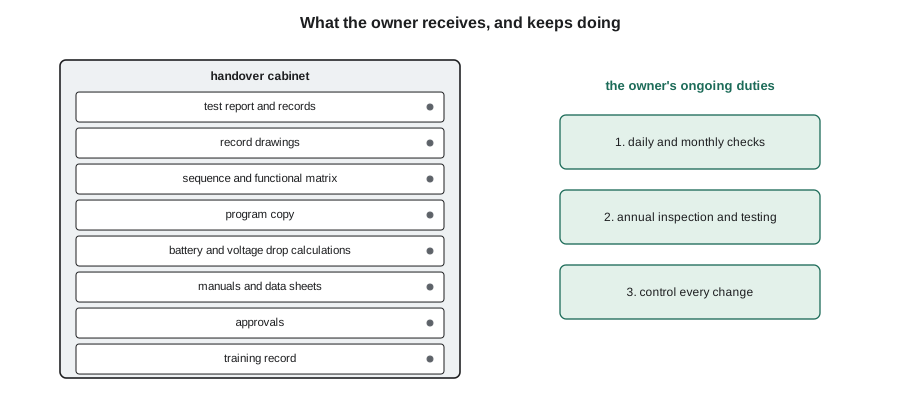
The handover package is everything the owner needs to operate, maintain, inspect and change the system. For the north wing it includes:
- the signed verification report and the integrated testing report;
- record drawings showing what was actually built: every device, its address, its circuit and its room, with the revision that matches the final program;
- the sequence of operation and the functional matrix as tested;
- a copy of the site-specific program, with its version and date, and the passwords or access arrangements the owner needs;
- battery and voltage drop calculations revised to match the installed load;
- equipment data sheets and the manufacturer's operating and maintenance manuals;
- the written approvals of any alternatives or deviations accepted by the authority;
- warranty terms and the service company's contact details for troubles and emergencies.
The National Fire Code requires the owner to keep fire alarm records available for the fire department, and the building's fire safety plan must reflect how the system operates. A documentation cabinet near the control unit holds a working copy so that technicians and inspectors have what they need on site.
Checking the record drawings
Record drawings are only useful if they match the building. Before handover Sasha reconciles three lists: the final design drawings, the panel's final point list, and the test matrix, which records what was found on site. Every device must appear in all three with the same address, type and room. Differences are corrected on the drawings before they are issued as records.
# Reconcile the as-built record: drawings, panel point list and test matrix
drawings = {"1-003": ("heat", "1.012"), "1-005": ("smoke", "1.014"), "1-006": ("smoke", "1.015"),
            "4-031": ("smoke", "4.108 med room"), "4-032": ("heat", "4.110 staff lounge"), "P-003": ("heat", "penthouse")}
panel =    {"1-003": ("heat", "1.012"), "1-005": ("smoke", "1.014"), "1-006": ("smoke", "1.015"),
            "4-031": ("smoke", "4.108 med room"), "4-032": ("heat", "4.110 staff lounge"), "P-003": ("heat", "penthouse")}
matrix =   {"1-003": ("heat", "1.012"), "1-005": ("smoke", "1.014"), "1-006": ("smoke", "1.015"),
            "4-031": ("smoke", "4.108 med room"), "4-032": ("heat", "4.110 staff lounge")}
problems = 0
for addr in sorted(set(drawings) | set(panel) | set(matrix)):
    seen = [src for src, d in (("drawings", drawings), ("panel", panel), ("matrix", matrix)) if addr in d]
    vals = {d[addr] for d in (drawings, panel, matrix) if addr in d}
    if len(seen) < 3 or len(vals) > 1:
        problems += 1
        print(f"{addr}: found in {', '.join(seen)}; values {sorted(vals)}")
print("record matches" if problems == 0 else f"{problems} difference(s) to resolve before issuing record drawings")P-003: found in drawings, panel; values [('heat', 'penthouse')]
1 difference(s) to resolve before issuing record drawingsOne difference remains: the penthouse heat detector P-003, added after the installation review, is on the drawings and in the panel but has no row in the matrix. It was installed after the penthouse was tested. Sasha tests it, adds the row, and only then are the record drawings issued.
Training the people who will use it
Training is part of handover, and the specification usually says who must be trained and for how long. At Eastview Gerry runs separate sessions for different groups, because each needs something different:
| Group | What they need to know |
|---|---|
| Security officers | Reading the panel and annunciator, the meaning of alarm, supervisory and trouble signals, what to do for each, calling the fire department and the monitoring station |
| Maintenance staff | Silencing and resetting correctly, owner checks, isolating devices for work in the building, impairment procedures, who to call for service |
| Nursing leadership | What the alert and alarm signals mean on their units, the staff response in the fire safety plan, why doors close and elevators recall |
| Facilities manager | Records, inspection schedule, controlling changes, the service contract and warranty |
The two-stage system needs particular care in training. Staff must understand that the alert signal means investigate and acknowledge, and that if nobody acknowledges within five minutes the alarm signal will sound throughout the wing. A staff member who resets the system instead of acknowledging it, to stop the noise, may hide a real fire.
# Training record: who attended, and who still needs a session
required = {"security": 12, "maintenance": 8, "nursing leadership": 10, "facilities": 2}
attended = {"security": 9, "maintenance": 8, "nursing leadership": 7, "facilities": 2}
for group, need in required.items():
    got = attended.get(group, 0)
    print(f"{group:20s} {got:2d} of {need:2d} trained" + ("" if got >= need else f"  - {need - got} still to train"))
total_need, total_got = sum(required.values()), sum(attended.values())
print(f"overall {total_got} of {total_need}; schedule a make-up session before occupancy" if total_got < total_need else "all trained")security 9 of 12 trained - 3 still to train maintenance 8 of 8 trained nursing leadership 7 of 10 trained - 3 still to train facilities 2 of 2 trained overall 26 of 32; schedule a make-up session before occupancy
The training record goes into the handover package with each person's name and the date. Gerry schedules a make-up session for the night shift, because the people most likely to be alone with an alarm at 3 a.m. are the ones least likely to attend a daytime class.
The owner's duties from day one
From occupancy, the owner is responsible for keeping the system in working order. Under the National Fire Code and CAN/ULC-S536, that includes the owner's daily and monthly checks (that the panel shows normal, that troubles are acted on, that the batteries and the monitoring connection are in order), the annual inspection and test by a qualified technician, and keeping the records. The first annual inspection is due within a year of verification, and Sasha's report becomes the baseline it is compared with.
The owner is also responsible for impairments. When the system or part of it is out of service, the owner must notify the fire department and the monitoring station, arrange a fire watch where required and get the system back in service. Dana's staff learn the hospital's impairment procedure in their training session, and the procedure is written into the fire safety plan.
Controlling later changes
Buildings change, and hospitals change constantly. A room becomes a lab, a wall moves, a new piece of equipment needs a heat detector. Each change to the fire alarm is a modification that must be designed, installed and verified. The owner's job is to make sure nobody changes the system without that process, including the hospital's own maintenance staff and other contractors.
Verifying a modification under CAN/ULC-S537 covers the new or changed devices and functions and every part of the system they affect. A new detector is verified completely. A removed device means the circuit is tested to prove it still works and the program no longer expects the device. A program change means every changed point and output is tested, with a sample of others. The modification's verification report lists what was verified and any deficiencies found in the existing system nearby, and the record drawings and program copy are updated.
Changes also affect integrated testing. A change to a door, a damper or an elevator interface means the integrated scenarios that use it must be retested, and the integrated testing report updated.
Warranty and the first year
Most contracts include a one-year warranty on the installation, and many hospitals pay for a service visit or two during that year. The first year is when early failures show: a detector that drifts dirty because construction dust is still settling, a waterflow switch that sticks, a battery that was weak from the start. Gerry recommends that the first inspection after occupancy be done by a crew that has the verification report in hand and compares every finding with it.
Worked problem
The renovation nobody mentioned
Eight months after occupancy, Bramwell's service technician finds two new rooms on the north wing's fifth floor, built by the hospital's own maintenance staff. One existing smoke detector was moved to the new corridor, and a new room has no detection. The panel shows no troubles. What does this mean and what should happen?
Show solution
- Moving a detector is a modification; it should have been designed, approved and verified. The detector's description is now wrong.
- A new room without detection where the design and the code require it is a deficiency the owner must correct.
- The technician reports both to Dana in writing and recommends the change be designed and verified properly.
- Ravi revises the design, the work is done, and the modification is verified, including the moved detector, the new detector and the affected descriptions.
- The record drawings, program copy and verification records are updated.
Answer: A system with no troubles can still be wrong after unmanaged changes; change control is the owner's job.
The fire safety plan
The fire alarm doesn't operate in isolation from people. The National Fire Code requires a fire safety plan for buildings like a hospital, describing what staff do when the alarm sounds, how the building is evacuated or how patients are protected in place, and how the fire department is met. Dana's team updates Eastview's fire safety plan for the north wing before occupancy, and Gerry reviews the parts that describe the fire alarm: the meaning of the alert and alarm signals, the location of the annunciator, the procedure for silencing and resetting, and the impairment procedure. A plan that describes signals the system doesn't produce, or controls it doesn't have, is a problem waiting for a fire.
Hospitals also hold fire drills on every shift, and the first drills on a new wing are a useful final check. Staff hear the signals where they really work, at the times they really work, and any room where a signal can't be heard or a door doesn't close shows up quickly. Gerry asks Dana to send him the results of the first round of drills, and two of the north wing's remarks are closed on the strength of them.
The service contract
The owner also needs a service arrangement in place from the first day: who answers trouble calls, how fast, who does the annual inspection and who keeps the program copy and passwords. On the north wing, the hospital extends its existing service agreement with Bramwell to cover the new wing. Donna Achebe, Bramwell's service manager, adds the wing's devices to the hospital's inspection schedule, loads the verification records into the service crew's files, and books the first inspection for the anniversary of the verification, so that the interval doesn't drift.
Passwords and access codes deserve particular care. The panel's programming passwords, the network access arrangements and any remote connection must be documented, held by the owner and changed from the installer's defaults before handover. A system that only the installer can reprogram leaves the owner dependent on one company; a system anyone can reprogram leaves it open to changes nobody verified.
Finally, the owner should know who to call first. A laminated card inside the panel door lists the service company's 24-hour number, the monitoring station's number and account, and the hospital's own internal contacts, so that the person standing at the panel during a trouble at 3 a.m. doesn't have to search for them.
Common mistakes
MistakeHanding over the design drawings as record drawings.
InsteadReconcile drawings, point list and test matrix and issue drawings that show what was built.
MistakeTraining only the facilities manager.
InsteadTrain security, maintenance, nursing leadership and the facilities manager separately.
MistakeTraining the day shift only.
InsteadRun sessions for night and weekend staff too.
MistakeLetting maintenance staff move devices without verification.
InsteadTreat every change as a modification: design, install, verify, update records.
MistakeStoring the program copy only at the service company.
InsteadKeep a copy in the documentation cabinet and with the owner.
Summary and key terms
- The owner receives the reports, record drawings, sequence, program copy, calculations, manuals, approvals and warranty.
- Record drawings are reconciled against the panel's point list and the test matrix before they are issued.
- Training is tailored to each group, including night staff, and is recorded.
- From occupancy the owner must keep the system working, inspected and recorded, and manage impairments.
- Every later change is a modification that must be verified, with records and integrated tests updated.
- The verification report is the baseline for every later inspection.
- Record drawings
- Drawings showing the system as actually built and verified.
- Handover package
- The documents and training the owner receives when the system is accepted.
- Owner checks
- The routine checks the owner makes between annual inspections.
- Modification
- An addition, deletion or change to an existing system.
- Impairment
- A condition where the system or part of it is out of service.
Practice problems
Work each problem on paper first, then reveal the answer to check.
Why reconcile the record drawings with the point list and test matrix?
Show answer
So the records show what was built and tested, not only what was designed.
Why train each group separately?
Show answer
Each needs different knowledge to do its part.
Why must night staff be trained?
Show answer
They are most likely to be alone with an alarm.
What is the owner responsible for after occupancy?
Show answer
Keeping the system working, inspected, recorded and controlled, and managing impairments.
What happens when a detector is moved during a renovation?
Show answer
It is a modification that must be designed, verified and recorded.
Lesson quiz · 5 questions
Score 60% or more to complete this lesson.
Create a free account to save your progress, take quizzes and earn a certificate.