
FAT-330 · Lesson 12 of 12 · 20 min
Capstone: verifying the Eastview north wing
This capstone follows the north wing from the day Bramwell accepted it for verification to the day the hospital's first patients arrived. It brings together everything in the course: planning, pre-test review, device-by-device verification, control unit and power tests, notification measurements, integrated testing, deficiency closure, the report and handover. Read it as Sasha's account of the job, and at each step ask yourself what you would have checked and what you would have recorded.
The building and the system
The north wing is six floors and a mechanical penthouse, connected to the rest of Eastview General Hospital by a link corridor on floors 1 to 3. Floor 1 holds outpatient clinics and the wing's fire department entrance; floor 2 is the operating suite; floor 3 is a secure psychiatric unit; floors 4 to 6 are inpatient units. The fire alarm is a networked addressable system: the wing's own control unit, joined to the hospital network, with three Class A signalling line circuits, two remote power supplies (RPS-3 and RPS-4), Class B notification circuits, an air-sampling system in the operating suite, duct detectors on the two air handlers, and 41 control outputs for door holders, dampers, air handlers, elevators, locked egress doors and the stair doors.
The system is two-stage, like the rest of Eastview. It is verified to the edition of CAN/ULC-S537 referenced by the 2020 National Building Code as adopted in Saskatchewan, and integrated testing follows CAN/ULC-S1001.
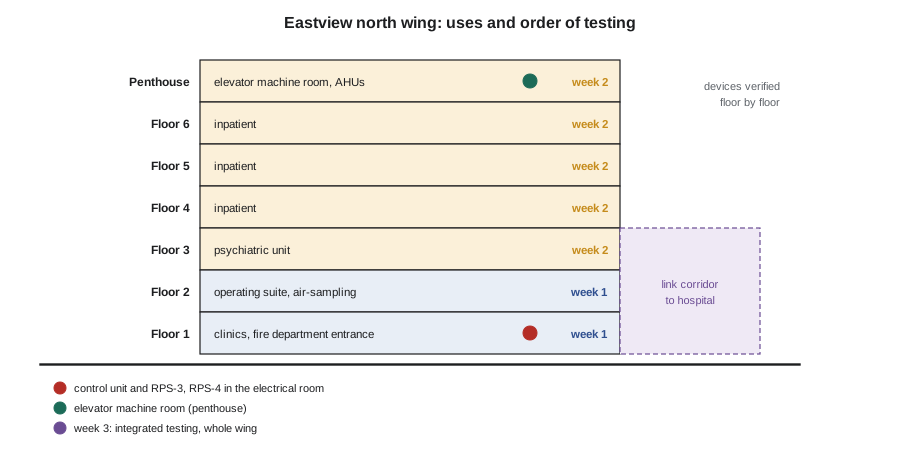
Week 1: readiness, panel and the first floors
The week began badly, with the third floor not ready (Lesson 5): an open ceiling, dust covers on, a manual station hanging by its wires and no pre-test record. Gerry recorded each item and moved the crew to the panel. Sasha's review of the installer's insulation records found three circuits below specification, all repaired before the end of the week. Her comparison of the program with the sequence of operation found the AHU-N2 duct detector mapped to AHU-N1 and the stair 4N lock mapped to the wrong relay, both corrected and the program version recorded.
At the panel, the control unit functions, the timed sequences and the network all passed. Circuit fault tests passed on every loop, and the L3 loop, rerouted after the installation review, survived its mid-loop open. Field device testing began on floors 1 and 2. The operating suite's detectors were tested on Thursday, before infection control's final cleaning, and the air-sampling system's transport times were recorded at all four pipes, the longest at 97 seconds against a limit of 120.
Week 2: field devices, sprinklers and sound
Floors 3 to 6 and the penthouse were tested in the second week. The psychiatric unit's tamper-resistant detectors took twice as long as the others, as planned. Across the wing, 8 smoke detectors failed at first: six with descriptions that didn't match their rooms, one with a damaged head and one programmed as the wrong type. The duct detector on AHU-N1's return failed its airflow check until its sampling tube was turned to face the airflow.
Luis spent Wednesday morning with Sasha on the sprinkler devices. All seven waterflow switches signalled within the allowed time, the slowest at 58 seconds, and all nine valve supervisory switches signalled early and cleared only when fully open. Every valve was left open, sealed and recorded.
On Saturday the crew measured sound. Six strobes were found at the wrong setting and the strobes at the fourth-floor cross-corridor doors were out of step until RPS-3 and RPS-4 were linked. Patient room 412 and the fourth-floor lounge failed audibility; Ravi added a horn to room 412 and moved the lounge appliance.
Week 2, continued: power
The battery tests found RPS-4's measured alarm current higher than its calculation because of drawing revision 4; its 18 Ah batteries were replaced with 26 Ah batteries in a new cabinet. RPS-4's NAC 2 measured 15.7 V at its last appliance in alarm on battery, below the 16 V listed minimum. Six appliances were moved to a spare circuit on RPS-3, and both supplies' circuits and batteries were retested.
Week 3: integrated testing
Owen ran eleven scenarios over two days, with every trade present and Captain Strand attending the most important ones. Three failed the first time:
- Smoke in the third-floor corridor: the psychiatric unit's egress doors didn't release, because the fire alarm input was wired to the lock supply's power-loss terminal. Corrected and the whole scenario rerun.
- Smoke in the first-floor elevator lobby: the elevators recalled to the main floor instead of the alternate floor, because the recall inputs were swapped at the elevator controller. Corrected and both recall scenarios rerun.
- Duct detector on AHU-N2: the fan didn't stop, because the shutdown wiring was on the wrong terminal at the air handler's controller. Corrected and rerun.
The loss-of-normal-power scenario passed: the generator transferred in 9 seconds, the fire alarm reported the AC loss and ran on battery until transfer, the elevators lowered and then one car ran on generator, and a fire alarm scenario run while on generator power passed completely.
# Integrated testing summary: scenarios, first-run results and retests
scenarios = [("smoke 3rd floor corridor", "fail", "pass"), ("smoke 1st floor elevator lobby", "fail", "pass"),
             ("smoke 3rd floor elevator lobby", "pass", ""), ("heat elevator machine room", "pass", ""),
             ("waterflow floor 4", "pass", ""), ("waterflow floor 6", "pass", ""), ("manual station floor 5", "pass", ""),
             ("duct detector AHU-N1 supply", "pass", ""), ("duct detector AHU-N2 supply", "fail", "pass"),
             ("loss of normal power", "pass", ""), ("smoke floor 2 while on generator", "pass", "")]
first_pass = sum(1 for _, a, _ in scenarios if a == "pass")
final_pass = sum(1 for _, a, b in scenarios if a == "pass" or b == "pass")
print(f"scenarios: {len(scenarios)}, passed first time: {first_pass}, passed after correction: {final_pass - first_pass}")
print("all scenarios pass" if final_pass == len(scenarios) else "open scenarios remain")scenarios: 11, passed first time: 8, passed after correction: 3 all scenarios pass
Closing the deficiencies
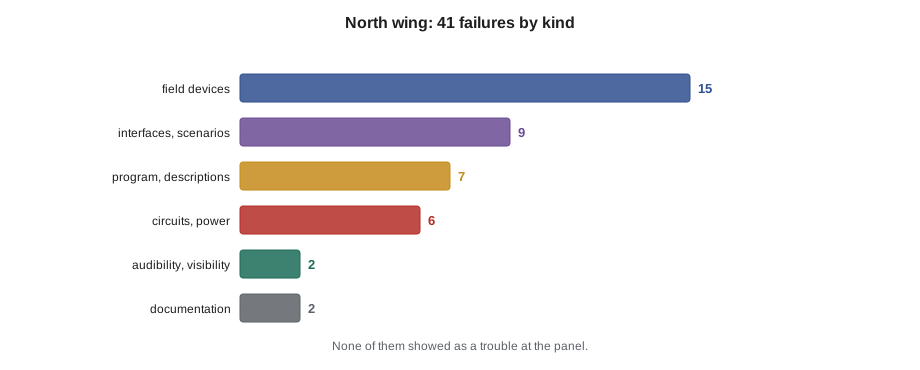
By the end of week three every row in the matrix had a result. Across the job, 41 rows had failed at least once. Sasha's tally by kind:
# Where the 41 failures came from
failures = {"field devices": 15, "circuits and power": 6, "program and descriptions": 7,
            "audibility and visibility": 2, "interfaces and integrated scenarios": 9, "documentation": 2}
total = sum(failures.values())
for k, n in sorted(failures.items(), key=lambda x: -x[1]):
    print(f"{k:38s} {n:2d}  {'#' * n}")
print("total:", total, "- all corrected and retested before the report was signed")field devices 15 ############### interfaces and integrated scenarios 9 ######### program and descriptions 7 ####### circuits and power 6 ###### audibility and visibility 2 ## documentation 2 ## total: 41 - all corrected and retested before the report was signed
Two facts in that tally interest Gerry more than the total. First, more failures came from programming, descriptions and interfaces than from devices, which is typical: the hardware usually works, and the connections and the information are where errors hide. Second, none of the 41 would have shown as a trouble on the panel. Every one was found only because someone operated the device or function and checked the result against the design.
The authority's review
Captain Strand had attended the integrated scenarios, and once the verification report arrived she reviewed it with the building official's plans examiner. She asked three questions: why room 412 needed an added horn (answered by the measurement records), whether the egress door correction had been rerun as a whole scenario (it had), and whether the psychiatric unit's manual station arrangement matched the written approval (it did, and the approval was in the report). The building official issued the occupancy permit the following week.
# A witness sample: choose devices at random from the record for the authority to see
import random
random.seed(412)
devices = [f"{floor}-{n:03d}" for floor in "123456" for n in range(1, 40)]
sample = sorted(random.sample(devices, 12))
print("devices chosen for the witnessed demonstration:")
print(", ".join(sample))
print("each was already tested; the witness sees it operate and checks its description")devices chosen for the witnessed demonstration: 1-015, 1-028, 1-030, 2-011, 2-012, 2-035, 2-038, 4-003, 4-028, 5-026, 6-007, 6-027 each was already tested; the witness sees it operate and checks its description
Handover
The handover package went to Dana: the signed verification report, the integrated testing report, reconciled record drawings, the sequence and functional matrix as tested, the program copy with its version, revised battery and voltage drop calculations, manuals, approvals and the training record. Gerry ran six training sessions, including two at night. The north wing node was taken out of test mode, its full network connection to the hospital restored, and the main panel confirmed every north wing point. The first patients arrived on a Monday in May.
Sasha's remarks for the report, kept for the first annual inspection, were: watch the small audibility margins in rooms with sealed doors; compare air-sampling transport times each year with the verification values; the tamper-resistant detector tool is with maintenance; and the integrated scenarios should be repeated after any change to doors, dampers or elevators.
What the job teaches
Gerry's debrief with Sasha and Nadia is short. Three weeks, 585 rows, 41 failures, eleven scenarios, one report. 'The installation was good,' he says. 'Better than most. And it still had 41 things wrong that nobody could see. That's why we do this. Not because installers are careless, but because a building is too complicated to get right without someone checking every piece, and checking that the pieces work together.' Nadia asks what she should remember most. 'Write down only what you saw,' Gerry says. 'Everything else follows from that.'
Worked problem
Your turn: the final checklist
Before Gerry signs, Sasha runs her readiness checklist: every matrix row passed; all 41 failures closed by passing retests; all eleven integrated scenarios passed; documents received and reconciled; meter calibration recorded; training record complete except two night-shift security officers; network test mode still on. What must happen before he signs?
Show solution
- Train the two night-shift officers (or schedule them and record it as a handover item the owner accepts).
- Take the network out of test mode and confirm every north wing point at the main panel, then record it.
- Re-read the whole report, sample the device records and check every closure.
- Then sign, distribute the report, and hand over the package.
Answer: Signing is the last step, after the system is fully back in its normal state and every record is complete.
Looking back from the first annual inspection
A year later, Bramwell's service crew carried out the north wing's first annual inspection, and Sasha, now leading the crew, compared every result with her verification report. Two detectors in the operating suite's anterooms had drifted toward the dirty end of their range as the last construction dust settled, and were cleaned. The air-sampling transport times were within two seconds of the verification values. Room 418, with its sealed door, still passed at 66 dBA. A new treatment room on the fifth floor had been built by the hospital's maintenance staff without telling anyone, and its detector had been moved; the inspection found it because its description no longer matched the room, and the change went through proper design and verification. Every one of those findings was easy to judge because the original record showed what the system had been when it was new.
That is the final lesson of verification. Its value isn't only on handover day. It is the reference that every later inspection, repair, modification and investigation measures against, for as long as the system exists.
For Nadia, the north wing was her first complete verification. She kept her copy of the test matrix, with her own initials on several hundred rows, and used it as a model for the next job. Gerry approved: the best way to learn what a complete record looks like is to have made one.
Common mistakes
MistakeTreating the capstone as a list of tests.
InsteadTreat it as a sequence: readiness, devices, panel and power, sound, integration, closure, report, handover.
MistakeCounting failures as a measure of the installer's quality alone.
InsteadMany failures are in information and interfaces; they show why testing is needed.
MistakeLeaving the system in test mode after testing.
InsteadRestore every connection and confirm it before signing.
MistakeHanding over without night-shift training.
InsteadTrain everyone who will be alone with the system.
MistakeRecording what should have happened.
InsteadRecord only what was observed.
Summary and key terms
- A verification is a sequence: readiness, devices, panel and power, notification, integration, closure, report, handover.
- Most failures are in programming, descriptions and interfaces, and none shows as a panel trouble.
- Integrated scenarios found faults that each system's own test missed.
- Every failure was corrected and retested before the report was signed.
- The authority's review relies on the records being complete and specific.
- Handover passes the knowledge on: documents, training and remarks for the next inspection.
- Capstone
- A final exercise bringing the whole course together.
- Witnessed demonstration
- Operating already-tested devices in front of the authority.
- Test mode
- A programmed state used during testing that must be removed before handover.
- Baseline
- The original test results that later inspections are compared with.
- Debrief
- A short review after a job of what went well and what to improve.
Practice problems
Work each problem on paper first, then reveal the answer to check.
Why did Sasha move the crew to the panel on the first morning?
Show answer
The third floor wasn't ready, so she did tests that didn't depend on it.
Where did most of the north wing's failures come from?
Show answer
Programming, descriptions and interfaces, more than from the devices themselves.
Why rerun the whole scenario after the egress door fix?
Show answer
The correction was inside shared equipment and could affect other responses.
What must be done with the network test mode before signing?
Show answer
Remove it, restore the network and confirm every point at the main panel.
What is the most important rule for the record?
Show answer
Write down only what you actually saw.
Lesson quiz · 5 questions
Score 60% or more to complete this lesson.
Create a free account to save your progress, take quizzes and earn a certificate.