
FAT-330 · Lesson 3 of 12 · 21 min
Who does what: installer, tester, designer, authority and owner
On a hospital job the fire alarm touches more people than any other system. At the north wing's first verification meeting the table is crowded: Gerry and Sasha from Bramwell, Ravi Menon who designed the system, Kyle Brandt from Northline Electric, Luis from the sprinkler contractor, the mechanical contractor's controls technician, the elevator mechanic, the door hardware supplier, Owen Petrakis as commissioning engineer and integrated testing coordinator, Dana Whitcombe for the hospital, and Captain Helen Strand from fire prevention. 'Every one of you has a piece of this,' Owen says. 'If anyone thinks someone else is doing their piece, we'll find out on test day, and that's the worst day to find out.' This lesson sets out who is responsible for what during verification and acceptance, and why it matters to write it down.
The designer
The designer is responsible for the system meeting the code and the standard on paper: device types and locations, circuit classes, the sequence of operation, the battery and voltage drop calculations and the interface list. On the north wing that is Ravi. During testing the designer answers questions about intent: if a device is in a location the drawings don't show, or a function behaves in a way the sequence doesn't describe, the designer decides whether it is acceptable or must change. The designer also issues revised drawings when the installation changes, and signs or seals the record drawings where the authority requires it.
The National Building Code assigns design responsibility to the registered professional where the building's size and use require one, and on a hospital the fire alarm design is part of the electrical engineer's sealed drawings. Ravi prepares the fire alarm design under the electrical engineer of record, who seals it.
The installer
The installer builds what the designer drew. On the north wing Northline Electric pulled the cable, mounted the back boxes and devices and terminated the field wiring, and Bramwell's installation technicians set the control equipment and programmed it. The installer is responsible for workmanship and for pre-testing: insulation resistance tests, continuity, correct device addresses, the program loaded, and every device operated at least once to prove it reports. The installer gives the verifier a written statement that the system is complete and pre-tested.
The verifier
The verifier tests every device and function against the standard and the design and writes the report. The verifier isn't there to fix the installation; when something fails, the verifier records it and the installer corrects it. Gerry is strict about this separation. 'If Sasha starts rewiring a detector base because the electrician is at lunch, two things go wrong: Northline doesn't learn about the fault, and the person who signs for the test also did the work being tested.' Small adjustments the standard allows, such as reprogramming a description at the installer's request, are recorded as changes made during verification.
The tester's independence is about honesty of the record more than about which company pays whom. A verifier or tester who quietly fixes faults produces a report that hides what the installation was really like, and the owner loses the chance to see whether the installer's work can be trusted.
The authority having jurisdiction
The authority enforces the codes. On the north wing there are two: the City of Saskatoon's building standards branch, which issues the building permit and the occupancy permit, and the fire department's fire prevention division, which enforces the fire code once the building is occupied. Captain Strand doesn't usually witness verification of every device, but she reviews the verification report, attends the integrated test of the most important sequences, and may ask to see any test repeated. The occupancy permit waits for the report.
The authority can also accept alternatives. When a device can't be installed exactly as the standard requires, or a test method doesn't fit the equipment, the authority decides whether what was done is acceptable. Those decisions must be in writing and kept with the system records, because the next technician won't know the deviation was approved.
The owner
The owner is responsible in law for the building's fire safety once it is occupied, and during construction the owner, through the general contractor and the commissioning engineer, is responsible for making sure the testing happens. Dana Whitcombe will inherit the system. She needs the records, the training and a working relationship with the service company. Owners who stay out of the verification often find, years later, that they don't have the documents the annual inspector asks for.
On a hospital the owner also has to decide how testing fits around patients. The north wing is new and empty, but it is connected to the occupied hospital through the network and through shared systems: the generator, the elevators in the link corridor and the fire doors between wings. Any test that makes the whole hospital alarm, or recalls elevators the rest of the hospital is using, must be scheduled with the hospital's operations team.
The other trades
Integrated testing depends on trades that don't work for the fire alarm company. The sprinkler contractor opens inspector's test valves and operates control valves so waterflow and supervisory switches can be tested. The mechanical contractor's controls technician shows that air handlers stop and dampers close when the fire alarm says so. The elevator mechanic is in the machine room when recall is tested. The door hardware supplier proves that locked doors release and hold-open devices let go. The electrician switches off the normal supply so that the generator transfer and the fire alarm's battery operation can be tested. Each needs notice, each needs to know the expected result, and each must sign the test record for their part.
| Party | Main responsibility during testing | Signs |
|---|---|---|
| Designer | Design intent, revisions, approval of field changes | Design statement, record drawings |
| Installer | Complete installation, pre-test, corrections | Installer statement |
| Verifier | Tests every device and function, records results | Verification report |
| Other trades | Operate their equipment for interface tests | Integrated test forms |
| Commissioning or integrated testing coordinator | Plans and runs integrated tests | Integrated test report |
| Authority | Reviews, witnesses, accepts alternatives | Occupancy permit |
| Owner | Arranges testing, receives records and training | Acceptance of handover |
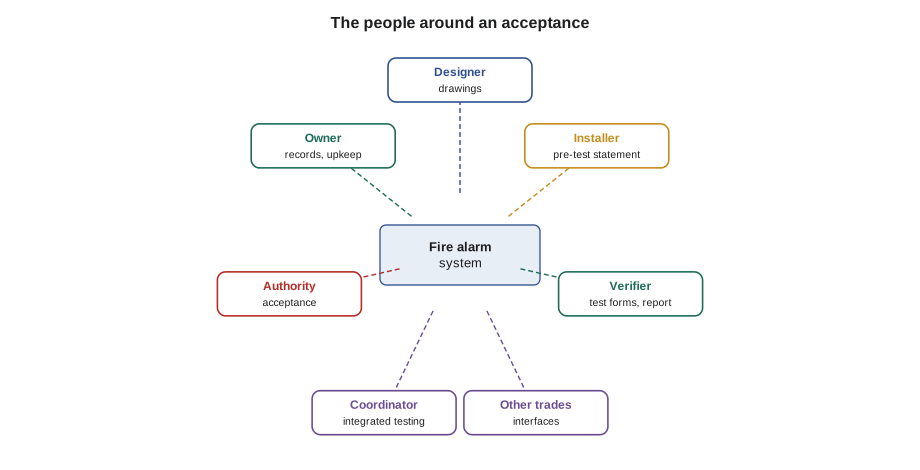
Writing it down: the responsibility matrix
Owen's first job as coordinator is a responsibility matrix: for each task, who does it, who must be there, who approves and who is told. It sounds bureaucratic, but it prevents the classic test-day failure, where the damper test is scheduled and nobody told the controls technician, or the elevator recall is tested and the elevator mechanic is at another job. The matrix also answers questions such as who pays for a retest when one trade wasn't ready.
# A small responsibility matrix: R = does it, A = approves, P = must be present, I = informed
tasks = {
    "pre-test and installer statement":   {"installer": "R", "designer": "I", "tester": "I"},
    "device-by-device test":              {"tester": "R", "installer": "P", "designer": "I", "owner": "I"},
    "waterflow and valve switch tests":   {"tester": "R", "sprinkler": "P", "installer": "P"},
    "air handler and damper shutdown":    {"tester": "R", "controls": "P", "coordinator": "A"},
    "elevator recall":                    {"tester": "R", "elevator": "P", "coordinator": "A", "authority": "P"},
    "integrated scenario tests":          {"coordinator": "R", "tester": "P", "controls": "P", "elevator": "P", "authority": "P"},
    "final report and acceptance":        {"tester": "R", "designer": "A", "authority": "A", "owner": "I"},
}
people = ["installer", "tester", "designer", "sprinkler", "controls", "elevator", "coordinator", "authority", "owner"]
print("task".ljust(36) + "".join(p[:6].rjust(7) for p in people))
for t, row in tasks.items():
    print(t.ljust(36) + "".join(row.get(p, ".").rjust(7) for p in people))
missing = [t for t, row in tasks.items() if "R" not in row.values()]
print("tasks with nobody responsible:", missing if missing else "none")task instal tester design sprink contro elevat coordi author owner pre-test and installer statement R I I . . . . . . device-by-device test P R I . . . . . I waterflow and valve switch tests P R . P . . . . . air handler and damper shutdown . R . . P . A . . elevator recall . R . . . P A P . integrated scenario tests . P . . P P R P . final report and acceptance . R A . . . . A I tasks with nobody responsible: none
Every row has exactly one R. If a task has two people marked responsible, each will assume the other did it; if it has none, nobody will do it. Owen sends the matrix to every trade with the schedule, and he asks each one to confirm their rows in writing.
Witnessing
Witnessing means a person watches a test and signs that they saw it. The authority, the owner's commissioning engineer and the designer may each want to witness some tests. CAN/ULC-S537 doesn't require the authority to witness every device, but authorities often witness integrated sequences, and the owner's specification may require the commissioning engineer to witness a sample of device tests. The verifier plans those tests for a time the witness can attend, and doesn't repeat the whole verification for each witness.
A witness signature means 'I saw this test and its result.' It doesn't make the witness responsible for the system, and it doesn't replace the tester's own record of every device.
Worked problem
Sorting out a test-day problem
On the first day of interface tests, the air handler AHU-N2 doesn't stop when its duct detector is operated. The controls technician says the fire alarm relay didn't change state; Sasha's meter shows the relay contacts did change. Who does what next?
Show solution
- Sasha records the result as a failure: relay operated, air handler didn't stop.
- The controls technician traces the wiring from the relay contacts to the air handler's controller and finds the shutdown input wired to the wrong terminal.
- The mechanical contractor corrects the wiring, because the fault is in their scope.
- Sasha retests and records the pass, with the date and the controls technician's name.
- Owen notes the failure and the correction in the integrated testing records.
Answer: The tester records, the responsible trade corrects, the tester retests, and the record shows all of it.
Communication on test days
On a large job the most common cause of lost time isn't a failed device; it is a person who didn't know what was happening. Owen and Gerry agree a communication routine for the north wing that every trade follows:
- A daily schedule, sent the afternoon before, listing which areas and tests are planned, which trades are needed, and when.
- A start-of-day meeting of ten minutes at the panel, where the plan is confirmed and changes are announced.
- Radios on one channel for everyone involved in a test, with a clear rule that the panel operator is told before any device is operated.
- A notice to the hospital's operations centre and the monitoring station before testing starts and when it ends each day.
- A short end-of-day summary: what passed, what failed, what is ready for retest and what is planned tomorrow.
The end-of-day summary goes to the installer, the designer, the owner and the commissioning engineer. It is the single most useful document on the job, because it turns failures into work for the right people the same evening, rather than at the next weekly meeting.
When roles overlap
On smaller jobs one company may design, install and test, and sometimes one person does more than one of those things. That isn't wrong in itself, but it makes the separation of roles on paper even more important. Where the same company installs and tests, the record must still show failures found during testing, the corrections and the retests, and the person signing as tester must be qualified and must have seen the tests. Where the designer is also the tester, a second qualified person should review the design decisions made in the field. Owners and authorities trust a record that shows the roles were respected, even when the same logo appears on every page.
The verification standard's expectation of independence is one way of making that trust automatic: the person who signs the verification didn't install the work. Where an authority accepts a verifier from the installing company, it usually expects the verification department to be separate from the installation department, with its own supervisor.
Disputes
Sometimes the parties disagree: the installer says a device meets the drawings, the tester says it doesn't meet the standard; the controls contractor says the damper closed, the observer says it didn't. The routine for disputes is the same every time. Record what was observed, with measurements and photographs. State the requirement that applies. Refer the question to the person whose decision it is: the designer for design intent, the authority for code compliance, the owner for contract scope. Don't resolve it by changing the record.
Common mistakes
MistakeAssuming another trade will be at the interface test.
InsteadConfirm attendance in writing from every trade on the matrix.
MistakeLetting the tester fix faults without recording them.
InsteadRecord the failure, have the installer correct it, then retest.
MistakeTreating a witness signature as a substitute for testing.
InsteadTest everything first; the witness sees a demonstration.
MistakeAccepting a field deviation verbally.
InsteadGet the designer's and the authority's decision in writing.
MistakeLeaving the owner out until handover.
InsteadInvolve the owner early so records, training and scheduling are planned.
Summary and key terms
- The designer answers for design intent and approves field changes.
- The installer completes and pre-tests the work and corrects faults.
- The verifier tests and records, but doesn't fix the installation.
- The authority reviews, witnesses and accepts alternatives, in writing.
- Other trades operate their equipment for interface tests and sign for their part.
- A responsibility matrix with exactly one responsible person per task prevents test-day failures.
- Designer
- The person responsible for the system design meeting the code.
- Installer
- The contractor who installs and pre-tests the system.
- Authority having jurisdiction
- The organization that enforces the code and accepts the system.
- Witness
- A person who watches a test and signs that they saw it.
- Responsibility matrix
- A table showing who does, approves, attends and is told about each task.
Practice problems
Work each problem on paper first, then reveal the answer to check.
Why shouldn't the tester correct installation faults without recording them?
Show answer
The record would hide the fault, and the person signing for the test would also have done the work.
Who decides whether a field deviation is acceptable?
Show answer
The designer, and where it affects code compliance, the authority, in writing.
What does a witness signature mean?
Show answer
That the witness saw the test and its result, not that they tested the system.
Why must every task have exactly one person responsible?
Show answer
Two responsible people each assume the other did it; none means nobody does it.
Which trade usually operates the sprinkler valves for supervisory tests?
Show answer
The sprinkler contractor.
Lesson quiz · 5 questions
Score 60% or more to complete this lesson.
Create a free account to save your progress, take quizzes and earn a certificate.