
FAT-330 · Lesson 10 of 12 · 20 min
Deficiencies, retesting and the verification report
At the end of the third week the north wing's test matrix has 585 rows, and 41 of them have, at some point, said fail. Sasha's job now is to turn that matrix into a report the building official will accept and the hospital will keep for decades. 'Nobody reads a report that only says everything passed,' Gerry tells her. 'They read the failures, what we did about them, and whether we tested again. Make that part perfect.' This lesson covers how deficiencies are recorded and closed, how much retesting each one needs, and how the verification report is assembled and signed.
Recording a deficiency
A deficiency is any condition found during testing that doesn't meet the standard, the code or the approved design. Each one is recorded when it is found, with enough detail that a person who wasn't there can find it, understand it and check that it was fixed. A good deficiency record has:
- a reference number;
- the device, circuit or function, with its address, tag and room;
- what was observed, in plain words, with measured values where there are any;
- what was required, citing the drawing, the sequence of operation or the clause of the standard;
- who is responsible for the correction;
- the correction made, the date and who made it;
- the retest, its date, its result and who did it.
'Detector doesn't work' is not a deficiency record. 'Smoke detector 2-007, room 2.114, no alarm with listed aerosol; head damaged (cracked chamber cover); replace head; responsible Northline' is one. The difference matters when the next person has to act on it.
Classifying deficiencies
Not every deficiency is equally serious, and a classification helps everyone set priorities. Bramwell uses three classes on new installations:
| Class | Meaning | Examples from the north wing |
|---|---|---|
| Critical | A life safety function doesn't work or would mislead responders | Egress doors that don't release; RPS-4 NAC 2 below listed voltage on battery; wrong room descriptions |
| Major | Doesn't meet the standard or design but the function partly works | Strobes at the wrong candela; duct detector airflow below range; audibility below target in one room |
| Minor | Workmanship or documentation, no effect on function | Missing circuit label at a junction box; panel clock slow; drawing revision not updated |
On a new installation the class affects the order of correction, not whether correction is needed. CAN/ULC-S537 expects deficiencies found on a new system to be corrected before the verification report is issued; the report doesn't go to the authority with open deficiencies. The deficiency section of the report is mainly for modifications, where existing parts of the system outside the work may have problems the verifier must record but isn't responsible for correcting.
How much retesting?
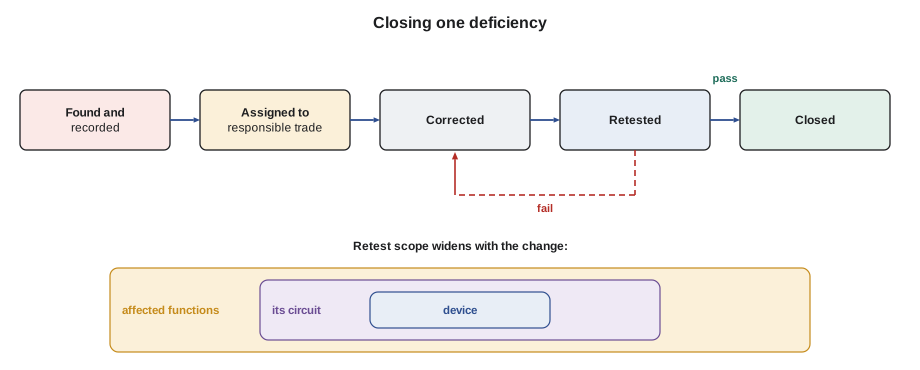
A correction must be retested, and the retest must cover not only the item corrected but anything the correction could have affected. The scope depends on what was done.
| Correction | Minimum retest |
|---|---|
| Replace a device with the same model | That device: alarm, address, description, supervision |
| Correct a device description in the program | That device, plus the functions the program change touches |
| Rewire a circuit or add devices to it | Every device on the circuit, fault tests on the circuit, and end voltage for a notification circuit |
| Change the program logic (outputs, timing, zones) | Every function the change affects, plus a sample of unaffected devices |
| Change a battery or power supply | Standby and alarm current, battery operation, and every circuit the supply feeds |
| Rework another trade's interface wiring | The whole integrated scenario that uses it |
When six appliances were moved from RPS-4 NAC 2 to RPS-3, the retest covered every appliance on both changed circuits, the synchronization where the circuits meet, the end voltage on both circuits in alarm on battery, the battery tests on both supplies, and the audibility in the rooms those appliances serve. It took half a day for what looked like a small change.
Program changes need particular care. The verifier compares the program after the change with the version recorded before it, identifies every point and output that changed, and tests all of them. Gerry also tests a sample of devices that shouldn't have been affected, because programming tools sometimes change more than the programmer intended.
# Deficiency tracker: what is still open, and is the report ready?
items = [
    ("D01", "critical", "psychiatric unit egress doors don't release", "closed", "retest pass"),
    ("D02", "critical", "RPS-4 NAC 2 15.7 V on battery", "closed", "retest pass"),
    ("D03", "critical", "4 smoke descriptions swapped", "closed", "retest pass"),
    ("D04", "major", "6 strobes wrong candela", "closed", "retest pass"),
    ("D05", "major", "AHU-N1 return duct detector airflow low", "closed", "retest pass"),
    ("D06", "major", "room 412 audibility 63 dBA", "corrected", ""),
    ("D07", "minor", "junction box label missing, L3", "closed", "retest pass"),
    ("D08", "minor", "record drawings rev 4 not issued", "open", ""),
]
open_items = [i for i in items if i[4] != "retest pass"]
print(f"{len(items)} deficiencies recorded, {len(items) - len(open_items)} closed with a passing retest")
for ref, cls, what, state, retest in open_items:
    print(f"  still open: {ref} [{cls}] {what} - {state}{', awaiting retest' if state == 'corrected' else ''}")
blocking = [i for i in open_items if i[1] in ("critical", "major")]
print("report can be issued" if not open_items else ("blocked by critical or major items" if blocking else "only minor items open"))8 deficiencies recorded, 6 closed with a passing retest still open: D06 [major] room 412 audibility 63 dBA - corrected, awaiting retest still open: D08 [minor] record drawings rev 4 not issued - open blocked by critical or major items
An item isn't closed when it is corrected; it is closed when the retest passes. D06 is corrected (the horn has been added) but not yet retested, so it is still open. The report waits for it.
Assembling the verification report
The report follows the forms in CAN/ULC-S537's appendix. For the north wing, Sasha assembles:
- the summary page: building, system, extent of the verification, the statement of conformance, and the verifier's signature;
- the documentation checklist: which drawings, calculations, data sheets and sequence of operation were received, with revision numbers;
- individual device records for all 585 devices and points, each with location, type, address or circuit, test result and date;
- control unit, power supply, battery, annunciator and monitoring link test records;
- sound pressure level records by zone and room, with the meter's details and calibration;
- the list of deficiencies found, each with its correction and retest, and remarks and recommendations.
# Check that the report has every required part before it is signed
required = ["summary page", "documentation checklist", "individual device records", "control unit and power tests", "sound level records", "deficiencies and retests", "remarks and recommendations", "verifier signature"]
have = ["summary page", "documentation checklist", "individual device records", "control unit and power tests", "sound level records", "deficiencies and retests", "remarks and recommendations"]
missing = [r for r in required if r not in have]
for r in required:
    print(("present  " if r in have else "MISSING  ") + r)
print("ready for signature" if not missing else f"{len(missing)} part(s) missing")present summary page present documentation checklist present individual device records present control unit and power tests present sound level records present deficiencies and retests present remarks and recommendations MISSING verifier signature 1 part(s) missing
The only missing part is the signature, which is the last thing added. Gerry reads the whole report before he signs it, not only the summary. He checks a sample of device records against the matrix, reads every deficiency closure, and confirms that every not-applicable section really doesn't apply. Then he signs, and the report goes to the building official with a copy to Captain Strand and the original to Dana.
Remarks and recommendations
The report has room for things that aren't deficiencies but that the owner and the next technician should know. Sasha's remarks for the north wing include: patient rooms with acoustic door seals have a small audibility margin; the air-sampling system's transport times are close to the supplier's figures and should be compared at each annual inspection; the psychiatric unit's tamper-resistant detectors need a special removal tool, which has been left with the hospital's maintenance department; and the north wing node is still in the test mode agreed with the hospital until integrated testing is complete. Remarks are written plainly and specifically, so they can be acted on.
Worked problem
A deficiency that won't stay fixed
Smoke detector 5-031 failed with a trouble on removal at the wrong address. It was corrected by swapping descriptions in the program, and retested successfully. Two days later, during an unrelated program change, the trouble appears at the wrong address again. What happened, and what should the report show?
Show solution
- The programmer loaded an older program file for the second change, undoing the first correction.
- Record a new failure for 5-031 and also check every other correction made by program change, because all of them may have been undone.
- Compare the panel's program with the version recorded after the first correction to find every difference.
- Correct, retest every affected point, and record the program version and date after the final change.
- The report shows the first failure, its closure, the reappearance and its closure, with the program versions.
Answer: Program changes during testing must be controlled by version, or corrections can quietly disappear.
Photographs and evidence
A deficiency record is stronger with evidence. Sasha photographs every failure where a photograph helps: the sampling tube facing the wrong way, the strobe with its setting switch visible, the meter display showing 15.7 V, the lock power supply's terminal strip before and after correction. The photographs are named by deficiency number and kept with the report. When a dispute arises weeks later about whether a fault existed, the photograph settles it. Photographs inside a hospital need care: patient areas are photographed only before occupancy, and nothing that identifies a person is ever recorded.
Partial reports and modifications
Large projects are sometimes verified and occupied in phases. Each phase gets its own verification report covering the parts of the system in that phase and the parts that serve it, such as the control unit and the network. The report states clearly what was and wasn't verified, so that nobody later assumes a part outside the phase was included. When the north wing joined the existing hospital network, the main panel's handling of north wing events was verified as part of the north wing; the rest of the main panel wasn't, and the report says so.
For a modification to an existing system, the report also notes the condition of the existing parts the verifier saw or tested in the course of the work. If the network test showed a trouble on another wing's node, that trouble is recorded as a deficiency in the existing system, outside the scope of the work, and reported to the owner. The verifier doesn't ignore it because it isn't part of the job.
Keeping the record honest
Every line of the report should be traceable to an observation: who saw it, when, with what instrument. Values copied from the design, results assumed from another floor, or tests 'done last week' by someone who isn't named have no place in it. If a device couldn't be tested, perhaps because a room was locked on the only day available, the row says not tested and why, and it stays open until it is tested. Gerry would rather send a report a day late than send one that says something nobody saw.
Sasha's last check before the report goes for signature is a count: the number of device records must equal the number of devices on the record drawings plus the points that appear only in the panel, and every row must carry a date and the initials of the person who tested it. On the north wing the count matches at 585.
Common mistakes
MistakeWriting vague deficiency records.
InsteadRecord the device, location, observation, requirement, responsibility, correction and retest.
MistakeClosing an item when it is corrected.
InsteadClose it only when the retest passes.
MistakeRetesting only the corrected device after rewiring a circuit.
InsteadRetest every device on the circuit and its fault behaviour.
MistakeIssuing the report with open items on a new system.
InsteadCorrect and retest first.
MistakeSigning after reading only the summary.
InsteadRead the whole report, sample the records and check every closure.
Summary and key terms
- A deficiency record lets someone who wasn't there find, understand and check the fault.
- Classify deficiencies to set priorities; on a new system all must be closed.
- Retest scope depends on the correction: device, circuit, program functions or the whole scenario.
- An item is closed only by a passing retest.
- The verification report follows the S537 forms: summary, documents, device records, tests, measurements, deficiencies, remarks.
- The responsible person reads the whole report before signing.
- Deficiency
- A condition that doesn't meet the standard, the code or the approved design.
- Retest
- Testing again after a correction, covering everything the correction could affect.
- Critical deficiency
- A fault where a life safety function doesn't work or would mislead responders.
- Remark
- A note for the owner or the next technician that isn't a deficiency.
- Program version
- The identifier of the panel program, recorded so changes can be detected.
Practice problems
Work each problem on paper first, then reveal the answer to check.
What must a deficiency record include?
Show answer
Reference, device and location, observation, requirement, responsibility, correction and retest.
When is a deficiency closed?
Show answer
When its retest passes.
What is retested after moving appliances between circuits?
Show answer
Every appliance on both circuits, synchronization, end voltage on battery, both supplies' batteries and the affected rooms' audibility.
Why test a sample of unaffected devices after a program change?
Show answer
To show the change didn't alter anything else.
Why read the whole report before signing?
Show answer
The signature covers everything in it, not only the summary.
Lesson quiz · 5 questions
Score 60% or more to complete this lesson.
Create a free account to save your progress, take quizzes and earn a certificate.