
FAT-330 · Lesson 1 of 12 · 20 min
Verification, acceptance and commissioning: what they mean
In March the electrical contractor on Eastview General Hospital's north wing tells the general contractor that the fire alarm is 'finished'. Every device is mounted, every cable is pulled and the panel lights up. Gerry Tremaine reads the email at Bramwell Fire Protection and smiles. 'Finished installing,' he tells Sasha Vukovic. 'Nobody knows yet whether it works. That's our job.' Bramwell supplied the control equipment for the wing, and its verification team, Gerry, Sasha and the trainee Nadia Fortier, will now prove that every device, circuit and function does what the drawings and the standard say it should, before a single patient sleeps in the building.
This course is about that moment: the step between a finished installation and a system the building can rely on. It is the last stage of the fire alarm's construction and the first stage of its working life. The inspection and testing you learned in FAT-230 keeps an existing system working; the work in this course proves that a new or changed system worked properly in the first place. This lesson sorts out the words people use for it, because they are often mixed up on job sites, and explains why the work matters.
Four words that are often confused
On a construction site you will hear verification, acceptance testing, commissioning and integrated testing used as if they meant the same thing. They overlap, but they are different jobs with different purposes and different paperwork.
| Term | What it asks | Who usually does it | Main document |
|---|---|---|---|
| Verification | Does every part of the fire alarm meet the installation standard and work as designed? | A qualified verifier, separate from the installer | Verification report (CAN/ULC-S537) |
| Integrated testing | Do the fire alarm and the systems it controls work together? | A coordinator or agent with every trade involved | Integrated testing report (CAN/ULC-S1001) |
| Commissioning | Does the whole building system meet the owner's project requirements, and are the operators ready? | A commissioning authority hired by the owner | Commissioning report and systems manual |
| Inspection and testing | Does an existing system still work? | Service technician | Annual report (CAN/ULC-S536) |
In Canada the key word is verification. The building code requires a fire alarm system to be installed to CAN/ULC-S524 and verified to CAN/ULC-S537 before the building is occupied. Verification is a complete, device-by-device check of the new system against the standard and the design, done by qualified people, with a written report that the authority accepts. CAN/ULC-S537 doesn't use the word acceptance, but the verification report is what the authority uses to decide whether to accept the system.
Why the building can't simply trust the installer
A fire alarm is one of the few building systems that may sit idle for years and then have to work perfectly the first time it is really needed. A light switch that doesn't work is noticed the same day. A heat detector wired to the wrong zone, a strobe on the wrong circuit or a door holder that never releases may go unnoticed until a fire. That is why the codes insist that the system be proven, not assumed, before occupancy.
Experienced verifiers find the same kinds of problems on almost every new job:
- devices that are installed but not connected, or connected to the wrong circuit or address;
- device descriptions in the panel that don't match the room the device is in;
- Class A circuits whose return leg was never terminated, so the circuit works but has no redundancy;
- notification appliances that work but are too quiet in rooms with doors closed;
- outputs that are programmed but never connected to the equipment they are meant to control;
- batteries sized for the design load but not for the load actually installed after changes;
- record drawings that show the design, not what was built.
None of these is visible from the panel. Each one is found only by operating every device and watching what happens, then comparing the result with the design and the standard. Gerry's rule is simple: 'Every device, every function, every time. If we didn't see it work, it doesn't work.'
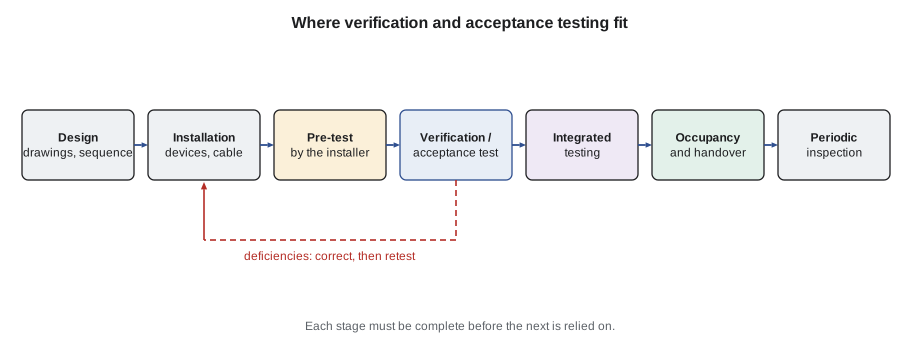
Where verification sits in the project
A new fire alarm moves through a sequence. The designer prepares drawings and a sequence of operation. The installer mounts devices, pulls and terminates cable and connects the control equipment. The installer then pre-tests: checks wiring for opens, shorts and grounds, programs the panel and operates devices to find obvious faults. Only when the installer says the system is ready does verification or acceptance testing begin. After the fire alarm itself is proven, it is tested together with the sprinklers, elevators, air handling, door hardware and emergency power in integrated testing. Then the authority accepts the system and the building can be occupied. From then on the system enters the cycle of periodic inspection and testing you learned in FAT-230.
The sequence matters because each step depends on the one before. Verifying a system the installer hasn't pre-tested wastes days on faults the installer should have found with a meter. Integrated testing before the fire alarm is verified is worse: when a damper doesn't close, nobody knows whether the fault is in the fire alarm, the wiring, the relay or the damper.
Commissioning is bigger than the fire alarm
Many owners, and nearly all hospitals, hire a commissioning authority for the whole building. Commissioning starts during design and asks a broader question than verification: does the building meet the owner's project requirements, are the systems documented, and are the people who will run them trained? The fire alarm is one of the systems commissioned. The commissioning authority usually doesn't test fire alarm devices; it reviews the verification or acceptance records, witnesses selected tests, and confirms that training and documents were delivered. Its interest in the fire alarm is mostly in the interfaces, because that is where systems from different trades meet.
At Eastview the hospital has hired Owen Petrakis, a commissioning engineer, who will also act as the coordinator for integrated testing. Dana Whitcombe, the hospital's facilities manager, will own the system after handover. Both want the same thing from Gerry's team: proof, in a form they can keep.
New systems, changed systems and replaced parts
Verification and acceptance testing aren't only for new buildings. They also apply when an existing system is changed. The rules are similar in both countries: whatever was added, removed or changed must be tested, and so must everything the change could affect. A new detector is tested; a removed detector means the circuit it was on is tested to prove it still works; a program change means every function the change touches is tested, plus a sample of other devices to prove nothing else was broken.
CAN/ULC-S537 calls this verifying a modification. The verification report covers the new or changed parts and the parts of the system affected, and the existing system's condition is noted. Lesson 11 returns to it.
# How big is the verification job? Device counts from the north wing schedule
devices = {"smoke detector": 236, "heat detector": 41, "duct detector": 4, "air sampling system": 1,
           "manual station": 38, "waterflow switch": 7, "valve supervisory": 9,
           "horn-strobe": 118, "strobe": 64, "control relay output": 41, "monitor module": 26}
minutes_each = {"smoke detector": 4, "heat detector": 5, "duct detector": 20, "air sampling system": 90,
                "manual station": 3, "waterflow switch": 15, "valve supervisory": 10,
                "horn-strobe": 2, "strobe": 2, "control relay output": 8, "monitor module": 6}
total = sum(devices.values())
minutes = sum(devices[k] * minutes_each[k] for k in devices)
print("field devices and points to verify:", total)
print(f"estimated test time: {minutes / 60:.0f} technician-hours, before walking, ladders and paperwork")
print(f"with a crew of 3 at 6 productive hours a day: {minutes / 60 / 18:.1f} days")field devices and points to verify: 585 estimated test time: 41 technician-hours, before walking, ladders and paperwork with a crew of 3 at 6 productive hours a day: 2.3 days
Sasha's first estimate for the north wing is about 41 technician-hours of pure testing for 585 devices and points, a little over two days for three people. Gerry doubles it for setup, access, ladders, waiting for other trades and paperwork, which is normal for a hospital. Lesson 4 turns this rough number into a real plan.
What a good verification gives the owner
The paper is not a formality. A complete verification or acceptance record tells every later technician what the system was when it was new: where each device is, what it was connected to, how loud each room was, what the batteries carried and how each interface behaved. When the annual inspection in five years finds a room that is too quiet, the original measurement shows whether the room was always quiet or something changed. When a fire investigator asks whether a detector worked, the record shows it was tested on a known date with a known result.
The verification report is also a legal document. It is signed by the verifier, accepted by the authority and kept with the building's fire safety records. A verifier who signs for devices that weren't tested is putting a signature on something untrue, and Gerry won't let anyone on his team do it.
Worked problem
Which word fits?
Classify each task on the Eastview north wing: (a) Northline Electric's crew meggers every cable before connecting it; (b) Sasha tests every detector and records the result against its address; (c) Owen runs a test in which a smoke detector in the third-floor corridor releases the door holders, closes a smoke damper and recalls the elevators; (d) Owen confirms that the hospital's maintenance staff were trained and the systems manual was delivered; (e) next year, Bramwell's service crew tests every device again.
Show solution
- (a) is the installer's pre-test, part of installation.
- (b) is verification to CAN/ULC-S537.
- (c) is integrated testing to CAN/ULC-S1001.
- (d) is commissioning, which covers the whole building.
- (e) is the annual inspection and test to CAN/ULC-S536.
Answer: Each task has a different purpose and produces a different record.
A short history of proving fire alarms
Fire alarm systems have been tested on installation for as long as they have existed, but for most of the twentieth century the test was informal: the installer pulled a few stations, lit a match under a few heat detectors and called the fire department to watch the bells ring. As systems became larger and more complex, with addressable devices, networked panels, voice messages and interfaces to every other building system, that kind of test stopped proving anything useful. A demonstration of ten devices says nothing about the other five hundred.
Canada responded by writing a separate verification standard. Its first editions in the 1990s and 2000s set out a complete, documented, device-by-device process, and the building code began requiring it for every new system. Later editions added sound level and intelligibility measurement, data communication links, the connection to the signal receiving centre and more detailed report forms. The trend has been steady: more of the system is proven, and more of what was proven is written down.
Integrated testing is the newest layer. Its standards appeared in the 2010s, after investigations of building fires repeatedly found that each system had been tested by its own trade and that nobody had tested them together. Hospitals, high buildings and buildings with smoke control were the first to need it, but the idea applies anywhere the fire alarm controls something else.
For a technician the history explains the paperwork. Every form and column in a modern report exists because, somewhere, a system that looked finished turned out not to work, and nobody could later tell what had been tested.
Common mistakes
MistakeTreating a lit panel with no troubles as proof that the system works.
InsteadA quiet panel proves only that the supervised wiring is intact; every device and function must still be operated.
MistakeStarting verification before the installer has pre-tested.
InsteadInsist on a pre-tested, ready system; otherwise the verification becomes troubleshooting.
MistakeRunning integrated tests before the fire alarm is proven.
InsteadProve the fire alarm first, then test how it works with other systems.
MistakeTesting only the changed device after a modification.
InsteadTest what changed and everything the change could affect.
MistakeRecording a device as passed without seeing it work.
InsteadRecord only what was observed; untested devices stay open on the list.
Summary and key terms
- Verification (Canada) and acceptance testing (US) prove that a new or changed fire alarm works before it is relied on.
- Integrated testing proves that the fire alarm and the systems it controls work together.
- Commissioning is broader: it covers the whole building, its documents and its operators.
- The installer pre-tests first; verification or acceptance testing follows; integrated testing comes last.
- Changes to an existing system need the changed parts and everything they affect retested.
- The record created is permanent and is signed; it must show only what was actually observed.
- Verification
- A complete device-by-device check of a fire alarm against CAN/ULC-S537, the installation standard and the design.
- Integrated testing
- Testing the fire alarm and interconnected fire protection and life safety systems together, to CAN/ULC-S1001.
- Commissioning
- A process covering the whole building, confirming it meets the owner's requirements and that operators are ready.
- Pre-test
- The installer's own checks before verification, including wiring tests and device operation.
- Modification
- An addition, deletion or change to an existing system that must itself be verified.
Practice problems
Work each problem on paper first, then reveal the answer to check.
Why isn't a panel with no troubles proof that the system works?
Show answer
Supervision shows the wiring is intact, not that devices are on the right circuit, described correctly, loud enough or connected to the right outputs.
What comes first, verification or integrated testing?
Show answer
Verification or acceptance testing of the fire alarm; integrated testing follows.
What does a commissioning authority usually do with fire alarm results?
Show answer
Reviews them, witnesses selected tests and confirms training and documents were delivered.
After a program change, what must be tested?
Show answer
Every function the change affects, plus a sample of other devices.
Why keep the original test record?
Show answer
It shows what the system was when new, for later inspections, changes and investigations.
Lesson quiz · 5 questions
Score 60% or more to complete this lesson.
Create a free account to save your progress, take quizzes and earn a certificate.