
FAT-330 · Lesson 6 of 12 · 20 min
Device-by-device verification
On the second day Sasha and Nadia start the field devices on the first floor. Nadia expects it to be repetitive, and it is: climb, check the label, spray, watch the panel display, record, reset, move. By the fortieth detector she understands why Gerry calls it the most important part of the job. 'Every device gets the same questions,' he says. 'Is it the right device, in the right place, wired to the right point, described correctly, and does it do what it should when it sees what it's meant to see? Five questions, every device, no exceptions.' This lesson covers how each kind of field device is verified and what the record must show.
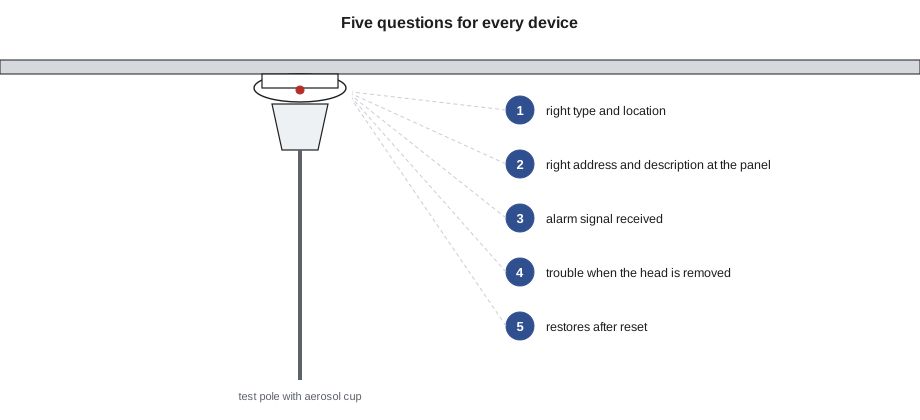
The five questions for every device
Whatever the device, verification asks the same things:
- Type and location: is it the device the drawings call for, in the location they show, and installed as the installation standard requires, for example at the right distance from walls, supply diffusers and the ceiling, and at the right mounting height?
- Identity: when it operates, does the panel report the right address or zone, and is the description the one a responder needs to find it?
- Function: does it produce the right signal type (alarm, supervisory or trouble) when it sees the condition it is meant to detect?
- Supervision: when it is removed or its circuit is opened, does the panel report a trouble at the right point?
- Restoration: does it return to normal after the test, and does the panel reset?
Each answer goes into the matrix. A device that operates but reports with the wrong description fails, because a responder sent to the wrong room is a real failure, even if the detector is working perfectly.
Smoke detectors
Spot-type smoke detectors are tested with a listed test aerosol or another method the manufacturer approves, applied through the detector's sensing chamber so that smoke-like particles enter it the way smoke would. Magnets and test buttons test only the electronics, not the chamber, and aren't accepted for verification. The technician watches for the detector's alarm indicator, confirms the panel shows the right address and description, then clears the aerosol and resets. To test supervision, the detector head is removed from its base; the panel should report a missing device or trouble at that address.
On the north wing the description test catches more faults than the alarm test. Of 236 smoke detectors, two don't alarm (one a damaged head, one with the wrong device type programmed), but six report with descriptions that don't match the room: two pairs swapped during addressing and two rooms renamed in a later drawing revision. All eight are recorded as failures and corrected.
In the third-floor psychiatric unit the detectors are tamper-resistant models with locking heads and no exposed parts a patient could use as a ligature point. Testing them takes longer: the head can only be removed with a special tool, and the aerosol must be applied through a narrow port. Sasha's plan allows double the normal time for each one.
Heat detectors
Restorable heat detectors, the rate-of-rise and fixed-temperature types that recover after operating, are tested with a heat source that doesn't damage them, usually a listed electric heat tool, applied until the detector alarms. The time to alarm is noted, because a detector that takes much longer than others of the same type may be faulty or mounted in a dead air space.
Non-restorable fixed-temperature heat detectors, which use a fusible element that melts, can't be heat tested without destroying them. They are tested by the method the standard and the manufacturer give: a mechanical or electrical test that operates the contacts or simulates the circuit, and a careful visual check that the device is the right temperature rating, undamaged and unpainted. On the north wing the penthouse and the mechanical rooms have 57 °C (135 °F) rated restorable detectors, and the kitchen servery has a higher-rated non-restorable unit beside the hood, tested electrically.
The temperature rating is part of the type check. A detector rated for ordinary temperatures mounted near a boiler or in an attic may false alarm on a hot day; one rated for high temperatures in an ordinary room may operate too late. The verifier checks the rating marked on the device against the drawing and the space.
Duct and air-sampling detectors
A duct smoke detector samples air from inside the duct through a sampling tube. It works only if air actually moves through its chamber, so verification has two parts. First, with the air handler running, the airflow through the detector housing is checked against the manufacturer's range, usually by measuring the pressure difference between the sampling and exhaust tubes with a manometer. Second, test aerosol is introduced through the test port and the detector must alarm, and the air handler must shut down if the design calls for it.
# Duct detector airflow check: pressure difference across the sampling tubes
limits = (0.025, 0.75)     # manufacturer's acceptable range, kPa
readings = {"AHU-N1 supply": 0.21, "AHU-N1 return": 0.018, "AHU-N2 supply": 0.33, "AHU-N2 return": 0.12}
for name, dp in readings.items():
    ok = limits[0] <= dp <= limits[1]
print(f"{name:14s} {dp:6.3f} kPa {'within range' if ok else 'OUT OF RANGE - check tube orientation and seal'}")AHU-N1 supply 0.210 kPa within range AHU-N1 return 0.018 kPa OUT OF RANGE - check tube orientation and seal AHU-N2 supply 0.330 kPa within range AHU-N2 return 0.120 kPa within range
The return-side detector on AHU-N1 is below range. Kyle's team finds the sampling tube installed with its holes facing downstream, so it barely picks up air. Turned to face the airflow and resealed, it reads within range and alarms correctly on retest.
The operating suite uses an air-sampling system, which draws air through a network of pipes to a central detector. Its verification includes the transport time: smoke introduced at the farthest sampling hole must reach the detector within the time the standard and the manufacturer require. In FAT-220 this system's transport time was flagged and later commissioned by the supplier; Sasha now repeats the test at the farthest hole of each pipe and records the times against the supplier's commissioning report.
# Air-sampling transport time at the farthest hole of each pipe
limit_s = 120
times = {"pipe 1": 64, "pipe 2": 71, "pipe 3": 88, "pipe 4": 97}
for pipe, t in times.items():
    print(f"{pipe}: {t:3d} s  {'ok' if t <= limit_s else 'TOO SLOW'}")
print("longest:", max(times.values()), "s; limit", limit_s, "s")pipe 1: 64 s ok pipe 2: 71 s ok pipe 3: 88 s ok pipe 4: 97 s ok longest: 97 s; limit 120 s
Manual stations
Each manual station is operated as an occupant would operate it and reset with its key. The check includes the mounting height, the clear space in front, its distance from the exit it serves and, for stations with protective covers, that the cover works and its local sounder (if fitted) sounds. In the psychiatric unit, by the design, manual stations are inside the staff areas and at staff-controlled exits rather than in patient corridors, and that arrangement, approved by the authority, is checked against the drawings and the written approval.
Sprinkler devices
Waterflow switches are tested by flowing water through the inspector's test connection or the floor's test and drain valve, so that water moves past the switch as it would when one sprinkler opens. The signal must reach the panel as an alarm within the time the standard allows, commonly 90 seconds, which includes the switch's built-in retard delay. Valve supervisory switches are tested by moving each control valve from fully open: the panel must show a supervisory signal before the valve has moved far, and the signal must clear only when the valve is fully open again. Luis operates every valve, and before he leaves each valve room Sasha checks that the valve is fully open, sealed or locked as the sprinkler standard requires, and that the panel shows normal.
Other supervisory devices, such as low-air switches on dry systems, fire pump running and trouble signals, and tank level switches, are tested by producing the condition or simulating it at the device, never by jumpering at the panel.
Monitor and control modules
Addressable monitor modules connect conventional contacts, such as sprinkler switches and kitchen suppression systems, to the loop. Each is tested from the contact it monitors, not by shorting its terminals, so that the wiring between the contact and the module is proven too. Control modules and relays are verified when the function they control is tested (Lesson 9), but their identity and supervision are checked here: each must report at the right address, and removing it must produce a trouble.
Recording results
# Device-by-device tracker: result per device and reasons for failures
results = [
    ("1-012", "smoke", "pass", ""), ("1-013", "smoke", "pass", ""), ("1-014", "smoke", "fail", "description: swapped with 1-015"),
    ("1-015", "smoke", "fail", "description: swapped with 1-014"), ("1-031", "heat", "pass", ""),
    ("2-007", "smoke", "fail", "no alarm: damaged head"), ("2-044", "manual", "pass", ""),
    ("3-020", "smoke", "pass", ""), ("3-021", "smoke", "retest pass", "wrong type programmed, corrected"),
    ("N1-R", "duct", "retest pass", "tube orientation corrected"), ("WF-3", "waterflow", "pass", ""),
]
from collections import Counter
by = Counter(r for _, _, r, _ in results)
print("results:", dict(by))
for addr, kind, res, why in results:
    if res != "pass":
        print(f"  {addr:6s} {kind:9s} {res:12s} {why}")
open_fail = [a for a, _, r, _ in results if r == "fail"]
print("open failures to correct and retest:", ", ".join(open_fail))results: {'pass': 6, 'fail': 3, 'retest pass': 2}
1-014 smoke fail description: swapped with 1-015
1-015 smoke fail description: swapped with 1-014
2-007 smoke fail no alarm: damaged head
3-021 smoke retest pass wrong type programmed, corrected
N1-R duct retest pass tube orientation corrected
open failures to correct and retest: 1-014, 1-015, 2-007Each failure keeps its row: the first result, the reason, the correction and the retest result. A matrix that shows only final passes hides what the verification found, and the owner and the authority want to see it.
Worked problem
A puzzling detector
Detector 4-018 in a patient room alarms correctly with aerosol and reports the right address and description, but when Nadia removes its head the panel shows a trouble for 4-019, the next room. What does it mean?
Show solution
- The panel's address for the head in 4-018's base is actually 4-019: the two heads were swapped between rooms after addressing.
- When aerosol was applied to the head in room 4-018, the panel should have shown 4-019's description; Nadia checks the display record and finds it did, and she had misread it.
- Both rows are failures: the descriptions don't match the rooms.
- Kyle's team swaps the heads back (or the programmer swaps the descriptions, with Ravi's approval), and both detectors are retested for alarm, description and supervision.
Answer: Testing removal as well as alarm catches errors that an alarm test alone can hide.
Beam detectors and special devices
The north wing has no projected beam detectors, but Bramwell's crews verify them in atriums and warehouses. Each beam is checked for alignment and signal strength at the receiver, then tested with the manufacturer's test filters, which block a known fraction of the beam to simulate smoke; the detector must alarm with the alarm filter and must not alarm with the lower one. A full blockage must produce a trouble, not an alarm. Flame detectors are tested with the manufacturer's test lamp at the distance it specifies, and carbon monoxide detectors with a listed test gas or the method the manufacturer gives. In every case the rule is the same: produce the condition the device is meant to detect, in the way the manufacturer and the standard allow, and record what happens.
Throughout the field tests, Sasha keeps the panel operator informed by radio before each device is operated and after it is restored, so that every event at the panel can be matched to a test. An event nobody announced is treated as real until it is explained.
Common mistakes
MistakeTesting smoke detectors with a magnet or test button.
InsteadUse listed aerosol through the chamber; buttons test only the electronics.
MistakeAccepting a correct alarm with a wrong description.
InsteadRecord a failure; responders rely on the description.
MistakeHeat-testing non-restorable detectors.
InsteadTest them mechanically or electrically and inspect them; heat destroys them.
MistakeTesting a duct detector with the air handler off.
InsteadRun the fan, check the airflow range, then test with aerosol.
MistakeTesting a monitor module by shorting its terminals.
InsteadOperate the contact it monitors so the wiring is proven.
Summary and key terms
- Every device is checked for type and location, identity, function, supervision and restoration.
- Smoke detectors are tested with listed aerosol through the chamber.
- Restorable heat detectors are heat tested; non-restorable ones are tested mechanically or electrically and inspected.
- Duct detectors need airflow within range and an aerosol test with the fan running.
- Waterflow must signal within the allowed time; valve switches must signal early and clear only when fully open.
- Every failure keeps its row with the reason, correction and retest result.
- Test aerosol
- A listed spray that simulates smoke particles for testing smoke detectors.
- Restorable heat detector
- A heat detector that resets after operating and can be heat tested.
- Sampling tube
- The tube that draws air from a duct into a duct detector housing.
- Transport time
- The time for smoke at the farthest sampling hole to reach an air-sampling detector.
- Monitor module
- An addressable device that connects a conventional contact to the loop.
Practice problems
Work each problem on paper first, then reveal the answer to check.
Why test the description, not only the alarm?
Show answer
A wrong description sends responders to the wrong place.
How is a non-restorable heat detector verified?
Show answer
By a mechanical or electrical test of its contacts and a visual check of its rating and condition.
What two things are checked on a duct detector?
Show answer
Airflow through the housing within range, and alarm with aerosol while the fan runs.
When should a valve supervisory signal clear?
Show answer
Only when the valve is fully open again.
Why test a monitor module from the contact it monitors?
Show answer
To prove the wiring between the contact and the module.
Lesson quiz · 5 questions
Score 60% or more to complete this lesson.
Create a free account to save your progress, take quizzes and earn a certificate.