
ELV-110 · Lesson 9 of 12 · 18 min
Running equipment and escalators
Some work cannot be done with the equipment stopped. A mechanic adjusting a brake has to see it set and release; one checking ropes watches them run over the sheave; one aligning escalator steps must move the step band to bring the next step into view. Working on or near running equipment is therefore a normal part of the trade, and it calls for a different set of controls from lockout. Tamsin met it in the Tillicum Building's machine room in her third week, and again on her first night shift at Brackenridge Centre, where Northcrest was replacing steps on the escalator bank. This lesson covers both settings.
When equipment must run
The decision to work on running equipment is made task by task in the JHA, not on the spot. For each step, the crew asks whether the work can be done with the equipment locked out. Cleaning, replacing parts, changing a coupling or a brake lining, and most electrical work in the controller can, and are. Observing, adjusting, testing and troubleshooting often cannot. Where the equipment must run, the work is planned so that the mechanic is never in the path of moving parts: guards stay on wherever possible, movement is controlled at low speed from a position where the mechanic can stop it instantly, and nobody puts a hand, tool or rag near a moving part.
The rules on both sides of the border allow this kind of work when it is done under alternative measures that give effective protection, and the elevator industry's field practices describe those measures in detail. Northcrest's own procedures name the tasks that may be done with equipment running and the controls for each.
| Task | Equipment running? | Main controls |
|---|---|---|
| Replace a brake lining | No | Lockout; car and counterweight landed or blocked |
| Adjust brake release timing | Yes, briefly | Inspection operation; mechanic at the controller with stop in reach; guards on |
| Inspect hoist ropes | Yes, at inspection speed | Watch from a fixed position; no hands near ropes; stop between sections |
| Clean the controller | No | Lockout; test for absence of voltage; wait for capacitor discharge |
| Troubleshoot a door fault | Yes | Car out of service; inspection; hands clear of door gear when cycling |
| Replace an escalator step | Step band moved in short runs | Inspection control; barricades at both landings; nobody on the step band |
Machine rooms and machine spaces
A machine room is full of rotating parts: the drive sheave and its ropes, deflector sheaves, the motor and its coupling, the brake drum, the governor sheave and its rope, and on old geared machines exposed gears and selector tapes. The code requires guards over many of these, and a well-kept machine room has them in place. The hazards are entanglement, where clothing, hair, gloves or a hand are caught and drawn in; nip points, where a rope runs onto a sheave; and contact with hot or electrically live parts.
Ray's machine room rules at the Tillicum Building are simple. Guards stay on unless the task needs them off, and they go back on before the car is returned to service. Nobody wears gloves, loose sleeves or anything hanging near a running machine. Nobody touches a moving rope, ever, to feel for broken wires; ropes are inspected visually while moving slowly, and by hand only when locked out and stationary. Nobody reaches across a machine to reach a switch on the other side. A second person, if present, stands where they can see the mechanic and reach the stop or the mainline disconnect.
On an MRL unit, the same parts are in the hoistway, usually at the top. Machine and brake work happens from the car top or a dedicated platform, which brings together the hazards of this lesson and of Lesson 8. The procedures for each MRL design are specific to its manufacturer, and they set out where the mechanic stands, how the car is secured and how the brake is tested.
Rope and governor inspection
Hoist ropes and governor ropes are inspected for broken wires, wear, corrosion, kinks and stretch. Much of this is done with the car running slowly on inspection while the mechanic watches the ropes pass a fixed point, usually at the drive sheave, and stops the car to look closely at any suspect section. The mechanic chooses a position where the ropes cannot catch anything if a wire is sticking out, keeps hands and tools away from the ropes, and has the stop switch or inspection control within reach. A broken wire end on a running rope can snag a sleeve or a glove; a cleaning rag held against a moving rope can be pulled into the sheave with the hand behind it.
Governor work deserves extra care, because tripping the governor sets the car safeties, and a test that goes wrong can strand a car in the hoistway or cause the safeties to set with someone on the car top. Governor and safety tests are done by trained mechanics under written procedures, often with the car empty and nobody on the car top.
Escalators and moving walks
An escalator is a long piece of running machinery with the public on top of it. Its hazards for mechanics are entanglement in the step chain, sprockets, handrail drive and drive chain; falls into the open truss when floor plates are removed or steps are taken out; crushing between steps and the truss when the step band moves; and confined, oily machine spaces at both ends. The mall setting adds working at night, often tired, with cleaning crews and security staff around who may not understand the hazards.
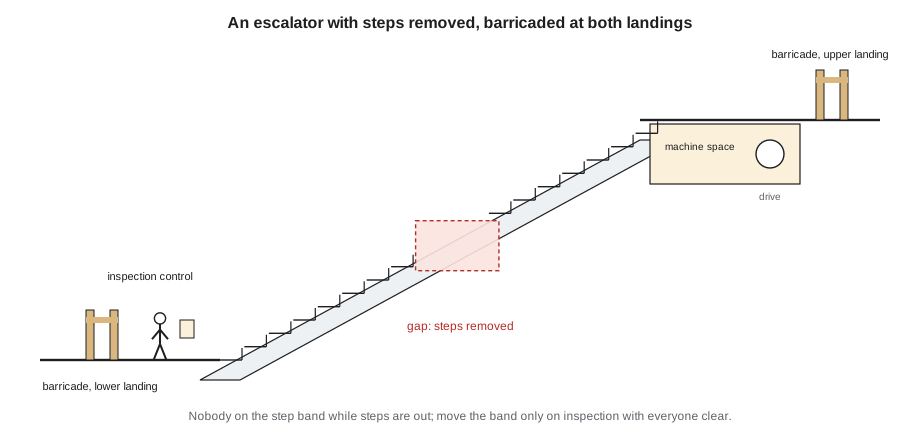
Before any work, the escalator is stopped, the public is kept off with barricades at both landings that cannot be walked around, and the unit is locked out or put under the mechanic's control at the inspection station. Floor plates are opened only when needed, and the open machine space is guarded by a barricade, because a person walking across a landing in the dark can step straight into it. When steps are removed, the gap in the step band becomes a hole in the escalator; anyone standing on the steps when the gap comes round can fall into the truss. Northcrest's rule is absolute: nobody stands or walks on the step band while steps are out, and the band is moved only on inspection, in short runs, with the mechanic at the control and everyone else clear.
# When will the gap from removed steps reach the upper landing on inspection?
rise = 5.5                    # vertical rise, m
incline = 30                     # degrees
import math
truss = rise / math.sin(math.radians(incline))      # length of the incline
band = 2 * truss + 2 * 2.5    # rough loop length including the flat ends, m
v = 0.2                          # inspection speed, m/s
gap_now = 6.0                  # distance of the gap from the upper landing, measured along the band, m
print(f"incline length {truss:.1f} m, step band loop about {band:.0f} m")
print(f"one full loop on inspection: {band / v / 60:.1f} minutes")
print(f"the gap reaches the upper landing in about {gap_now / v:.0f} s of running")incline length 11.0 m, step band loop about 27 m one full loop on inspection: 2.2 minutes the gap reaches the upper landing in about 30 s of running
The output reminded Tamsin that a short run on inspection still moves the gap a long way. Ray's practice at Brackenridge Centre is to mark the step band with paint beside the gap, so that its position is always visible from the inspection control, and to stop the band before the gap reaches either comb plate, where the step band turns and the clearances are tight.
Handrails are another hazard. The handrail runs into the newel at each end through an entry guard designed to stop hands being drawn in; with the guard off for work, the nip point is open. Handrail drives use rollers or sheaves that can trap a hand. Northcrest treats a handrail drive like any other rotating machinery: locked out for work, guards on when running, and no hands near it while it moves.
Escalator machine spaces are confined, cramped and often slippery with oil. Working in them involves kneeling and reaching around the drive, the main drive chain and the brake. Some are deep enough, and poorly enough ventilated, to be assessed as confined spaces, especially when solvents are used for cleaning. The unit is locked out before anyone enters, with the brake set and the step band prevented from moving under gravity, because a step band with steps removed can run back on the incline if the brake is released.
Night work at the mall
The Brackenridge Centre job runs from 22:00 to 06:00, four nights a week, while the mall is closed. Night work brings its own risks: fatigue, low lighting, fewer people around if something goes wrong, and other contractors and cleaners who may not respect barricades. Northcrest plans for them. Each shift starts with a JHA at the first escalator, the crew is never fewer than two, the mall's security desk is told which units are under work and given the crew's phone numbers, temporary lighting is set up at both landings of each unit, and barricades are rigid and lockable rather than tape. Lena checks the shift schedule so that nobody works a night shift directly after a full day shift.
On her first night, Tamsin noticed how easy it was to lose track of time and of the other units. A cleaning crew had started buffing the floor at the bottom of the next escalator, a unit that was running in normal service for the cleaners to use. Ray had her walk over and ask them to keep their cords and machines clear of the comb plate, which they did. Nothing happened, but it went on the JHA as a hazard for the next night.
Returning running equipment to service
Work on running equipment ends with a careful return to service. Guards are replaced; tools, rags and loose parts are removed and counted; floor plates and step band are checked; barricades stay in place while the unit is test run on inspection and then on normal operation. On an escalator, the test run includes checking the safety switches that the work could have affected, such as comb plate switches, step-up switches, handrail entry switches and the emergency stop buttons, and checking that the brake stops the unit within the expected distance. The crew does not remove the last barricade until the unit has run cleanly. Each test is recorded in the unit's logbook.
Platform lifts and other slow equipment
Slow equipment can lull a mechanic into carelessness. The branch library's vertical platform lift on Route 7 moves at a walking pace under constant-pressure operation, and it looks harmless. Its hazards are real all the same: the platform can trap a foot or hand against the runway wall or the landing sill as it moves; its drive, often a screw, a chain or a small hydraulic jack, has nip points close to where the mechanic kneels; and a platform raised for work can drop if its support is removed. Ray treats it like any other elevating device. The lift is taken out of service, the library staff are told, the platform is supported mechanically before anyone works under it, and the drive is locked out for any work that does not need motion. When the platform must move for testing, he runs it from the control with his hands and feet clear of the edges and the drive, and he stops it before reaching across.
Moving walks, dumbwaiters and material lifts follow the same pattern. A moving walk's pallet band has the same gap hazard as an escalator step band when pallets are removed. A dumbwaiter's car is small, but its hoistway is still an open shaft, and its doors may lack the interlocks found on passenger elevators in old installations. A material lift may run on a drum. For each, the questions from Lesson 2 come first: what is it, how does it move, and what can move it unexpectedly? The answers set the controls.
Common mistakes
MistakeFeeling a moving rope for broken wires.
InsteadInspect running ropes visually; touch ropes only when locked out and stationary.
MistakeRemoving guards for a quick look and leaving them off.
InsteadReplace guards before returning the unit to service, and keep them on wherever the task allows.
MistakeWalking on an escalator step band with steps removed.
InsteadNobody stands on the band while steps are out; move it only on inspection with everyone clear.
MistakeUsing tape barricades at an escalator under work.
InsteadUse rigid, lockable barricades at both landings and guard open floor plates.
MistakeReleasing an escalator brake with steps out without restraining the band.
InsteadPrevent the step band from running back under gravity before releasing or working on the brake.
Summary and key terms
- Decide in the JHA, step by step, whether the equipment can be locked out or must run.
- Running work is done on inspection at low speed, with guards on where possible and the stop in reach.
- Never touch moving ropes; inspect them visually and stop to look closely.
- Escalator hazards include entanglement, falls into the truss through removed steps or open floor plates, and confined machine spaces.
- Escalators under work have rigid barricades at both landings and nobody on the step band while steps are out.
- Night work needs planning for fatigue, lighting, communication and other people in the building.
- Entanglement
- Being caught by and drawn into rotating or moving machinery.
- Nip point
- The point where a rope, belt or chain runs onto a sheave or sprocket.
- Step band
- The continuous loop of linked escalator steps.
- Floor plate
- The removable cover over an escalator machine space at a landing.
- Newel
- The curved end of an escalator balustrade where the handrail turns.
- Comb plate switch
- A safety switch that stops the escalator if the comb plate is struck or displaced.
Practice problems
Work each problem on paper first, then reveal the answer to check.
Name two tasks that are normally done with the equipment locked out.
Show answer
Replacing a brake lining and cleaning the controller, among others.
Why is a cleaning rag never held against a running rope?
Show answer
It can be pulled into the sheave with the hand behind it.
What is Northcrest's rule about the step band while steps are removed?
Show answer
Nobody stands or walks on it; it moves only on inspection with everyone clear.
Name three escalator safety switches to check after step work.
Show answer
Comb plate switches, step-up switches, handrail entry switches and emergency stops, among others.
Lesson quiz · 5 questions
Score 60% or more to complete this lesson.
Create a free account to save your progress, take quizzes and earn a certificate.