
ELV-110 · Lesson 5 of 12 · 18 min
Hoistway and pit hazards
The hoistway is the elevator mechanic's workplace and the source of most of the trade's serious injuries. It is a vertical shaft that can be more than a hundred metres tall, with openings at every floor, two large masses that move in opposite directions, and a pit at the bottom where water, oil and debris collect. On her first day inside one, Tamsin noticed how quiet it was until a car moved in the next hoistway and the air rushed past. This lesson maps the hazards of the hoistway and pit so that the procedures in the next three lessons make sense: lockout in Lesson 6, fall protection in Lesson 7, and top-of-car and pit work in Lesson 8.
The open hoistway entrance
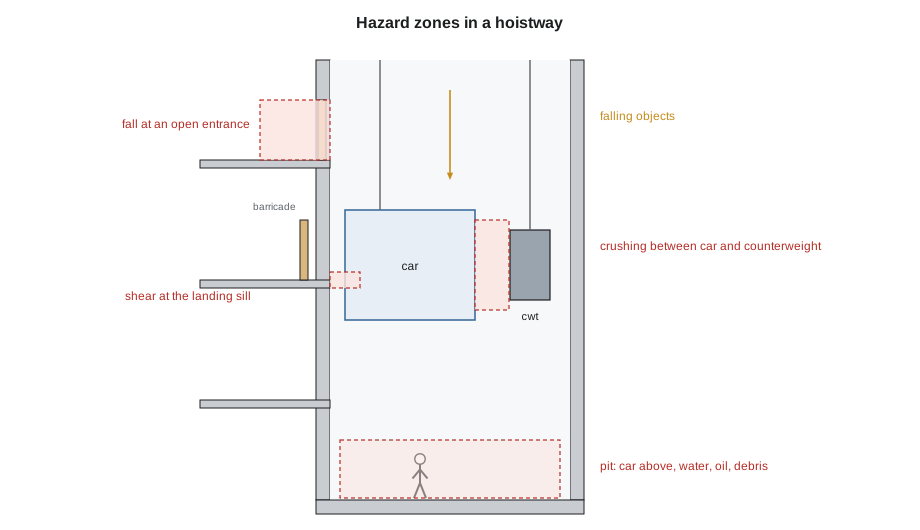
An open hoistway entrance is the single most dangerous place on an elevator job. During construction, every landing opening is an unprotected edge with a fall of up to the full building height behind it, until the hoistway doors are installed and their interlocks work. In an existing building, the hoistway door hides the same fall, held back only by its interlock. The CPWR study's finding that more than half of elevator construction deaths were falls, and nearly half of those from 30 feet or more, is mostly a story about these openings.
On a construction site, each open hoistway entrance must be protected by a guardrail or barricade strong enough to stop a person falling into it, with a top rail, a mid rail and a toe board, and in British Columbia the barricade must meet the guardrail requirements of the OHS Regulation. At Quayside Tower, the general contractor installed full-height plywood barricades at every hoistway entrance when the walls were poured, with a lockable access hatch in each one. The rule on site is that a barricade may be opened only by the elevator crew, only for the time it takes to do the work at that landing, and only with the worker tied off to an anchor before the barricade is opened. A barricade that is found open, damaged or removed is reported at once, and nobody walks past it.
The hoistway door key
In a finished building, the hoistway door is opened from the landing with a hoistway door unlocking device. Using it is the first step of nearly every hoistway entry, and it is also how people have fallen into empty hoistways for as long as elevators have existed. The rule is simple: never open a hoistway door without knowing where the car is, and never step through it without seeing the car top or the pit floor under your feet.
Ray's procedure for opening a hoistway door with the key has five steps. First, he confirms the car's position, by calling it to a landing and sending it to where he wants it, or by looking at the position indicator, and he places a barricade or a person at the landing to keep the public away. Second, he unlocks the door and opens it only a few centimetres, holding it with his foot or a door stop so it cannot open further. Third, he looks through the gap to confirm that the car top or pit is where he expects. Fourth, he tests that the interlock is doing its job: with the door cracked open, he or a partner tries to call or run the car, and it must not move. Fifth, only then does he open the door fully and proceed with the entry procedure from Lesson 8. If anything is not as expected, he closes the door and starts again.
| Rule | Why |
|---|---|
| Know where the car is before unlocking | The car may have been moved by a passenger, another mechanic or fire service |
| Crack the door, do not swing it open | A gap of a few centimetres is enough to look but not enough to fall through |
| Look before stepping | The car top, landing sill and pit floor can be in the wrong place or missing |
| Test that the car will not move | A failed interlock or a jumper can leave the car free to run with the door open |
| Guard the landing | The public must not walk into an open hoistway behind you |
| Never leave a door open unattended | An open door with no one there is an invitation to fall |
A hoistway door that has been opened must be closed and checked before the mechanic leaves the landing. Every hoistway door should close and lock on its own when released, and checking that it does so is part of every maintenance visit: the door closer, the interlock and the door restrictor that prevents the car door from being opened outside the unlocking zone are all life-safety devices for the public.
Moving car and counterweight
Inside the hoistway, the hazard changes from falling to being struck or crushed. The car and counterweight move in opposite directions on a traction elevator, and they pass each other at the middle of the travel. A person leaning out from the car top, standing in the pit near the counterweight or reaching between the car and the hoistway wall is in a crushing or shearing zone. In a multiple-car hoistway, such as the four-car group at Quayside, the adjacent car and its counterweight are hazards too, and the space between cars may be separated only by a divider beam, a screen in the pit and the code's minimum running clearances.
Shear points are places where a moving edge passes a fixed edge: the car platform passing a landing sill, the car top passing a beam or bracket, the counterweight passing a rail bracket. A mechanic's hand, foot or head caught at a shear point is cut or crushed in an instant. The defence is to stay inside the car top's protected area, to keep body parts within the car top guardrail and away from the edges, to move the car only on inspection at low speed with the stop switch within reach, and to know the hoistway's layout before riding it.
Counterweight hazards are easy to forget, because the counterweight is out of sight behind the car. The counterweight runs down when the car runs up. A mechanic on the car top riding up toward the top of the hoistway is also bringing the counterweight down toward the pit, and anyone in the pit may be under it. That is why only one person controls the car and why nobody works in the pit while the car is being moved from the car top, unless both are in direct communication and the pit worker is in a protected position.
Falling objects and work overhead
Everything dropped in a hoistway falls to the pit. A bolt dropped from the 20th floor of Quayside Tower falls about 60 m (200 ft) and lands at about 34 m/s (110 ft/s), fast enough to cause serious injury through a hard hat. Rail clips, wrenches, bracket bolts, chunks of concrete knocked off by drilling, and tools left on the car top all become projectiles. The controls are to tether tools, to keep small parts in closed containers, to use toe boards on platforms, to sweep the car top before moving the car, and above all to keep people out of the pit and lower hoistway while work goes on above. Northcrest's rule on construction is no work below other work in the same hoistway, ever.
# Speed of an object dropped from a given height (no air resistance)
import math
g = 9.81                     # gravity, metres per second squared
for floors in (2, 5, 10, 20, 29):
    h = floors * 3.0       # floor-to-floor height m
    v = math.sqrt(2 * g * h)
    t = math.sqrt(2 * h / g)
print(f"{floors:2d} floors ({h:5.0f} m): {v:5.1f} m/s after {t:.1f} s")2 floors ( 6 m): 10.8 m/s after 1.1 s 5 floors ( 15 m): 17.2 m/s after 1.7 s 10 floors ( 30 m): 24.3 m/s after 2.5 s 20 floors ( 60 m): 34.3 m/s after 3.5 s 29 floors ( 87 m): 41.3 m/s after 4.2 s
The pit
The pit is the bottom of the hoistway, below the lowest landing. It contains the buffers, the governor tension sheave, the compensation sheave or chains on taller traction units, the bottom of the rails, the pit stop switch, a light, a ladder, and on hydraulic elevators the cylinder head and its packing. Its hazards come from the car above, from what falls into it and from its own conditions.
- The car above. If the car comes down while someone is in the pit, the space between the car and the pit floor shrinks to the clearance left when the car is on its compressed buffers. The pit stop switch and the code's refuge space exist to protect a person in this situation, but only if the switch is used and the person is in the refuge space.
- Water and oil. Pits collect rainwater, groundwater and leaking hydraulic oil. Water near electrical equipment is a shock hazard, oil is a slip and fire hazard, and both hide the floor. Many pits have a sump, which on hydraulic units should have an oil-separating pump or be pumped out by hand rather than to a drain.
- Debris and fire load. Construction debris, paper and oil-soaked rags collect in pits and burn easily. A clean pit is a safer pit and a faster inspection.
- Access and air. Pits are reached by a fixed ladder from the lowest landing, or for deep pits through a pit access door. Deep, wet or poorly ventilated pits may need to be assessed as confined spaces, especially on hydraulic units with oil vapour or where solvents are used.
- Tripping and striking. Buffers, sheaves, rail ends and cylinder heads are low obstacles in a dark space, often with the car's underside a short distance overhead.
Refuge spaces and clearances
The code requires a refuge space in the pit and on top of the car: a clear volume, free of equipment, large enough for a person to lie or crouch in safely when the car is at its lowest or highest position. It also sets minimum clearances between the lowest parts of the car and the pit floor when the car rests on its fully compressed buffers, and between the car top and the overhead when the counterweight rests on its buffer. The exact dimensions and the alternative shapes allowed have changed between editions of the code, so mechanics check the edition in force for the unit. What matters for a mechanic is to know where the refuge space is before entering, to keep it clear of tools and material, and to get into it if the car moves unexpectedly.
# Is there a clear refuge block under the car? (illustrative dimensions for practice only;
# the code edition in force for the unit sets the real values)
options = [                  # (length, width, height) in mm
    (1200, 600, 600),     # lie-down shape
    (900, 450, 1070),     # crouching shape
]
pit_clear = {"length": 1300, "width": 700, "height_under_car_on_buffers": 850}
for L, W, H in options:
    fits = (pit_clear["length"] >= L and pit_clear["width"] >= W
            and pit_clear["height_under_car_on_buffers"] >= H)
print(f"block {L} x {W} x {H} mm: {'fits' if fits else 'does not fit'}")block 1200 x 600 x 600 mm: fits block 900 x 450 x 1070 mm: does not fit
The output shows a pit where the lie-down space fits but the crouching space does not. A mechanic entering this pit needs to know that the safe place is lying flat in the marked area, not crouching beside the buffer. Ray paints the refuge space outline on the pit floor at every unit he maintains when the building owner agrees, so that nobody has to remember it under stress.
Hoistway control on a construction site
On a construction site, the elevator contractor controls access to its hoistways. Nobody else enters them without the elevator superintendent's permission, because other trades do not know the hazards and may not know where the car or the work platform is. At Quayside, Lena keeps a hoistway access log at the base of each hoistway: who is in it, where, doing what, and who to contact. Every person signs in and out. The general contractor's site rules back this up, and the barricades carry signs naming Northcrest as the controlling contractor.
Other trades still need to work near the hoistways: drywallers finishing the shaft walls, electricians running feeders to the machine space, fire protection crews installing sprinklers at the top. Their work is scheduled with Northcrest so that it never happens above or below elevator workers in the same hoistway. Lena attends the general contractor's weekly coordination meeting to agree the schedule, and she walks the floors on Friday afternoon to check barricades before the weekend.
Common mistakes
MistakeOpening a hoistway door fully before looking.
InsteadCrack it a few centimetres, look, test that the car will not move, then open it.
MistakeWorking in the pit while someone moves the car from above without a plan.
InsteadOnly one person controls the car, and the pit worker stays in a protected position in direct communication, or out of the pit.
MistakeLeaving a barricade open while stepping away.
InsteadClose and secure it every time you leave the landing, even for a minute.
MistakeForgetting the counterweight.
InsteadIt moves down when the car moves up, and it may pass through the pit or the work area.
MistakeLeaving tools on the car top.
InsteadSweep the car top and secure tools before every move; anything loose can fall to the pit.
Summary and key terms
- Open hoistway entrances cause most fall deaths in the trade; barricades and tie-off control them.
- The hoistway door key is opened only after locating the car, cracking the door, looking and testing that the car will not move.
- The car, the counterweight and adjacent cars create crushing and shearing zones inside the hoistway.
- Falling objects reach the pit at high speed, so no work is done below other work in the same hoistway.
- The pit has the car above, water and oil, debris, access hazards and sometimes confined-space conditions.
- Refuge spaces and clearances are set by the code edition in force; know where they are before entering.
- Hoistway entrance
- The opening at each landing, closed by the hoistway door.
- Barricade
- A guardrail or panel protecting an open hoistway entrance during construction.
- Hoistway door unlocking device
- The key used to open a hoistway door from the landing side.
- Shear point
- A place where a moving edge passes a fixed edge.
- Refuge space
- A clear space in the pit or on the car top where a person is safe when the car is at the end of its travel.
- Hoistway access log
- The record of who is in a hoistway, where and doing what.
Practice problems
Work each problem on paper first, then reveal the answer to check.
What are the five steps for opening a hoistway door with the key?
Show answer
Locate the car and guard the landing; unlock and crack the door; look; test that the car will not move; open and proceed.
An object falls 30 m. About how fast is it moving when it lands?
Show answer
About 24 m/s.
Which way does the counterweight move when the car goes up?
Show answer
Down.
Why are other trades kept out of elevator hoistways?
Show answer
They may not know the hazards or where the car or platform is; the elevator contractor controls access.
Lesson quiz · 5 questions
Score 60% or more to complete this lesson.
Create a free account to save your progress, take quizzes and earn a certificate.