
ELV-110 · Lesson 12 of 12 · 17 min
Capstone: the first-month field log
At the end of her first month, Lena asked Tamsin to hand in her field log and to lead two tasks with Ray watching: a top-of-car and pit visit on one of the Tillicum Building's geared cars on Route 7, and the lockout of a hydraulic car at Holloway Memorial Hospital before a valve replacement. Neither task was new to her. The point was to show that she could plan and carry out each one in the right order, explain why each step was there, and record it properly. This lesson follows the log and the two tasks and brings together the whole course: the industry, the equipment, the safety culture and the procedures for hoistways, pits, lockout, falls, running equipment, electricity, tools and housekeeping.
The field log
Northcrest asks every apprentice to keep a field log: one line per day with the job, the tasks, the hours and anything learned or reported, plus a weekly note. The log supports the official hours record for certification and, more importantly, shows the apprentice's progress. Tamsin's first month looked like this.
| Week | Jobs | Main tasks | Safety items |
|---|---|---|---|
| 1 | Branch orientation; Quayside Tower | Orientation; harness fit and suspension test; rail setting from the platform in hoistway 2 | First JHA rewritten; reported an open barricade at the 9th floor |
| 2 | Route 7; Quayside Tower | Hydraulic pump coupling at the Marlowe; maintenance visits; more rail setting | Full lockout with Ray; first toolbox talk on hoistway barricades |
| 3 | Quayside Tower; Brackenridge Centre | Platform work in hoistway 3; two night shifts on escalator steps | Fall clearance check for the platform; night-shift JHA; cleaning crew near a comb plate |
| 4 | Route 7; Holloway Memorial Hospital | Top-of-car and pit procedures at the Tillicum Building; hydraulic modernization prep | Led a top-of-car entry; infection control orientation at the hospital |
Tamsin's weekly notes were short and specific. Week 1: "A JHA control has to name a thing someone will do." Week 2: "Switching off is not lockout. The car is held up by oil." Week 3: "An SRL anchored overhead needs less clearance than a lanyard at my feet." Week 4: "Test it before you trust it: the interlock, the stop switch, inspection." Lena read them aloud at the branch meeting as an example of what a log should contain.
# Hours check from the field log after the first month
days = [8, 8, 8, 8, 8,  8, 8, 8, 8, 9,  8, 8, 10, 10, 8,  8, 8, 8, 8, 8]   # 20 working days
kinds = {"installation": 9, "service": 5, "repair": 3, "modernization": 3}   # days of each kind
total = sum(days)
print(f"hours this month: {total}")
for k, d in kinds.items():
    print(f"  {k:<14} {d:2d} days ({100 * d / len(days):.0f} %)")
required = 8000
print(f"share of the 8,000-hour Class A requirement logged so far: {100 * total / required:.1f} %")hours this month: 165 installation 9 days (45 %) service 5 days (25 %) repair 3 days (15 %) modernization 3 days (15 %) share of the 8,000-hour Class A requirement logged so far: 2.1 %
Task 1: a top-of-car and pit visit at the Tillicum Building
The Tillicum Building's car 2 is a geared traction elevator with a relay controller, a machine room in the penthouse and no car top guardrail. The work order was a routine maintenance visit: inspect the car top equipment and door operator, check the hoistway, then inspect the pit, buffers and governor tension sheave. Tamsin started with the JHA, which listed the steps in the order she would do them, with the hazards and controls for each.
| Step | Hazard | Control |
|---|---|---|
| Take car 2 out of service | Passengers enter while the car is under work | Independent service; signs and barricades at the lobby and the 8th floor |
| Open the 8th floor door with the key | Fall into the hoistway; car not where expected | Tie off to the landing anchor; crack the door and look |
| Test the interlock | Car moves with the door open | Ray calls the car from the lobby; it must not move |
| Car top stop switch, light, inspection | Car moves before the test | Operate from the landing before stepping on |
| Step onto the car top | Fall through the gap to the hoistway wall | Tie off to the crosshead anchor before stepping across |
| Ride the car top on inspection | Counterweight passing; beams; dropped tools | Stay inside the marked area; call every move; tools tethered |
| Exit at the 8th floor | Car runs while still on the car top | Step off first, then inspection to normal, stop switch to run |
| Pit entry at the lobby | Car comes down; slip on oil; ladder fall | Car run up and left out of service; crack, look, test; pit stop switch to stop and tested; three points of contact |
| Inspect buffers and tension sheave | Caught in the governor rope | Car stopped; no hands near the rope; stop switch on stop |
| Return to service | Tools left in the hoistway; car fault | Count tools; close and check doors; run on normal operation |
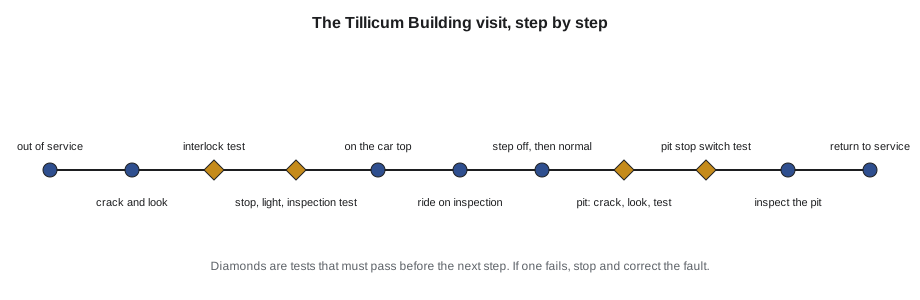
The visit went well, with one stop. On the car top, during the interlock check at the 6th floor landing, Tamsin noticed that the hoistway door's closer was weak: the door did not close fully on its own when released. She stopped, called it to Ray, and they wrote it up as a deficiency for repair that afternoon. Ray pointed out that the weak closer would not have been found if she had been in a hurry. In the pit, she found a puddle of oil under the counterweight buffer, an oil buffer whose oil level then checked low. Both items went into the logbook and the work order, with a note to the building manager.
On the way out of the pit, Tamsin climbed to the landing and, before she had returned the pit stop switch to run, a tenant walked up to the lobby barricade and asked when the elevator would be back. Ray answered while Tamsin finished. Her log entry for the day included the line: "People will always talk to you at the worst moment. Finish the step."
Task 2: the hydraulic lockout at Holloway Memorial Hospital
Holloway's car 1 is a four-stop in-ground hydraulic serving the emergency department, imaging and two inpatient floors. Northcrest was replacing its control valve as part of the modernization, and the hospital's facilities manager had agreed a four-hour window during the night with car 2 kept in service for patients. Infection control rules required the work area at the power unit to be inside a sealed barrier with negative air, and every worker had completed the hospital's orientation. Before the night, Tamsin worked out the stored energy and pressure in the system with Ray.
# Holloway car 1: static pressure and stored energy in the hydraulic system
import math
g = 9.81
car = 2300            # car and sling, kg
plunger = 700         # plunger, kg
rated = 2000          # rated load, kg
d = 0.150             # plunger diameter, m
h = 12.0              # travel from buffers to the top landing, m
A = math.pi * d**2 / 4
for label, load in (("empty car", 0), ("full rated load", rated)):
    W = (car + plunger + load) * g
    p = W / A
    print(f"{label}: static pressure {p / 1e6:.2f} MPa ({p / 6895:.0f} psi)")
E = (car + plunger) * g * h
print(f"stored energy with the empty car at the top landing: {E / 1000:.0f} kJ")
print(f"oil in the cylinder at the top landing: {A * h * 1000:.0f} L")empty car: static pressure 1.67 MPa (242 psi) full rated load: static pressure 2.78 MPa (403 psi) stored energy with the empty car at the top landing: 353 kJ oil in the cylinder at the top landing: 212 L
The figures gave Tamsin a feel for the system. The static pressure is modest for hydraulics, but the oil in the cylinder holds up several tonnes, and the stored energy with the car at the top is the energy of the car falling the full height of the building. Opening the valve body with the car above its buffers would release it. The lockout therefore had to bring that energy down to zero before any fitting was opened.
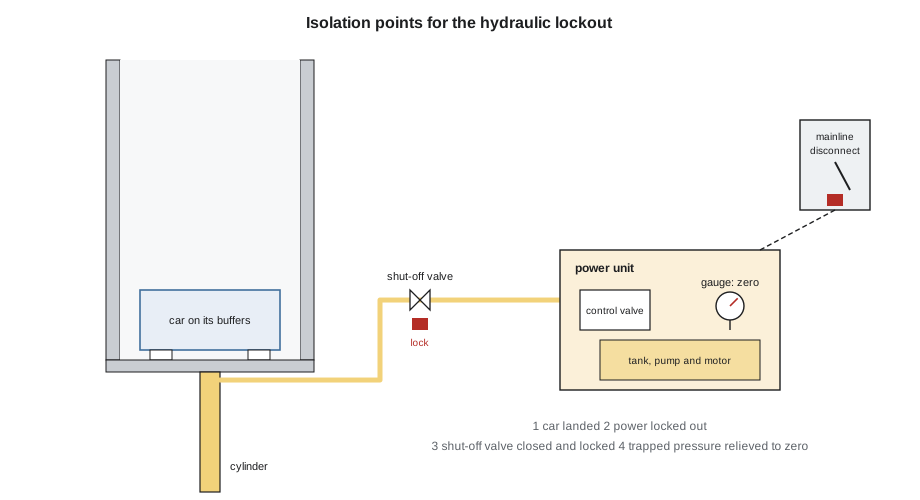
Tamsin's written lockout sheet, checked by Ray before they started and by Lena afterwards, had these steps.
- Prepare: read the written procedure for the unit and the valve maker's instructions; identify every energy source (mainline, car light and fan, the old valve's solenoids, oil pressure, gravity, hot oil); gather locks, tags, a hasp, a tested voltage tester, absorbent and drip trays.
- Notify: confirm with the facilities manager and the charge nurse on each floor that car 1 is out of service and car 2 is in service; signs and barricades at all four landings.
- Shut down: run the car to the lowest landing on normal operation, then on inspection lower it onto its buffers and continue lowering until the pressure gauge shows the car's weight is off the oil.
- Isolate: open the mainline disconnect and the car light and fan disconnect; close the manual shut-off valve in the oil line.
- Lock and tag: Ray's and Tamsin's personal locks on the mainline disconnect hasp, the car light disconnect and the shut-off valve lockout device, each with a tag.
- Release stored energy: relieve the pressure trapped between the shut-off valve and the control valve by the method in the valve maker's instructions, into a container; confirm the gauge reads zero; let the oil cool.
- Verify: try a call from the lobby and an inspection run from the controller; nothing moves; controls back to off; live-dead-live test at the valve solenoid terminals and the controller.
- Work and restore: replace the valve; refill and bleed as specified; remove tools; tell the facilities manager; remove locks in reverse order of application by their owners; test run on inspection and normal operation; check the valve adjustment and the levelling; return car 1 to service.
The work went to plan, with one change. When Tamsin opened the shut-off valve after the new valve was fitted, a slow drip appeared at a fitting. She closed the shut-off valve again, relieved the pressure, confirmed zero on the gauge and tightened the fitting before reopening. Ray said it was the right call, made in the right order, and that he would have done the same.
What the month showed
Lena's review of the month covered three points. First, Tamsin had done every procedure in order, and when something was not as expected, she had stopped and called it. Second, her JHAs had improved from vague to specific, and her controls now named actions and devices. Third, she still needed practice at estimating time: both tasks had taken longer than planned, and in occupied buildings that matters to the people waiting for the elevator. Lena's answer was not to rush, but to plan more carefully, with the procedure steps written out in advance so that each one takes as long as it needs and no longer.
The review ended with the outline of the year ahead. Tamsin would spend most of the next months at Quayside Tower, where hoistway construction and rail setting would be the main work, the subject of the next course in the program. The hospital modernization, the mall escalators and Route 7 would bring her back to hydraulics, escalators and service, each with its own course later in the program. Every one of them would build on the procedures in this course.
| Course topic | Procedure from this course that carries forward |
|---|---|
| Hoistway construction and rail installation | Barricades, platform fall protection, hoistway access control, falling objects |
| Rigging and hoisting | Rated capacity, sling angles, never under a load, signals |
| Electrical theory and controllers | Supplies, live-dead-live testing, approach boundaries, jumper control |
| Hydraulic elevators | Hydraulic lockout and stored energy |
| Traction machines and ropes | Gravity, counterweight balance, rope inspection on running equipment |
| Escalators and service | Step band control, barricades, top-of-car and pit procedures |
Common mistakes
MistakeTreating the capstone tasks as tests of speed.
InsteadThey test order, verification and recording; speed comes from planning, not skipping.
MistakeIgnoring a defect found during a routine step.
InsteadStop, call it, record it and get it repaired, as with the weak door closer.
MistakeReopening a hydraulic line under pressure to fix a drip.
InsteadClose the shut-off valve, relieve pressure, confirm zero, then tighten.
MistakeFinishing a step while answering the public.
InsteadLet someone else answer, or finish the step first.
MistakeKeeping a log of hours only.
InsteadRecord tasks, safety items and what was learned as well.
Summary and key terms
- A good field log records hours, tasks, safety items and lessons, and supports the certification record.
- The top-of-car and pit visit followed the procedures of Lesson 8, with each test passed before the next step.
- Routine steps find defects, such as a weak door closer or a low oil buffer, when they are not rushed.
- The hydraulic lockout landed the car, isolated the electricity and the oil, relieved trapped pressure and verified before any fitting was opened.
- Stored energy in a hydraulic system is the car and plunger weight times their height above the buffers.
- Every procedure in this course carries into the later courses of the program.
- Field log
- A daily record of jobs, tasks, hours, safety items and lessons kept by the apprentice.
- Deficiency
- A defect found during inspection or maintenance that must be corrected.
- Static pressure
- The oil pressure needed to hold a hydraulic car at rest.
- Infection control barrier
- A sealed enclosure used in hospitals to keep construction dust away from patients.
- Levelling
- The car stopping level with the landing floor.
- Return to service
- Testing and handing a unit back to normal use after work.
Practice problems
Work each problem on paper first, then reveal the answer to check.
A hydraulic car and plunger weigh 3,000 kg on a 150 mm plunger. What is the static pressure?
Show answer
About 1.67 MPa.
Why was the car lowered onto its buffers before the valve was opened?
Show answer
To take the car's weight off the oil, so that opening the system cannot drop it.
Name the three isolation points used in the Holloway lockout.
Show answer
The mainline disconnect, the car light and fan disconnect, and the oil line shut-off valve.
What should a field log contain besides hours?
Show answer
Jobs, tasks, safety items reported and lessons learned.
Lesson quiz · 5 questions
Score 60% or more to complete this lesson.
Create a free account to save your progress, take quizzes and earn a certificate.