
ELV-110 · Lesson 11 of 12 · 18 min
Tools, rigging awareness and housekeeping
By the end of her first month Tamsin had carried, used, cleaned and put away more tools than in two years of labouring. Elevator crews use ordinary construction tools, specialized trade tools and lifting gear, often in spaces where a dropped tool falls a long way and a tangled cord or a stray rag can start a fire or trip someone at an open edge. This lesson covers the safe use of tools, the basics of rigging and lifting that every apprentice needs before the detailed rigging course (ELV-130), noise exposure from drilling in hoistways, and the housekeeping that keeps hoistways, pits and machine rooms safe.
Hand tools
Most hand-tool injuries come from using the wrong tool, a damaged tool or a good tool the wrong way: a wrench that slips because it is the wrong size, a chisel with a mushroomed head that throws chips, a screwdriver used as a pry bar. Elevator work adds height. A hand tool dropped from a car top or platform becomes a falling object, so tools used at height are tethered to the worker or to an anchor point with a tool lanyard rated for the tool's weight, and small parts go in closed bags or magnetic trays. Tools are carried in a bag or pouch, not in pockets, when climbing ladders.
Insulated hand tools, rated for the voltage, are used for electrical work near live parts. Non-sparking tools are used where flammable vapours could be present, which in elevator work is mostly around solvent cleaning. Tools are inspected before use and damaged ones are tagged and removed. On Tamsin's first Friday, Ray had her sort through the crew's spare tool bin, and she found a cracked socket, two screwdrivers with damaged tips and a hammer with a loose head. All four went into the scrap bin.
Power tools
Power tools on an elevator job include hammer drills and rotary hammers for anchor holes, magnetic-base drills for steel, angle grinders, band saws and reciprocating saws for cutting, and impact wrenches. Each one has its own hazards, and the manufacturer's manual is the starting point for its safe use. A few rules apply to all of them: guards stay on; the right accessory is fitted for the material and rated for the tool's speed; cords and batteries are in good condition; the tool is held with both hands where it has two handles; and the work is clamped or secured rather than held by hand.
Rotary hammers can bind in rebar and twist hard enough to break a wrist or throw a worker off balance on a platform. The side handle is always fitted, the clutch is set, and the operator braces against the bind before it happens. Grinders throw sparks and fragments, so they need face shields over safety glasses, a guard positioned between the wheel and the operator, and a hot work check if anything combustible is nearby. Magnetic drills must be secured with a safety strap in case the magnet releases, especially on vertical or overhead steel.
Powder-actuated tools, which drive fasteners into concrete or steel with a cartridge, are used on some jobs to fasten small brackets. They can kill if a fastener passes through the material or ricochets. In British Columbia, the OHS Regulation requires operators of powder-actuated tools to be trained and certified for the tool, and Northcrest allows only certified mechanics to use them. Most rail brackets at Quayside are fixed with drilled expansion or embedded anchors instead.
Noise from drilling and machinery
Drilling anchor holes in a concrete hoistway is one of the loudest jobs in construction, because the hoistway reflects the sound back at the driller. Northcrest's noise survey at Quayside measured levels of about 103 dBA at the operator of a rotary hammer drilling in the hoistway, about 92 dBA at a grinder, about 85 dBA on the platform near the hoist motor and about 78 dBA in the machine space of a running MRL unit. Noise exposure is assessed as a daily dose, which adds up the fraction of the allowed time spent at each level.
British Columbia uses an exposure limit of 85 dBA averaged over eight hours with a 3 dB exchange rate: each 3 dB increase halves the allowed time. Above the limit, the employer must reduce noise where practicable, provide hearing protection, and run a hearing conservation program with annual hearing tests.
# Daily noise dose for a day of rail setting at Quayside Tower
tasks = [            # (level dBA, hours)
    (103, 1.5),      # rotary hammer drilling in the hoistway
    (92, 0.5),       # grinding bracket edges
    (85, 4.0),       # platform work near the hoist motor
    (78, 2.0),       # MRL machine space and breaks
]

def dose(criterion, exchange):
    total = 0.0
    for level, hours in tasks:
        allowed = 8 / 2 ** ((level - criterion) / exchange)
        total += hours / allowed
    return 100 * total

print(f"dose, 85 dBA criterion with 3 dB exchange (BC): {dose(85, 3):.0f} %")
print(f"time at 103 dBA allowed on its own: {8 / 2 ** ((103 - 85) / 3) * 60:.1f} minutes")dose, 85 dBA criterion with 3 dB exchange (BC): 1286 % time at 103 dBA allowed on its own: 7.5 minutes
The day's dose is many times the limit, almost all of it from the hour and a half of drilling. Tamsin was surprised that the quieter tasks hardly mattered. The controls follow the hierarchy: Northcrest uses drills with dust and noise shrouds where they fit, rotates drilling among the crew so nobody drills all day, keeps other workers out of the hoistway during drilling, and requires double hearing protection, earplugs under earmuffs, for anyone drilling in a hoistway.
Rigging awareness
Elevator work involves lifting heavy, awkward loads in confined spaces: rail sections, machines, cars, counterweight frames and filler weights, power units, escalator trusses and steps. Rigging those lifts is a skill in its own right, covered in ELV-130. Every apprentice still needs the basics from day one, because they will be working beside lifts, steadying loads and handing up gear. The first rule is simple: never stand or put any part of your body under a suspended load, and never ride a load.
Every piece of lifting gear has a rated capacity, also called the working load limit, marked on it: slings, shackles, hooks, chain hoists, lever hoists and beam clamps. The overhead lifting beam at the top of a hoistway or in a machine room is marked with its rated load too. Gear without a legible rating is not used. Before each use, the rigger inspects it: slings for cuts, crushing, broken wires, heat damage and missing tags; shackles and hooks for distortion, cracks and missing safety latches; hoists for chain wear and a working brake.
The load on each leg of a sling depends on the angle of the legs. As the legs spread wider, the tension in each leg rises above its share of the weight, and at a shallow angle a light load can overload a sling.
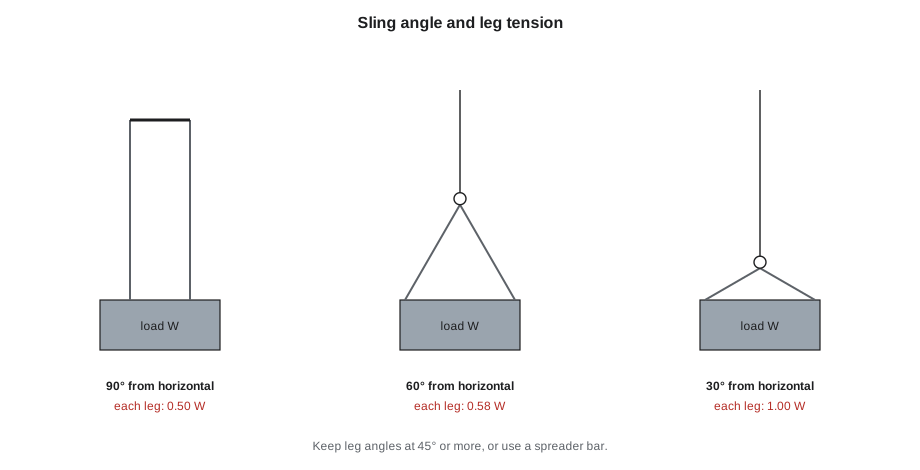
In the equation, W is the load weight, n the number of legs and θ the angle of each leg from the horizontal. At 60 degrees each leg of a two-leg sling carries about 58 percent of the load, and at 30 degrees each leg carries the whole load. Riggers keep sling angles at 45 degrees or more and use spreader bars where headroom is short. Tag lines keep loads from spinning or swinging into the hoistway walls, and a single person gives the signals to the hoist operator using an agreed set.
| Leg angle from horizontal | Tension in each leg of a two-leg sling |
|---|---|
| 90° | 0.50 × load |
| 60° | 0.58 × load |
| 45° | 0.71 × load |
| 30° | 1.00 × load |
| 15° | 1.93 × load |
Housekeeping
Housekeeping sounds like the least important topic in safety, and it is one of the most important in the elevator trade. A tool left on a car top falls when the car moves. A pile of rail clips at a landing trips a worker toward the open hoistway. Oily rags in a pit catch fire. A machine room used for storage hides the disconnect and blocks the way out. The code requires machine rooms, control rooms and machinery spaces to be used only for elevator equipment, and Northcrest's procedures go further.
- Car tops are swept and cleared of tools, parts and debris before every move and at the end of every shift.
- Pits are kept dry and clean; oil is cleaned up with absorbent and disposed of properly; sumps are checked; nothing is stored in a pit.
- Machine rooms and control spaces hold only elevator equipment; the path to the disconnect and the exit is always clear; doors are kept closed and locked.
- Oily rags and absorbents go into closed metal containers emptied daily.
- Material at landings is stacked away from hoistway openings, on the floor not leaning against barricades, and no higher than is stable.
- Cords are routed away from walkways, sills and the car's path, and coiled when not in use.
Housekeeping also covers hot work. Welding, cutting and grinding in a hoistway can drop sparks the full height of the shaft onto debris in the pit or onto combustible material on landings. Northcrest uses a hot work permit for every job: combustibles cleared or covered for a set distance, a fire extinguisher at hand, a fire watch who stays during the work and for a period afterwards, and the building's fire alarm contractor or management informed if detectors may be affected.
At Route 7 buildings, housekeeping is part of every maintenance visit. Ray's last task at each unit is a walk-round: machine room swept, nothing stored, disconnects labelled, pit dry, car top clean, logbook signed. He leaves each unit the way he would want to find it, and that is how Northcrest wants Tamsin to work too.
Ladders and access
Ladders are tools too, and many falls in the trade start on one. Pit ladders are fixed ladders fitted when the hoistway is built, and the code sets where they go and how far they must extend above the landing sill so that a worker has a handhold when stepping on and off. Before climbing, the mechanic checks that the ladder is secure, clean of oil and in good condition, and climbs facing it with three points of contact and tools in a bag. Portable ladders are used in machine rooms and at landings. They are set on firm, level ground at the right angle, about one unit out for every four units up, with the top secured or held, and they extend above the landing they serve. A ladder is never set up on a car top or a work platform to gain height, because a fall from the ladder becomes a fall into the hoistway; if more height is needed, the car or platform is moved instead.
Step ladders are used only fully open with the spreaders locked, and nobody stands on the top cap or the step below it. Ladders made of metal are not used near exposed live parts. Damaged ladders are tagged out of service and removed. Northcrest's van checklist includes the ladder: feet, rungs, rails, locks and labels.
Manual handling
Most of the injuries in the branch's records are not dramatic. They are strains and sprains from lifting, carrying and twisting: rail sections, filler weights, door panels, power unit parts, toolboxes carried up stairs in buildings where the elevator under repair is the only one. Northcrest's rules are the usual ones applied consistently. Plan the lift and the route before picking anything up. Use carts, dollies, hoists and the general contractor's material hoist rather than carrying. Lift with the load close to the body, without twisting. Share heavy or awkward loads with a partner and agree who calls the lift. Counterweight filler weights, which are small, dense and heavy for their size, are handled one at a time with gloves, and never thrown or dropped into the counterweight frame. At Brackenridge Centre, escalator steps are moved on a purpose-built step cart, two at a time, rather than carried.
Ray's advice to Tamsin was to notice where the job made her twist or reach. Those were the places where a small change, a step stool, a cart, a different order of work, would save her back for a thirty-year career.
Common mistakes
MistakeCarrying tools in pockets up a pit ladder.
InsteadUse a bag or pouch and tether tools used at height.
MistakeUsing a rotary hammer without the side handle.
InsteadFit the side handle and set the clutch to control binding.
MistakeIgnoring short loud tasks in a noise assessment.
InsteadShort periods at very high levels dominate the dose.
MistakeUsing flat sling angles to save headroom.
InsteadKeep sling angles at 45 degrees or more, or use a spreader bar.
MistakeStoring material in the machine room.
InsteadMachine rooms and machinery spaces hold only elevator equipment.
Summary and key terms
- Tools used at height are tethered; damaged tools are removed; insulated tools are used near live parts.
- Power tools need guards, the right accessories, both hands and secure work; powder-actuated tools need trained operators.
- Drilling in hoistways is very loud; BC uses 85 dBA with a 3 dB exchange.
- Never stand under a suspended load; check rated capacities and inspect gear before use.
- Sling leg tension rises as the angle from the horizontal falls; keep angles at 45 degrees or more.
- Housekeeping on car tops, in pits and machine rooms prevents falls, falling objects and fires; hot work needs a permit and fire watch.
- Tool lanyard
- A tether that connects a tool to the worker or an anchor to prevent drops.
- Working load limit
- The maximum load a piece of lifting gear is rated to carry in service.
- Sling angle
- The angle between a sling leg and the horizontal.
- Tag line
- A rope attached to a load to control its swing and rotation.
- Noise dose
- The fraction of the allowed daily noise exposure a worker receives, as a percentage.
- Hot work permit
- A written authorization with fire precautions for welding, cutting or grinding.
Practice problems
Work each problem on paper first, then reveal the answer to check.
A two-leg sling lifts 1,000 kg with legs at 45 degrees. What is the tension in each leg?
Show answer
About 707 kg.
How long may a worker be exposed to 103 dBA on the 85 dBA, 3 dB basis?
Show answer
About 7.5 minutes.
Name three housekeeping rules for a pit.
Show answer
Keep it dry and clean, clean up oil properly, store nothing in it, check the sump.
What does a hot work fire watch do?
Show answer
Watches for sparks and fire during the work and for a period afterwards, with an extinguisher at hand.
Lesson quiz · 5 questions
Score 60% or more to complete this lesson.
Create a free account to save your progress, take quizzes and earn a certificate.