
ELV-110 · Lesson 1 of 12 · 19 min
The elevator industry and your career
Tamsin Iwasaki reported for her first day at Northcrest Elevator at 6:45 on a wet Monday morning in Vancouver. She had spent two years in a general construction labourer job, finished the trades entry course, and applied to Northcrest after watching an elevator crew set rails in a tower across the street from her last site. The branch office sits in an industrial unit off Marine Drive, with a stores room, a small training room and a yard full of crated rail and drums of hydraulic oil. Lena Ostrander, the field superintendent, met her at the door with a hard hat, a harness fitted to her size, a copy of the company safety manual and a printed schedule for her first week. By noon Tamsin had been paired with Ray Abernethy, a mechanic with 27 years in the trade, who would be her mentor for the year. This course follows Tamsin through her first months: what the elevator industry is, how an elevator works, and above all how mechanics in this trade go home safe every day.
What the elevator trade does
Elevator mechanics install, maintain, repair, modernize and test the equipment that moves people and goods vertically and on inclines: passenger and freight elevators, escalators, moving walks, dumbwaiters, wheelchair and platform lifts, material lifts and, in some jurisdictions, construction hoists. The industry calls all of these elevating devices or conveyances. Very few trades cover such a wide spread of skills. On one job a mechanic may be setting steel rail brackets with a hammer drill; on the next, reading a ladder diagram for a relay controller built in 1962; on the next, connecting a laptop to a variable frequency drive. The common thread is that every piece of equipment carries the public, often thousands of trips a day, and that the mechanic works where a car, a counterweight or a step band can move.
The work divides into four lines of business, and most mechanics work in more than one of them over a career. New installation crews build equipment in new buildings, starting from an empty concrete hoistway. Service or maintenance mechanics run a route of buildings, carrying out scheduled preventive maintenance, answering callbacks when a unit stops, and freeing trapped passengers. Modernization crews replace controllers, machines, door equipment, power units and fixtures in existing buildings while keeping as much of the original structure as makes sense. Repair crews take on larger jobs that a route mechanic cannot finish in a visit, such as a rope replacement, a hydraulic cylinder replacement or an escalator step chain change.
| Line of business | Typical work | Northcrest example |
|---|---|---|
| New installation | Hoistway layout, rails, machines, cars, doors, wiring, adjusting and acceptance testing | Quayside Tower, a 30-storey residential tower |
| Modernization | New controllers, power units, door operators and fixtures in existing buildings | Holloway Memorial Hospital, two hydraulic elevators |
| Repair | Major component work beyond a routine visit, often on a bank of units | Brackenridge Centre escalator bank, step and handrail work |
| Service and maintenance | Scheduled maintenance, callbacks, entrapments and safety tests | Route 7, a group of older buildings on the east side |
Northcrest Elevator and its jobs
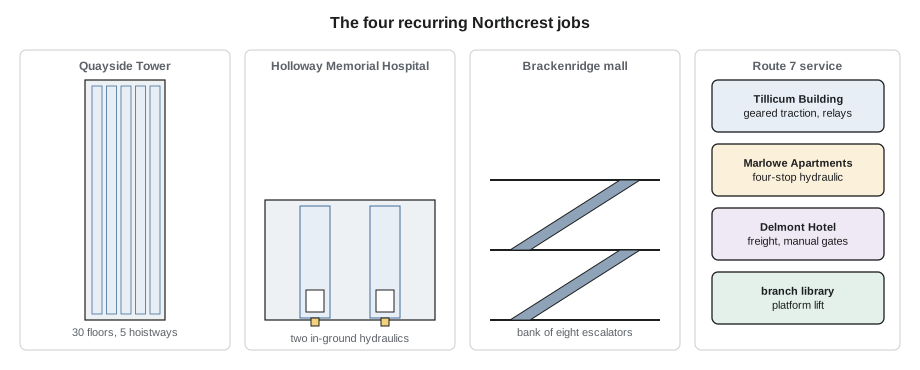
Northcrest is an invented mid-sized independent elevator contractor of about 60 field staff. It installs and services equipment from several manufacturers, which means its mechanics meet a wider range of equipment than those who work for a single brand. Four jobs run through this course and the rest of the elevator program, and Tamsin will work on all of them in her first months.
- Quayside Tower is a 30-storey residential tower under construction. Northcrest has the contract for four machine-room-less gearless traction passenger elevators and one service elevator that will also act as the construction elevator for the other trades. When Tamsin starts, the hoistways have been poured to the 22nd floor and the crew is setting rail in the lower floors.
- Holloway Memorial Hospital has two in-ground hydraulic elevators, built in the 1980s, that serve four floors between the emergency department, imaging and two inpatient floors. Northcrest is modernizing them one at a time with new power units, valves, controllers, door operators and fixtures. The hospital needs one car running at all times, so the schedule is tight and the work areas are inside infection control barriers.
- Brackenridge Centre is a three-level shopping mall with a bank of eight escalators. Northcrest services them and is replacing steps, handrails and comb plates over a series of night shifts while the mall is closed.
- Route 7 is a service route of older buildings: the Tillicum Building, a 1962 office building with two geared traction elevators and relay logic controllers; the Marlowe Apartments, a 1978 building with a four-stop hydraulic; the Delmont Hotel, which still has a freight elevator with manual gates; and a branch library with a vertical platform lift. Ray has run Route 7 for six years.
Who regulates elevating devices
In British Columbia, elevating devices are regulated under the Safety Standards Act and the Elevating Devices Safety Regulation, and the regulator is Technical Safety BC. Technical Safety BC adopts the CSA B44 Safety Code for Elevators and Escalators, and related standards such as CSA B355 for lifts for persons with physical disabilities, and it publishes the edition in force together with any BC variations. It issues installation permits for new and altered equipment, carries out or audits acceptance inspections, issues operating permits that owners must keep current, licenses elevating device contractors and certifies the mechanics who do the work. Workplace health and safety for the mechanics themselves, including fall protection, lockout and confined spaces, falls under the Occupational Health and Safety Regulation enforced by WorkSafeBC. The two sets of rules work together: B44 is mainly about the equipment and its safe design and use by the public, and the WorkSafeBC regulation is about the safety of workers.
The code book is something Tamsin will carry for her whole career. It sets the rules for hoistway construction, clearances and refuge spaces, machine rooms, car and counterweight safeties, buffers, door locks and contacts, electrical protective devices, escalator step clearances and many other details, and it sets the tests that must be passed before a unit carries the public. Code editions change every few years, and a jurisdiction adopts a new edition by regulation, sometimes with local variations, so the edition that applies to a job is the one in force where and when the work is permitted. A modernization may be held to the current code for the parts being altered while the untouched parts stay under the code they were built to. Questions about which rule applies are settled by the authority having jurisdiction, never by guesswork on site.
Becoming a certified mechanic
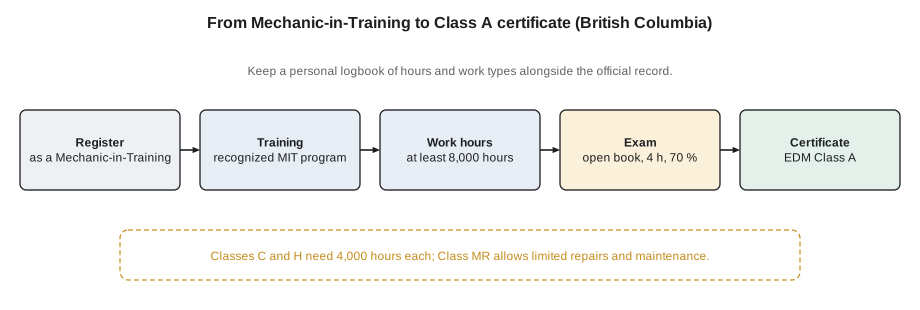
In British Columbia, a person who does elevating device work must hold an Elevating Devices Mechanic (EDM) certificate or be a registered Mechanic-in-Training (MIT) working under the supervision of a certified mechanic. Technical Safety BC issues EDM certificates in four classes. Class A is the full certificate for the broad range of elevating devices and is the one Tamsin is working toward. Class C covers the types of personnel hoists listed on the holder's Skills Passport, Class H covers the types of devices designed for persons with physical disabilities listed on the Skills Passport, and Class MR allows limited repairs and maintenance on devices identified on the certificate, while employed by a licensed Class MR contractor. For Class A, the route is to register as an MIT, enrol in a recognized training program, record at least 8,000 hours of work experience, complete the MIT program and pass the certification exam. The exam is open book, four hours long, with a pass mark of 70 percent; a candidate who fails waits 30 days before trying again, and has three attempts. Classes C and H each require 4,000 hours of experience with their own MIT programs.
Northcrest is a union contractor, and Tamsin is enrolled in the elevator industry's apprenticeship training program through the union and contractors' joint committee. The classroom part of the program is delivered in modules alongside the work hours, with an early block on safety, the history of the trade and basic electrical and mechanical theory. The program and the employer both keep records of hours and training, and Tamsin keeps her own logbook as a backup, because a gap in her records could delay her certificate by months.
# Months until Tamsin can apply for her certificate, from logged hours
required = 8000          # Class A EDM experience requirement
logged = 0                # hours at the start of the apprenticeship
week_hours = 40
weeks_worked_per_year = 48     # allows for holidays, school blocks, weather and slow periods
per_year = week_hours * weeks_worked_per_year
years = (required - logged) / per_year
print(f"hours per year: {per_year:,}")
print(f"years to reach {required:,} hours: {years:.1f}")
print(f"that is about {years * 12:.0f} months, plus the time to complete the training program and the exam")hours per year: 1,920 years to reach 8,000 hours: 4.2 that is about 50 months, plus the time to complete the training program and the exam
Ray's advice on hours was blunt: the hours are the minimum, not the goal. A mechanic who has logged 8,000 hours only on new installation will meet a service callback on a 1960s relay controller as a stranger. Northcrest rotates its apprentices through installation, modernization, repair and service so that each one sees the full range before the exam.
Why safety comes first in this trade
The elevator trade is one of the more dangerous construction trades. CPWR, the construction research centre run with the building trades unions, studied elevator-related deaths in US construction between 2011 and 2016 and counted 145 deaths in that period. Falls to a lower level caused 53.5 percent of them, and nearly half of those falls were from 30 feet (about 9 m) or more, which is what an open hoistway offers. The rate for elevator installers and repairers was 14.9 deaths per 100,000 full-time workers, several times the rate for construction as a whole, and the annual count rose from 14 in 2003 to 28 in 2016, with a peak of 37 in 2015. Most of the remaining deaths came from being caught in or between moving parts, being struck by a car, counterweight or falling object, and electrocution. Canadian figures are smaller because the workforce is smaller, but the pattern of hazards is the same.
| Main hazard | Where it happens | Lesson in this course |
|---|---|---|
| Falls | Open hoistway entrances, car tops, pits, ladders, scaffolds in the hoistway | Lessons 5 and 7 |
| Caught in or between | Car and counterweight, car and hoistway wall, sheaves, steps and comb plates | Lessons 5, 8 and 9 |
| Struck by | Moving car or counterweight, falling tools and material, unexpected movement | Lessons 5 and 6 |
| Hazardous energy | Electrical supply, stored energy in hydraulics, gravity, springs | Lesson 6 |
| Electrical shock and arc flash | Controllers, disconnects, drives and capacitors | Lesson 10 |
Northcrest's safety record is good, and Lena wants to keep it that way. On Tamsin's first afternoon she sat through the company orientation: the right to refuse unsafe work, how to report a hazard or a near miss, the company rule that nobody enters a hoistway, pit or car top alone during their first year, and the rule that a mechanic who is not sure whether a unit is under control stops and asks. Lena told her the story of every serious injury in the branch's history, by name, because each one had changed a company rule. The lessons that follow explain those rules and the reasons behind them.
A day in the trade
Elevator work starts early and often runs long. On new installation, the crew's day is set by the general contractor's schedule and by the floors that are ready. On service, the route mechanic plans maintenance visits around building hours, and the callback phone can change the plan at any time: a stopped car in a hospital or a trapped passenger moves to the top of the list. Escalator work at the mall happens at night, when the public is out of the building. Modernization in occupied buildings means working around tenants, patients and residents who still need to get to their floors. Tamsin's first month will include all of these.
The trade also asks for physical fitness and steady nerves. Mechanics climb ladders into pits, ride car tops in hoistways forty floors high, lift heavy components, and work in tight, dirty, noisy spaces. They also need patience with documents: drawings, wiring diagrams, permits, test forms and maintenance logs. The best mechanics Tamsin met in her first week were careful, orderly and calm, and the word she heard most often was "verify".
| Time | Activity |
|---|---|
| 06:45 | Arrive at the branch, pick up tools and material, check the van |
| 07:15 | Toolbox talk and job hazard analysis at Quayside Tower |
| 07:45 | Rail setting in hoistway 2 from the work platform |
| 12:00 | Lunch, then a material lift with the general contractor's crane |
| 13:00 | Rail setting continues; Ray checks alignment |
| 15:15 | Clean up, secure the hoistway entrances, sign out on the access log |
Common mistakes
MistakeThinking the code book only covers equipment design.
InsteadThe code also covers tests, inspections and the conditions under which equipment may be put into service; worker safety rules sit alongside it.
MistakeAssuming the hours requirement is all that matters.
InsteadThe training program, the exam and broad experience across installation, service, repair and modernization all count.
MistakeTreating a code edition as universal.
InsteadThe edition that applies is the one adopted where and when the work is permitted, with any local variations.
MistakeWorking without supervision as a new trainee.
InsteadA trainee works under a certified or licensed mechanic, and the company's first-year rules add to that.
MistakeKeeping no personal record of hours.
InsteadKeep a logbook of hours and work types as a backup to the employer's records.
Summary and key terms
- The elevator trade installs, services, repairs and modernizes elevators, escalators, moving walks, lifts and other elevating devices.
- In British Columbia, Technical Safety BC regulates elevating devices under the Safety Standards Act and adopts CSA B44; WorkSafeBC regulates worker safety.
- The Class A EDM certificate requires the MIT program, at least 8,000 hours and an exam with a 70 percent pass mark.
- Falls are the leading cause of death in elevator construction, followed by caught-in and struck-by events and electrocution.
- Northcrest's four recurring jobs are a tower install, a hospital hydraulic modernization, a mall escalator bank and a service route of older buildings.
- Elevating device
- Any elevator, escalator, moving walk, lift or similar device regulated as a conveyance.
- Modernization
- Replacing major components of existing equipment, such as the controller, power unit or door equipment.
- Callback
- An unscheduled service visit because a unit has stopped or is not working properly.
- EDM
- Elevating Devices Mechanic, the certificate issued by Technical Safety BC.
- MIT
- Mechanic-in-Training, a registered apprentice working under a certified mechanic.
- Operating permit
- The permit an owner must hold to operate an elevating device in British Columbia.
Practice problems
Work each problem on paper first, then reveal the answer to check.
Name the four lines of business in the elevator trade.
Show answer
New installation, modernization, repair, and service and maintenance.
What is the minimum number of work hours for the Class A EDM certificate?
Show answer
8,000 hours, together with the MIT program and the exam.
Which body enforces fall protection and lockout rules for elevator workers in British Columbia?
Show answer
WorkSafeBC, under the Occupational Health and Safety Regulation.
What share of elevator construction deaths in the CPWR 2011 to 2016 study were falls to a lower level?
Show answer
53.5 percent.
Lesson quiz · 5 questions
Score 60% or more to complete this lesson.
Create a free account to save your progress, take quizzes and earn a certificate.