
ELV-110 · Lesson 3 of 12 · 19 min
How an elevator works
Before Tamsin could understand any safety rule in the trade, she had to know what each part of an elevator does and how the parts depend on one another. Ray took her through a traction elevator from the bottom of the pit to the top of the hoistway at Quayside Tower, where the first car was being assembled, and then through the hydraulic cars at Holloway Memorial Hospital. Every safety rule in the lessons that follow refers to these parts. This lesson names them and explains, in plain terms, what each one does when things go right and what it does when things go wrong.
The hoistway, pit and overhead
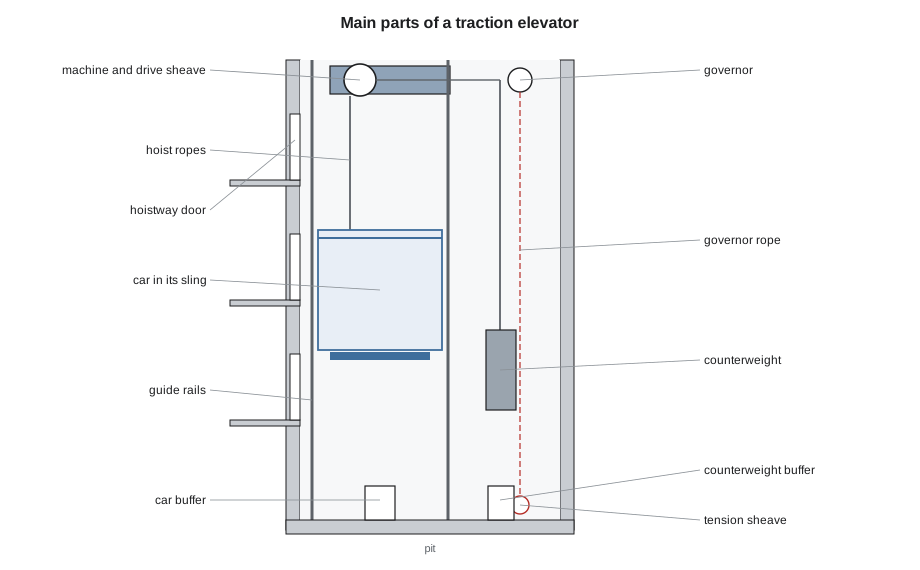
The hoistway is the vertical shaft the car and counterweight travel in. It is enclosed with fire-rated walls, and it has an opening at each landing closed by a hoistway door. The pit is the part of the hoistway below the lowest landing. It holds the buffers, the governor tension sheave, the bottom of the rails and, on hydraulic units, the cylinder head. The overhead is the space above the highest landing, and its height must leave room for the car to overtravel slightly and still leave a clear space above the car top. The code sets minimum clearances and refuge spaces in the pit and above the car so that a person there is not crushed if the car reaches the end of its travel. On a traction elevator the counterweight runs in the same hoistway, usually at the back or side of the car, behind a guard in the pit.
In an older building, the machine room above the hoistway (or beside the pit, for a hydraulic) holds the machine, the controller and the governor. On a machine-room-less elevator, the machine and governor are in the hoistway and the controller is in a cabinet or small room near a landing. Wherever the equipment sits, the code requires its spaces to be secured against entry by anyone but authorized people, lit and kept clear of storage.
The car and its guidance
The car is built on a steel frame called the sling, made of a crosshead at the top, two uprights or stiles at the sides and a plank at the bottom that carries the platform. The cab, with its walls, ceiling and finishes, sits on the platform inside the sling. Guide shoes or roller guides on the sling run on the car guide rails, which are steel T-section rails fixed to the hoistway walls with brackets at regular spacing. The counterweight has its own guide rails and guides. Setting rails straight and plumb is a large part of installation work and the main subject of ELV-120; in this course, the point is that rails also carry the forces when the safeties grip, so their brackets and fastenings matter to everyone who rides.
The car also carries equipment the mechanic works with every day: the car door and its door operator on top of the car, the car top inspection station with its stop switch and up and down buttons, a light and a power outlet, the car top guardrail where the clearance to the hoistway wall calls for one, and the travelling cable that carries power and signals between the car and the controller. Underneath, the car carries the safety device that clamps the rails in an emergency.
Ropes, sheaves and the counterweight
On a typical traction elevator, several steel wire ropes run from the car crosshead up to the drive sheave, over it and down to the counterweight. Some modern machines use flat coated steel belts instead. Ropes are inspected for broken wires, wear and stretch, and each rope's tension is balanced against the others so that they share the load. The ratio between rope travel and car travel is called the roping: on 1:1 roping the car moves as far as the ropes move over the sheave; on 2:1 roping, used on most MRL units, the ropes pass under sheaves on the car and counterweight and the car moves half as far as the ropes, which halves the load on the machine.
The counterweight is a frame filled with steel or concrete weights. It is usually chosen to balance the car plus about 40 to 50 percent of the rated load, a figure called the overbalance. With a half-loaded car, the machine only overcomes friction and inertia. With an empty car, the counterweight is heavier than the car, so a released brake would let the empty car rise and the counterweight fall. With a full car, the car is heavier and would fall. This is the first lesson in stored energy: a traction elevator is a balance of two large masses, and either side can move when the brake opens.
In the equation, W is a weight, Q is the rated load and q is the overbalance fraction. The difference between the two sides is what the brake must hold, and it is what moves if the brake is released by hand or fails.
# Counterweight balance and the out-of-balance load at different car loads
g = 9.81
car = 1500            # car weight, kg
Q = 1600                # rated load, kg
q = 0.45               # overbalance fraction
cwt = car + q * Q
print(f"counterweight: {cwt:,.0f} kg")
for share in (0, 0.25, 0.45, 0.75, 1.0):
    load = share * Q
    diff = (car + load) - cwt          # positive: car side heavier, car would fall
    side = "car side heavier" if diff > 0 else ("balanced" if diff == 0 else "counterweight side heavier")
print(f"car {share:4.0%} loaded: out of balance {abs(diff):,.0f} kg ({side})")counterweight: 2,220 kg car 0% loaded: out of balance 720 kg (counterweight side heavier) car 25% loaded: out of balance 320 kg (counterweight side heavier) car 45% loaded: out of balance 0 kg (balanced) car 75% loaded: out of balance 480 kg (car side heavier) car 100% loaded: out of balance 880 kg (car side heavier)
Ray pointed at the first line of the output. An empty car on Quayside's passenger units is out of balance by roughly the weight of nine adults, and the counterweight side is the heavier side. Anyone working under the counterweight, or above the car, needs to know that a brake that slips will move the car up, not down.
The machine, brake and drive
The traction machine turns the drive sheave. Its brake is a spring-applied, electrically released brake: springs press the brake shoes or pads onto a drum or disc, and the controller energizes a coil to lift them when the car is to move. If power fails, the springs apply the brake. Many modern machines have two independent brake arms so that either one alone can stop and hold the car. The drive is the electronic power unit, usually a variable frequency drive, that controls the motor's speed and torque. Drives store energy in capacitors that can stay charged for minutes after the power is switched off, which is a hazard covered in Lesson 10.
The governor, safeties and buffers
Three devices protect against overspeed and free fall. The governor is a sheave, usually at the top of the hoistway or in the machine room, driven by a separate governor rope attached to the car (and on some units to the counterweight). If the car runs too fast, the governor first opens a switch that cuts power to the machine and applies the brake; if the car keeps accelerating, the governor grips its rope, and the rope pulls a linkage on the car that sets the safeties. The safeties are wedge or roller clamps on the car frame that grip the guide rails and stop the car. Instantaneous safeties stop the car abruptly and are used at low speeds; progressive safeties stop it over a short distance and are used at higher speeds.
Buffers sit in the pit under the car and the counterweight. They are not meant to stop a falling car from full speed on their own; they absorb the energy of a car or counterweight that overtravels the bottom landing at or near rated speed. Spring buffers are used at low speeds and oil buffers, which force oil through an orifice, at higher speeds. A buffer marks the bottom of travel, and the space beside and around it is where the code's pit refuge space must be. The counterweight buffer is just as important: when the car overtravels at the top, the counterweight lands on its buffer, which is what stops the car from striking the overhead.
| Device | What it does | Where it is |
|---|---|---|
| Brake | Holds the car at rest and stops it when power is removed | On the machine |
| Governor | Detects overspeed, opens a switch, then trips the safeties | Top of the hoistway or machine room, with a tension sheave in the pit |
| Safeties | Clamp the rails to stop the car | Under the car on the sling |
| Buffers | Absorb the energy of overtravel at the bottom | In the pit under the car and the counterweight |
| Terminal stopping devices | Slow and stop the car at the end landings | Switches or sensors in the hoistway |
| Final limit switches | Remove power if the car runs past the terminal landing | Near the top and bottom of the hoistway |
Doors and interlocks
Most elevator accidents to the public, and many to workers, involve doors. Each hoistway door has an interlock: a mechanical lock that holds the door shut unless the car is at the landing, combined with an electrical contact that prevents the car from moving unless the door is closed and locked. The car door has its own contact or lock. All of these contacts are wired in series in the door circuit, so if any door is open the car cannot run on normal operation. The car door operator opens both doors together by a clutch or vane on the car door that engages rollers on the hoistway door when the car is level with the landing.
Hoistway doors can be opened from the landing side with a special unlocking device, often called a hoistway door key or lunar key, inserted through a small hole in the door panel. That key is one of the most dangerous tools in the trade, because it allows a person to open a door onto an empty hoistway. Only trained, authorized people carry it, and Lesson 5 explains how it is used. When a hoistway door is open and the car is not there, the gap is an unguarded opening onto a fall of up to the full height of the building.
The safety circuit and the controller
The controller decides when and where the car moves, in response to calls from landing and car buttons, and it runs the drive or the hydraulic valves. Older controllers used relays and are drawn as ladder diagrams; modern controllers use microprocessors. Every controller has a safety circuit: a series chain of switches that must all be closed for the car to run. It includes the pit stop switch, the car top stop switch, the governor switch, the safety-operated switch on the car, the final limit switches, buffer switches on oil buffers, and the door circuit. Opening any one of them stops the car. This is why the first thing a mechanic does when entering the car top or the pit is to open the stop switch there, and why a jumper across the safety circuit is so dangerous: it defeats every switch beyond it.
Controllers also have special operating modes. Inspection operation lets a mechanic run the car at a low speed with constant-pressure buttons from the car top or the controller, with the hall calls and the door operator out of service. Fire service operation recalls cars to a designated landing and gives firefighters control. Independent service and hospital emergency service take a car out of group service for one user. A mechanic who knows these modes knows how to take a car out of the public's hands before working on it.
Hydraulic elevators in the same terms
A hydraulic elevator has the same hoistway, car, doors, interlocks, controller and safety circuit, but in place of the machine, ropes and counterweight it has a power unit and a jack. The power unit pumps oil through a control valve into the cylinder to raise the car. To lower the car, the controller opens the down valve and the car's own weight pushes the oil back to the tank. A manual lowering valve on the power unit lets a mechanic lower the car without power, for example to free trapped passengers. Many installations also have a rupture valve in the line near the cylinder, which closes if the oil flow suddenly rises as it would after a burst line. The Holloway cars will get new power units and valves, and their single-bottom cylinders will be replaced with new protected cylinders.
For safety, the important fact is that the car's weight is held up by oil under pressure, trapped by valves. Opening any valve, fitting or line while the car is above its buffers can drop the car or spray hot oil at high pressure. Lesson 6 shows how to bring the car down onto its buffers or a block before opening the hydraulic system.
Common mistakes
MistakeThinking the counterweight is lighter than the car.
InsteadIt balances the car plus about 40 to 50 percent of the rated load, so with an empty car the counterweight side is heavier.
MistakeTreating buffers as the main protection against free fall.
InsteadThe governor and safeties stop overspeed; buffers absorb overtravel energy at the bottom.
MistakeAssuming the brake is released by power and applied by power.
InsteadIt is applied by springs and released electrically, so power loss sets it.
MistakeTreating the hoistway door key as an ordinary tool.
InsteadIt opens a door onto a possible fall of the full building height; only trained, authorized people use it.
MistakeThinking a jumper in the safety circuit is a quick test aid.
InsteadA jumper defeats every switch it bridges, including the stop switches that protect people in the hoistway.
Summary and key terms
- The hoistway, pit and overhead enclose the car and counterweight and must keep the code's clearances and refuge spaces.
- The car runs on guide rails in a sling, with doors, an operator, an inspection station and a travelling cable.
- The counterweight balances the car plus part of the rated load, so either side can move if the brake opens.
- The spring-applied brake, the governor, the safeties and the buffers protect against overspeed and overtravel.
- Interlocks and the series safety circuit stop the car when any door or protective switch is open.
- A hydraulic car is held up by trapped oil pressure, which is stored energy.
- Sling
- The steel frame of the car: crosshead, uprights and plank.
- Overbalance
- The fraction of the rated load that the counterweight balances in addition to the car.
- Governor
- An overspeed device that opens a switch and then trips the safeties.
- Safeties
- Clamps on the car that grip the rails to stop an overspeeding car.
- Interlock
- A hoistway door lock combined with an electrical contact that stops the car unless the door is locked.
- Safety circuit
- The series chain of protective switches that must all be closed for the car to run.
Practice problems
Work each problem on paper first, then reveal the answer to check.
A car weighs 1,500 kg and the rated load is 1,600 kg, with 45 percent overbalance. What is the counterweight?
Show answer
2,220 kg.
With the car empty, which side is heavier?
Show answer
The counterweight side.
What applies the machine brake?
Show answer
Springs; the coil releases it.
What stops the car from running when a hoistway door is open?
Show answer
The door's interlock contact, wired in series in the door circuit.
Lesson quiz · 5 questions
Score 60% or more to complete this lesson.
Create a free account to save your progress, take quizzes and earn a certificate.