
ELV-110 · Lesson 7 of 12 · 18 min
Fall protection in hoistways
In Tamsin's third week the Quayside crew started work from a temporary work platform in hoistway 3, a steel deck hung from a hoist at the top of the poured walls and used to set rail floor by floor. Before she was allowed on it, Lena took her through the fall protection plan for the job, checked her harness fit, and had her climb into it and hang for a few seconds in the training room so that she would know what the harness felt like under load. "If you ever fall in a hoistway," Lena said, "the harness, the anchor and the plan to get you down are all that's between you and the pit. You check all three every day." This lesson covers that plan: the rules, the equipment, the clearance arithmetic and the rescue.
Why falls dominate
Falls are the leading cause of death in elevator construction, and the hoistway explains why. During installation, every landing is an open edge until the doors are hung. Workers step between landings and platforms, climb in and out of pits, stand on car tops near unguarded edges and work on platforms hung in the hoistway. The fall distance is often the full height of the building. In the CPWR study, nearly half of the fatal falls were from 30 feet (about 9 m) or more. At those heights, fall protection does not reduce injury; it decides survival.
In British Columbia, Part 11 of the Occupational Health and Safety Regulation requires fall protection when a worker could fall 3 m or more, or could fall a lesser distance where the fall could cause serious injury, such as onto machinery or into an opening. A written fall protection plan is required where work is done at 7.5 m or more and the workers are not protected by guardrails, or where work procedures are used as the means of fall protection. The plan names the fall hazards, the equipment, the anchors, the procedures for assembly, maintenance and inspection, and the rescue procedure. Equipment must meet the applicable CSA Z259 standards, and anchors for fall arrest must have an ultimate load capacity of at least 22 kN in any direction the force can be applied, or be designed by a professional engineer with a safety factor of at least two times the maximum arrest force.
Northcrest's plan for Quayside adds a company rule: every worker inside a hoistway, on a work platform or at an open entrance is tied off, at every height, unless they are inside a fully guarded area that the plan names. There is no "just for a second".
Restraint, positioning and arrest
Fall protection comes in a sequence of preference that mirrors the hierarchy of controls. Guardrails and covers protect everyone without any action by the worker, so they come first: hoistway barricades, platform guardrails and car top guardrails. Fall restraint comes next: a harness and lanyard short enough that the worker cannot reach the edge, so no fall can start. Fall arrest stops a fall that has already started, with a harness, a connector, an energy absorber or self-retracting lifeline and an anchor. Work positioning holds a worker in place while leaning on the equipment, and is always backed up by fall arrest. Fall arrest is the least preferred method because a fall still happens, the worker can be injured by the arrest or by swinging into something, and the worker must then be rescued.
| Method | How it works | Hoistway example |
|---|---|---|
| Guardrail or cover | Physical barrier at the edge | Barricade at a landing; platform guardrail; car top guardrail |
| Fall restraint | Short tether keeps the worker from reaching the edge | Lanyard to an anchor on the landing set so the worker cannot reach the opening |
| Fall arrest | Stops a fall after it starts | Self-retracting lifeline to a beam above the platform; rope grab on a vertical lifeline |
| Work positioning | Holds the worker against a surface, backed by arrest | Rarely used in hoistways; arrest backup always required |
The equipment
A personal fall arrest system has three parts, sometimes called the ABCs: the anchorage, the body support and the connector. The body support is a full-body harness with a dorsal D-ring between the shoulder blades for fall arrest. The connector links the harness to the anchor: a lanyard with an energy absorber that tears open to limit the arrest force, a self-retracting lifeline (SRL) that pays out and locks like a seat belt, or a rope grab running on a vertical lifeline. The anchorage is the structural point, the anchor connector fitted to it, or a lifeline system.
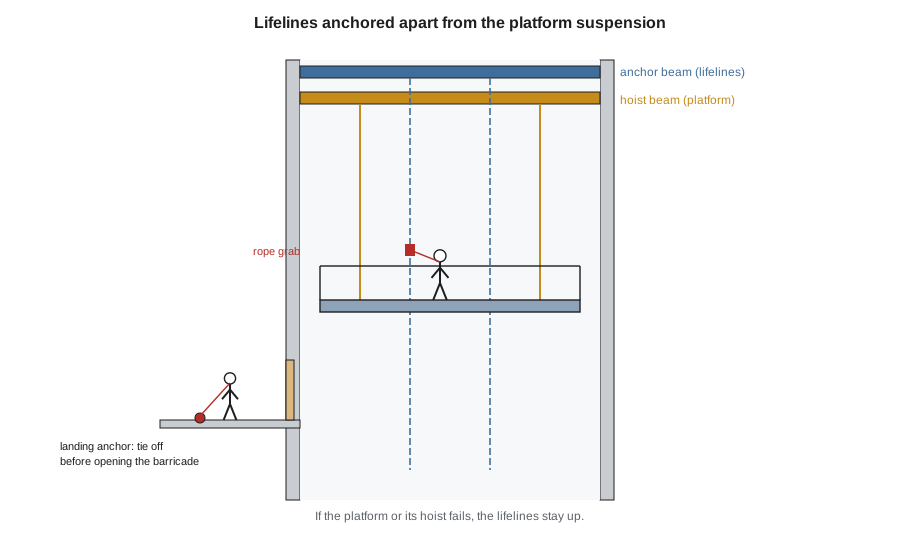
In a hoistway, anchors are usually at the top of the hoistway: a beam across the overhead, a machine beam, or engineered anchors in the walls. Vertical lifelines are hung from them down the hoistway, independent of any platform suspension, so that a platform failure does not take the lifeline with it. Workers on the platform use rope grabs on the lifelines or SRLs anchored above. At the landings, anchors set in the floor slab or the wall beside the entrance let a worker tie off before opening a barricade.
In December 2023, federal OSHA issued an interpretation letter that applies directly to this work. It said that a temporary configuration of an elevator car or platform used to install equipment in a hoistway is a suspended scaffold under OSHA's construction scaffold rules, so the scaffold requirements for fall protection and training apply to it, and that personal fall arrest lifelines must be anchored independently of the platform's suspension. Northcrest applies the same principle on both sides of the border: the lifeline anchor is never on the platform, its hoist or its suspension.
Inspection before use
Every worker inspects their harness, connectors and lanyards before each use, and a competent person inspects them formally at the interval the manufacturer and the plan require, usually at least once a year. The daily check takes two minutes: webbing without cuts, burns, frays or chemical damage; stitching intact; buckles, D-rings and snap hooks without cracks, corrosion or distortion; gates that close and lock on their own; labels legible; the energy absorber pack not opened. An SRL is pulled out and released to check that it locks and retracts. Any equipment that has arrested a fall is removed from service at once.
Fit matters too. A harness that is too loose can let a worker slip out or ride up into the neck during a fall; leg straps that are too loose can injure the groin. Ray checked Tamsin's harness the way he checks his own every morning: dorsal D-ring between the shoulder blades, chest strap at mid-chest, leg straps snug enough to fit a flat hand under them, no twists.
Fall clearance
A fall arrest system only works if the worker stops before hitting anything. The required clearance below the anchor or working surface is the sum of the free fall, the deceleration distance of the energy absorber, the height of the harness D-ring above the worker's feet, the stretch of the harness and connectors, and a safety margin. On a platform in a hoistway, the thing to miss may be the platform below, a landing sill, a rail bracket or a car top.
# Required fall clearance below the walking surface for a lanyard with an energy absorber
lanyard = 1.8            # lanyard length, m
anchor_above_dring = 0.0 # anchor height above the D-ring (negative if below), m
free_fall = max(lanyard - anchor_above_dring, 0)
decel = 1.2              # maximum deceleration distance of the energy absorber, m
d_ring = 1.5              # D-ring height above the feet, m
stretch = 0.3             # harness and connector stretch, m
margin = 0.9              # safety margin, m
total = free_fall + decel + d_ring + stretch + margin
print(f"free fall {free_fall:.1f} + deceleration {decel:.1f} + D-ring {d_ring:.1f} + stretch {stretch:.1f} + margin {margin:.1f}")
print(f"required clearance below the walking surface: {total:.1f} m")
for gap in (3.0, 6.0):
print(f"obstruction {gap} m below the surface: {'OK' if gap >= total else 'NOT enough clearance, use an SRL or a closer anchor'}")free fall 1.8 + deceleration 1.2 + D-ring 1.5 + stretch 0.3 + margin 0.9 required clearance below the walking surface: 5.7 m obstruction 3.0 m below the surface: NOT enough clearance, use an SRL or a closer anchor obstruction 6.0 m below the surface: OK
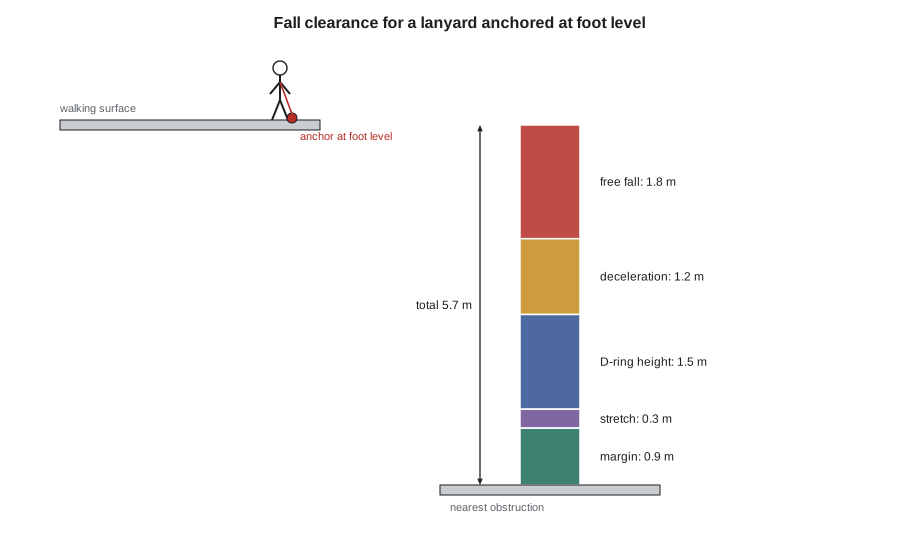
The output shows why a foot-level anchor with a 1.8 m lanyard is a poor choice on a hoistway platform: with only one floor below the platform, the worker would hit the next landing sill or bracket before the arrest finished. Raising the anchor above the D-ring cuts the free fall to zero, and an SRL locks within a short distance, so overhead anchors with SRLs are Northcrest's standard on platforms. The calculation also shows why the manufacturer's numbers matter: deceleration distances differ between products, and the label gives the value to use.
Swing falls are the other clearance problem. A worker who falls while tied to an anchor off to one side swings like a pendulum and can strike the hoistway wall, a rail or the counterweight. Anchors placed directly overhead reduce the swing; at a landing, the anchor beside the entrance is placed so that the worker's lanyard is short and nearly perpendicular to the opening.
Rescue and suspension
Every fall protection plan includes a rescue plan, because a worker hanging in a harness is not safe. Suspension in a harness can cause suspension intolerance, also called orthostatic intolerance: blood pools in the legs, and the worker can lose consciousness in a matter of minutes. The rescue must be prompt, practised and possible with the equipment on site. In a hoistway, the usual rescue is to bring the platform or the car to the worker and lift them onto it, or to lower them to the landing below with a rescue system. Calling the fire department is part of the plan, but not the whole of it, because the fire department may take too long and may not know how to work in a hoistway.
Suspension trauma straps, built into many harnesses, let a suspended worker stand in a loop and relieve the pressure on the legs while waiting. Tamsin's harness has them, and her training included deploying them while hanging. A worker who has been suspended, even briefly, gets medical attention afterwards, and is not laid flat at once, which some first-aid guidance warns against; first-aid attendants follow their current protocol.
| Rescue plan item | Quayside Tower answer |
|---|---|
| Who rescues | The crew on the platform, led by the mechanic in charge; the site first-aid attendant |
| Equipment | Rescue and descent kit at the base of each hoistway; platform controls; radios |
| Method | Bring the platform level with the worker and lift them on; or lower to the landing below |
| Target time | Worker relieved of suspension within minutes |
| Communication | Radio to the superintendent; site emergency number; fire department called at once |
| Practice | Rescue drill at the start of each hoistway and every three months |
Car tops and landings in finished buildings
In finished buildings, the falls happen at the landings and on car tops. A car top can be a large, unguarded steel deck with a gap to the hoistway wall on several sides, and the code requires a guardrail on the car top where the gap is larger than a set distance. Even with a guardrail, the space between the rail and the wall can be wide enough to fall through, and many older cars have no guardrail at all. Northcrest's rule is to tie off on any car top without a full guardrail, to an anchor point on the crosshead or a dedicated car top anchor, using a short lanyard or an SRL rated for the possible fall. On Route 7, the Tillicum Building's two cars have no guardrails, so Ray ties off every time he rides them.
At the landing, the danger is the moment of stepping between the landing and the car top, or the landing and the pit ladder. The step-on and step-off are the parts of the top-of-car procedure in Lesson 8 that Northcrest drills hardest, because the worker is at the edge with the door open and the car top a short step below. A worker who is tied off before opening the door, and stays tied off until the door is closed, is protected throughout.
Common mistakes
MistakeAnchoring a lifeline to the work platform or its hoist.
InsteadAnchor lifelines independently of the platform suspension.
MistakeUsing a foot-level anchor with a long lanyard where there is little clearance.
InsteadCalculate the clearance; use an overhead anchor and an SRL.
MistakeSkipping the daily harness check.
InsteadInspect webbing, stitching, hardware, labels and absorbers before every use.
MistakeRelying on the fire department as the rescue plan.
InsteadHave an on-site rescue plan that can relieve a suspended worker within minutes.
MistakeRiding an unguarded car top untethered for a short move.
InsteadTie off on any car top without a full guardrail, every time.
Summary and key terms
- WorkSafeBC Part 11 requires fall protection at 3 m or where a lesser fall could cause serious injury, with a written plan at 7.5 m or more without guardrails.
- Guardrails and covers come first, then restraint, then arrest, which stops a fall that has already started.
- Hoistway lifelines are anchored independently of any platform suspension.
- Fall clearance is the sum of free fall, deceleration, D-ring height, stretch and a margin.
- Every plan includes a prompt on-site rescue, because suspension in a harness is dangerous within minutes.
- Tie off on car tops without full guardrails and when stepping between landings and car tops.
- Fall restraint
- A system that prevents a worker from reaching a fall edge.
- Fall arrest
- A system that stops a fall after it starts.
- Self-retracting lifeline (SRL)
- A connector that pays out and retracts and locks quickly when a fall starts.
- Energy absorber
- A device in a lanyard that limits the arrest force by tearing open.
- Swing fall
- A pendulum motion after a fall from a point not directly below the anchor.
- Suspension intolerance
- Loss of consciousness from blood pooling while suspended in a harness.
Practice problems
Work each problem on paper first, then reveal the answer to check.
A 1.8 m lanyard is anchored at foot level. Deceleration is 1.2 m, the D-ring is 1.5 m above the feet, stretch is 0.3 m and the margin is 0.9 m. What clearance is needed?
Show answer
5.7 m.
Where must a hoistway lifeline be anchored relative to a platform?
Show answer
Independently of the platform's suspension.
Name three items in a harness pre-use check.
Show answer
Webbing and stitching, hardware and gates, labels and the energy absorber pack, among others.
Why must a fallen worker be rescued quickly?
Show answer
Suspension intolerance can cause loss of consciousness within minutes.
Lesson quiz · 5 questions
Score 60% or more to complete this lesson.
Create a free account to save your progress, take quizzes and earn a certificate.