
ELV-110 · Lesson 2 of 12 · 19 min
Types of elevators, escalators and lifts
On her second day Tamsin rode with Ray around Route 7 before reporting to the tower. In five hours they visited a geared traction elevator with its machine in a penthouse, a hydraulic elevator with its power unit beside the pit, a freight elevator with a vertical bi-parting door and a manual gate, and a platform lift that moves at the speed of a slow walk. Ray's point was simple. Each kind of equipment has its own hazards, and the first question a mechanic asks on arriving at any unit is: what is this, how does it move, and what can move it unexpectedly? This lesson sorts the equipment into families so that Tamsin can answer the first part of that question at a glance.
Two ways to lift a car
Almost every elevator is either a traction elevator or a hydraulic elevator. A traction elevator hangs the car from steel ropes or coated steel belts that pass over a grooved drive sheave and down to a counterweight on the other side. Friction between the ropes and the sheave, called traction, moves the car when the machine turns the sheave. The counterweight balances the weight of the car plus part of the rated load, so the machine only has to lift the difference. A hydraulic elevator pushes the car up with a piston, called a plunger or ram, driven by oil pumped into a cylinder. The car goes down when a valve lets the oil flow back to the tank under the weight of the car. Hydraulic elevators have no counterweight in their common forms.
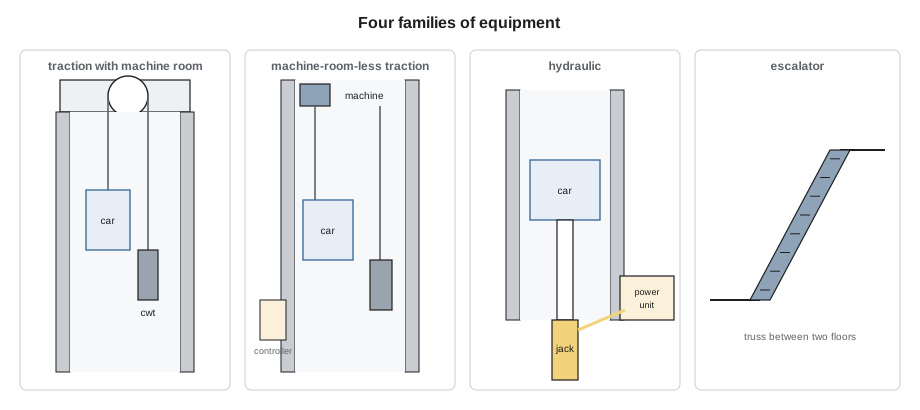
Traction elevators suit taller buildings because rope length is not a practical limit and speeds can be high. Hydraulic elevators suit low-rise buildings, usually up to about five or six stops, because the plunger length and the oil volume grow with the travel and the speed is modest. The trade-offs show up in maintenance and in safety work: a traction elevator has a counterweight that can move when the car moves, while a hydraulic elevator stores energy in pressurized oil and can drift down if a valve or the cylinder leaks.
Traction machines: geared, gearless and machine-room-less
A geared traction machine drives the sheave through a reduction gear, usually a worm and gear, from a smaller, faster motor. Geared machines are common in mid-rise buildings built from the 1920s to the 1990s and still run in thousands of buildings, including the two cars at the Tillicum Building on Route 7. Their speeds are moderate, typically up to about 2.5 m/s (500 ft/min). A gearless machine mounts the sheave directly on a large, slow-turning motor shaft. Gearless machines are used for high-rise and high-speed elevators and are quiet and efficient. Modern gearless machines use permanent-magnet synchronous motors, which are compact enough to fit inside the hoistway.
That compactness gave rise to the machine-room-less (MRL) elevator, now the usual choice for mid-rise buildings. The machine sits at the top of the hoistway on the rails or on a beam, and the controller sits in a cabinet at a landing or in a small control room. Quayside Tower's four passenger cars are MRL units. MRL design moves some of the work that used to happen in a machine room into the hoistway itself: brake work, rope inspections and machine maintenance are done from the car top or from a platform in the hoistway. That changes the safety picture, because the mechanic is now working beside the machine inside the hoistway rather than in a separate room with a lockable door.
Older buildings also contain a few drum machines, which wind the hoist rope onto a drum the way a winch does. Drum machines have no counterweight in the usual sense and are limited in travel. They are rare now but still turn up on old freight elevators and dumbwaiters, and they demand care, because overtravel can pull a car into the overhead.
Hydraulic arrangements
The classic in-ground hydraulic sets the cylinder in a drilled hole below the pit, as deep as the travel, and the plunger pushes directly on the car. The two Holloway Memorial Hospital elevators are of this type. Older in-ground cylinders were often single-bottom steel cylinders buried without protection, and corrosion could lead to oil leaks into the soil or, in rare cases, a sudden loss of pressure. Codes now require protection against corrosion and, for many installations, a safety bulkhead or other means to prevent free fall; replacing old single-bottom cylinders is one of the main reasons for hydraulic modernization.
Holeless hydraulics avoid the drilled hole by placing one or two cylinders in the pit beside the car, either with a single-stage plunger or a telescoping plunger. Their travel is short, often two to four stops. Roped hydraulics combine a holeless cylinder with ropes and a sheave on top of the plunger, so the car travels twice the plunger stroke. Every hydraulic elevator has a power unit with a tank, a pump driven by a motor (usually submerged in the oil), a control valve and a manual lowering valve, and every one has stored energy in the oil whenever the car is above its buffers.
| Type | How it moves | Typical use | Hazard to note |
|---|---|---|---|
| Geared traction | Motor drives a sheave through a gear | Mid-rise buildings, older stock | Counterweight motion; open gears and sheaves in the machine room |
| Gearless traction | Sheave on a slow motor shaft | High-rise, high-speed | High speeds; long falls in tall hoistways |
| Machine-room-less | Compact gearless machine in the hoistway | Mid-rise residential and commercial | Machine and brake work inside the hoistway |
| In-ground hydraulic | Plunger in a cylinder below the pit | Low-rise, hospitals, offices | Stored oil pressure; drift; cylinder leaks |
| Holeless or roped hydraulic | Cylinders in the pit; ropes on roped units | Two to four stops | Stored oil pressure; rope and sheave hazards on roped units |
| Drum machine | Rope wound onto a drum | Old freight and dumbwaiters | Overtravel into the overhead |
By use: passenger, freight, service and special purpose
Elevators are also sorted by what they carry. Passenger elevators carry people and are sized by rated load and platform area; the code limits the platform area for a given rated load so that the car cannot be overloaded by a crowd. Freight elevators carry goods and people who handle the goods, and the code assigns them a loading class, depending on whether freight is loaded by hand, by forklift or by motor vehicle, which sets the strength of the car and platform. The Delmont Hotel's freight elevator, with its bi-parting hoistway door and its manual car gate, is a classic example. Service elevators carry staff, carts and material in hotels, hospitals and offices. Hospital or bed elevators have deep cars sized for a stretcher or bed and attendants, and many have special operation such as hospital emergency service, which lets staff take a car out of normal service and run it directly to a floor.
Some equipment carries people under limited conditions and has its own section of the code. Limited-use/limited-application elevators (LULA) are small, slow elevators for low-rise public buildings such as churches and small schools. Residential elevators serve a single private dwelling. Vertical and inclined platform lifts and stairway chairlifts give access to people using wheelchairs and mobility aids, and they move slowly, often under constant-pressure operation in which the user must hold a button for the lift to move. The branch library's lift on Route 7 is a vertical platform lift with an enclosed runway. Dumbwaiters carry small goods only, and nobody rides them. Material lifts carry goods in industrial settings.
Construction elevators and hoists are another family. Many tower projects use a rack and pinion hoist on the outside of the building early in construction, and later use one of the permanent elevators as a temporary construction elevator. At Quayside Tower, the service car will be turned over to the general contractor as a construction elevator once it passes its temporary acceptance inspection, and Northcrest will maintain it until the building is finished.
Escalators and moving walks
An escalator is a moving stairway: a continuous loop of steps, linked by step chains, running on tracks inside a steel truss that spans between two floors. A drive machine at the upper end turns the step chain sprockets and the handrail drive. The steps flatten at the landings and pass under comb plates whose teeth mesh with grooves in the step treads. Moving walks work the same way, with pallets or a belt instead of steps, and run flat or at a gentle incline. Brackenridge Centre's bank of eight escalators has two pairs on each of the main flights plus two between the parking level and the lower mall.
Escalators and moving walks are where the public is closest to running machinery, and the code puts much effort into the gaps between steps and skirts, the comb plates, the handrail entry points and the safety switches that stop the unit when something goes wrong. For a mechanic, they bring their own hazards: entanglement in step chains and sprockets, steps removed from the band, and machinery spaces inside the truss at both ends that are confined, cramped and often wet with oil. Lesson 9 covers escalator work in detail.
Rise, speed and travel time
Rise is the vertical distance an elevator travels from the lowest landing to the highest. Rated speed is the speed the car is designed to run at, but a car never reaches it on a short trip, because it must accelerate and slow down at comfortable rates. Ray uses travel time to explain why tall buildings need fast cars, and why every mechanic should respect the speed of a car even on inspection operation.
# Travel time for a full-rise run: accelerate, cruise, slow down (comfort limits)
rise = 87            # m, lowest to highest landing
v = 2.5                  # rated speed, m per second
a = 1.0                  # acceleration and deceleration, m per second squared
t_acc = v / a
d_acc = 0.5 * a * t_acc**2       # distance used to reach full speed
if 2 * d_acc >= rise:            # short run: never reaches rated speed
    t = 2 * (rise / a) ** 0.5
else:
    t = 2 * t_acc + (rise - 2 * d_acc) / v
print(f"time to reach rated speed: {t_acc:.1f} s over {d_acc:.1f} m")
print(f"full-rise travel time: {t:.0f} s")
for vv in [0.5, 1.0, 1.75, 3.5]:
    ta = vv / a; da = 0.5 * a * ta**2
    tt = 2 * (rise / a) ** 0.5 if 2 * da >= rise else 2 * ta + (rise - 2 * da) / vv
print(f" at {vv:g} m/s: {tt:.0f} s")time to reach rated speed: 2.5 s over 3.1 m full-rise travel time: 37 s at 0.5 m/s: 174 s at 1 m/s: 88 s at 1.75 m/s: 51 s at 3.5 m/s: 28 s
For Quayside Tower, the full rise at rated speed takes under a minute. The same run at hydraulic speeds would take several minutes, which is why tall buildings use traction. The output also hints at a safety point that matters in later lessons: a car running at rated speed covers several metres a second, which is far faster than anyone can react. The speeds used when people are on the car top or in the pit are much lower, and the controls that allow them are covered in Lessons 8 and 9.
| Equipment | Typical rise | Typical rated speed |
|---|---|---|
| Hydraulic, in-ground | Up to about 18 m (60 ft) | About 0.5 to 1.0 m/s (100 to 200 ft/min) |
| Holeless hydraulic | Up to about 4 to 12 m (13 to 40 ft) | About 0.5 m/s (100 ft/min) |
| Geared traction | Mid-rise | Up to about 2.5 m/s (500 ft/min) |
| Gearless traction | High-rise | About 2.5 to 10 m/s (500 to 2,000 ft/min) and above |
| Escalator | One floor per unit | About 0.5 m/s (100 ft/min) along the incline |
| Platform lift | One or two floors | Very slow, often under 0.15 m/s (30 ft/min) |
Identifying a unit on arrival
Ray's arrival routine on Route 7 is the same at every building. He reads the unit's identifying number at the controller and checks it against the work order, because a large building may have several similar cars and working on the wrong one is a classic error. He reads the data plate on the controller or in the machine room: rated load, rated speed, the type of drive and the year. He looks at the logbook kept on site for recent work, and he asks the building contact whether anyone has reported a problem. Only then does he decide how the unit will be controlled while he works on it.
Tamsin made a pocket card of the questions: What family is it, traction or hydraulic? Where is the machine and where is the controller? Is there a counterweight, and where does it run? What stored energy is there: gravity, oil pressure, springs, capacitors? How many people use it and who needs to know it will be out of service? Her answers on Route 7 filled half a notebook page per unit.
Common mistakes
MistakeAssuming every elevator has a counterweight.
InsteadCommon hydraulic elevators do not; traction elevators do, and the counterweight moves in the opposite direction to the car.
MistakeAssuming a parked hydraulic car cannot move.
InsteadOil pressure holds it up; a leaking valve or cylinder can let it drift down.
MistakeTreating an MRL unit like one with a machine room.
InsteadOn an MRL unit the machine and brake are in the hoistway, so machine work happens in a space where the car and counterweight can move.
MistakeWorking on a unit identified only by its location.
InsteadCheck the unit number at the controller against the work order before starting.
MistakeThinking escalators are low-risk because they are slow.
InsteadStep chains, sprockets, comb plates and removed steps are serious entanglement and fall hazards.
Summary and key terms
- Traction elevators hang the car from ropes or belts over a drive sheave with a counterweight; hydraulic elevators push the car up with oil pressure.
- Geared, gearless and machine-room-less traction machines differ in where the machine sits and how fast it runs.
- In-ground, holeless and roped hydraulic arrangements all store energy in pressurized oil.
- Passenger, freight, service, hospital, LULA, residential, platform lifts, dumbwaiters and construction elevators each have their own code requirements.
- Escalators and moving walks bring the public close to running machinery and bring the mechanic entanglement hazards.
- Identify the unit, its drive, its stored energy and its users before starting any work.
- Traction
- Friction between the hoist ropes and the grooves of the drive sheave that moves the car.
- Counterweight
- A weight that balances the car and part of its load, running in the hoistway opposite the car.
- Machine-room-less (MRL)
- A traction elevator with its machine in the hoistway rather than in a separate machine room.
- Plunger
- The piston of a hydraulic elevator jack, also called the ram.
- Rise
- The vertical distance from the lowest landing to the highest.
- Comb plate
- The toothed plate at an escalator landing that meshes with the grooves in the steps.
Practice problems
Work each problem on paper first, then reveal the answer to check.
Which drive type uses a plunger and pressurized oil?
Show answer
Hydraulic.
Where is the machine on an MRL elevator?
Show answer
At the top of the hoistway, inside the hoistway.
Why do tall buildings use traction rather than hydraulic elevators?
Show answer
Traction allows long travel and high speeds; hydraulic plungers and oil volumes become impractical.
What does a mechanic check first on arriving at a unit?
Show answer
That the unit number matches the work order, then its type, drive and stored energy.
Lesson quiz · 5 questions
Score 60% or more to complete this lesson.
Create a free account to save your progress, take quizzes and earn a certificate.