
ELEC-220 · Lesson 7 of 12 · 33 min
Special occupancies and equipment
The general rules of the code apply to every installation, but certain occupancies and types of equipment carry special risks or needs and have their own rules that modify or add to the general ones. Health care facilities protect patients who may be unconscious, connected to equipment and especially vulnerable to electric shock; swimming pools combine water, metal and bare skin; electric vehicle chargers, solar systems and battery storage add new sources and large continuous loads; fire pumps must keep running even at the cost of their own destruction; and IT rooms have their own rules for disconnects and cabling. This lesson surveys these special cases and the calculations electricians most often perform for them.
Relevant CEC sections include Section 24 (patient care areas, with CSA Z32), Section 68 (pools, tubs and spas), Section 86 (electric vehicle charging systems), Section 64 (renewable energy systems and energy storage), Section 32 (fire alarm systems and fire pumps), Section 38 (elevators) and Section 22 (locations where corrosive liquids, vapours or excessive moisture are likely).
Health care facilities
Patients in hospitals may be connected to monitors, catheters and other devices that bypass the skin's natural resistance, so currents too small to be felt can be dangerous. Health care rules reduce shock risk, ensure reliable grounding and keep power available for life-sustaining equipment:
- CSA Z32 (Electrical safety and essential electrical systems in health care facilities), referenced by Section 24, classifies patient care areas as basic, intermediate or critical care, with increasing requirements for receptacles, grounding, bonding and isolation.
- Redundant grounding: branch circuits serving patient care areas need two grounding paths, typically an insulated copper equipment grounding conductor plus a metallic wiring method (armoured or metal-clad cable or metal raceway) qualified as a grounding path.
- Hospital-grade receptacles and specified numbers of receptacles at each bed location, with some on emergency power.
- Isolated power systems in wet procedure locations or anaesthetizing locations where required: an isolation transformer supplies ungrounded circuits, so a single fault to ground does not cause a shock or trip the circuit, and a line isolation monitor alarms when the potential fault current reaches about 5 mA.
- Essential electrical systems supplied by generators (Lesson 9) are divided into branches such as vital, delayed vital and conditional, under CSA Z32 and CSA C282.
Worked problem
Why microamperes matter
A cardiac catheter provides a low-resistance path directly to the heart, with about 500 Ω total body resistance from a hand to the catheter. A faulty device frame is at 0.1 V above the catheter's reference because of leakage current on a poor ground. What current flows if a nurse touches the frame and the catheter connection at the same time?
Show solution
- \(I = V/R = 0.1/500 = 0.0002\) A \(= 200\ \mu\)A.
Answer: 200 microamperes, imperceptible through the skin but above the roughly 10 to 50 µA considered hazardous for current applied directly to the heart (microshock). This is why patient care grounding limits voltage differences between grounded surfaces to millivolts and why redundant equipment grounding is required.
Pools, spas and fountains
Water, wet skin and metal create high shock risk: a person in a pool is surrounded by conductive water, and small voltage gradients can cause paralysis and drowning. The rules include:
- Equipotential bonding: all metal parts of the pool structure, reinforcing steel, ladders, handrails, pump motors, metal fittings and the deck within a specified distance are bonded together with a solid copper conductor (typically 8 AWG, or 6 AWG in Canada) so that no voltage difference can exist between surfaces a swimmer can touch.
- Ground fault protection (GFCI or GFP) for underwater luminaires, pump motors and receptacles near the pool.
- Clearances: receptacles, overhead conductors and switching devices must be kept specified distances from the water's edge.
- Low-voltage underwater lighting through listed or certified transformers.
Section 68 contains these requirements, including bonding of conductive parts in and around the pool with copper conductors not smaller than 6 AWG, minimum distances between receptacles and the pool edge with GFCI protection for receptacles near the pool, and GFCI protection for underwater luminaires operating above low voltage. Check the exact distances in the Code edition in force.
Electric vehicle charging
EV chargers are large continuous loads: a Level 2 charger draws 32 to 80 A at 208 to 240 V for hours, and DC fast chargers draw tens to hundreds of kilowatts. Branch circuits and feeders must be sized at 125% of the charger's rating, and many chargers in a parking facility can quickly exceed the building's service capacity, so electric vehicle energy management systems (load management) that limit total charging current are permitted to reduce the calculated load.
Section 86 covers EV charging systems, which are treated as continuous loads, and Rule 8-106 permits the calculated load of EV charging equipment to be limited by an electric vehicle energy management system that monitors and controls the load. GFCI protection is required for many EV receptacles.
Worked problem
Charging in a parking garage
A condominium garage will have 40 Level 2 chargers, each drawing 32 A at 208 V single-phase. What is the calculated load without load management, and what if an energy management system limits total charging to 200 A on a 208 V three-phase feeder?
Show solution
- Each charger: \(32 \times 208 = 6.66\) kW; 40 chargers \(= 266\) kW.
- Spread over three phases: \(266{,}000/(\sqrt3 \times 208) = 739\) A; at 125%: 924 A.
- With load management at 200 A: \(200 \times 1.25 = 250\) A feeder capacity.
Answer: Without load management the chargers would need a feeder of more than 900 A, likely exceeding the building's service; with an energy management system limiting total current to 200 A, a 250 A feeder suffices. Each vehicle charges more slowly when many are connected, but overnight charging usually leaves ample time.
Solar photovoltaic systems and energy storage
PV systems produce DC power from modules connected in series strings, converted to AC by inverters. Their rules differ from ordinary circuits because PV sources are current-limited (short-circuit current only slightly above operating current), their voltage rises in cold weather, and they cannot be turned off while the sun shines.
- Circuit current: PV source circuit current is the modules' short-circuit current multiplied by 1.25 (to allow for irradiance above standard test conditions), and conductors and overcurrent devices are then sized at a further 125% for continuous operation, giving 156% of short-circuit current.
- Maximum voltage: the string's open-circuit voltage increases as temperature falls, so it is corrected for the lowest expected ambient temperature and must stay within equipment ratings (1000 V or 1500 V DC typically).
- Rapid shutdown: on buildings, PV conductors must be reduced to safe voltages within a short time of shutdown to protect firefighters.
- Interconnection: where inverters connect to the load side of a service, the sum of the PV breaker and the main breaker is limited (the 120% rule) so that busbars are not overloaded.
Section 64 covers PV and other renewable systems, energy storage and interconnection, with Rule 64-112 on the connection of inverters to busbars and conductors and related rules on circuit sizing, voltage and rapid shutdown.
Worked problem
PV string calculations
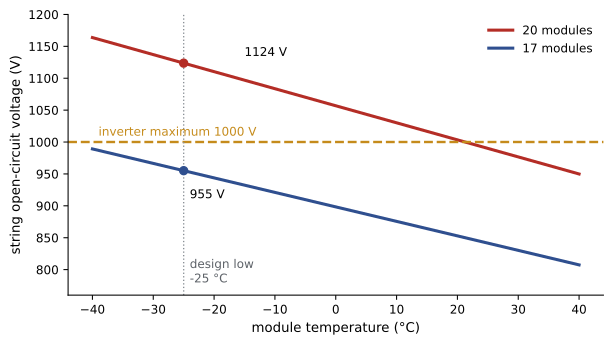
A string has 20 modules, each with short-circuit current 13.8 A and open-circuit voltage 49.5 V at 25 °C, with a voltage temperature coefficient of −0.27% per °C. The lowest expected temperature is −25 °C. Find the circuit current, the conductor sizing current and the maximum string voltage.
Show solution
- Circuit current: \(1.25 \times 13.8 = 17.25\) A. Sizing current: \(1.25 \times 17.25 = 21.6\) A.
- Temperature difference: \(-25 - 25 = -50\) °C; voltage increase \(= 0.27\% \times 50 = 13.5\%\).
- Maximum voltage: \(20 \times 49.5 \times 1.135 = 1124\) V.
Answer: Conductors and fuses sized for at least 21.6 A, and a maximum voltage of 1124 V, which exceeds a 1000 V inverter rating; the string must be shortened to 17 modules (955 V) or a 1500 V system used. Cold, sunny mornings produce the highest voltages.
Worked problem
The 120% busbar rule
A 200 A panel with a 200 A main breaker is to receive a backfed PV breaker at the opposite end of the busbar from the main. What is the largest PV breaker permitted under the 120% rule, and how much inverter output current does that allow?
Show solution
- Limit: \(1.2 \times 200 = 240\) A total; PV breaker \(\le 240 - 200 = 40\) A.
- Inverter output current \(\le 40/1.25 = 32\) A.
Answer: A 40 A breaker, allowing an inverter with up to 32 A output (about 7.7 kW at 240 V). Larger systems need a supply-side connection, a downsized main breaker, a larger busbar or a power control system that limits current.
Battery energy storage systems add hazards of high fault current, DC arcs and thermal runaway (DCE-340). Their rules cover disconnects, overcurrent protection, location, ventilation, signage and coordination with fire codes, which limit the energy capacity in a room and require separation and suppression.
Fire pumps
A fire pump must run when a fire threatens the building, even if it overheats or overloads, because the building matters more than the pump. The rules therefore reverse the usual priority of protecting equipment:
- Reliable supply: from a dedicated service, an on-site generator or a tap ahead of the main disconnect, with conductors routed or protected so a fire cannot easily destroy them.
- No overload protection that could stop the pump; overcurrent devices are sized to carry the motor's locked-rotor current indefinitely, so they open only for short circuits.
- Voltage drop limits so the motor can start and run: typically no more than 15% at the controller terminals while starting and 5% while running at 115% of full-load current.
Section 32 and NFPA 20 (as referenced through the building code) govern fire pump installations in Canada, with Rule 32-200 and related rules on supply, wiring, overcurrent protection and the fire pump controller.
Worked problem
Fire pump overcurrent device
A 100 hp fire pump motor has a locked-rotor current of 725 A at 460 V (a 575 V motor of the same size about 580 A), and a 5 A jockey pump. What overcurrent device rating is needed?
Show solution
- 460 V: \(725 + 5 = 730\) A; next standard size up: 800 A.
- 575 V: \(580 + 5 = 585\) A; next standard size up: 600 A.
Answer: An 800 A device at 460 V (600 A at 575 V), several times the motor's full-load current, so that it opens only for a short circuit. Conductors are sized for 125% of the full-load current, but are protected only against short circuit, which is accepted for this life-safety load.
Information technology rooms
IT equipment rooms contain dense cabling and equipment with large stored energy. Where an IT room meets specified conditions (separated by fire-rated construction, with a dedicated HVAC system and a disconnecting means at the exit), special rules permit cables under raised floors and require a disconnecting means that removes power from all electronic equipment and shuts down the room's HVAC, so that firefighters can make the room safe. Large data centres usually do not use these optional rules and instead follow the general wiring rules with fire-rated construction and the owner's standards (DCE-310, DCE-440).
The CEC does not have a separate article for IT rooms; the general rules of the Code, building code fire separations, and manufacturer requirements apply, with Section 12 governing wiring methods under raised floors and plenums.
Lesson 9 covers the emergency and standby power systems that many of these occupancies require, and Lesson 10 their fire alarm systems.
Common mistakes
MistakeUsing a single grounding path for patient care circuits.
InsteadProvide redundant grounding: insulated conductor plus qualified metal wiring method.
MistakeOmitting bonding of pool deck, reinforcing steel or metal fittings.
InsteadBond all specified conductive parts to create an equipotential grid.
MistakeSizing EV chargers or PV circuits at 100% of rated current.
InsteadApply the 125% continuous factors (and the 1.25 irradiance factor for PV).
MistakeIgnoring cold-weather voltage rise in PV strings.
InsteadCorrect open-circuit voltage for the lowest expected temperature.
MistakeProviding overload protection for fire pumps.
InsteadFire pump circuits are protected only against short circuit, sized for locked-rotor current.
Summary and key terms
- Section 24 and CSA Z32 protect patients with redundant grounding, isolation and essential power.
- Microshock currents of tens of microamperes can be dangerous to patients with cardiac connections.
- Pools need equipotential bonding, GFCI protection and clearances.
- EV chargers are continuous loads at 125%; energy management can reduce calculated loads.
- PV circuits use 1.25 × Isc × 1.25 and cold-temperature voltage correction; the 120% rule limits backfed busbars.
- Fire pumps must run to destruction: overcurrent devices carry locked-rotor current indefinitely.
- Section 32 and NFPA 20 govern fire pumps; Section 64 covers PV and storage.
- IT room rules provide remote disconnects and cabling allowances under specified conditions.
- Patient care area
- A space where patients are examined or treated.
- Microshock
- Small current applied directly to the heart through a medical conductor.
- Isolated power system
- An ungrounded system supplied by an isolation transformer with a line isolation monitor.
- Line isolation monitor
- A device alarming when potential fault current in an isolated system exceeds a limit.
- Equipotential bonding
- Connecting conductive parts so they are at the same potential.
- Energy management system
- Controls that limit the total load of equipment such as EV chargers.
- Rapid shutdown
- Reducing PV conductor voltage on buildings quickly when shut down.
- 120% rule
- Limit on the sum of supply breakers backfeeding a busbar.
- Locked-rotor current
- The current a motor draws at standstill with rated voltage.
- Jockey pump
- A small pump maintaining fire system pressure.
Practice problems
Work each problem on paper first, then reveal the answer to check.
Why do patient care areas need redundant grounding?
Show answer
To keep voltage differences between grounded surfaces tiny even if one path fails, protecting against microshock.
50 mV across 1000 Ω through a catheter path. Current?
Show answer
50 µA.
What does a line isolation monitor do?
Show answer
It alarms when the potential fault current of an isolated system reaches about 5 mA.
Why is equipotential bonding essential at pools?
Show answer
It prevents voltage gradients between surfaces a swimmer touches.
A 48 A EV charger. Minimum branch circuit rating?
Show answer
60 A (125%).
Ten 7.2 kW chargers at 240 V single-phase without load management. Calculated current at 125%?
Show answer
72,000/240 = 300 A; × 1.25 = 375 A.
PV module Isc = 11 A. Conductor sizing current?
Show answer
11 × 1.25 × 1.25 = 17.2 A.
Voc 40 V, coefficient −0.3%/°C, low temperature −30 °C, 24 modules. Maximum voltage?
Show answer
24 × 40 × 1.165 = 1118 V.
225 A busbar with a 200 A main. Maximum backfed PV breaker under the 120% rule?
Show answer
270 − 200 = 70 A.
Why are fire pumps not given overload protection?
Show answer
The pump must keep running during a fire even if damaged.
Lesson quiz · 5 questions
Score 60% or more to complete this lesson.
Create a free account to save your progress, take quizzes and earn a certificate.