
ECON-102 · Lesson 8 of 12 · 26 min
The Bank of Canada and monetary policy
The Bank of Canada is the country's central bank. It issues bank notes, oversees the payment system, acts as banker to the federal government and to the financial system, and conducts monetary policy. Of these jobs, monetary policy, the management of short-term interest rates to keep inflation low and stable, is the one that most directly affects households and businesses. When the Bank raised its policy rate from 0.25 % to 5 % in 2022–2023, mortgage payments rose for millions of Canadians; when it cut the rate to 2.25 % by October 2025, borrowing costs fell. This lesson explains what the Bank of Canada is trying to achieve, the tools it uses, how its decisions spread through the economy, and the debates about how it should act.
Structure and independence
The Bank of Canada was created in 1934 and became a Crown corporation owned by the federal government in 1938. Monetary policy decisions are made by the Governing Council, consisting of the governor (Tiff Macklem since 2020), the senior deputy governor, the deputy governors, including external deputy governors appointed from outside the Bank. The Bank announces its policy rate on eight scheduled dates a year, four of them accompanied by a Monetary Policy Report with detailed forecasts, and since 2023 it publishes a summary of the Governing Council's deliberations two weeks after each decision. Under the Bank of Canada Act, the minister of finance can issue a written directive to the Bank in the event of a profound disagreement, but this power has never been used, and in practice the Bank operates independently in setting interest rates.
Why make central banks independent? The main argument is credibility. Politicians facing elections may be tempted to stimulate the economy before a vote, accepting higher inflation later. If people expect this, they build higher inflation into wages and prices, and the economy ends up with higher inflation and no lasting gain in employment. Delegating monetary policy to an independent institution with a clear mandate makes low-inflation promises more believable. Cross-country evidence from the 1980s and 1990s found that countries with more independent central banks had lower average inflation without lower growth. Critics respond that independence gives significant power to unelected officials, which is why it comes with clear mandates, transparency and accountability to legislatures.
The mandate
Since 1991 the Bank of Canada has conducted monetary policy by targeting inflation, a framework it pioneered with New Zealand. Every five years the Bank and the federal government renew an agreement that sets the target. Since 1995 the target has been 2 % total CPI inflation, the midpoint of a 1 to 3 % control range. The 2021 renewal kept the 2 % target and added that the Bank would continue to use the flexibility of the range to seek the maximum sustainable level of employment, when consistent with price stability. The agreement is due for renewal by the end of 2026. In June 2026 the Bank published the results of public consultations, which found strong support for flexible inflation targeting and the 2 % target; at the time of writing (October 2026), the outcome of the renewal had not yet been announced.
Inflation targeting is flexible in practice. Central banks do not try to hit the target every month, which would require large swings in interest rates and output. They aim to bring inflation back to target over a horizon of roughly one to two years, while paying attention to employment, output and financial stability. Clear communication of the target helps anchor inflation expectations: if people believe inflation will average 2 %, they set wages and prices accordingly, which makes the target easier to hit.
The policy interest rate and how it is implemented
The Bank of Canada's main tool is its target for the overnight rate, the interest rate at which major financial institutions borrow and lend one-day funds among themselves. The Bank keeps the actual overnight rate close to the target by operating a band of 50 basis points: it pays the target rate on settlement balances that institutions hold at the Bank (the deposit rate) and lends at the top of the band (the bank rate). Since the Bank supplies ample settlement balances, the overnight rate stays near the target. Changes in the target quickly pass through to the prime rates of commercial banks and to variable-rate mortgages and lines of credit.
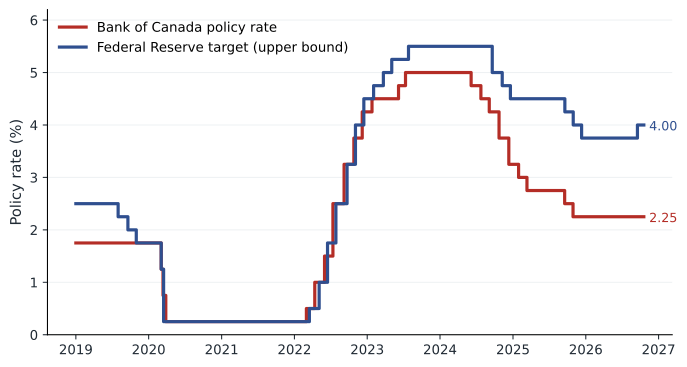
Central banks change their policy rates in steps, usually of 25 basis points (a quarter of a percentage point), occasionally 50 or more when conditions change quickly. The chart shows how closely the two central banks moved after 2020, and how their paths diverged in 2025–2026: the Bank of Canada cut further, because the Canadian economy was weaker and more exposed to US tariffs, while the Fed stopped cutting earlier and raised rates in 2026 when inflation rose.
Other tools: balance sheets and guidance
When the policy rate reaches its effective lower bound, near zero, central banks cannot cut it further in a meaningful way. In 2020 both central banks turned to other tools. Quantitative easing (QE) means buying large quantities of government bonds and, in the Fed's case, mortgage-backed securities, paid for by creating reserves. QE lowers longer-term interest rates by reducing the supply of bonds available to investors and by signalling that the policy rate will stay low. Forward guidance means communicating the likely future path of the policy rate; promising to keep rates low for an extended period lowers longer-term rates today. When inflation rose, the central banks reversed course with quantitative tightening (QT), letting bonds mature without replacing them, which shrinks the balance sheet.
The Bank of Canada bought large amounts of Government of Canada bonds in 2020–2021, its first use of QE. It began QT in April 2022 and ended it in early 2025, when it resumed normal purchases of short-term securities to meet the growing demand for bank notes and settlement balances.
How monetary policy works: the transmission mechanism
A change in the policy rate affects the economy through several channels. Through the interest rate channel, higher short-term rates raise the rates on mortgages, car loans, business loans and, via expectations, longer-term bonds, which discourages borrowing for houses, durable goods and investment. Through the wealth channel, higher rates tend to lower the prices of stocks, bonds and houses, making households feel less wealthy and spend less. Through the exchange rate channel, higher rates attract foreign capital, raising the value of the currency, which makes exports more expensive and imports cheaper. Through the credit channel, higher rates weaken borrowers' balance sheets and make banks more cautious. And through the expectations channel, credible policy actions shape expected inflation, which feeds into wages and prices.
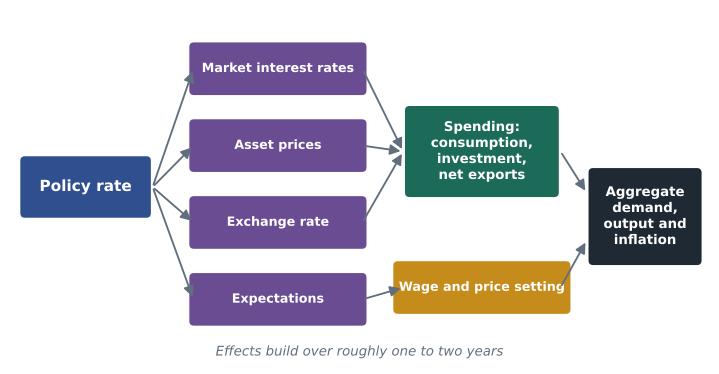
These effects take time. Most estimates suggest that a change in the policy rate has its largest effect on output after about a year and on inflation after one to two years. The lags are long and variable, which means central banks must act on forecasts rather than current data, and must accept uncertainty about the effects of their decisions.
The exchange rate channel is especially important in Canada, where trade equals about two thirds of GDP. The housing channel is also strong, because Canadian mortgages are typically renewed every five years or less, so higher rates reach a large share of borrowers within a few years, unlike the 30-year fixed-rate mortgages common in the United States. The wave of mortgage renewals at higher rates in 2024–2026 was a significant drag on consumer spending.
The Taylor rule
How should a central bank choose its policy rate? A widely used guide is the Taylor rule, proposed by John Taylor in 1993. It sets the nominal policy rate equal to the neutral real rate plus current inflation, plus half the gap between inflation and the target, plus half the output gap. The rule captures a key principle: when inflation rises, the nominal rate should rise by more than one for one, so that the real interest rate rises and restrains demand. Central banks do not follow any rule mechanically, but they consult rules like this as benchmarks.
Worked problem
Applying the Taylor rule (illustrative)
Suppose the neutral real rate is 0.75 %, core inflation is 2.2 %, the target is 2 % and the output gap is −1.0 %. What policy rate does the Taylor rule suggest? How does the answer change if you use headline inflation of 3.1 %?
Show solution
- With core inflation: i = 0.75 + 2.2 + 0.5 × 0.2 + 0.5 × (−1.0) = 0.75 + 2.2 + 0.1 − 0.5 = 2.55 %.
- With headline inflation: i = 0.75 + 3.1 + 0.5 × 1.1 − 0.5 = 3.90 %.
Answer: Using core inflation, the rule suggests about 2.5 %, close to the actual 2.25 % in autumn 2026; using headline inflation inflated by the oil shock, it suggests nearly 4 %. The choice of inflation measure, and of the neutral rate and output gap, which are unobservable, can change the answer substantially.
# Taylor-rule policy rates under different assumptions
def taylor(r_star, infl, target, gap, a=0.5, b=0.5):
    return r_star + infl + a * (infl - target) + b * gap

cases = [
    ("core inflation, small negative gap", 0.75, 2.2, 2.0, -1.0),
    ("headline inflation after oil shock", 0.75, 3.1, 2.0, -1.0),
    ("higher neutral rate", 1.50, 2.2, 2.0, -1.0),
    ("inflation 3.5 %, positive gap", 1.00, 3.5, 2.0, 0.5),
]
for label, r, pi, tgt, gap in cases:
print(f"{label:36s} -> policy rate {taylor(r, pi, tgt, gap):.2f} %")core inflation, small negative gap -> policy rate 2.55 % headline inflation after oil shock -> policy rate 3.90 % higher neutral rate -> policy rate 3.30 % inflation 3.5 %, positive gap -> policy rate 5.50 %
Monetary policy in practice: 2020 to 2026
The past few years illustrate how hard monetary policy can be. In March 2020 both central banks cut rates to near zero and launched QE to cushion the pandemic shock. As the economy recovered in 2021, inflation rose; both central banks initially judged the rise to be transitory, caused by supply disruptions that would fade. By early 2022 it was clear that inflation was broader and more persistent, and both began raising rates rapidly. Critics argue they waited too long, allowing expectations to drift up; defenders note that the supply shocks were unprecedented and that the subsequent disinflation occurred without a recession. Both central banks have since published reviews of what they learned, including the need to consider supply shocks and risk scenarios more seriously.
After holding at 5 % from July 2023, the Bank of Canada began cutting in June 2024, reducing the rate to 2.25 % by October 2025 as inflation returned to target and the economy weakened under US tariffs. It held at 2.25 % throughout 2026. When the 2026 oil shock pushed headline inflation above 3 %, the Bank emphasized that its core measures remained close to 2 % and that a weak labour market, with unemployment of 6.5 % in September 2026, limited the risk that higher energy prices would spill into broader inflation. Some economists urged it to stay alert to rising inflation expectations; others argued for further cuts to support employment.
A central lesson of this period is that central banks must distinguish between shocks they should look through and shocks that threaten to unanchor expectations. A one-time rise in oil prices raises the price level but need not cause persistent inflation if expectations stay anchored; responding aggressively could cause an unnecessary recession. But after a long period of above-target inflation, people may begin to expect more of it, and the central bank may need to act to protect its credibility. Lesson 9 analyses supply shocks with the aggregate demand and aggregate supply model, and lesson 12 returns to the debate.
Common mistakes
MistakeThe central bank sets mortgage rates directly.
InsteadIt sets a short-term policy rate; mortgage and bond rates respond through markets and expectations.
MistakeMonetary policy works within weeks.
InsteadEffects on output peak after about a year and on inflation after one to two years.
MistakeRaising rates one for one with inflation is enough.
InsteadThe Taylor principle says nominal rates should rise more than inflation so real rates rise.
MistakeIndependence means the central bank answers to no one.
InsteadIt operates under a legal mandate with transparency and accountability to parliament or Congress.
MistakeQE is the same as printing money to pay for government spending.
InsteadQE buys existing bonds from markets to lower long-term rates and can be reversed through QT; it is not direct financing of deficits.
Summary and key terms
- The Bank of Canada targets 2 % CPI inflation within a 1–3 % range under an agreement renewed every five years; the 2026 renewal was under way in autumn 2026.
- Central bank independence improves the credibility of low-inflation commitments, balanced by mandates and accountability.
- The main tool is a short-term policy interest rate, implemented with administered rates on reserves.
- At the lower bound, central banks use quantitative easing and forward guidance; quantitative tightening reverses QE.
- Policy works through interest rates, asset prices, the exchange rate, credit and expectations, with long and variable lags.
- The Taylor rule is a benchmark: nominal rates should rise more than inflation, adjusted for the output gap.
- Central banks must decide whether to look through supply shocks or act to keep expectations anchored.
- Central bank
- The institution that manages a country's currency, money and monetary policy.
- Inflation targeting
- A framework in which the central bank commits to a numerical inflation target.
- Policy interest rate
- The Bank of Canada's target for the overnight rate.
- Effective lower bound
- The level near zero below which the policy rate cannot usefully be cut.
- Quantitative easing (QE)
- Large-scale central bank purchases of bonds to lower long-term interest rates.
- Quantitative tightening (QT)
- Shrinking the central bank balance sheet by not replacing maturing bonds.
- Forward guidance
- Communication about the likely future path of policy rates.
- Transmission mechanism
- The channels through which monetary policy affects spending and inflation.
- Taylor rule
- A formula linking the policy rate to inflation and the output gap.
- Anchored expectations
- Inflation expectations that stay close to the target despite shocks.
Practice problems
Work each problem on paper first, then reveal the answer to check.
Why are central banks made independent?
Show answer
To make low-inflation commitments credible and avoid political pressure for short-term stimulus.
What is the Bank of Canada's inflation target?
Show answer
2 % CPI inflation, the midpoint of a 1–3 % range.
Name four channels of monetary transmission.
Show answer
Interest rates, asset prices, exchange rate, credit, expectations.
Neutral real rate 1 %, inflation 4 %, target 2 %, gap 0. Taylor rule rate?
Show answer
1 + 4 + 1 + 0 = 6 %.
Why must central banks act on forecasts?
Show answer
Policy affects inflation with lags of one to two years.
What is QE meant to achieve?
Show answer
Lower longer-term interest rates when the policy rate is at its lower bound.
Why might a central bank look through an oil price shock?
Show answer
It raises the price level once; if expectations stay anchored, inflation returns to target without tightening.
Why might it not look through?
Show answer
After prolonged high inflation, expectations may rise and credibility may require action.
How do mortgage terms affect transmission?
Show answer
Short renewal periods pass rate changes to borrowers faster; long fixed rates delay the effect.
Portfolio task: read the latest policy rate announcement and summarize the reasons given for the decision in three sentences.
Show answer
Answers vary; should identify the inflation and growth assessment.
Lesson quiz · 5 questions
Score 60% or more to complete this lesson.
Create a free account to save your progress, take quizzes and earn a certificate.