
ECON-102 · Lesson 7 of 12 · 28 min
Money and banking
Money is so familiar that we rarely think about what it is or why people accept it. Yet money is one of the most important social institutions ever invented, and most of it today is not coins or notes but entries in bank accounts. This lesson explains what money does, how it is measured, how banks create it, why banking systems are vulnerable to runs and how deposit insurance and regulation protect them, and how the quantity of money relates to inflation in the long run. Lesson 8 then explains how the central bank influences money and interest rates.
What money does
Money is any asset that is widely accepted as payment for goods, services and debts. Economists identify three functions. As a medium of exchange, money removes the need for barter, which requires a double coincidence of wants: a barber who wants bread must find a baker who wants a haircut. As a unit of account, money provides a common measure of value, so that prices, wages, debts and accounts are all expressed in the same units. As a store of value, money allows people to transfer purchasing power from today to the future, though inflation erodes this function and other assets such as bonds or houses may store value better.
Throughout history many things have served as money: shells, cattle, salt, gold and silver coins. Such commodity money has value apart from its use as money. Modern currencies are fiat money: notes and coins with no intrinsic value, accepted because the government declares them legal tender and, more importantly, because people trust that others will accept them. That trust depends on the issuer keeping the supply of money under control. When governments print money recklessly, as in the hyperinflations described in lesson 3, fiat money loses its value.
Measuring the money supply
Because many assets can be used for payment or converted into payment quickly, there is no single definition of the money supply. Central banks publish several monetary aggregates, ranging from narrow measures that include only the most liquid assets to broad measures that include savings and term deposits.
In Canada, currency in circulation (notes issued by the Bank of Canada and coins issued by the Royal Canadian Mint) is only a small part of money. M1+ adds chequable deposits at banks and other institutions. M2 adds non-chequable savings deposits and term deposits under a certain size at chartered banks. M2++ is a very broad measure that includes deposits at all deposit-taking institutions, Canada Savings Bonds when they existed, and mutual funds.
Credit cards are not money; they are a way of arranging a short-term loan, and the card balance is paid later with money from a bank account. Debit cards and payment apps are not money either; they are ways of moving money held in bank deposits. Cryptocurrencies such as Bitcoin are sometimes described as money, but their prices are so volatile that they serve poorly as a unit of account or store of value, and they are little used for everyday purchases. Stablecoins, tokens designed to hold a fixed value against a currency such as the US dollar by holding reserves of safe assets, are closer to money, and governments have begun to regulate them.
In Budget 2025 the federal government announced a framework for regulating fiat-backed stablecoins, with the Bank of Canada given an oversight role. The Bank of Canada scaled back its research on a retail digital Canadian dollar in 2024, concluding there was no compelling case to issue one at that time, while continuing work on payments modernization.
How banks create money
Most money is created by commercial banks when they make loans. Suppose you deposit 1,000 dollars of currency in a bank. The bank does not keep all of it in its vault. It keeps a fraction as reserves, either cash or deposits at the central bank, to meet withdrawals and payments, and lends the rest, say 900 dollars, to a borrower. The borrower spends the 900 dollars, and the seller deposits it in another bank, which keeps some as reserves and lends the rest. Each loan creates a new deposit. Because bank deposits are money, lending increases the money supply. This system, in which banks hold only a fraction of their deposits as reserves, is called fractional-reserve banking.
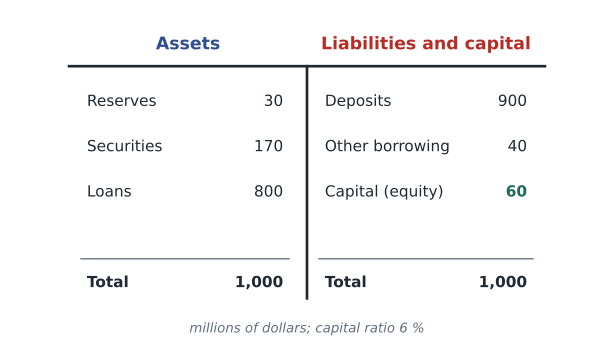
A bank's balance sheet, or T-account, shows this. Assets are what the bank owns: reserves, loans and securities. Liabilities are what it owes: mainly deposits. Capital, or equity, is the difference between assets and liabilities, the owners' stake, which absorbs losses. A bank is solvent if its assets exceed its liabilities, and liquid if it has enough reserves and easily sold assets to meet withdrawals.
Worked problem
A bank T-account
A bank has deposits of 900 million dollars, other borrowing of 40 million and capital of 60 million. It holds reserves of 30 million and government securities of 170 million; the rest of its assets are loans. Find its loans, its capital ratio and its leverage. What happens if 5 % of loans default?
Show solution
- Total assets = liabilities + capital = 900 + 40 + 60 = 1,000 million.
- Loans = 1,000 − 30 − 170 = 800 million.
- Capital ratio = 60 ÷ 1,000 = 6 %; leverage = 1,000 ÷ 60 ≈ 16.7.
- A 5 % default on loans = 40 million loss, reducing capital to 20 million.
Answer: Losses of only 4 % of total assets wipe out two thirds of the bank's capital. Leverage magnifies both gains and losses, which is why regulators require minimum capital.
The money multiplier and why textbooks changed
Older textbooks described a simple money multiplier. If banks are required to hold a fraction \( rr \) of deposits as reserves and lend out everything else, and the public holds no extra cash, then each dollar of new reserves supports \( 1 / rr \) dollars of deposits. With a 10 % reserve ratio, 100 dollars of new reserves could ultimately support 1,000 dollars of deposits. In this story the central bank controls the money supply by controlling the quantity of reserves.
# The textbook money multiplier as a chain of deposits and loans
rr = 0.10                  # reserve ratio
deposit, total_dep, total_loans = 100.0, 0.0, 0.0
for round_ in range(1, 61):
    total_dep += deposit
    loan = deposit * (1 - rr)
    total_loans += loan
    if round_ in (1, 2, 3, 10, 60):
        print(f"after round {round_:2d}: deposits {total_dep:7.1f}  loans {total_loans:7.1f}")
    deposit = loan
print(f"limit 1/rr = {1 / rr:.0f}, so deposits approach {100 / rr:,.0f}")after round 1: deposits 100.0 loans 90.0 after round 2: deposits 190.0 loans 171.0 after round 3: deposits 271.0 loans 243.9 after round 10: deposits 651.3 loans 586.2 after round 60: deposits 998.2 loans 898.4 limit 1/rr = 10, so deposits approach 1,000
The real world works differently, and modern central banks have said so explicitly. First, reserve requirements have disappeared or become irrelevant.
Canada eliminated reserve requirements in the early 1990s (fully by 1994). Canadian banks hold settlement balances at the Bank of Canada to settle payments with each other, not because of any requirement.
Second, banks do not wait for reserves before lending. They make loans when they find creditworthy borrowers at a profitable interest rate, creating deposits in the process, and then obtain any reserves they need. What limits bank lending is the demand for loans, the interest rate set by the central bank, the bank's capital and regulatory requirements, and its assessment of risk. Third, central banks today set a short-term interest rate rather than a quantity of reserves, and supply whatever reserves are needed at that rate. The money supply is therefore determined largely by the economy's demand for credit and money at the interest rate the central bank sets. The multiplier remains a useful illustration of how deposits and loans expand together, but it is not how monetary policy works in practice. The Bank of England, the Bank of Canada and the Federal Reserve have all published explanations along these lines.
Bank runs, deposit insurance and regulation
Fractional-reserve banking has a built-in vulnerability. A bank holds long-term, illiquid loans funded by deposits that can be withdrawn at any time. If many depositors try to withdraw at once, even a solvent bank may not be able to meet them without selling assets at fire-sale prices, which can make it insolvent. Because each depositor knows this, a rumour can become self-fulfilling: fearing that others will withdraw, everyone withdraws. Bank runs were common before the 1930s; thousands of US banks failed during the Great Depression. Canada's banking system, dominated by a few large, nationally diversified banks, had no bank failures during the Depression, a contrast often cited in comparisons of the two systems.
Several safeguards now reduce the risk of runs. Deposit insurance guarantees deposits up to a limit, so small depositors have no reason to run. The central bank acts as lender of last resort, lending to solvent banks facing temporary liquidity problems against good collateral. And regulators require banks to hold minimum capital and liquid assets, following international standards developed by the Basel Committee on Banking Supervision, and they test banks' ability to withstand severe scenarios.
The Canada Deposit Insurance Corporation (CDIC) insures eligible deposits at member institutions up to 100,000 dollars per insured category (such as deposits in one name, joint deposits, RRSPs and TFSAs) per institution. The Office of the Superintendent of Financial Institutions (OSFI) regulates federally chartered banks and requires the largest, designated as systemically important, to hold extra capital. Provinces insure deposits at credit unions.
The limits of these safeguards were tested in March 2023, when Silicon Valley Bank in California failed after a run by uninsured depositors, mostly technology firms, who withdrew about 42 billion dollars in a single day, spreading fear through social media. The bank had invested heavily in long-term bonds whose value had fallen as interest rates rose. US authorities guaranteed all deposits at Silicon Valley Bank and Signature Bank to prevent contagion, and the Fed created an emergency lending facility. The episode showed that runs can happen at digital speed and that interest rate risk can threaten banks even when their borrowers repay. The 2008 global financial crisis showed something broader: runs can occur not only at banks but at lightly regulated non-bank institutions, such as investment banks and money market funds, that perform bank-like maturity transformation.
Money and inflation in the long run
The quantity theory of money links money to the price level. It starts from an identity, the equation of exchange: the money supply times the velocity of money, the average number of times each dollar is spent on final output in a year, equals nominal GDP.
In growth rates, money growth plus velocity growth equals inflation plus real output growth. If velocity is stable and real output is determined by real factors in the long run (as lesson 5 showed), then faster money growth translates into higher inflation. This is the basis for Milton Friedman's famous claim that inflation is always and everywhere a monetary phenomenon. Across countries and over long periods the evidence is strong: countries with very high money growth have very high inflation, and hyperinflations are always accompanied by explosive money growth.
Worked problem
The quantity equation
Money grows 7 % a year, real GDP grows 2 % and velocity is constant. What inflation does the quantity theory predict? What if velocity falls 3 % a year?
Show solution
- With constant velocity: inflation ≈ 7 + 0 − 2 = 5 %.
- With velocity falling 3 %: inflation ≈ 7 − 3 − 2 = 2 %.
Answer: Predicted inflation is 5 % with stable velocity but only 2 % if velocity falls, which shows why the relationship is unreliable when velocity moves.
In the short run and at low inflation, however, the link is loose, because velocity is unstable. Velocity fell sharply when interest rates dropped to near zero after 2008 and again in 2020, as people and firms held more money relative to spending. Broad money grew very rapidly in 2020–2021, by about a quarter in the United States, and inflation did follow, which revived interest in monetary aggregates; but for most of the previous two decades, money growth was a poor guide to inflation. This is why modern central banks focus on interest rates and inflation forecasts rather than targeting money growth, a strategy several tried and abandoned in the 1970s and 1980s, including the Bank of Canada, which targeted M1 from 1975 to 1982.
Common mistakes
MistakeMoney means wealth.
InsteadMoney is the subset of wealth used for payments; houses and stocks are wealth but not money.
MistakeCredit cards are money.
InsteadThey arrange a loan; the balance is paid later with money from deposits.
MistakeBanks lend out depositors' money only after receiving reserves.
InsteadBanks create deposits when they lend and then obtain any reserves needed; lending is limited by demand, capital and the central bank's interest rate.
MistakeDeposit insurance covers all deposits.
InsteadCoverage has limits per category or per depositor; large uninsured deposits can still run.
MistakeMore money always means proportionally higher prices right away.
InsteadThe link holds over long periods; in the short run velocity and output change too.
Summary and key terms
- Money serves as a medium of exchange, unit of account and store of value; modern money is fiat money.
- Monetary aggregates range from narrow (currency and deposits used for payments) to broad (savings and term deposits).
- Banks create money by making loans; a bank's balance sheet shows assets equal to liabilities plus capital.
- The textbook money multiplier is a useful illustration, but reserve requirements are zero and central banks now set interest rates, not reserves.
- Fractional-reserve banks are vulnerable to runs; deposit insurance, lenders of last resort and capital rules reduce the risk.
- Silicon Valley Bank's 2023 failure showed that runs can be fast and that interest rate risk matters.
- The quantity theory links money growth to inflation in the long run, but unstable velocity weakens the link in the short run.
- Money
- Assets widely accepted as payment for goods, services and debts.
- Fiat money
- Money with no intrinsic value that is accepted because of government decree and trust.
- Medium of exchange
- An item used to pay for goods and services.
- Monetary aggregate
- A measure of the money supply, such as M1 or M2.
- Reserves
- Bank holdings of cash and deposits at the central bank.
- Fractional-reserve banking
- A system in which banks hold only part of their deposits as reserves.
- Bank capital
- Assets minus liabilities; the owners' stake that absorbs losses.
- Bank run
- Many depositors withdrawing at once because they fear the bank will fail.
- Lender of last resort
- A central bank lending to solvent banks facing temporary liquidity shortages.
- Velocity of money
- The average number of times money is spent on final output per period.
Practice problems
Work each problem on paper first, then reveal the answer to check.
Name the three functions of money.
Show answer
Medium of exchange, unit of account, store of value.
Why is a debit card not money?
Show answer
It is a way to transfer bank deposits, which are the money.
Reserve ratio 20 %. What is the simple money multiplier?
Show answer
5.
A bank has assets of 500 and capital of 25. What is its capital ratio and leverage?
Show answer
5 %; 20.
What limits bank lending in practice?
Show answer
Loan demand, interest rates, bank capital, regulation and risk assessment.
Why can a solvent bank fail in a run?
Show answer
It may have to sell illiquid assets at fire-sale prices, creating losses.
Money grows 5 %, velocity constant, real GDP 3 %. Predicted inflation?
Show answer
2 %.
Why did central banks stop targeting money growth?
Show answer
Velocity proved unstable, so money growth was a poor guide to inflation.
What happened at Silicon Valley Bank in 2023?
Show answer
Uninsured depositors ran after losses on long-term bonds; authorities guaranteed deposits.
Portfolio task: find the deposit insurance limit that applies to your accounts and explain how much of your savings it covers.
Show answer
Answers vary; should cite CDIC or FDIC rules.
Lesson quiz · 5 questions
Score 60% or more to complete this lesson.
Create a free account to save your progress, take quizzes and earn a certificate.