
DCT-220 · Lesson 7 of 12 · 20 min
Generators: diesel, fuel and starting
When the utility fails and stays failed, the UPS batteries buy minutes; the generators buy hours or days. A data centre's generator plant is a small power station: a yard of large diesel engines with alternators, fuel tanks, cooling radiators, exhaust stacks and control panels, ready to start and carry the whole campus within seconds of a utility failure. Technicians spend a lot of time around the generators, on rounds, during monthly tests, and during outages. This lesson explains how a standby generator works, how it is fuelled and started, how it is tested, and what the technician watches for.
The parts of a generator set
A generator set, or genset, is a diesel engine coupled to an alternator on a common frame. The engine burns fuel to turn the shaft at a fixed speed, usually 1,800 revolutions per minute for a 60 Hz alternator with four poles. The alternator converts the shaft's rotation into three-phase electricity, its voltage held steady by an automatic voltage regulator and its frequency held steady by the engine governor. Around these are the systems that keep the set ready: a radiator and fan for engine cooling, an air intake with filters, an exhaust system with a silencer and often emission controls, a fuel system, starting batteries and a battery charger, a coolant heater that keeps the engine block warm so it starts quickly, and a control panel that starts, monitors and protects the set.
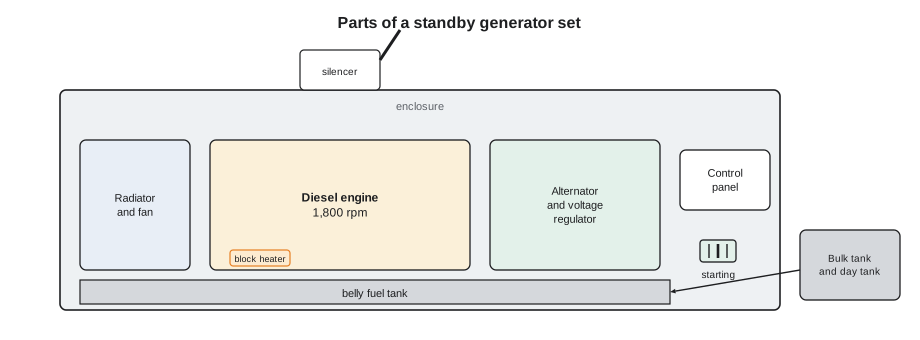
Stonebridge's generator plant at YUL-2 has blocks of generators for each part of the campus. The Hall A block has three 2,000 kW sets, GEN-A1, GEN-A2 and GEN-A3, connected at 600 V to the Hall A generator switchboard. Two sets can carry the Hall A block's whole load, IT plus cooling, so the third is the N+1 spare. The larger Halls B, C and D blocks have medium-voltage generators connected at 25 kV, each 2,500 to 3,000 kW, also arranged N+1.
Ratings: standby, prime and continuous
Generators carry different ratings for different duties. A standby rating is the most a set can deliver during a utility outage for limited hours per year, usually with variable load. A prime rating allows unlimited hours at variable load with a lower average. A continuous rating is for running at constant load indefinitely and is the lowest of the three. Data centre operators often choose generators by their continuous or data-centre-specific rating, because a long outage can mean many days of constant load. The Uptime Institute's tier standard, for example, expects engine generators in Tier III and Tier IV designs to be able to carry the load for unlimited hours, which is why manufacturers publish data centre continuous ratings. Stonebridge's sets have data centre ratings at least as high as the loads they are planned to carry.
Fuel: storage, quality and runtime
Diesel fuel is stored in belly tanks under each set, which give a few hours of running, and in bulk storage tanks that supply the belly tanks or day tanks through transfer pumps. Stonebridge's bulk storage is sized for 48 hours at full campus load, and the operations team holds contracts with two fuel suppliers for priority deliveries during a long outage. Fuel planning has to allow for delivery being slow during exactly the kind of regional event that causes a long outage, such as an ice storm or hurricane.
A diesel engine at full load burns roughly a quarter of a litre of fuel for every kilowatt-hour it produces, a little more at part load. That rule of thumb, together with the tank volumes, lets technicians estimate runtime during an outage. The code below does this for the Hall A block. Manufacturers' fuel consumption tables give the exact figures for each set and load, and those are what the operations team uses.
# Generator fuel use and runtime for the Hall A block (illustrative consumption curve)
load_kw_block = 2600          # total block load, IT plus cooling
sets_running = 3                 # all three sets share the load during an outage
set_rating = 2000
fuel_rate = {0.25: 0.33, 0.50: 0.28, 0.75: 0.26, 1.00: 0.25}   # litres per kWh at each fraction of rating
per_set = load_kw_block / sets_running
frac = per_set / set_rating
# interpolate the litres-per-kWh figure for this load fraction
pts = sorted(fuel_rate.items())
for (f1, r1), (f2, r2) in zip(pts, pts[1:]):
    if f1 <= frac <= f2:
        rate = r1 + (r2 - r1) * (frac - f1) / (f2 - f1)
l_per_h = load_kw_block * rate
usable_l = 72000               # usable fuel in belly tanks plus this block's share of bulk storage
hours = usable_l / l_per_h
print(f"Each set carries {per_set:.0f} kW ({frac * 100:.0f} % of rating)")
print(f"Fuel use: {l_per_h:,.0f} L/h for the block")
print(f"Runtime on {usable_l:,.0f} L: {hours:.0f} hours")Each set carries 867 kW (43 % of rating) Fuel use: 763 L/h for the block Runtime on 72,000 L: 94 hours
Diesel fuel ages. It absorbs water, grows microbes at the fuel-water interface, and forms sediment and gums that block filters. A generator that has sat for a year can fail to start, or run for a few minutes and stop when its filters clog, exactly when it is needed. Fuel quality programmes include sampling and testing, removing water from tank bottoms, fuel polishing (circulating the fuel through filters), and using additives where approved. NFPA 110, the standard for emergency and standby power systems, includes fuel testing requirements, and its recent editions shortened the interval for some fuel tests. Fuel containing biodiesel needs particular attention because it holds more water and degrades faster.
Starting the generator
Standby generators start automatically when their transfer controls detect that the utility supply has failed or gone outside its limits. The controls wait a short time, typically one to three seconds, to ignore brief interruptions, then send the start signal. The starter motor cranks the engine from the starting batteries; a warm engine fires within a second or two, accelerates to rated speed and builds voltage. When voltage and frequency are within limits, the generator is ready to accept load, usually within about ten seconds of the start signal. Standards for emergency power systems that serve life safety loads, such as NFPA 110 in the United States and CSA C282 in Canada, set maximum times for emergency loads to be restored, ten seconds for the highest class in NFPA 110. Data centre IT loads are usually classed as optional standby or legally required standby loads, but operators design to the same quick start because the UPS battery reserve is limited.
If a set fails to start on its first cranking attempt, the controls rest the starter and try again, typically for three attempts before declaring a failure to start. In an N+1 plant, the other sets still start and carry the load. Generator paralleling switchgear, described in lesson 8, synchronizes the sets and closes them onto a common bus as each becomes ready.
| Start problem | Common cause | What the technician sees |
|---|---|---|
| Failure to crank | Flat or failed starting batteries, charger fault, starter fault | Battery charger alarm on the panel; low battery voltage reading |
| Cranks but will not fire | Fuel supply problem, air in fuel, clogged filter, cold engine | Low fuel or low fuel pressure alarm; block heater alarm; cold block |
| Starts then stops | Clogged fuel filter, low coolant, low oil pressure, high temperature | Shutdown alarm with the cause on the controller |
| Runs but will not take load | Voltage or frequency out of limits, controller fault | Not-ready status; voltage or frequency alarm |
Engine heaters and readiness
A cold diesel engine is hard to start and slow to accept load. Standby sets have jacket water heaters that keep the coolant, and therefore the engine block, at about 32 to 49 °C (90 to 120 °F). In a Quebec winter or a Virginia cold snap, a failed block heater can turn a ten-second start into a failure to start. The block heater status and coolant temperature are on every generator round. So are the starting battery voltage and charger status, the fuel level in the belly tank, oil and coolant levels where visible, any leaks under the set, and the controller showing that it is in automatic mode, ready to start, with no alarms.
The most dangerous position for a generator control switch is the one that looks almost right. A set left in off or manual after maintenance will not start when the utility fails. Stonebridge's round checklist asks the technician to confirm and photograph each controller's mode display, and the monitoring system raises an alarm for any set not in automatic.
Testing generators
Generators are tested regularly because the only real proof that a set will start and carry load is to make it do so. Stonebridge runs each set every month, following NFPA 110 practice for exercising: the set runs under load for at least half an hour, either carrying building load or a load bank, with the readings recorded. Many sites test monthly by transferring real load to the generators; others use the generator test without transfer, which proves starting but not load carrying. Periodically, typically annually, each set is run on a load bank at higher loads for longer, and the whole system is tested by simulating a utility failure. Diesel engines that run often at light load suffer from wet stacking, unburned fuel and soot building up in the exhaust; load bank testing burns this off.
Monthly tests are good opportunities for technicians to learn the plant, because the sets run and the controllers show live readings. Technicians record start time, time to ready, voltage, frequency, current, kilowatts, coolant and oil temperatures and pressures, fuel level before and after, and any alarms.
# Monthly generator test record: check the readings against limits (illustrative)
tests = {  # set: (seconds to ready, volts L-L, frequency Hz, coolant C, oil pressure kPa, load kW)
    "GEN-A1": (8.6, 600, 60.0, 84, 410, 1310),
    "GEN-A2": (9.1, 600, 60.0, 86, 395, 1295),
    "GEN-A3": (14.8, 600, 59.9, 85, 402, 1302),
}
for gen, (t, v, f, cool, oil, kw) in tests.items():
    issues = []
    if t > 10: issues.append(f"slow to ready ({t} s)")
    if abs(v - 600) / 600 > 0.05: issues.append("voltage out of limits")
    if abs(f - 60) > 0.5: issues.append("frequency out of limits")
    if cool > 95: issues.append("coolant hot")
    if oil < 275: issues.append("oil pressure low")
print(f"{gen}: {kw} kW, " + ("; ".join(issues) + " -> ticket" if issues else "all readings normal"))GEN-A1: 1310 kW, all readings normal GEN-A2: 1295 kW, all readings normal GEN-A3: 1302 kW, slow to ready (14.8 s) -> ticket
GEN-A3 took nearly fifteen seconds to be ready. Jamal opens a ticket, and the generator vendor finds that its block heater thermostat has failed, leaving the engine about 20 °C (36 °F) colder than the others. A slow start like this is exactly what monthly tests are meant to catch.
Emissions and permits
Large diesel generators emit nitrogen oxides, particulates, carbon monoxide and hydrocarbons, and they are regulated. In Quebec, the generators are covered by the provincial environmental authorization for the site, which sets conditions on testing hours and emissions, and the engines meet federal emission standards for their type. Northern Virginia's huge concentration of data centre generators has made these permits a public issue, and operators track every hour of running carefully.
The technician's part is accurate records: every start, every stop, every hour run, and the reason. A test that runs longer than planned, or an outage, appears in the hour totals that are reported to the regulator.
Working safely around generators
Generators are loud, hot and start without warning. A set in automatic can start at any moment if the utility fails or a test is started remotely. The rules in DCT-120 apply: hearing protection in the generator yard and enclosures, never reaching into a set that could start, and staying away from rotating parts, hot exhausts and electrical connections. Fuel spills are reported and cleaned up with the spill kit, and no smoking or open flames are allowed near fuel storage. Technicians may operate the controller's display to read values, but changing the mode switch, stopping a running set or resetting a shutdown is done only by authorized critical facilities staff following the procedure.
Worked problem
A failed start during a monthly test
During the monthly no-load start test of the Halls B and C generator block, GEN-C4 cranks three times without firing and the controller shows failure to start, low fuel pressure. The other sets start normally.
Show solution
- Jamal records the alarm and the controller reading: fuel pressure low on every crank.
- He calls Roz, who checks the day tank: full. The fuel transfer pump is running normally.
- Roz opens a ticket with the generator vendor and marks the redundancy whiteboard: the Halls B and C block is at N, not N+1, until GEN-C4 is repaired.
- The vendor's technician finds a fuel filter almost blocked with dark sludge, and a fuel sample from the belly tank shows water and microbial growth at the bottom.
- The tank is drained of water, the fuel is polished and the filters changed. GEN-C4 then starts in 8.4 seconds and carries a load bank for two hours without problems.
- Because GEN-C4's tank had not been sampled since its last top-up, the fuel sampling schedule is moved from yearly to every six months for all sets.
Answer: A test caught a problem that would have left the block without its spare generator during a real outage. The fix was not just a new filter but a change to the fuel programme.
Common mistakes
MistakeAssuming a generator in its enclosure is ready because it ran last month.
InsteadCheck the controller mode, block heater, battery charger and fuel on every round.
MistakeTreating fuel as if it keeps forever.
InsteadDiesel ages and grows microbes; sample, drain water and polish fuel.
MistakeForgetting that a set in automatic can start without warning.
InsteadNever reach into a set that could start; wear hearing protection.
MistakeTesting only without load.
InsteadLoad tests and load bank tests prove the set can carry load and prevent wet stacking.
MistakeNot recording run hours.
InsteadEvery hour of running counts against permits and must be recorded.
Summary and key terms
- A generator set is a diesel engine and alternator with cooling, fuel, starting, exhaust and control systems.
- Generators carry standby, prime and continuous ratings; data centres rely on ratings that allow unlimited hours at load.
- Fuel is stored in belly and bulk tanks, planned for days of running, and kept in good condition by testing and polishing.
- Sets start automatically on utility failure and are ready for load in about ten seconds; N+1 plants tolerate one failed start.
- Block heaters, starting batteries, fuel and the controller mode are checked on every round.
- Monthly and annual load tests prove the plant, and run hours are recorded for environmental permits.
- Generator set
- A diesel engine and alternator on a common frame, with its supporting systems.
- Governor
- The control that holds engine speed, and therefore frequency, steady.
- Automatic voltage regulator
- The control that holds the alternator output voltage steady.
- Block heater
- A heater that keeps the engine coolant warm so the engine starts quickly.
- Load bank
- A device that applies an artificial electrical load to test a generator.
- Wet stacking
- Unburned fuel and soot in the exhaust of a diesel engine run at light load.
Practice problems
Work each problem on paper first, then reveal the answer to check.
About how much diesel does a generator burn per kilowatt-hour at full load?
Show answer
Roughly 0.25 litres (about 0.07 US gallons).
Why do standby generators have block heaters?
Show answer
A warm engine starts quickly and accepts load sooner.
What does an N+1 generator plant allow?
Show answer
One set can fail or be out of service and the others still carry the load.
Name three things checked on a generator round.
Show answer
Controller in automatic with no alarms, block heater and coolant temperature, starting battery and charger, fuel level, leaks.
Lesson quiz · 5 questions
Score 60% or more to complete this lesson.
Create a free account to save your progress, take quizzes and earn a certificate.