
DCT-220 · Lesson 5 of 12 · 20 min
UPS batteries: VRLA, lithium-ion and runtime
A UPS is only as good as its stored energy. When the utility fails, the batteries carry the whole load of a hall until the generators are running and accepting load, which usually takes ten to fifteen seconds, and longer if a generator fails to start and the team has to react. The batteries must be ready every second of every day for an event that might happen once a year. This lesson looks at the batteries as part of the power system: how they are arranged, how runtime is worked out, how they age, and what technicians monitor. The hazards of batteries, from hydrogen to thermal runaway, were covered in DCT-120 lesson 5 and are not repeated here.
Strings, cabinets and battery rooms
Individual battery cells have a low voltage, about 2 V for lead-acid and about 3.2 to 3.7 V for lithium-ion. To reach the DC bus voltage of a large UPS, typically between about 400 V and 800 V depending on the design, cells are connected in series into a string. Several strings are connected in parallel to provide enough energy and current, and so that one string can be taken out of service while the others carry on.
Hall A's UPS-A2 and UPS-B2 have valve-regulated lead-acid (VRLA) batteries in a dedicated battery room. Each system has four parallel strings of 40 monoblocs, each monobloc a 12 V block containing six cells, for 480 V nominal per string. Halls B, C and D use lithium-ion battery cabinets in the UPS rooms. Each cabinet holds modules of cells in series with its own battery management system, and several cabinets are paralleled per UPS.
VRLA and lithium-ion compared
| Feature | VRLA (lead-acid) | Lithium-ion |
|---|---|---|
| Typical service life in a UPS | About 4 to 6 years at 25 °C (77 °F) | About 10 to 15 years |
| Weight and space for the same energy | Heavy; large rooms or many cabinets | Roughly a third of the weight and half the space or less |
| Sensitivity to temperature | Life halves for each 8 to 10 °C (15 to 18 °F) above 25 °C (77 °F) | Tolerates warmer rooms better |
| Monitoring | Separate monitoring system on each block or string, often added on | Built-in battery management system for every cell |
| Main hazards | Hydrogen, acid, thermal runaway when overcharged | Thermal runaway that can spread, toxic and flammable gases |
| Recharge time after a discharge | Many hours to full charge | Faster, often an hour or two |
| Upfront cost | Lower | Higher, often offset by longer life |
The trend in new data centres is toward lithium-ion, for its smaller footprint, longer life and better monitoring. VRLA remains common in existing halls and is well understood. Lithium-ion systems bring their own requirements: fire codes such as NFPA 855 and the locally adopted fire code limit how much lithium-ion energy may be in one fire area and require separation, detection and protection, and the batteries must be tested by their manufacturer under UL 9540A for their fire behaviour.
# Footprint and weight: the same usable energy in VRLA and lithium-ion cabinets (illustrative)
energy_needed_kwh = 220       # usable energy for one UPS: about 10 minutes at 1,200 kW, the whole Hall A load
options = {
    #                 usable kWh per cabinet, cabinet mass kg, footprint m2
    "VRLA cabinet":        (30, 1900, 0.75),
    "Lithium-ion cabinet": (75, 1150, 0.70),
}
import math
for name, (kwh, mass, area) in options.items():
    n = math.ceil(energy_needed_kwh / kwh)
print(f"{name:20s}: {n:2d} cabinets, {n * mass / 1000:5.1f} t, {n * area:5.1f} m2")VRLA cabinet : 8 cabinets, 15.2 t, 6.0 m2 Lithium-ion cabinet : 3 cabinets, 3.5 t, 2.1 m2
How runtime is worked out
Runtime is the time the battery can carry the UPS load before reaching its end-of-discharge voltage, at which the UPS shuts down to protect the cells. It depends on the load, on the battery's energy, on the efficiency of the inverter, on the temperature and on the battery's age. Runtime is not simply proportional to load. Lead-acid batteries in particular deliver less total energy when discharged quickly than when discharged slowly, an effect described by Peukert's law. Doubling the load on a lead-acid battery more than halves its runtime.
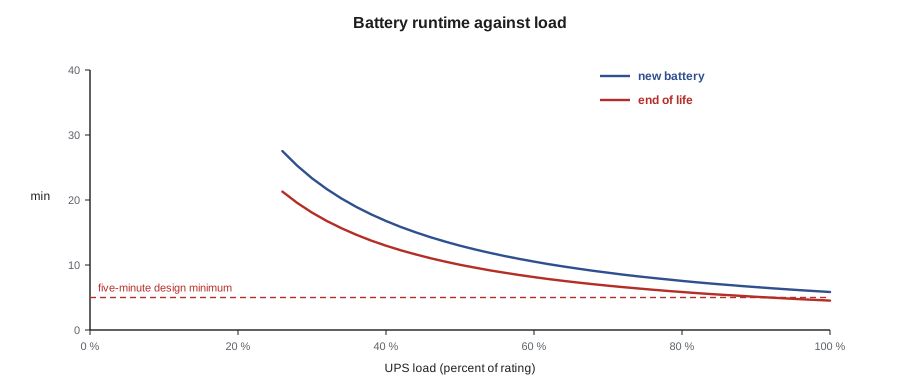
Stonebridge's design target for Hall A is at least five minutes of runtime with end-of-life batteries at 1,200 kW, the whole hall's load, which one UPS system must carry alone if its partner side fails. In normal operation each UPS carries only about 600 kW, so its runtime is far longer. Five minutes is far more than the ten to fifteen seconds the generators normally need, but it gives time for a second generator start attempt or for the critical facilities team to act if something goes wrong. Many modern designs use shorter runtimes, sometimes only a few minutes, relying on reliable generators; others keep longer runtimes for sites without generators or with unusual risks.
# Estimate UPS runtime from load, battery energy, efficiency, ageing and temperature (illustrative)
usable_kwh_new = 220.0      # usable energy when new, at the rated discharge time
inverter_eff = 0.95
rated_kw = 2000.0
peukert = 1.15              # lead-acid style: faster discharge delivers less energy
def runtime_min(load_kw, health=1.0, temp_factor=1.0):
    energy = usable_kwh_new * health * temp_factor
    base_min = energy / (load_kw / inverter_eff) * 60
    ref = 10.0               # minutes at which the usable energy was quoted
    return ref * (base_min / ref) ** peukert
for load in (600, 1200, 1600, 2000):
    new = runtime_min(load)
    old = runtime_min(load, health=0.80)
    cold = runtime_min(load, health=0.80, temp_factor=0.92)
print(f"{load:5.0f} kW ({load / rated_kw * 100:3.0f} %): new {new:5.1f} min, end of life {old:5.1f} min, end of life and cool room {cold:5.1f} min")600 kW ( 30 %): new 23.3 min, end of life 18.1 min, end of life and cool room 16.4 min 1200 kW ( 60 %): new 10.5 min, end of life 8.1 min, end of life and cool room 7.4 min 1600 kW ( 80 %): new 7.6 min, end of life 5.8 min, end of life and cool room 5.3 min 2000 kW (100 %): new 5.8 min, end of life 4.5 min, end of life and cool room 4.1 min
The table shows the pattern. At today's normal load of about 600 kW per side, new batteries give over twenty minutes. At 1,200 kW, the load one side carries if the other fails, they give about ten and a half minutes, and an end-of-life battery in a cool room still gives over seven, above the five-minute design target. At the UPS's full 2,000 kW rating, though, that same old battery would give only about four minutes. That is one reason the load is kept well under the rating, why the battery is replaced at the end of its life rather than when it fails, and why the UPS screen's runtime estimate is recorded on every round.
Ageing and end of life
Every battery loses capacity over time. VRLA batteries are usually treated as at end of life when their capacity falls to 80 % of rated. Their life depends strongly on temperature: a VRLA battery designed for a ten-year life at 25 °C (77 °F) might last only five years at 33 °C (91 °F). For that reason the Hall A battery room is kept at about 25 °C (77 °F), cooler than the data halls. Lithium-ion batteries age more slowly and report their state of health directly through the battery management system.
Batteries also age through cycling, each discharge and recharge. A UPS battery in a reliable grid area may see only a handful of real discharges a year, plus test discharges, so cycling matters less than temperature and calendar age for VRLA, but it does count for lithium-ion systems used for other purposes such as peak shaving or grid services, which some operators are beginning to do.
Battery monitoring
Because a battery with one bad block can fail the whole string at the moment it is needed, batteries are monitored closely. VRLA strings at Stonebridge have a monitoring system that measures the voltage, internal resistance and temperature of every monobloc and the current of every string. Internal resistance rises as a block ages or develops a fault, so it is the best early indicator. Lithium-ion battery management systems measure every cell's voltage and temperature, balance the cells, and calculate state of charge and state of health.
# Battery monitoring: find blocks whose internal resistance has risen (illustrative)
baseline = 3.20     # milliohms, average of the string when installed
blocks = {"S3-B07": 3.31, "S3-B12": 3.42, "S3-B18": 4.05, "S3-B21": 3.28, "S3-B33": 4.03, "S3-B39": 3.25}
for block, r in blocks.items():
    rise = (r - baseline) / baseline * 100
    if rise > 25:
        status = "replace: rise over 25 %"
    elif rise > 15:
        status = "watch: rise over 15 %, retest next month"
    else:
        status = "normal"
print(f"{block}: {r:.2f} mohm ({rise:+.0f} %) -> {status}")S3-B07: 3.31 mohm (+3 %) -> normal S3-B12: 3.42 mohm (+7 %) -> normal S3-B18: 4.05 mohm (+27 %) -> replace: rise over 25 % S3-B21: 3.28 mohm (+2 %) -> normal S3-B33: 4.03 mohm (+26 %) -> replace: rise over 25 % S3-B39: 3.25 mohm (+2 %) -> normal
Blocks S3-B18 and S3-B33 have both crossed the replacement threshold. In DCT-120, the failing cell in string 3 was found by smell; the monitoring system is meant to catch problems like that before anyone can smell them. The thresholds above are illustrative; each battery manufacturer gives its own.
Charging, float and equalize
When a lead-acid battery is fully charged, the UPS holds it at a float voltage, slightly above its resting voltage, that keeps it charged without overcharging. After a discharge, the charger delivers a higher current until the battery reaches float again. Recharging a VRLA string to full capacity can take many hours, and during that time the battery cannot give its full runtime. That matters after an outage: if the utility fails again an hour after the first outage, the batteries are only partly charged. The UPS screen shows the state of charge and the estimated runtime during recharge, and the technician records them after any event.
Battery tests
Batteries are tested in several ways. Monitoring tests run continuously. Periodic impedance or resistance tests are done by the battery vendor on systems without full monitoring. Discharge tests, in which the battery carries a real or simulated load for a set time, are the only way to prove the actual capacity; they are done during planned work, often when a system has been taken out of service with its partner side carrying the load, or with a load bank. IEEE recommended practices describe these tests for lead-acid and other battery types, and manufacturers' warranties often require them.
Technicians help with tests by escorting the vendor, recording readings and watching the room. They also do simple visual checks on rounds: swollen or cracked cases, leaking or corroded terminals, loose cables, unusual heat, the hydrogen detector and ventilation status in the battery room, and the battery management system screen on lithium-ion cabinets.
What the UPS screen tells you about the battery
| Reading | Normal | Report if |
|---|---|---|
| Battery status | Float or fully charged | Discharging when the input is normal, charging for a long time, or fault |
| Estimated runtime | Close to the usual value for the present load | Lower than usual at the same load |
| Battery temperature | About 25 °C (77 °F) in the battery room | Rising above the usual range |
| String current | Near zero on float | A string discharging or charging differently from the others |
| State of health (lithium-ion) | Slowly declining over years | A sudden drop or a cabinet warning |
Worked problem
Runtime estimate dropping on UPS-A2
Over three weeks, the runtime estimate on UPS-A2's screen at about 600 kW falls from 23.1 minutes to 19.8 minutes, while UPS-B2 at the same load stays at 22.9 minutes. The battery room temperature is normal.
Show solution
- Jamal notices the trend while comparing his round sheets and opens the battery monitoring system.
- String 2 of UPS-A2 shows three blocks whose internal resistance has risen more than 25 % above baseline, and one with a temperature 4 °C (7 °F) above its neighbours.
- He reports to Roz, who confirms and calls the battery vendor.
- The vendor replaces the four blocks the following week, with string 2 isolated and the other three strings carrying the UPS. Dmitri marks the whiteboard: UPS-A2 at reduced runtime during the work.
- After the work, the runtime estimate returns to 23.0 minutes.
Answer: The trend on a single screen value, checked against the partner system, led to the failing blocks. Without the round sheets, the drop might have gone unnoticed until a real outage, when string 2 could have failed early and shortened the ride-through.
Common mistakes
MistakeAssuming runtime halves when load doubles.
InsteadLead-acid runtime falls faster than that because of the Peukert effect.
MistakeTreating a battery that works today as good for the next outage.
InsteadWatch internal resistance and runtime trends; replace at end of life.
MistakeLetting the battery room run warm.
InsteadHeat shortens VRLA life sharply; report temperature rises.
MistakeForgetting that batteries are partly charged after an outage.
InsteadRecord state of charge and runtime during recharge; a second outage has less reserve.
MistakeRelying only on the monitoring system.
InsteadWalk the room: swelling, leaks, smells and heat are seen and smelled before some alarms.
Summary and key terms
- Cells are connected in series into strings to reach the UPS DC voltage, and strings in parallel for energy and redundancy.
- VRLA batteries are cheaper but heavier, shorter-lived and very sensitive to heat; lithium-ion batteries are smaller and longer-lived.
- Runtime depends on load, energy, efficiency, temperature and age, and falls faster than load rises for lead-acid.
- Batteries are replaced at end of life, usually 80 % capacity for VRLA, not when they fail.
- Internal resistance and cell data from monitoring systems are the best early warnings.
- After a discharge, batteries take hours to recharge, so a second outage has less reserve.
- String
- Battery cells or blocks connected in series to reach the required voltage.
- Monobloc
- A battery block containing several cells in one case, such as a 12 V block of six cells.
- Runtime
- The time a battery can carry a given load before reaching its end-of-discharge voltage.
- Peukert effect
- The reduction in a lead-acid battery's usable capacity at high discharge rates.
- Float voltage
- The voltage at which a fully charged battery is held to keep it charged.
- State of health
- A measure of a battery's remaining capacity compared with when it was new.
Practice problems
Work each problem on paper first, then reveal the answer to check.
Why are UPS batteries arranged in several parallel strings?
Show answer
For enough energy and current, and so one string can be taken out while the others carry on.
What is usually treated as end of life for a VRLA battery?
Show answer
Capacity falling to about 80 % of rated.
Which measurement gives the best early warning of a failing VRLA block?
Show answer
A rise in internal resistance.
Why is runtime lower after an outage, even when the utility is back?
Show answer
The batteries are still recharging and are not yet at full charge.
Lesson quiz · 5 questions
Score 60% or more to complete this lesson.
Create a free account to save your progress, take quizzes and earn a certificate.