
DCE-440 · Lesson 7 of 12 · 29 min
Lithium-ion battery fire hazards
Batteries are everywhere in a data centre: in the uninterruptible power supply (UPS) systems that carry the load until generators start, in battery backup units inside server racks, in network equipment, in generator starting systems and increasingly in large battery energy storage systems (BESS) that support the grid or reduce peak demand. Over the last decade, lithium-ion batteries have replaced valve-regulated lead-acid (VRLA) batteries in many new UPS installations because they are smaller, lighter, last longer and tolerate higher temperatures. But lithium-ion batteries bring a distinctive fire hazard: thermal runaway, a self-sustaining reaction that releases heat and flammable gases and can spread from cell to cell. Several of the most damaging recent data centre fires started in lithium-ion batteries. This lesson explains the hazard, the standards that address it, and the layers of protection that make lithium-ion batteries acceptable in data centres.
Why lithium-ion batteries are attractive
Compared with VRLA batteries for the same UPS runtime, lithium-ion batteries typically occupy about a third to half of the floor space and weigh about a third as much, last 10 to 15 years instead of 3 to 6, tolerate warmer rooms (reducing cooling needs), recharge faster, and include a battery management system (BMS) that monitors each cell. Over a facility's life, fewer replacements can offset their higher purchase price. Lead-acid batteries are not free of hazards either: they contain sulfuric acid, release hydrogen when charging (requiring ventilation), and can suffer thermal runaway of their own when overcharged in warm conditions, but their fires are generally less intense.
Worked problem
Battery energy in a UPS
A 1 MW UPS must carry its full load for 5 minutes. If the battery may be discharged to 80% depth of discharge and the UPS is 95% efficient, what nominal battery energy is required?
Show solution
- Energy delivered to the load: \(1000 \times 5/60 = 83.3\) kWh.
- Energy from the battery: \(83.3/0.95 = 87.7\) kWh.
- Nominal capacity: \(87.7/0.8 = 110\) kWh.
Answer: About 110 kWh, before allowances for ageing and temperature. A large data centre with dozens of such UPS modules holds several megawatt-hours of battery energy, far above the thresholds (for example, 20 kWh for lithium-ion) at which energy storage rules in codes and NFPA 855 apply.
Thermal runaway
A lithium-ion cell contains a graphite anode, a metal-oxide or phosphate cathode, a thin porous separator, and a flammable organic liquid electrolyte. Thermal runaway is a chain of heat-releasing reactions that, once started, accelerates on its own:
- Trigger: something heats the cell or damages it internally. Causes include internal short circuits from manufacturing defects, overcharging, external short circuits, mechanical damage (crushing, penetration), and external heat.
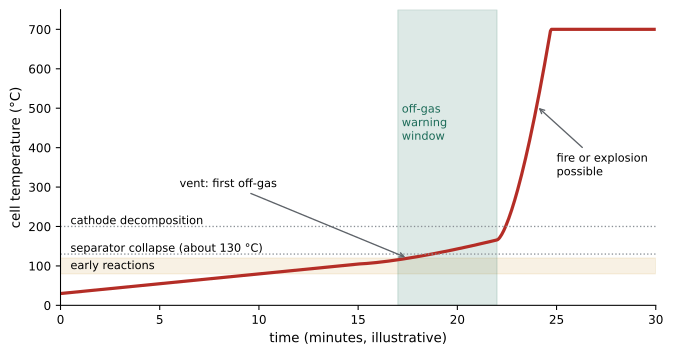
- Early reactions (roughly 80 °C to 120 °C): the protective layer on the anode breaks down, and the anode reacts with the electrolyte, releasing heat.
- Separator collapse (about 130 °C and above): the separator melts, allowing large internal short circuits.
- Cathode decomposition (around 200 °C or higher, depending on chemistry): some cathodes release oxygen, feeding combustion inside the sealed cell.
- Venting: pressure opens the cell vent, releasing hot flammable gases and electrolyte vapour, which may ignite as a jet flame or accumulate unburned.
- Propagation: heat from one cell drives its neighbours into runaway, spreading through a module, rack and room unless stopped.
Cathode chemistry strongly affects severity. Lithium iron phosphate (LFP) cells have a higher onset temperature and release less heat and no oxygen from the cathode, so they are generally considered safer than nickel manganese cobalt (NMC) or nickel cobalt aluminum (NCA) cells, which store more energy per kilogram. LFP is now common in stationary storage and many UPS products, but even LFP cells can enter runaway and release flammable gases.
Off-gases and explosion hazard
Gases vented during thermal runaway typically include hydrogen, carbon monoxide, carbon dioxide, methane, ethylene and other hydrocarbons, plus electrolyte vapour and toxic species such as hydrogen fluoride. Hydrogen often makes up a large share. These gases are flammable over a wide range: hydrogen's lower flammability limit (LFL) is about 4% in air. If a cell vents without igniting, gas can accumulate in a room or enclosure until a spark ignites it, causing a deflagration (a rapid burning that creates a pressure wave). In 2019, an explosion in a battery energy storage container in Surprise, Arizona, injured several firefighters when they opened the door after gases had accumulated. The risk of explosion is one reason why simply extinguishing visible flames, for example with a clean agent, does not make a battery room safe: runaway can continue, and unburned gas can build up.
Worked problem
Gas accumulation
A battery room has a free volume of 200 m³. One module in thermal runaway releases 2 m³ of gas containing 35% hydrogen. Treating hydrogen alone (LFL 4%) and assuming complete mixing, what is the hydrogen concentration? What if 10 modules propagate?
Show solution
- One module: hydrogen \(= 2 \times 0.35 = 0.7\) m³; concentration \(= 0.7/200 = 0.35\%\), about 9% of the LFL.
- Ten modules: 7 m³; concentration \(= 3.5\%\), about 88% of the LFL.
Answer: A single module gives a concentration well below the LFL when mixed, but propagation through ten modules brings the room close to a flammable mixture, and real gas does not mix evenly: pockets near the ceiling or inside enclosures can reach flammable concentrations much sooner. Designs therefore detect gas early, ventilate it away, and stop propagation.
Two strategies address the explosion hazard, often together:
- Explosion prevention by ventilation (NFPA 69): gas detection triggers exhaust fans sized to keep the gas concentration below 25% of the LFL.
- Deflagration venting (NFPA 68): panels in walls or roofs of containers and rooms open at low pressure to release an explosion safely in a chosen direction, limiting damage.
Worked problem
Exhaust ventilation rate
A module releases its 0.7 m³ of hydrogen over about 5 minutes. What exhaust flow keeps the hydrogen concentration in the exhaust stream below 25% of the LFL (1%)?
Show solution
- Release rate: \(0.7/300 = 0.00233\) m³/s.
- Required dilution flow: \(0.00233/0.01 = 0.233\) m³/s, about 840 m³/h.
Answer: About 0.23 m³/s per module in runaway at the same time; the design basis (how many modules may vent at once) comes from large-scale fire testing of the actual product. Exhaust fans and their controls must be on reliable power and arranged to draw gas from where it collects.
Standards and testing
Battery equipment is certified to product standards: cells and modules to standards such as UL 1973 and UL 1642 (or their CSA equivalents), and complete energy storage systems to CSA C22.2 No. 340201 or UL 9540. UPS equipment is certified to CSA C22.2 No. 107.3. UL 9540A is a test method (not a pass-fail standard) that characterizes how a battery behaves in thermal runaway at the cell, module, unit and installation levels, including gas composition and whether fire spreads. Installation is governed by the Canadian Electrical Code (Section 64 for energy storage systems) and by provincial building and fire codes; many AHJs also apply NFPA 855 (Standard for the Installation of Stationary Energy Storage Systems), whose 2026 edition makes a hazard mitigation analysis the default for most installations and adds explicit large-scale fire testing requirements. Where NFPA 75 is applied, it includes provisions for lithium-ion batteries in IT equipment rooms.
Common installation requirements include limits on the energy of each battery unit and spacing between units unless large-scale fire testing shows that fire will not spread; fire-rated separation of battery rooms (often 2 hours); gas detection and ventilation or explosion control; automatic sprinklers or an alternative system demonstrated by testing; signage, emergency response plans and training; and commissioning and periodic testing.
Layers of protection
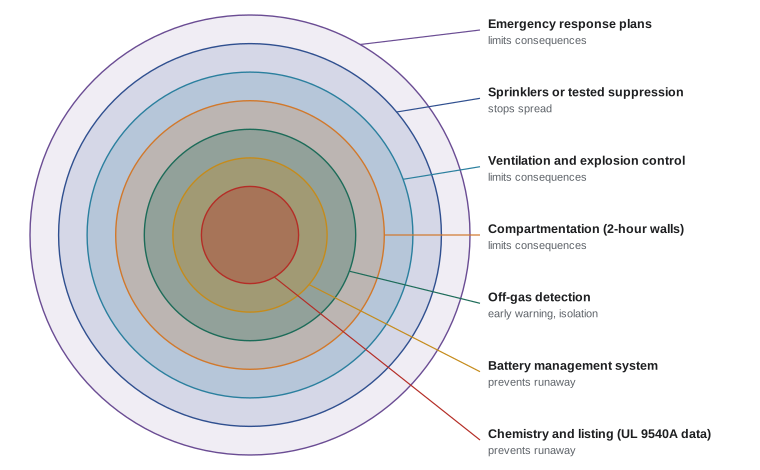
No single measure makes lithium-ion batteries safe. Designers use layers, each reducing either the chance of a runaway or the consequences:
- Product selection: listed products with UL 9540A data, preferably LFP chemistry for stationary use, from manufacturers with good quality control.
- Battery management system: monitors cell voltage, temperature and current; prevents overcharge and over-discharge; disconnects strings on faults; reports anomalies.
- Environment: stable room temperature, protection from mechanical damage and water, proper clearances.
- Off-gas detection: sensors that detect electrolyte vapour or early vent gases can warn before runaway accelerates, allowing the BMS to isolate the string; the 2024 edition of NFPA 75 added provisions addressing lithium-ion battery off-gas detection.
- Compartmentation: dedicated, fire-rated battery rooms away from data halls and critical electrical rooms; limited energy per room.
- Ventilation and explosion control: exhaust triggered by gas detection, deflagration vents where needed.
- Suppression: sprinklers (often at higher densities) to cool adjacent cells and stop spread, or systems proven by large-scale testing. Clean agents may suppress flames but cannot stop runaway.
- Emergency response: pre-incident plans, firefighter training, shutdown procedures, and monitoring after a fire, since cells can re-ignite hours or days later.
Distributed batteries in racks
Some large operators have moved batteries out of central UPS rooms and into the server racks themselves, as battery backup units (BBUs) in each rack or power shelf, a design popularized by the Open Compute Project. This removes large battery rooms but spreads lithium-ion cells throughout the data hall, next to the IT equipment. Each unit holds a small amount of energy, often below code thresholds individually, but the total in a hall can be large. Designers and AHJs evaluate these with UL 9540A data, limits on energy per rack, and detection and suppression in the data hall. The same questions apply to AI training clusters, whose very high rack power has led to new energy storage arrangements to smooth power swings.
Large battery energy storage systems on data centre sites, used to support the grid, shave peak demand or ride through generator start, are usually installed outdoors in containers or cabinets away from the main building. Separation distances from buildings, property lines and each other, explosion control in each container, fire department access and water supply are set by the installation codes and the hazard mitigation analysis. Placing large energy storage outside the data centre building keeps a battery fire from threatening the IT spaces, although cables, controls and fire alarm connections still link the systems.
Maintenance and work practices
Several battery fires have begun during installation, maintenance or relocation work, when batteries are disconnected, moved or exposed to tools. The Daejeon fire in 2025 started during work on UPS batteries. Good practice includes:
- Following manufacturer procedures for disconnecting, isolating and handling batteries, including reducing state of charge before moving them where the manufacturer recommends it.
- Using insulated tools and personal protective equipment for DC arc flash hazards.
- Inspecting batteries for swelling, damage or abnormal temperatures, and reviewing BMS logs.
- Storing spare and removed batteries in designated, protected areas, not in the data hall.
- Having a plan for damaged batteries, which may need to be moved to a safe outdoor location and monitored.
Firefighting considerations
Lithium-ion battery fires are hard to extinguish because the reaction does not depend on outside oxygen and heat continues to propagate between cells. Large volumes of water applied for a long time are usually needed to cool cells and stop propagation, and runoff may be contaminated. Firefighters may choose to let a containerized system burn while protecting surroundings. Toxic gases require breathing apparatus, and stranded energy in damaged batteries remains a shock and re-ignition hazard after the fire. Data centre operators should share battery locations, chemistries, quantities and shutdown procedures with the fire department in advance.
Lesson 8 extends this lesson to the wider electrical system, including connection heating, arc flash and the power supply for life safety systems.
Common mistakes
MistakeRelying on a clean agent alone in a lithium-ion battery room.
InsteadClean agents cannot stop runaway; use detection, ventilation, separation and water-based protection.
MistakeTreating all lithium-ion chemistries as equal.
InsteadLFP generally has lower runaway severity than NMC or NCA.
MistakeIgnoring unburned gas accumulation.
InsteadDetect gas and ventilate or vent explosions.
MistakeAssuming small rack batteries need no evaluation.
InsteadAssess total energy and spread in the data hall with test data.
MistakeMoving or servicing batteries without manufacturer procedures.
InsteadIsolate, reduce state of charge where advised, and use proper tools and PPE.
Summary and key terms
- Lithium-ion batteries save space and last longer than VRLA, but can enter thermal runaway.
- Runaway proceeds from early reactions through separator collapse and cathode decomposition to venting and propagation.
- LFP chemistry is generally less severe than NMC or NCA.
- Vented gases (much of it hydrogen) are flammable; accumulation can cause deflagrations.
- Equipment is certified (UL 1973, CSA C22.2 No. 340201, UL 9540A test data); installation follows the CEC Section 64, provincial codes and often NFPA 855.
- Protection uses layers: listing, BMS, off-gas detection, separation, ventilation, sprinklers and emergency plans.
- Many battery fires start during maintenance; follow procedures and plan for damaged cells.
- Thermal runaway
- A self-accelerating heat-releasing reaction in a battery cell.
- Battery management system (BMS)
- Electronics that monitor and protect battery cells.
- LFP
- Lithium iron phosphate, a cathode chemistry with lower runaway severity.
- NMC
- Nickel manganese cobalt, a high-energy cathode chemistry.
- Off-gas detection
- Sensing gases vented by cells before full runaway.
- Lower flammability limit (LFL)
- The lowest gas concentration in air that can burn.
- Deflagration
- Rapid combustion creating a pressure wave, slower than a detonation.
- UL 9540A
- A test method characterizing battery thermal runaway and fire spread.
- Hazard mitigation analysis
- A structured assessment of failure scenarios and protective measures.
- Battery backup unit (BBU)
- A small battery pack installed in a server rack or power shelf.
Practice problems
Work each problem on paper first, then reveal the answer to check.
Give three advantages of lithium-ion over VRLA for UPS.
Show answer
Smaller, lighter, longer life, higher temperature tolerance, faster recharge, BMS monitoring.
A 500 kW UPS for 10 minutes at 95% efficiency and 80% depth of discharge. Nominal battery energy?
Show answer
83.3/0.95/0.8 = 110 kWh.
List four triggers of thermal runaway.
Show answer
Internal short, overcharge, external short, mechanical damage, external heat.
Why is LFP considered safer than NMC?
Show answer
Higher onset temperature, less heat, no oxygen release from the cathode.
Why doesn't extinguishing flames make a battery room safe?
Show answer
Runaway continues and unburned flammable gas can accumulate and explode.
300 m³ room; 1.2 m³ of hydrogen released. Concentration and share of LFL?
Show answer
0.4%; 10% of the LFL.
Hydrogen release 0.003 m³/s. Exhaust flow to keep below 1%?
Show answer
0.3 m³/s.
What does UL 9540A provide?
Show answer
Test data on runaway behaviour, gas composition and fire spread at several levels.
What does the 2026 edition of NFPA 855 make the default?
Show answer
A hazard mitigation analysis for most installations, with large-scale fire testing.
Why are rack-level battery units a new challenge?
Show answer
They spread lithium-ion cells throughout the data hall next to IT equipment.
Lesson quiz · 5 questions
Score 60% or more to complete this lesson.
Create a free account to save your progress, take quizzes and earn a certificate.