
DCE-440 · Lesson 3 of 12 · 29 min
Detection and early warning
Most data centre fires begin small: an overheating power supply, a failing capacitor, a loose connection in a power distribution unit, or a cable damaged during installation. Such fires often smoulder for minutes or hours, producing small amounts of smoke before open flame appears. If staff can find and de-energize the faulty equipment during this early stage, the fire never grows and there is no need to discharge a suppression system. Early detection is therefore the most valuable layer of data centre fire protection. This lesson explains how fires develop, the types of detectors used, why the high airflow in data centres makes detection difficult, how aspirating smoke detection works, and how alarm sequences connect detection to staff response and automatic suppression.
How fires develop
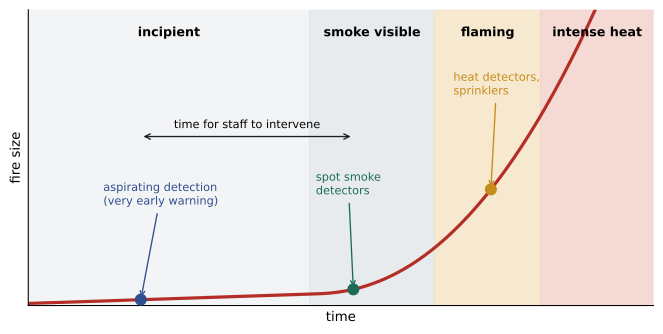
A fire typically passes through four stages:
- Incipient: overheating materials release invisible particles and gases, with no visible smoke or flame. This stage can last a long time in electrical equipment.
- Smouldering: visible smoke appears, but there is little heat and no flame.
- Flaming: open flame, rising heat and rapid smoke production.
- Intense heat: the fire spreads to nearby materials, and temperatures rise quickly.
Electrical fires in IT equipment often stay in the incipient and smouldering stages for a long time because the energy source is limited and modern equipment uses flame-retardant materials. Detectors that respond to tiny amounts of smoke can give warning during these stages, whereas heat detectors and sprinkler heads respond only once a fire is flaming and hot.
Types of detectors
- Spot-type smoke detectors: individual detectors on the ceiling (and sometimes under raised floors or in ceiling voids). Photoelectric detectors sense light scattered by smoke particles and respond well to smouldering fires; ionization detectors respond to small particles from flaming fires but are now uncommon. Spot detectors respond only when smoke reaches them in sufficient concentration.
- Aspirating smoke detectors (ASD): a fan draws air continuously through a network of pipes with small sampling holes into a central detector with very high sensitivity, often a laser-based particle counter. Known by trade names such as VESDA, they can detect smoke concentrations hundreds of times lower than a typical spot detector.
- Heat detectors: respond to a fixed temperature or a rapid rise; used where smoke detectors would give false alarms (generator rooms, kitchens) and as a reliable confirmation.
- Beam detectors: a light beam across a large open space; smoke reduces the light received.
- Flame detectors: sense ultraviolet or infrared radiation from flames; used for fuel and generator areas.
- Gas detectors: for hydrogen or other gases from batteries (Lesson 7), carbon monoxide, or refrigerant leaks.
- Video smoke and flame detection: software examines camera images for smoke or flame; used in large or tall spaces.
Sensitivity is often expressed as obscuration, the percentage of light lost per metre (or per foot) of smoke-laden air. Spot photoelectric detectors are listed to alarm somewhere between about 1.6% and 12.5% obscuration per metre (0.5% to 4% per foot), commonly around 3% per metre, while aspirating systems can be set to alarm at 0.005% per metre or less.
The airflow problem
Data halls move enormous amounts of air through the IT equipment to cool it. A data hall may change its entire air volume 30 to 100 or more times per hour, compared with a few times per hour in an office. This airflow dilutes smoke, carries it away from ceiling detectors, and can blow it through cooling units where it is filtered or mixed with clean air. In hot-aisle and cold-aisle arrangements, smoke from a server is exhausted into the hot aisle and may travel directly to the cooling unit returns without passing a ceiling detector.
Detector spacing must therefore be reduced in high-airflow spaces. CAN/ULC-S524 and the detector manufacturer's instructions govern installation in Canada, and designers often refer to the NFPA 72 approach, which reduces the floor area covered by each spot smoke detector as air changes increase: from the normal maximum of about 84 m² (900 ft²) at 7.5 air changes per hour or fewer, down to about 11.6 m² (125 ft²) at 60 air changes per hour.
where \(Q\) is the airflow in m³/s (or the equivalent in ft³/min with 60 minutes per hour) and \(V\) is the room volume.
| Air changes per hour | Area per spot detector (ft²) | Area per spot detector (m²) |
|---|---|---|
| 60 | 125 | 11.6 |
| 30 | 250 | 23.2 |
| 20 | 375 | 34.8 |
| 15 | 500 | 46.5 |
| 12 | 625 | 58.1 |
| 10 | 750 | 69.7 |
| 8.6 | 875 | 81.3 |
| 7.5 or fewer | 900 | 83.6 |
Worked problem
Detectors in a high-airflow hall
A data hall is 30 m by 20 m with a 4 m ceiling. Its cooling units move 40 m³/s. How many air changes per hour occur, and how many spot smoke detectors are needed on the ceiling?
Show solution
- Volume: \(30 \times 20 \times 4 = 2400\) m³.
- ACH: \(40 \times 3600 / 2400 = 60\).
- Coverage at 60 ACH: 11.6 m² per detector. Floor area 600 m²: \(600/11.6 = 51.7\), so at least 52 detectors (arranged on a grid of about 3.4 m).
Answer: About 60 air changes per hour, requiring at least 52 ceiling detectors instead of about 8 in a normal room. Even then, smoke may not reach them quickly. This is why aspirating detection, which can sample at the cooling unit returns and in the hot aisles, is common in data halls.
Aspirating smoke detection
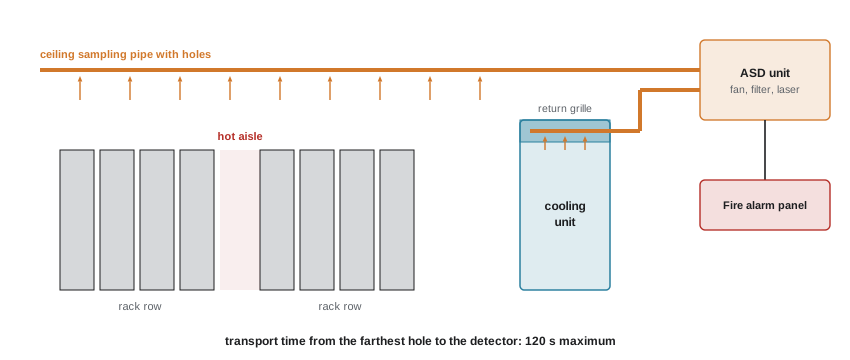
An aspirating smoke detection system consists of a detector unit with a fan, filter and sensing chamber, and a network of plastic pipes with sampling holes drilled at intervals. The fan draws air continuously from all holes into the detector. Because the detector is very sensitive and sees air from many points, it can detect smoke that has been heavily diluted. Sampling pipes are commonly placed:
- At the ceiling, as a replacement for spot detectors (each hole treated like a detector for spacing).
- Across the return air grilles of cooling units, where all air from the room passes (return air sampling).
- Inside hot aisle containment or above rack exhausts.
- Inside individual cabinets or under raised floors.
- In ducts and ceiling voids.
Two parameters matter in design. Transport time is how long air takes to travel from the farthest hole to the detector; NFPA 72 limits this to 120 seconds for aspirating systems, and very early warning designs often target 60 to 90 seconds. Hole sensitivity is the smoke concentration needed at a single hole to trigger the alarm; because air from one hole is diluted by air from all the others, the more holes on a pipe, the less sensitive each hole is.
where \(N\) is the number of holes with equal flow and \(S_{\text{detector}}\) the detector's alarm threshold. Design software from the manufacturer calculates transport times, flows and hole sensitivities for a pipe layout.
Worked problem
Hole sensitivity
An aspirating detector is set to alarm at 0.02% obscuration per metre and serves 25 sampling holes with roughly equal flow. What concentration must reach one hole to trigger the alarm? How does that compare with a spot photoelectric detector alarming at 3% per metre?
Show solution
- Hole sensitivity: \(25 \times 0.02 = 0.5\%\) per metre.
- Ratio to spot detector: \(3/0.5 = 6\).
Answer: About 0.5% per metre at a single hole, six times more sensitive than the spot detector, and much more if smoke reaches several holes at once (as it does when the smoke is spread through the return air). Very sensitive settings must be balanced against false alarms from dust, construction work or diesel exhaust drawn into the building.
Alarm levels and staged response
Very sensitive detection would cause disruption if every small reading triggered an evacuation or suppression. Data centre systems therefore use staged alarm levels, each with a defined response:
| Level | Typical threshold | Response |
|---|---|---|
| Alert | Very low smoke (ASD) | Notify operations staff; investigate the area |
| Action | Low smoke (ASD) | Staff search with handheld detectors or thermal cameras; prepare to de-energize equipment |
| Fire 1 | Moderate smoke (ASD or first spot detector) | Building fire alarm; notify fire department; shut down HVAC if required; start suppression countdown where cross-zoned |
| Fire 2 | Second, independent detector or zone | Release clean agent or open pre-action valve; disconnect power if required |
Requiring two independent detections (called cross-zoning or a double-knock) before releasing a suppression system reduces the risk of an unnecessary discharge caused by a single faulty detector. Clean agent systems also include a pre-discharge alarm with a time delay (often 30 seconds) to allow occupants to leave, an abort switch that holds the discharge while staff investigate, and a manual release.
The investigation stage matters. Staff must be able to find the source quickly in a large hall: zoned aspirating detection that indicates which pipe or area sees smoke, handheld sniffers, thermal imaging cameras and power monitoring that shows which circuit is drawing abnormal current all help. Procedures should define who can de-energize a rack or power distribution unit and how customers are informed.
Integration with other systems
Fire detection interacts with many other systems in a data centre: HVAC shutdown or smoke control, door releases on egress paths and access control, elevator recall, power disconnection, suppression release, the building management system and the fire department connection. These interactions must be designed, documented in a cause-and-effect matrix (which inputs cause which outputs) and tested together.
In Canada, CAN/ULC-S537 covers verification of fire alarm systems, CAN/ULC-S536 periodic inspection and testing, and CAN/ULC-S1001 integrated testing of fire protection and life safety systems, which checks that interconnected systems work together as intended.
Shutting down cooling on a fire alarm is a difficult decision in a data centre: it prevents fans from spreading smoke and helps a gaseous agent hold its concentration (Lesson 5), but without cooling, IT equipment overheats within minutes. Designs usually shut down only the units serving the affected room, and often only at the Fire 2 stage or on agent release.
Worked problem
Cause-and-effect check
A data hall's design states: Fire 1 (one detector) activates building alarm and notifies the fire department; Fire 2 (second zone) starts a 30-second pre-discharge countdown, shuts down the room's cooling units, closes dampers, and then releases the clean agent. During testing, the cooling units stop at Fire 1. What is the problem?
Show solution
- The cause-and-effect matrix ties cooling shutdown to Fire 2, but the system implemented it at Fire 1.
- Consequence: a single detector (possibly a false alarm) would shut down cooling for the whole hall, risking overheating and outage.
Answer: The programming does not match the design, and must be corrected and retested. This is exactly the kind of fault that integrated testing is meant to find before the facility goes live.
Maintenance and false alarms
Detection systems need regular inspection, testing and cleaning: detectors are tested with smoke or approved aerosols, aspirating systems are checked for airflow faults, transport time and blocked holes, and filters are replaced. False alarms waste staff time, may cause unnecessary fire department responses (some jurisdictions charge for them), and, worst of all, train people to ignore alarms. Common causes include construction dust, cardboard fibres, diesel exhaust drawn in by air intakes, and incorrect sensitivity settings. Temporary disabling or covering of detectors during construction work must follow a permit process with fire watch, and must be reversed when the work ends.
Lesson 4 explains how the fire alarm system turns these detector signals into notification, fire department response and control of other building systems.
Common mistakes
MistakeUsing normal detector spacing in high-airflow data halls.
InsteadReduce spacing for air changes and sample where airflow carries smoke.
MistakeAdding many holes to one aspirating pipe without checking sensitivity.
InsteadUse design software to check transport time and hole sensitivity.
MistakeReleasing suppression on a single detector.
InsteadUse cross-zoning, pre-discharge delay and abort switches.
MistakeShutting down all cooling on the first alarm.
InsteadFollow a designed cause-and-effect matrix that limits shutdowns.
MistakeLeaving detectors covered after construction work.
InsteadUse permits, fire watch and verification of restoration.
Summary and key terms
- Electrical fires often smoulder for a long time; early detection lets staff act before suppression.
- Detector types include spot smoke, aspirating, heat, beam, flame, gas and video.
- High air change rates dilute smoke; spot detector coverage shrinks to about 11.6 m² at 60 ACH.
- Aspirating systems sample many points, including cooling returns, with high sensitivity and transport time limited to 120 s.
- Hole sensitivity is roughly the detector threshold times the number of holes.
- Staged alarms (alert, action, Fire 1, Fire 2) and cross-zoning match response to severity.
- Detection integrates with HVAC, doors, power and suppression through a tested cause-and-effect matrix.
- Incipient stage
- The earliest fire stage, with overheating but no visible smoke.
- Photoelectric detector
- A smoke detector that senses light scattered by smoke particles.
- Aspirating smoke detector (ASD)
- A detector that draws air through sampling pipes to a sensitive central unit.
- Obscuration
- The percentage of light lost per unit length of smoky air.
- Air changes per hour (ACH)
- Airflow per hour divided by room volume.
- Transport time
- The time for air to travel from the farthest sampling hole to the detector.
- Hole sensitivity
- Smoke concentration at a single hole needed to trigger the alarm.
- Cross-zoning
- Requiring detection in two independent zones before release.
- Pre-discharge alarm
- A warning with time delay before a gaseous agent is released.
- Cause-and-effect matrix
- A table defining which fire system inputs trigger which outputs.
Practice problems
Work each problem on paper first, then reveal the answer to check.
Why is early detection especially valuable in data centres?
Show answer
Staff can de-energize faulty equipment before suppression or damage is needed.
List the four stages of fire development.
Show answer
Incipient, smouldering, flaming, intense heat.
A room of 1,500 m³ with 25 m³/s of airflow. ACH?
Show answer
60.
At 30 ACH, how many detectors for 480 m²?
Show answer
480/23.2 = 20.7, so 21.
Where can aspirating pipes sample in a data hall?
Show answer
Ceiling, cooling unit returns, hot aisles, cabinets, under floors, ducts.
What is the maximum ASD transport time in NFPA 72?
Show answer
120 seconds.
Detector threshold 0.05%/m with 20 holes. Hole sensitivity?
Show answer
1%/m.
What is cross-zoning?
Show answer
Requiring two independent detections before releasing suppression.
Why not shut down all cooling on the first alarm?
Show answer
IT equipment overheats quickly; a single false alarm would cause an outage.
Name three causes of false alarms.
Show answer
Construction dust, cardboard fibres, diesel exhaust, incorrect sensitivity.
Lesson quiz · 5 questions
Score 60% or more to complete this lesson.
Create a free account to save your progress, take quizzes and earn a certificate.