
DCE-440 · Lesson 5 of 12 · 30 min
Sprinklers, pre-action and clean agents
If a fire grows despite early detection, an automatic suppression system must control or extinguish it. Data centres face a dilemma: water is the most effective, reliable and economical way to control fires, and building codes usually require sprinklers, but water sprayed onto energized servers causes damage and outages. The industry has developed several approaches to reconcile these needs: pre-action sprinkler systems that keep pipes dry until a fire is confirmed, gaseous clean agents that extinguish fires without leaving residue, and water mist systems that use far less water. This lesson explains how each works, how they are designed and sized, their limitations and safety issues, and how owners choose among them.
Why sprinklers are still used
Automatic sprinklers have an excellent record of controlling fires in buildings of all kinds. Each sprinkler head opens individually when its heat-sensitive element (a glass bulb or fusible link) reaches its rated temperature, commonly about 68 °C for ordinary-temperature heads, so water discharges only over the fire. In most fires, only one to a few heads open. Building codes require sprinklers in most large or tall buildings, and insurers generally require them because they protect the building structure and contents from a fire that grows despite other measures. Gaseous agents, by contrast, are a single release whose concentration lasts only minutes; if a deep-seated fire re-ignites after the agent leaks away, nothing remains to fight it.
For these reasons, most data centres combine sprinklers (to protect the building and as a final layer) with early detection (to catch fires before sprinklers operate) and in some cases clean agents (to extinguish fires in critical rooms without water).
Sprinkler systems are designed to NFPA 13 as referenced by the NBC. The hazard classification of data halls is agreed with the AHJ and insurer; designers often use at least Ordinary Hazard Group 1 design criteria (about 6.1 mm/min over the most remote 139 m²), and insurers may require more.
Worked problem
Sprinkler water demand
A pre-action system is designed for 6.1 mm/min over 139 m². What sprinkler water flow is required, ignoring the hose allowance and overdischarge?
Show solution
- Flow: \(6.1 \text{ L/min per m}^2 \times 139 = 848\) L/min.
- For a 60-minute duration: \(848 \times 60 = 50{,}900\) L, about 51 m³.
Answer: About 850 L/min for the sprinklers, plus a hose stream allowance, from a water supply that can sustain it for the required duration. In practice the hydraulic calculation adds overdischarge at heads near the supply, so actual flows are higher.
Wet, dry and pre-action systems
- Wet pipe: pipes are always full of water; a head opens and water flows immediately. Simple and reliable, but a damaged head or leaking fitting releases water over IT equipment. Wet systems are used in offices and support areas, and sometimes in data halls where owners accept the risk.
- Dry pipe: pipes are filled with pressurized air; when a head opens, air escapes, a dry valve opens and water fills the pipes. Used where pipes could freeze. Water reaches the fire with a delay.
- Pre-action: pipes are filled with air (often nitrogen to limit corrosion) and a valve holds back water until the detection system confirms a fire. Water then fills the pipes, but it is discharged only where a sprinkler head has also opened from heat. The pipes are dry in normal operation, so a damaged head or leaking pipe releases only air and causes a supervisory alarm rather than a flood.
Pre-action systems come in three types:
- Non-interlock: the valve opens on either detection or loss of air pressure (from an open head or broken pipe).
- Single interlock: the valve opens on detection only; water then fills the pipes and flows from any heads that open.
- Double interlock: the valve opens only when both detection and loss of air pressure occur. This gives the most protection against accidental water release, but water delivery is delayed, so NFPA 13 limits the size of double-interlock systems and requires a water delivery time to be demonstrated, similar to dry-pipe systems.
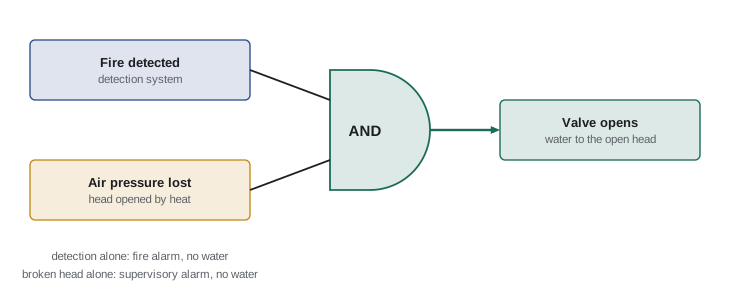
Pre-action systems need more maintenance than wet systems: air compressors or nitrogen generators, valve trip tests, detection system testing, and draining of condensation. Corrosion in partly drained pipes has caused leaks, which is why nitrogen inerting and galvanized or stainless piping are common.
Clean agents: how they work
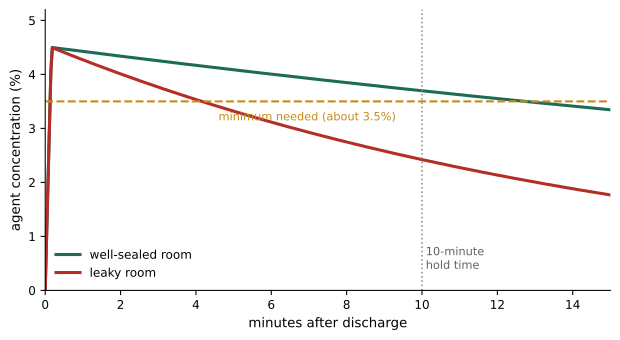
Clean agents are gaseous or vaporizing extinguishing agents that leave no residue, are electrically non-conductive and can be used in occupied spaces at their design concentrations. They are used in total flooding systems: the agent is stored in cylinders and discharged through nozzles to fill the protected room to a design concentration within about 10 seconds (halocarbons) or 60 to 120 seconds (inert gases), then held for a specified time, typically at least 10 minutes, so that the fire is extinguished and hot surfaces cool. NFPA 2001 is the main design standard in both Canada and the US (with ISO 14520 used internationally).
There are two families:
- Halocarbon agents extinguish mainly by absorbing heat (and partly chemically). FK-5-1-12 (a fluoroketone formerly sold as 3M Novec 1230) and HFC-227ea (sold as FM-200 and other names) are the most common. Design concentrations are a few percent by volume, so cylinder storage is compact.
- Inert gases (IG-541, a mix of nitrogen, argon and carbon dioxide; IG-55, nitrogen and argon; IG-100, nitrogen; IG-01, argon) extinguish by reducing the oxygen concentration from about 21% to about 12% to 14%, below what most fires need but still survivable for a short exposure. Design concentrations are around 35% to 50% by volume, so more cylinders are needed, but the agents are natural gases with no environmental concerns.
| Agent | Typical Class A design concentration | Mechanism | Environmental notes |
|---|---|---|---|
| FK-5-1-12 | About 4.2% to 4.7% | Heat absorption | Very low global warming potential; a PFAS under some definitions; 3M exited production by the end of 2025, other makers supply it |
| HFC-227ea | About 6.7% to 7.9% | Heat absorption | High global warming potential; supply reduced under HFC phase-down rules |
| IG-541, IG-55, IG-100 | About 35% to 50% | Oxygen reduction | Natural gases; no global warming effect |
Canada controls HFCs under the Ozone-depleting Substances and Halocarbon Alternatives Regulations, which phase down HFC consumption in line with the Kigali Amendment to the Montreal Protocol; fire protection uses are not banned outright, but supply and cost are affected.
Sizing a halocarbon system
The quantity of halocarbon agent needed to reach a design concentration in a room is given by the NFPA 2001 flooding equation:
where \(W\) is the agent mass (kg), \(V\) the protected volume (m³), \(C\) the design concentration (% by volume) and \(S\) the specific volume of the agent vapour at the minimum expected room temperature, \(S = k_1 + k_2 T\) with \(T\) in °C. For FK-5-1-12, \(k_1 = 0.0664\) and \(k_2 = 0.0002741\); for HFC-227ea, \(k_1 = 0.1269\) and \(k_2 = 0.0005\).
Worked problem
Quantity of FK-5-1-12
A network room is 20 m by 15 m with a 3.5 m height (including the raised floor and ceiling void, which must also be protected). The minimum room temperature is 20 °C and the design concentration is 4.5%. How much FK-5-1-12 is needed? How much HFC-227ea would be needed at 7%?
Show solution
- Volume: \(20 \times 15 \times 3.5 = 1050\) m³.
- FK-5-1-12: \(S = 0.0664 + 0.0002741 \times 20 = 0.07188\) m³/kg; \(W = \frac{1050}{0.07188} \times \frac{4.5}{95.5} = 14{,}608 \times 0.04712 = 688\) kg.
- HFC-227ea: \(S = 0.1269 + 0.0005 \times 20 = 0.1369\); \(W = \frac{1050}{0.1369} \times \frac{7}{93} = 577\) kg.
Answer: About 688 kg of FK-5-1-12 or 577 kg of HFC-227ea, stored in several cylinders. Volumes of solid objects can be deducted only where permanent, and adjustments are made for altitude. The calculation must use the lowest expected temperature, because colder vapour is denser and more mass is needed.
Inert gas quantities are expressed as volumes. The NFPA 2001 equation for inert gases gives the volume of agent per unit room volume:
where \(V_s\) is the specific volume at 21 °C and \(S\) at the minimum room temperature. For IG-541, \(k_1 = 0.65799\) and \(k_2 = 0.00239\).
Worked problem
Quantity of IG-541
The same 1,050 m³ room is protected with IG-541 at 40% at a minimum of 20 °C. What volume of agent is needed?
Show solution
- \(V_s = 0.65799 + 0.00239 \times 21 = 0.7082\); \(S = 0.65799 + 0.00239 \times 20 = 0.7058\).
- \(X = 2.303 \times \frac{0.7082}{0.7058} \times \log_{10}(100/60) = 2.303 \times 1.0034 \times 0.2218 = 0.513\).
- Agent volume: \(0.513 \times 1050 = 538\) m³.
Answer: About 538 m³ of IG-541 at reference conditions, typically stored in many 80 L or 140 L cylinders at high pressure. Inert gas systems need larger storage rooms but can be located farther from the protected space and serve several rooms through selector valves.
Room integrity and pressure
A gaseous agent is only effective if it stays in the room long enough. Leaks through gaps around doors, cable openings, unsealed ceiling tiles and ducts let the agent escape, and because halocarbon-air mixtures are denser than air, they drain out through low openings while fresh air enters through high ones. NFPA 2001 requires an enclosure integrity test, usually a door fan test that pressurizes the room and measures leakage area, from which software predicts the hold time (the time until the agent concentration at a specified height falls below the level needed). A minimum hold time of 10 minutes is typical. Rooms must be resealed whenever new penetrations are made.
Discharging a large volume of gas into a sealed room changes its pressure rapidly. Inert gas discharge raises pressure, and halocarbon discharge first lowers then raises it, enough to damage walls, ceilings and doors unless pressure relief vents are installed. Vent area is calculated from the agent flow rate and the room's pressure strength.
Safety and side effects
Clean agents are designed for occupied spaces, but they are not harmless:
- Halocarbon agents have a no observed adverse effect level (NOAEL), about 10% for FK-5-1-12 and 9% for HFC-227ea; design concentrations are kept below it in normally occupied spaces. In a fire, halocarbons decompose into hydrogen fluoride, a toxic and corrosive gas, which is one reason for fast discharge.
- Inert gases reduce oxygen; NFPA 2001 limits exposure times and concentrations so that occupants can escape safely.
- Discharge is loud and turbulent, can reduce visibility and dislodge ceiling tiles. Very loud discharge noise has been shown to damage hard disk drives; in a widely reported 2016 incident at a bank's data centre in Bucharest, a test of an inert gas system disrupted services after the noise damaged disks. Acoustic (silenced) nozzles reduce the risk.
- Personnel must evacuate on the pre-discharge alarm, and rooms must not be re-entered until ventilated or confirmed safe.
For these reasons, clean agent systems need lock-out procedures during maintenance, training for staff, warning signs, and careful testing by qualified technicians.
Water mist and other approaches
Water mist systems discharge very fine droplets at high pressure. The droplets absorb heat quickly and turn to steam, cooling the fire and displacing oxygen locally, while using a small fraction of the water of a sprinkler system. Mist systems are listed for specific hazards, including some IT and electrical applications, and are designed to NFPA 750. Other approaches include oxygen reduction (hypoxic air) systems, which continuously keep the oxygen level in a room at about 15% to 16% so that fires cannot readily start; they are used in some European data centres and archives but require occupational health controls. In-rack and in-cabinet suppression units protect individual cabinets or battery enclosures.
Choosing an approach
| Option | Strengths | Weaknesses |
|---|---|---|
| Wet sprinklers | Simple, reliable, low cost | Risk of water on equipment from leaks or damage |
| Pre-action sprinklers | Dry pipes; protects building; widely accepted | Delayed water; more maintenance; water damage if discharged |
| Clean agent (halocarbon) | Fast, no residue, compact storage | Room integrity needed; one shot; environmental and supply issues |
| Clean agent (inert gas) | No residue; natural gases; long pipe runs | Many cylinders; pressure relief; oxygen reduction |
| Water mist | Little water; good cooling | Specialized design and listings |
A common modern design for large hyperscale and colocation halls is early warning aspirating detection plus pre-action sprinklers, with clean agents reserved for smaller critical rooms (network and telecom rooms, tape libraries) or omitted. Smaller enterprise data centres frequently use clean agents. Insurers, local codes and business risk drive the choice.
Lesson 6 shows how the water demand of a sprinkler system is calculated in detail and checked against the water supply, and when a fire pump is needed.
Common mistakes
MistakeAssuming clean agents replace sprinklers.
InsteadCodes and insurers usually still require sprinklers; agents are an added layer.
MistakeCalculating agent quantity at the average room temperature.
InsteadUse the minimum expected temperature.
MistakeForgetting the raised floor and ceiling void.
InsteadInclude all connected volumes in the protected space.
MistakeAdding penetrations after the integrity test.
InsteadReseal and retest to maintain hold time.
MistakeOmitting pressure relief vents.
InsteadSize vents for the agent flow and room strength.
Summary and key terms
- Sprinklers remain required in most data centres; heads open individually at their rated temperature.
- Pre-action systems keep pipes dry; double interlock needs both detection and an open head.
- Clean agents extinguish without residue: halocarbons absorb heat; inert gases reduce oxygen.
- Halocarbon mass: W = (V/S)·C/(100−C), using the minimum temperature.
- Inert gas volume uses a logarithmic equation and design concentrations around 35% to 50%.
- Enclosure integrity tests confirm at least a 10-minute hold time; pressure relief vents prevent damage.
- Safety issues include NOAEL limits, oxygen reduction, decomposition products and discharge noise.
- Pre-action system
- A dry-pipe sprinkler system that admits water only after detection confirms a fire.
- Double interlock
- A pre-action type requiring both detection and loss of air pressure.
- Clean agent
- A residue-free, non-conductive gaseous extinguishing agent.
- Total flooding
- Filling an enclosed space with agent to a uniform concentration.
- Design concentration
- The agent concentration a system is designed to achieve.
- Specific volume
- Volume per unit mass of agent vapour at a given temperature.
- Hold time
- How long the agent concentration remains above the required level.
- Enclosure integrity test
- A door fan test measuring room leakage to predict hold time.
- NOAEL
- The highest concentration with no observed adverse effect on people.
- Water mist
- A suppression system using very fine water droplets at high pressure.
Practice problems
Work each problem on paper first, then reveal the answer to check.
Why are sprinklers still used in data centres with clean agents?
Show answer
They protect the building, are required by codes and insurers, and continue working if a fire re-ignites.
What happens if a head breaks on a double-interlock system with no fire?
Show answer
Air escapes and a supervisory alarm sounds; no water is released.
Which pre-action type opens on either detection or loss of pressure?
Show answer
Non-interlock.
How do inert gases extinguish fire?
Show answer
By reducing oxygen to about 12% to 14%.
FK-5-1-12 for a 600 m³ room at 4.5% and 20 °C?
Show answer
600/0.07188 × 4.5/95.5 = 393 kg.
Why does a colder room need more halocarbon agent?
Show answer
Vapour is denser, so specific volume is smaller and more mass is needed.
What does an enclosure integrity test predict?
Show answer
Hold time from measured leakage.
Why are pressure relief vents needed?
Show answer
Rapid discharge changes room pressure enough to damage walls and doors.
How can discharge noise affect IT equipment?
Show answer
It can damage hard disk drives; silenced nozzles reduce the risk.
Name one advantage and one disadvantage of water mist.
Show answer
Uses little water; requires specialized listed design.
Lesson quiz · 5 questions
Score 60% or more to complete this lesson.
Create a free account to save your progress, take quizzes and earn a certificate.