
DCE-440 · Lesson 4 of 12 · 34 min
Fire alarm systems, notification and emergency planning
Detecting a fire is only useful if it leads to action. The fire alarm system turns a detector signal into warnings for occupants, messages to the fire department, and commands to other building systems: closing dampers, releasing doors, shutting down air handlers, recalling elevators and, in rooms with gaseous suppression, starting the release sequence. People then have to act on those warnings in the right way, which depends on a written fire safety plan, trained staff and regular drills. This lesson covers the parts of a fire alarm system, how occupants are notified in noisy data halls, how alarms reach the fire department, how alarm sequences are coordinated with suppression and other systems, and the emergency planning that makes the whole arrangement work.
Parts of a fire alarm system
At the centre of every fire alarm system is the fire alarm control unit (often called the fire alarm panel). It monitors all connected devices, decides what each signal means, operates notification appliances and outputs, and records events. Modern systems are addressable: each device on a signalling loop has its own address, so the panel knows exactly which detector or manual station has operated, and analog detectors report their measured value so the panel can apply alarm thresholds and drift compensation. Large campuses network several panels together and display events at a central location and at an annunciator near the fire department entrance.
Connected devices fall into a few groups:
- Initiating devices start an alarm: smoke, heat and aspirating detectors (Lesson 3), manual pull stations, and sprinkler waterflow switches that detect water moving in the pipes.
- Supervisory devices report abnormal conditions in fire protection equipment that could prevent it from working: a closed sprinkler control valve, low air pressure in a pre-action system, low temperature in a valve room, or a fire pump running.
- Notification appliances warn occupants: horns, bells, speakers and visible strobes.
- Control outputs operate other systems: door holders, damper actuators, fan shutdown, elevator recall, clean agent release panels and the transmitter to the monitoring station.
The panel distinguishes three kinds of signal. An alarm signal indicates a fire or a condition requiring immediate action. A supervisory signal indicates that part of the fire protection system needs attention. A trouble signal indicates a fault in the alarm system itself, such as an open circuit, a ground fault or a failed battery, that could stop it working. Each must be responded to, but with different urgency.
In Canada, fire alarm control units are listed to CAN/ULC-S527, installed to CAN/ULC-S524, verified after installation to CAN/ULC-S537, and inspected and tested to CAN/ULC-S536, as required by the NBC and NFC. Many Canadian buildings use a two-stage system, in which an alert signal first notifies supervisory staff, who investigate, and an alarm signal (sounding automatically after a set time or on staff action) tells all occupants to evacuate; manual stations and some devices can initiate the alarm signal directly. The NBC requires the evacuation alarm signal to use the temporal pattern, a repeating group of three tones.
Notifying people in noisy spaces
Data halls are loud. Cooling fans in servers and air handlers commonly produce 70 to 85 dBA in the aisles, and the hot aisles of high-density rows can exceed this. Alarm signals must be clearly audible above this background noise everywhere people work, without being so loud that they cause hearing damage or confusion.
The NBC requires the alarm signal in a floor area to be at least 10 dBA above the ambient noise level, and not less than 65 dBA, while limiting the level in normally occupied areas to 100 dBA measured 3 m from the device. Where the ambient noise exceeds 87 dBA, or where occupants wear hearing protection, visual signal devices must be added.
Sound level falls with distance from a horn or speaker. In open space, a point source loses about 6 dB each time the distance doubles, so a horn rated at 99 dBA at 3 m produces about 93 dBA at 6 m and 87 dBA at 12 m. Racks, containment panels and walls reduce the level further in their shadow, while reflections in a closed room partly offset the loss. Designers place appliances in each aisle or contained pod and verify audibility by measurement after installation.
import math

L3 = 99.0            # horn rating, dBA at 3 m
ambient = 80.0       # average ambient noise in the data hall, dBA
need_ca = max(ambient + 10, 65)     # NBC: 10 dBA above ambient, at least 65 dBA
need_us = ambient + 15              # NFPA 72 public mode: 15 dB above average ambient

def level(r):
    # point source in open space: -6 dB per doubling of distance (20 log10)
    return L3 - 20 * math.log10(max(r, 3.0) / 3.0)

def combine(*levels):
    # sound levels add on an energy basis
    return 10 * math.log10(sum(10 ** (x / 10) for x in levels))

spacing = 24.0       # two horns 24 m apart along an aisle
print(f"required: Canada {need_ca:.0f} dBA, US {need_us:.0f} dBA")
print(" x (m)  one horn  two horns   Canada   US")
for x in (3, 6, 9, 12, 15, 18, 21):
    one = level(x)
    two = combine(level(x), level(spacing - x))
    ok_ca = "ok" if round(two, 1) >= need_ca else "low"
    ok_us = "ok" if round(two, 1) >= need_us else "low"
    print(f"{x:5.0f}  {one:7.1f}  {two:9.1f}   {ok_ca:>6}  {ok_us:>4}")
# How far can one horn reach before falling below each requirement?
for label, need in (("Canada", need_ca), ("US", need_us)):
    r = 3.0 * 10 ** ((L3 - need) / 20)
print(f"one horn meets the {label} requirement out to about {r:.1f} m")required: Canada 90 dBA, US 95 dBA
x (m) one horn two horns Canada US
3 99.0 99.1 ok ok
6 93.0 93.4 ok low
9 89.5 90.8 ok low
12 87.0 90.0 ok low
15 85.0 90.8 ok low
18 83.4 93.4 ok low
21 82.1 99.1 ok ok
one horn meets the Canada requirement out to about 8.5 m
one horn meets the US requirement out to about 4.8 mThe output shows that a single horn can cover only a limited area in a noisy hall, and that adding a second horn raises the level where their coverage overlaps by up to 3 dB. With 80 dBA of ambient noise, horns 24 m apart just meet a 10 dBA margin but fall well short of a 15 dB margin, which would need appliances every 10 m or so, or a lower ambient level. Raising horn output is limited by the maximum permitted level near each appliance, so in very noisy halls designers add more appliances and visible signals rather than louder ones. In a hot-aisle containment system, each contained aisle generally needs its own notification appliances, because the containment panels block sound and light from appliances outside.
Visible notification appliances (strobes) are rated by their effective light intensity in candela (cd). Spacing tables relate intensity to the area one appliance can cover; for example, NFPA 72 allows a 15 cd strobe to cover a room up to 6.1 m (20 ft) square and a 110 cd strobe a room up to about 16.5 m (54 ft) square, with large rooms covered by several appliances. Where more than two strobes are visible at once, they must flash in synchronization so that the combined flash rate does not trigger seizures in people with photosensitive epilepsy.
Worked problem
Strobes for a data hall
A data hall is 48 m long and 32 m wide, with open rows (no containment). Using 110 cd strobes that each cover up to 16.5 m square, how many are needed if they are laid out in a regular grid?
Show solution
- Along the length: \(48 / 16.5 = 2.9\), so 3 columns of strobes.
- Across the width: \(32 / 16.5 = 1.9\), so 2 rows.
- Total: \(3 \times 2 = 6\) strobes, synchronized.
Answer: Six 110 cd strobes in a 3 by 2 grid, each covering 16 m by 16 m. In practice, tall racks block lines of sight, so strobes are often mounted in each aisle or above the rows to ensure they are visible from every working position, and contained aisles get their own appliances.
Voice communication and mass notification
Simple horns tell people that something is wrong, but not what to do. Voice systems replace or supplement them with recorded and live spoken messages, which allow different instructions to different zones (evacuate the battery room, stay in place elsewhere), explain the reason for an alarm, and give directions around blocked routes. Spoken messages must be intelligible as well as loud; intelligibility is commonly assessed with the speech transmission index (STI), with a target average of about 0.5 in each acoustically distinct space. Loud, reverberant data halls make intelligibility hard to achieve, and designers often use many low-power speakers close to listeners rather than a few loud ones.
In Canada, the NBC requires a voice communication system in high buildings and certain other buildings, installed to CAN/ULC-S524. Campus-wide mass notification for other emergencies (severe weather, security threats, hazardous releases) is often provided as well, integrated with the fire alarm system so that fire signals take priority unless a risk analysis determines otherwise.
Reaching the fire department
An alarm in an unattended or lightly staffed building is useless unless it reaches someone who will respond. Fire alarm systems in most commercial buildings therefore transmit alarm, supervisory and trouble signals to a monitoring station, which calls the fire department for alarms and the owner's contacts for other signals.
In Canada, fire signal receiving centres and the services they provide are covered by CAN/ULC-S561, which sets requirements for the communication paths, the centre's operations and response times. Many Canadian data centres also route all fire alarm events to their own operations centre, but this does not replace monitoring by a listed receiving centre where the code requires it.
Communication paths are monitored: if the link to the monitoring station fails, a trouble signal is generated. Modern systems use cellular radio, internet protocol paths or both, with at least one path supervised at short intervals. Alarm verification policies, in which a monitoring operator calls the site before dispatching, are sometimes used to reduce unwanted fire department responses, but they must not delay the response to a real fire, and many jurisdictions restrict them.
Alarm sequences and system interfaces
Lesson 3 described how aspirating detection gives several levels of warning, from an early alert that prompts investigation to a fire level that triggers the building alarm. The fire alarm system implements this staged response and connects it to other systems through a defined sequence of operations, documented in a matrix that lists each input and the outputs it causes. Typical interfaces in a data centre include:
- Air handling: shutting down or switching modes on smoke detection, closing smoke dampers, and in some designs keeping cooling running until suppression discharges.
- Doors: releasing hold-open devices on fire doors, and unlocking access-controlled doors on the egress path.
- Elevators: recalling cars to the designated floor and preventing them from stopping at the fire floor.
- Suppression: monitoring pre-action valves, waterflow and clean agent systems, and controlling agent release.
- Power: signalling the EPO or shutdown of affected equipment where the strategy requires it (Lesson 1).
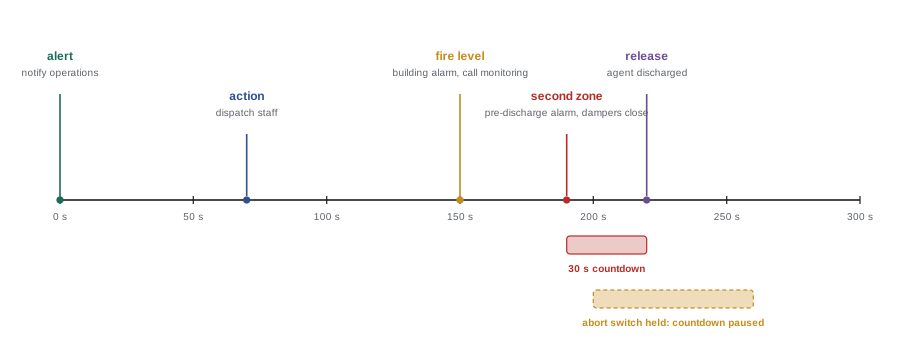
Clean agent systems use a release sequence that guards against accidental discharge while making sure a real fire is suppressed. A common arrangement is cross-zoning (or counting): the first detector in alarm produces a local alarm and alerts staff; a second detector in a separate zone confirms the fire and starts the pre-discharge alarm and a time delay, often 30 seconds, so that people can leave; at the end of the delay the agent is released. An abort switch, which must be held in by hand (a deadman type), suspends the countdown while staff verify the situation, and a manual release station allows immediate discharge. The release panel also confirms that doors are closed and dampers shut before discharge so that the agent will hold.
# Staged alarm and cross-zoned clean agent release sequence for a network room
DELAY = 30           # pre-discharge time delay, seconds

def run(events, abort_held):
    zones_in_alarm = set()
    countdown = None
    released = False
    start = None
    log = []
    for t in range(0, 400):
        for et, source, zone, level in events:
            if et != t:
                continue
            if level == "alert":
                log.append((t, f"{source} alert: notify operations centre"))
            elif level == "action":
                log.append((t, f"{source} action: dispatch staff to investigate"))
            elif level == "fire":
                first = not zones_in_alarm
                zones_in_alarm.add(zone)
                action = "building alarm, call monitoring station" if first else "zone alarm"
                log.append((t, f"{source} fire in zone {zone}: {action}"))
                if len(zones_in_alarm) >= 2 and countdown is None:
                    countdown = DELAY
                    start = t
                    log.append((t, "second zone confirms: pre-discharge alarm, close dampers, stop air handlers"))
        if countdown is not None and not released and t > start:
            holding = abort_held[0] <= t < abort_held[1]
            if holding:
                if t == abort_held[0]:
                    log.append((t, f"abort switch held: countdown paused at {countdown} s"))
            else:
                if t == abort_held[1] and abort_held[1] > abort_held[0]:
                    log.append((t, f"abort released: countdown resumes from {countdown} s"))
                countdown -= 1
                if countdown == 0:
                    released = True
                    log.append((t, "agent released: discharge alarm, do not enter"))
    for t, msg in log:
        print(f"  t = {t:3d} s  {msg}")

events = [(0, "ASD sector 2", 1, "alert"), (70, "ASD sector 2", 1, "action"),
          (150, "ASD sector 2", 1, "fire"), (190, "Spot detector 14", 2, "fire")]
print("Without abort:")
run(events, (0, 0))
print("Abort switch held from 200 s to 260 s:")
run(events, (200, 260))Without abort: t = 0 s ASD sector 2 alert: notify operations centre t = 70 s ASD sector 2 action: dispatch staff to investigate t = 150 s ASD sector 2 fire in zone 1: building alarm, call monitoring station t = 190 s Spot detector 14 fire in zone 2: zone alarm t = 190 s second zone confirms: pre-discharge alarm, close dampers, stop air handlers t = 220 s agent released: discharge alarm, do not enter Abort switch held from 200 s to 260 s: t = 0 s ASD sector 2 alert: notify operations centre t = 70 s ASD sector 2 action: dispatch staff to investigate t = 150 s ASD sector 2 fire in zone 1: building alarm, call monitoring station t = 190 s Spot detector 14 fire in zone 2: zone alarm t = 190 s second zone confirms: pre-discharge alarm, close dampers, stop air handlers t = 200 s abort switch held: countdown paused at 21 s t = 260 s abort released: countdown resumes from 21 s t = 280 s agent released: discharge alarm, do not enter
In this simulation, releasing the abort switch resumes the countdown where it stopped. Release panels offer several abort modes, and in some the countdown restarts from the full delay or a fixed time when the switch is released; the mode chosen must be agreed with the authority having jurisdiction and explained in staff training, because staff who expect one behaviour and meet another may leave too late.
Every interface is a place where something can go wrong: a damper that does not close, a door that stays locked, a release panel that was left disabled after maintenance. That is why integrated testing of all interconnected systems together, rather than each system on its own, is required for new installations and periodically afterwards (Lesson 11).
The fire safety plan
The NFC requires a fire safety plan for most buildings with a fire alarm system, prepared in cooperation with the fire department and kept up to date. It sets out the emergency procedures to follow when a fire is discovered or the alarm sounds, the appointment and duties of supervisory staff, the measures for controlling fire hazards, the maintenance of fire protection systems, schematic drawings showing fire protection equipment and exits, and arrangements for fire drills.
For a data centre, the plan should address features that general templates may miss:
- Investigation procedures for early-warning alerts: who goes, what they look for, how they find the source using the aspirating detector's sector information and thermal cameras, and when to de-energize equipment.
- Clean agent rooms: pre-discharge evacuation, use of abort and manual release stations, and re-entry only after ventilation.
- Battery rooms: actions on off-gas or battery management alarms, and keeping people out of rooms where explosive gas may have accumulated (Lesson 7).
- Security interfaces: how doors and mantraps behave on alarm, and how security staff help account for everyone in the building.
- Contractors and visitors: briefing on alarm signals and assembly areas, since they may make up a large share of people on site during construction or upgrades.
- Business continuity: who decides to transfer load to another site and how customers are informed.
Fire drills test the plan with real people. Drills reveal problems that drawings do not: alarms that cannot be heard in a contained aisle, mantraps that trap people, staff who do not know where the assembly area is, or a security desk that cannot produce a list of who is on site. Lessons from each drill and from real alarms should be recorded and used to update the plan.
Worked problem
Accounting for people
A data centre has 24 staff, 40 contractors and 6 visitors on site during an evacuation. The access control system logs badge entries and exits, but 9 contractors entered by following others through a door rather than badging (tailgating), and 3 staff left by a side door without badging out. How reliable is a badge-based headcount?
Show solution
- People actually present: \(24 + 40 + 6 = 70\).
- Badge system count: \(70 - 9 + 3 = 64\), because 9 people are missing from the log and 3 who left still appear as present.
- The roll call at the assembly area would therefore show 6 fewer people than are present, while 3 people would appear to be missing who are already safe.
Answer: The badge system misses 9 people and falsely reports 3 as still inside. Such errors can send firefighters searching for people who are safe, or leave someone unaccounted for. Anti-tailgating measures (Lesson 9), contractor sign-in at the assembly area, and wardens who check areas as they leave all improve accuracy.
Working with the fire department
Firefighters arriving at a data centre face an unfamiliar building with high-voltage equipment, batteries, security barriers and possibly gaseous agents. The pre-incident plan described in Lesson 1, regular site visits, a key box at the entrance, a fire alarm annunciator showing which zone is in alarm, and a knowledgeable staff member who meets the crew all reduce delay and risk. The fire safety plan should name who provides this liaison at every hour of the day, including weekends when staffing is low.
Common mistakes
MistakeAssuming a horn in the main aisle will be heard inside contained aisles.
InsteadProvide appliances inside each containment system and verify audibility by measurement.
MistakeIgnoring trouble and supervisory signals because they are not fires.
InsteadRespond promptly; they indicate the protection may not work when needed.
MistakeLeaving a clean agent release panel disabled after maintenance.
InsteadUse lock-out procedures with sign-off to restore the system.
MistakeTesting each system separately and assuming the interfaces work.
InsteadCarry out integrated testing of all interconnected systems.
MistakeRelying solely on badge records for a headcount.
InsteadCombine access records with wardens, contractor sign-in and roll calls.
Summary and key terms
- The fire alarm control unit monitors initiating and supervisory devices and drives notification and control outputs.
- Signals are alarm, supervisory or trouble, each requiring a defined response.
- Canadian systems follow CAN/ULC-S524, S527, S536 and S537; two-stage systems are common.
- Audible signals must be at least 10 dBA above ambient; visual devices are needed above 87 dBA.
- Voice systems give specific instructions; intelligibility must be verified.
- Clean agent release uses cross-zoning, a pre-discharge delay, an abort switch and a manual release.
- A fire safety plan, drills and fire department liaison turn alarms into effective action.
- Fire alarm control unit
- The panel that monitors devices and controls notification and outputs.
- Addressable system
- A system in which each device has its own identifying address.
- Supervisory signal
- A signal indicating an abnormal condition in fire protection equipment.
- Trouble signal
- A signal indicating a fault in the fire alarm system itself.
- Notification appliance
- A horn, speaker or strobe that warns occupants.
- Temporal pattern
- A standard evacuation signal of three pulses followed by a pause.
- Speech transmission index (STI)
- A measure of speech intelligibility from 0 to 1.
- Cross-zoning
- Requiring two detectors in separate zones before releasing an agent.
- Abort switch
- A hand-held switch that suspends a clean agent countdown while pressed.
- Fire safety plan
- A written plan for emergency procedures, staff duties and hazard control.
Practice problems
Work each problem on paper first, then reveal the answer to check.
Name the three types of signal a fire alarm panel handles.
Show answer
Alarm, supervisory and trouble.
Give two examples of supervisory devices.
Show answer
Valve tamper switches, low air pressure switches, low temperature switches, fire pump running.
Ambient noise is 78 dBA. What is the minimum alarm level under the NBC?
Show answer
88 dBA.
A horn gives 96 dBA at 3 m. Estimate the level at 12 m in open space.
Show answer
Two doublings: 96 − 12 = 84 dBA.
Why must strobes in view of each other be synchronized?
Show answer
To limit the combined flash rate, which could trigger photosensitive seizures.
A room is 30 m by 16 m. How many strobes covering 16.5 m square each?
Show answer
2 by 1, so 2.
Why are voice messages useful in a data centre?
Show answer
They can give different instructions to different zones and explain what to do.
What does an abort switch do in a clean agent system?
Show answer
It suspends the countdown while held, allowing staff to verify the alarm.
Name two data-centre-specific items for a fire safety plan.
Show answer
Early-warning investigation procedures, clean agent evacuation, battery alarm response, mantrap behaviour, contractor briefing.
Why can badge records give a wrong headcount?
Show answer
Tailgating and unrecorded exits make the log differ from reality.
Lesson quiz · 5 questions
Score 60% or more to complete this lesson.
Create a free account to save your progress, take quizzes and earn a certificate.