
DCE-340 · Lesson 5 of 12 · 34 min
Generators, fuel and emissions
The UPS buys minutes; the generators buy hours or days. When the utility fails, every data centre of any size relies on on-site engine-generators to carry the whole facility, IT, cooling and support systems, until utility power returns. Generators are therefore among the most important and most expensive pieces of equipment on a site, and a large campus may have a hundred or more of them, each 2 to 3.5 MW. This lesson covers how generator sets work and are rated, how they are sized for data centre loads, fuel storage and quality, testing, emissions regulations, and the alternatives now emerging.
The engine-generator set
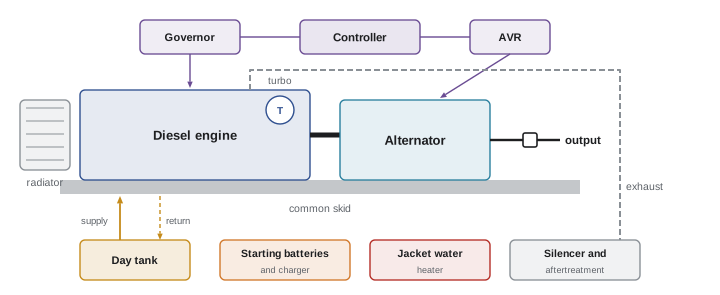
A generator set (genset) consists of a reciprocating engine, almost always a turbocharged diesel for data centres, coupled to a synchronous alternator, with its control and support systems:
- The engine converts fuel into shaft power at a constant speed: 1800 r/min for a four-pole 60 Hz alternator in North America (1500 r/min for 50 Hz).
- The governor controls fuel injection to hold the speed, and therefore the frequency, constant as the load changes.
- The alternator's automatic voltage regulator (AVR) controls the field excitation to hold the output voltage.
- The controller starts and stops the set, monitors and protects it (overspeed, low oil pressure, high coolant temperature, overcurrent), and communicates with the transfer and paralleling equipment.
- Support systems: starting batteries and charger (or air starters), jacket water heaters that keep the engine warm for a fast start, a radiator or remote cooling, an exhaust silencer and aftertreatment, fuel day tank, and a weatherproof, sound-attenuated enclosure or a generator room.
Large diesel sets can start and reach rated speed and voltage in under 10 seconds. Codes for life-safety emergency systems require exactly that: the generator must be able to carry the emergency load within 10 seconds of power loss. Data centre generators are mostly standby systems rather than life-safety systems, but they are typically specified to the same start time, because the UPS battery runtime is planned around it.
Generator ratings
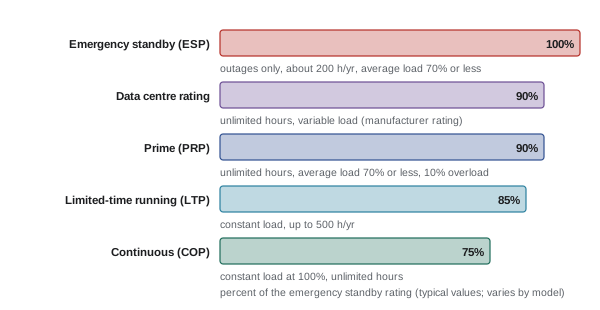
A generator's rating depends on how it is used. ISO 8528-1 defines the principal ratings:
- Emergency standby power (ESP): the maximum power for a variable load during a utility outage, limited to about 200 hours a year, with an average load of no more than about 70% of the ESP rating over 24 hours. This is the highest number on the data sheet.
- Prime rated power (PRP): power for a variable load for unlimited hours a year, with average load up to 70% of PRP and a 10% overload available for short periods. PRP is typically about 90% of ESP.
- Limited-time running power (LTP): constant load for up to 500 hours a year.
- Continuous operating power (COP): constant load at 100% for unlimited hours, typically 70 to 80% of ESP.
Data centres complicate this, because an outage may last days and the load is fairly constant. The Uptime Institute's Tier standard requires that, for Tier III and IV, the generators be rated to carry the design load for unlimited hours: a standby rating with a 200 hour limit does not qualify. Manufacturers therefore publish a data centre power (DCP) or similar rating, allowing unlimited hours at a load that may vary, usually somewhere between the prime and standby figures. Designers must be careful which number they use: a set sold as "3000 kW" at standby might be rated 2500 kW for data centre duty.
Sizing generators for data centre loads
The generator plant must carry everything needed to keep the facility running: the UPS input (IT load divided by UPS efficiency, plus battery recharge), the mechanical plant (chillers, pumps, fans and cooling towers), and the house loads (lighting, controls, security, offices). It must also handle how these loads behave, which is often harder than meeting the total kW.
Worked problem
Generator plant for a data hall
A data hall has 3.0 MW of IT load fed through UPSs at 96% efficiency. After an outage the UPSs recharge their batteries, adding 10% of the UPS output to their input for the first hour. The mechanical load at design conditions is 1.1 MW and house loads are 0.15 MW. Generators have a data centre rating of 2.25 MW each. How many are needed for N, and for N+1?
Show solution
- UPS input: \(3.0/0.96 = 3.125\) MW, plus recharge \(0.10 \times 3.0 = 0.30\) MW: 3.425 MW.
- Total: \(3.425 + 1.1 + 0.15 = 4.675\) MW.
- N: \(4.675/2.25 = 2.08\), so 3 generators. N+1 = 4.
Answer: Three for N and four for N+1. Many designers limit the recharge current or delay it until all generators are online, so that the recharge does not push the N count up; here, without recharge, the load is 4.375 MW and still needs 3 for N.
Step loads and transient response
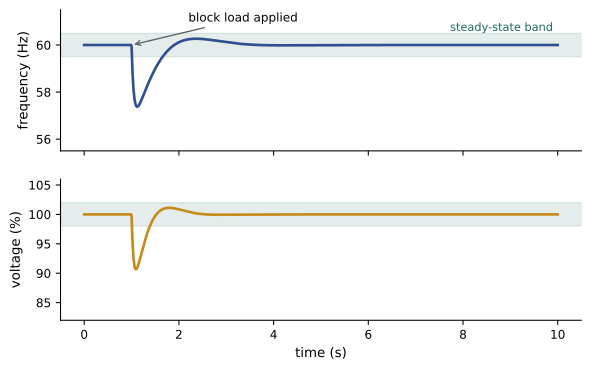
A diesel engine cannot accept its full rating instantly. When load is applied, the speed dips until the governor injects more fuel and the turbocharger spools up, and the voltage dips until the AVR raises excitation. ISO 8528-5 defines performance classes G1 to G4 that set limits on frequency and voltage dips and recovery times; data centre sets are usually specified as class G3 (and some loads G4). A modern turbocharged diesel can typically accept about 50 to 70% of its rating in a single step while staying within those limits, depending on its brake mean effective pressure: the more highly rated the engine, the smaller the first step it accepts.
Data centre loads are sequenced onto the generators in blocks after transfer: UPSs walk in their rectifiers over 10 to 30 seconds, and mechanical loads start in steps controlled by the building management system, with large chillers ramped by variable-frequency drives. Motor starting across the line can draw six times rated current at low power factor and is the classic cause of excessive voltage dip.
Worked problem
Load steps
A 2000 kW generator can accept 60% of its rating in the first step and 100% of its remaining capacity after recovering. Its loads are UPS input 1100 kW (walked in as one block), chilled-water pumps 250 kW, and a chiller 450 kW. How should the loads be sequenced?
Show solution
- First step limit: \(0.6 \times 2000 = 1200\) kW. The UPS block of 1100 kW fits.
- After recovery, remaining capacity: \(2000 - 1100 = 900\) kW. Add the pumps (250 kW) and then the chiller (450 kW) as separate steps, totalling 1800 kW.
Answer: UPSs first (1100 kW), then pumps, then the chiller ramped in by its drive, ending at 1800 kW (90%). Cooling continuity during the sequence relies on thermal storage or a mechanical UPS, as described in DCE-330.
Nonlinear and leading power factor loads
Generators are a high-impedance source compared with a utility transformer, so harmonic currents from rectifiers and drives create more voltage distortion on generator power. Alternators for data centres are often oversized relative to the engine, or specified with low subtransient reactance (X″d around 12 to 15%), to limit distortion. A less obvious issue is leading power factor: IT power supplies and UPS input filters can present a capacitive load when lightly loaded, and an alternator supplying leading reactive power loses excitation control. The generator's capability curve limits leading kVAr, typically to about 10 to 20% of rating, and designers check the worst case, such as UPSs walking in onto a lightly loaded generator.
Derating
Engine output falls at high altitude and high intake air temperature because the air is less dense; manufacturers publish derating curves, typically starting above 25 to 40 °C and 150 to 1000 m elevation. The radiator must also reject full heat at the highest site temperature, including recirculation of hot exhaust air between closely spaced enclosures, which is a frequent problem on generator yards.
Fuel
Consumption and storage
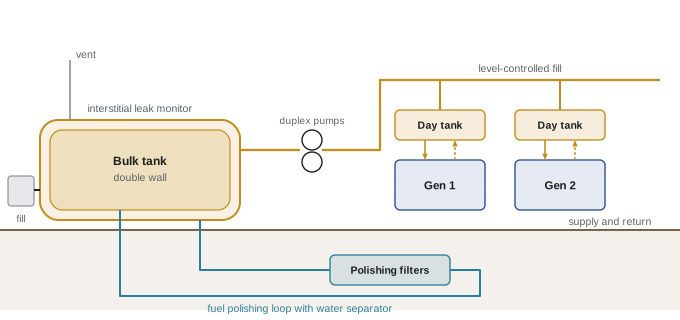
A large diesel set burns about 0.25 to 0.28 litres of fuel per kWh at full load (somewhat more per kWh at part load). A 2 MW set at full load therefore uses about 530 L/h, and a 50 MW campus running on generators burns over 13,000 L every hour. Fuel is stored in a day tank or base (belly) tank under each generator, holding several hours, and in bulk tanks that refill the day tanks through duplex pumps. The amount of on-site storage is a key design decision: the Uptime Institute requires a minimum of 12 hours for Tier ratings, and most facilities store 24 to 72 hours at design load and hold priority refuelling contracts with more than one supplier.
Worked problem
Bulk fuel storage
A site has eight 2 MW generators running at 75% load in an outage. Using 0.27 L/kWh and allowing 10% of tank volume as unusable, what storage provides 48 hours?
Show solution
- Load: \(8 \times 2 \times 0.75 = 12\) MW, or 12,000 kWh each hour.
- Fuel rate: \(12{,}000 \times 0.27 = 3240\) L/h.
- 48 hours: \(3240 \times 48 = 155{,}500\) L; with 10% unusable: \(155{,}500/0.9 = 172{,}800\) L.
Answer: About 173,000 L of tank capacity, for example four 45,000 L bulk tanks, plus the day tanks. A tanker carries roughly 30,000 to 60,000 L, so the site would need several deliveries a day in a long outage.
Fuel quality
Diesel fuel degrades in storage: it oxidizes, forms gums and sediment, absorbs water through condensation, and supports microbial growth ("diesel bug") at the fuel-water interface, which clogs filters. Biodiesel blends are even less stable. Because standby fuel may sit for years, sites test fuel regularly, drain water from tank bottoms, and run fuel polishing systems that circulate and filter the fuel. A generator that starts perfectly in monthly tests can still fail hours into an outage when sludge stirred up from the bottom of a tank reaches its filters.
Hydrotreated vegetable oil (HVO), also called renewable diesel, is a drop-in replacement that meets the diesel fuel specification. It is chemically similar to fossil diesel but contains no aromatics or sulphur, stores for longer, and can reduce lifecycle greenhouse gas emissions by 70 to 90% depending on its feedstock. Several operators have converted generator fleets to HVO.
Regulations for storage tanks
In Canada, fuel storage is governed by the National Fire Code of Canada (Part 4, flammable and combustible liquids) as adopted provincially, by provincial regulations such as the Technical Standards and Safety Authority's Liquid Fuels Handling Code in Ontario, and, for federal lands, by the federal Storage Tank Systems for Petroleum and Allied Petroleum Products Regulations. The CCME Environmental Code of Practice for storage tank systems sets out good practice for secondary containment, leak detection and overfill protection. Tanks are usually double-walled or placed in a containment dike.
Testing and maintenance
A generator that has not been tested under load cannot be trusted. Standard practice is:
- Weekly inspection: fluid levels, battery charger, jacket water heater, leaks, alarms.
- Monthly run under load for at least 30 minutes, at a load high enough (commonly 30% of nameplate or more) to reach normal operating temperature.
- Annual load bank test, with a multi-hour run, for sets that cannot carry enough building load monthly.
- Periodic integrated tests that open the utility breaker ("pull-the-plug" tests) to prove the complete sequence of UPS, transfer switches and generators.
Diesel engines run at light load for long periods suffer wet stacking: unburned fuel and carbon accumulate in the exhaust, reducing performance and causing smoke. Load bank tests burn these deposits off.
For emergency (life-safety) power systems in buildings, CSA C282, Emergency electrical power supply for buildings, sets requirements for installation, weekly inspection and monthly load testing, and the CEC (Section 46) and the National Building Code set where emergency power is required. Data centre standby generators are usually not life-safety systems, but owners commonly apply similar test regimes.
Emissions and air permits
Diesel engines emit nitrogen oxides (NOx), particulate matter (PM), carbon monoxide and hydrocarbons, along with carbon dioxide. Because data centre generators run only for testing and real outages, their annual emissions are modest per engine, but large campuses with dozens of engines can approach regulatory thresholds.
In Canada, air emissions from stationary engines are regulated mainly by the provinces, through environmental approvals such as Ontario's Environmental Compliance Approval or registration under its Environmental Activity and Sector Registry, with limits often based on CCME guidelines. Federal off-road and stationary engine emission standards align broadly with US EPA tiers. Approvals typically limit annual operating hours for testing and require modelling of nearby air quality.
Worked problem
Annual NOx from generator testing
A campus has 20 generators of 2.5 MW. Each runs 50 hours a year for testing at an average of 75% load. Compare annual NOx emissions for engines emitting 6.0 g/kWh (typical of Tier 2) and 0.67 g/kWh (Tier 4 Final).
Show solution
- Energy: \(20 \times 2500 \times 0.75 \times 50 = 1{,}875{,}000\) kWh.
- Tier 2: \(1{,}875{,}000 \times 6.0 = 11{,}250{,}000\) g \(= 11.3\) t.
- Tier 4 Final: \(1{,}875{,}000 \times 0.67 = 1{,}256{,}000\) g \(= 1.3\) t.
Answer: About 11 tonnes of NOx a year with Tier 2 engines versus about 1.3 tonnes with Tier 4 Final. Permit limits are often based on potential emissions at maximum permitted hours rather than actual testing, so some regions require aftertreatment even on emergency engines.
Alternatives to diesel
Pressure to cut emissions and the scale of AI campuses are pushing operators to consider other options:
- Natural gas generators avoid fuel storage and emit less NOx and PM, but they accept load steps less readily, and their fuel supply depends on a pipeline that may be affected by the same event as the grid.
- Bi-fuel engines start on diesel and then substitute natural gas for much of the fuel.
- Fuel cells (solid oxide on natural gas or hydrogen, or proton exchange membrane on hydrogen) can run continuously as primary power, with the grid as backup.
- Large battery energy storage systems can replace some generator hours and provide grid services, though batteries for multi-day outages are not economic.
- On-site gas turbines and reciprocating engine plants, sometimes built as primary power where the grid connection is delayed, which turns backup generation into a power plant with full air permitting.
Lesson 6 looks at battery energy storage and on-site generation that can reduce reliance on diesel, and Lesson 8 at how a generator's limited fault current affects protection.
Common mistakes
MistakeSizing data centre generators on the emergency standby rating.
InsteadUse a rating allowed for unlimited hours at the design load (data centre, prime or continuous), as Tier III and IV require.
MistakeApplying the whole facility load in one step.
InsteadSequence loads in blocks within the engine's step-load capability and check voltage and frequency dips.
MistakeIgnoring leading power factor at light load.
InsteadCheck the generator capability curve for leading kVAr when UPSs and IT loads come on.
MistakeStoring diesel for years without testing or polishing.
InsteadTest fuel regularly, remove water and circulate it through polishing filters.
MistakeRunning generators at very light load in monthly tests.
InsteadTest at a meaningful load or use load banks to avoid wet stacking.
Summary and key terms
- Diesel gensets start and accept load within about 10 seconds and carry the facility for as long as fuel lasts.
- ISO 8528 ratings (ESP, PRP, LTP, COP) depend on hours and load profile; Tier III and IV need unlimited-hour ratings.
- Size for UPS input plus recharge, mechanical and house loads, then check step loads, harmonics and leading power factor.
- Diesel engines accept about 50 to 70% of their rating in one step; loads are sequenced after transfer.
- Fuel use is about 0.27 L/kWh; sites typically store 24 to 72 hours with refuelling contracts.
- Fuel degrades: test, drain water and polish; HVO is a drop-in, lower-carbon option.
- Test monthly under load and annually with load banks; avoid wet stacking.
- Emissions are regulated provincially; storage under the NFC and provincial codes; CSA C282 covers emergency power.
- Natural gas, fuel cells and batteries are emerging alternatives.
- Genset
- An engine and alternator with controls, forming a generator set.
- Governor
- The control that regulates engine speed and hence frequency.
- AVR
- Automatic voltage regulator controlling the alternator excitation.
- Emergency standby power (ESP)
- ISO 8528 rating for variable load during outages, limited hours per year.
- Prime rated power (PRP)
- ISO 8528 rating for variable load with unlimited hours.
- Continuous operating power (COP)
- ISO 8528 rating for constant load with unlimited hours.
- Block load
- A large load applied to a generator in a single step.
- Subtransient reactance
- The alternator reactance governing its response to sudden load changes and harmonics.
- Day tank
- A small fuel tank at each generator, refilled from bulk storage.
- Fuel polishing
- Circulating and filtering stored fuel to remove water, sediment and microbial growth.
- Wet stacking
- Accumulation of unburned fuel and carbon in a diesel exhaust from light-load running.
- HVO
- Hydrotreated vegetable oil, a renewable drop-in diesel fuel.
- Load bank
- A test load used to run a generator at a controlled load.
Practice problems
Work each problem on paper first, then reveal the answer to check.
A set is rated 3000 kW ESP. Roughly what continuous (COP) rating might it have?
Show answer
About 70 to 80% of ESP: 2100 to 2400 kW.
Why do Tier III and IV designs not use ESP ratings?
Show answer
ESP is limited to about 200 hours a year; these Tiers require generators able to carry the load for unlimited hours.
IT load 1.5 MW, UPS efficiency 95%, mechanical 0.6 MW, house 0.1 MW. Generators are 1 MW each. How many for N+1, ignoring recharge?
Show answer
1.5/0.95 + 0.6 + 0.1 = 2.28 MW; N = 3; N+1 = 4.
A 1500 kW engine accepts 55% in the first step. What is the largest first block?
Show answer
825 kW.
Why are alternators often oversized for UPS loads?
Show answer
To lower source impedance (subtransient reactance), reducing voltage distortion from harmonic currents, and to handle reactive power.
How much fuel does a 2.5 MW set use in 24 hours at 80% load, at 0.27 L/kWh?
Show answer
2500 × 0.8 × 24 × 0.27 = 12,960 L.
What is wet stacking and how is it prevented?
Show answer
Unburned fuel and carbon accumulating in the exhaust from light-load running; prevent it by testing at adequate load or with load banks.
Give two reasons a generator might fail hours into an outage despite passing monthly tests.
Show answer
Contaminated fuel clogging filters; day tank refill failures; cooling or ventilation problems at sustained load; wet stacking deposits.
Ten 3 MW generators run 40 h/yr at 70% load emitting 6 g/kWh NOx. Annual NOx?
Show answer
10 × 3000 × 0.7 × 40 = 840,000 kWh × 6 g = 5.04 t.
What is one advantage and one disadvantage of natural gas generators for backup?
Show answer
Advantage: no on-site fuel storage, lower emissions. Disadvantage: slower step-load acceptance, pipeline supply may fail with the grid.
Lesson quiz · 5 questions
Score 60% or more to complete this lesson.
Create a free account to save your progress, take quizzes and earn a certificate.