
DCE-340 · Lesson 3 of 12 · 33 min
Batteries: lead-acid, lithium-ion and safety
The battery is the part of the UPS that actually keeps the load alive in the seconds after the utility fails, and it is also the part most likely to let the system down. Battery failures, from a single weak cell in a long string to a dried-out jar or a loose connection, are consistently among the leading causes of UPS-related outages, and large lithium-ion installations bring fire risks that building and fire codes now treat very seriously. This lesson covers battery chemistries, how much runtime to provide, how to size a battery, monitoring and maintenance, and the safety requirements for battery rooms.
How much runtime?
The battery only has to carry the load until the generators are online and stable, plus a margin. Generators that start and accept load within 10 seconds (Lesson 5) suggest that very short runtimes would suffice, but designers allow for a failed start and a retry, for a generator that must be paralleled before taking load, and for operators to respond if automatic systems fail. Historically, data centres specified 15 minutes of battery at full load. Modern facilities typically specify 5 to 10 minutes with lead-acid and 3 to 5 minutes with lithium-ion, and sites with flywheels accept 15 to 30 seconds. The runtime decision is ultimately a trade between the cost, floor space and weight of storage and the probability that the generators will not take the load in time.
Energy stored is power times time: 1 MW for 5 minutes is \(1000 \times 5/60 = 83\) kWh delivered to the load. Because the battery delivers power through the inverter and is discharged at a very high rate, the installed nameplate energy is much larger, as the sizing example later shows.
Battery chemistries
Lead-acid
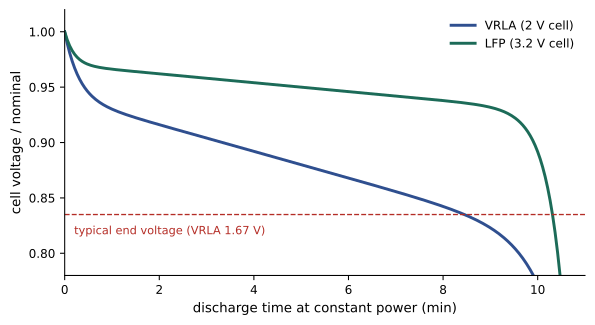
Lead-acid batteries have served UPS systems for a century. Each cell has a nominal voltage of 2 V, floats at about 2.25 to 2.27 V and is considered discharged at an end voltage of 1.60 to 1.75 V per cell for short, high-rate discharges. Two forms are used:
- Vented (flooded, wet) cells have free liquid electrolyte, transparent jars, and vents that release hydrogen and oxygen during charging. They last 15 to 20 years with good maintenance, need water topping and regular inspection, and require spill containment and ventilation. They remain common in telecom central offices and utility substations.
- Valve-regulated lead-acid (VRLA) cells immobilize the electrolyte in an absorbent glass mat (AGM) or gel and recombine most of the oxygen and hydrogen internally, releasing gas only through a pressure-relief valve. They need no watering and can be mounted in cabinets or racks beside the UPS. Their design life is usually quoted as 10 years (or 5 years for cheaper blocks), but service life in UPS duty is often only 4 to 7 years, especially if warm.
Lithium-ion
Lithium-ion batteries have largely replaced VRLA in new large UPS installations. Compared with VRLA they offer about a third of the weight and half to a third of the floor space for the same power, a service life of 10 to 15 years (matching the UPS itself), tolerance of higher room temperatures, much faster recharge, and an integrated battery management system (BMS) that monitors every cell. They cost more initially, but their total cost of ownership is often lower because they avoid one or two replacements.
The two chemistries used in UPS applications are lithium iron phosphate (LFP, 3.2 V nominal per cell), which is more thermally stable and is now dominant, and lithium nickel manganese cobalt oxide (NMC, about 3.6 to 3.7 V), which has higher energy density but releases more heat and oxygen if it fails. Other storage technologies, such as nickel-zinc and sodium-ion, are appearing for UPS duty because of their safety characteristics, and nickel-cadmium is still used in some industrial and utility systems.
| Property | Vented lead-acid | VRLA | Lithium-ion (LFP) |
|---|---|---|---|
| Nominal cell voltage | 2.0 V | 2.0 V | 3.2 V |
| Typical service life in UPS duty | 15 to 20 years | 4 to 10 years | 10 to 15 years |
| Relative footprint (same power) | Largest | 1 | About 0.4 |
| Relative weight | Heaviest | 1 | About 0.3 |
| Optimum temperature | 20 to 25 °C | 20 to 25 °C | Up to 30 to 35 °C |
| Maintenance | Watering, cleaning, inspections | Inspections, ohmic tests | BMS monitoring |
| Main hazards | Hydrogen, acid spills | Hydrogen (lower), thermal runaway (rare) | Thermal runaway, flammable gases |
Battery strings and the DC bus
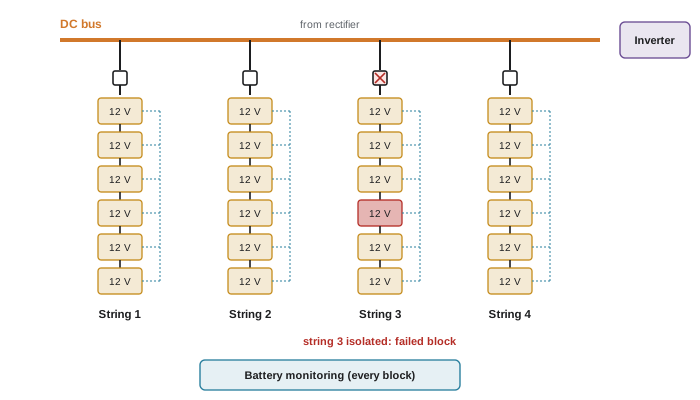
A battery string is a series connection of cells or blocks whose total voltage matches the UPS DC bus. A UPS with a nominal 480 V DC bus might use 240 lead-acid cells (forty 12 V blocks of six cells each) or 150 LFP cells. Strings are paralleled to obtain more capacity, each with its own DC breaker or fused disconnect, so that a faulty string can be isolated while the others continue. Designers avoid paralleling too many strings, typically no more than four to six, because current sharing becomes uneven and a single weak string can go unnoticed.
Each string is only as strong as its weakest cell: one cell with high internal resistance limits the current of the whole string and heats up, and an open cell or connection disables the string entirely. This is why single-string systems are risky and why monitoring of every block matters.
Discharge behaviour and sizing
A battery's available capacity falls as the discharge rate rises, so a battery that provides 100 Ah over 10 hours might deliver only half of that in 10 minutes. For this reason UPS batteries are sized from manufacturers' constant-power discharge tables, which give the watts per cell (or per block) that can be delivered for a given time to a given end voltage, rather than from ampere-hour ratings.
The sizing procedure is:
- Determine the battery power: UPS output kW divided by inverter efficiency (and the DC-DC converter efficiency if present).
- Choose the number of cells per string and the end voltage, set by the UPS's minimum DC bus voltage divided by the number of cells.
- Divide the battery power by the number of cells to obtain the watts per cell required.
- Apply correction factors: an aging factor (1.25 for lead-acid, so that the battery still meets the runtime at 80% of its capacity at end of life), a temperature factor for rooms colder than 25 °C, and a design margin (often 1.1 to 1.15) for load growth and uncertainty.
- Select a cell or block from the table that delivers the corrected watts per cell for the runtime, or calculate the number of parallel strings needed.
Worked problem
Sizing a VRLA battery
A 500 kW UPS has an inverter efficiency of 96% and a DC bus using 240 cells per string (forty 12 V blocks) with a minimum voltage of 400 V. A candidate block delivers 600 W per cell for 10 minutes to 1.67 V per cell. With an aging factor of 1.25 and a design margin of 1.1 at 25 °C, how many parallel strings provide 10 minutes at full load?
Show solution
- Battery power: \(500/0.96 = 521\) kW.
- End voltage: \(400/240 = 1.67\) V per cell, which matches the table.
- Watts per cell for one string: \(521{,}000/240 = 2170\) W.
- Corrected: \(2170 \times 1.25 \times 1.1 = 2984\) W per cell.
- Strings: \(2984/600 = 4.97\), so 5 strings.
Answer: Five parallel strings of forty blocks, 200 blocks in total. Each block is 12 V and roughly 200 Ah, so the installed nameplate energy is about \(200 \times 12 \times 200 = 480\) kWh at the 10-hour rate, compared with only \(500 \times 10/60 = 83\) kWh delivered to the load, showing how much capacity is lost to the high discharge rate, aging allowance and margin.
Lithium-ion systems are sized in the same way from the manufacturer's data, usually as complete cabinets with a rated kW for a given runtime. No aging factor of 1.25 is applied, but the end-of-life capacity (often 70 to 80%) and the BMS's current limits must be checked. A lithium-ion battery must also be able to deliver the UPS's peak current and survive the recharge current after an outage.
Temperature and battery life
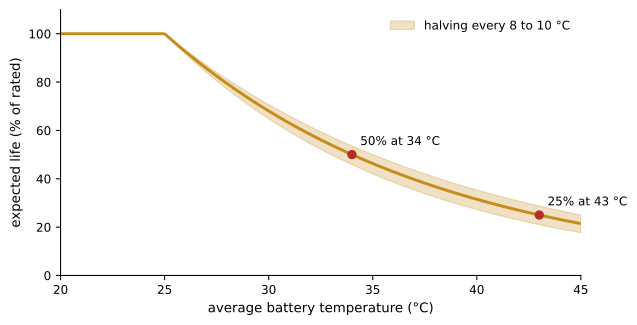
Temperature is the main enemy of lead-acid batteries. The chemical reactions that corrode the positive plate grids roughly double their rate for every 8 to 10 °C rise, so the life of a VRLA battery designed for 10 years at 25 °C falls to about 5 years at 33 to 35 °C. Battery rooms and cabinets for lead-acid are therefore kept at 20 to 25 °C, and a battery placed beside a hot UPS or in a warm aisle ages fast. Cold reduces available capacity instead (roughly 1% per degree below 25 °C), which is handled by the temperature factor in sizing. Lithium-ion is more tolerant but its life also shortens at high temperature, and its BMS restricts charging below about 0 °C.
Worked problem
Effect of a warm battery room
A VRLA battery has a design life of 10 years at 25 °C, and its life halves for every 9 °C increase. A failed air conditioner keeps the battery cabinet at 31 °C on average for a year before anyone notices. How much life is consumed in that year?
Show solution
- Life factor at 31 °C: \(2^{-(31-25)/9} = 2^{-0.667} = 0.63\).
- Effective life at 31 °C: \(10 \times 0.63 = 6.3\) years, so one year at 31 °C consumes \(1/6.3 = 16\%\) of the battery's life, compared with 10% at 25 °C.
Answer: About 16% of the life in one year, equivalent to 1.6 years at 25 °C. The battery will reach end of life roughly seven months earlier than planned, which is why battery temperatures are monitored and alarmed.
Monitoring, testing and maintenance
Because a battery's condition cannot be seen while it floats, operators rely on regular measurements:
- Float voltage of each cell or block, and overall string voltage and float current.
- Ohmic measurements (internal resistance, impedance or conductance) of each block. An increase of 20 to 30% above the baseline for that model, or a block well out of line with its neighbours, signals aging or a defect.
- Connection resistance of the intercell links, and terminal temperature, since loose or corroded links can overheat or fail open under discharge current.
- Ambient and pilot-cell temperatures.
- Capacity (load bank) discharge tests, which are the only definitive proof of runtime. A battery is normally replaced when its capacity falls to 80% of rated.
IEEE 450 (vented lead-acid), IEEE 1188 (VRLA) and IEEE 1679 and related guides (lithium-ion and other technologies) describe inspection intervals and test methods. Continuous battery monitoring systems measure voltage, resistance and temperature on every block and alarm on trends, and lithium-ion BMSs do the same at cell level. A good maintenance program replaces individual weak blocks early and whole strings before end of life, rather than waiting for a failure during an outage.
Battery safety
Electrical hazards
A large UPS battery is a DC source of several hundred volts that cannot be switched off: opening the string breaker isolates the bus, but the cells themselves remain live. Short-circuit currents of tens of kiloamperes are possible, and DC arcs are harder to extinguish than AC arcs. Work on batteries requires insulated tools, removal of jewellery, arc-flash assessment for DC systems and, for large strings, sectioning the string into lower-voltage segments before work.
Hydrogen and electrolyte
Lead-acid batteries release hydrogen when charging, especially during equalize or boost charges and if a cell fails. Hydrogen is flammable between about 4% and 75% by volume in air, so ventilation must keep the concentration well below 4%, usually under 1% (25% of the lower flammable limit). IEC 62485-2 gives the airflow needed as \(Q = 0.05\,n\,I_{gas}\,C \times 10^{-3}\) m³/h, where \(n\) is the number of cells, \(C\) the 10-hour capacity in Ah and \(I_{gas}\) the gassing current in mA per Ah: about 1 for VRLA on float, 8 on boost charge, and 5 and 20 for vented cells. Vented cells also require spill containment, neutralizing materials and eyewash stations.
Worked problem
Battery room ventilation
A battery room contains five strings of 240 VRLA cells, each 200 Ah. Find the ventilation airflow on float charge and on boost charge using the IEC 62485-2 formula.
Show solution
- Cells: \(n = 5 \times 240 = 1200\).
- Float: \(Q = 0.05 \times 1200 \times 1 \times 200 \times 10^{-3} = 12\) m³/h.
- Boost: \(Q = 0.05 \times 1200 \times 8 \times 200 \times 10^{-3} = 96\) m³/h.
Answer: 12 m³/h on float and 96 m³/h on boost, both small compared with normal room air conditioning, but the ventilation must be reliable and its failure alarmed. The calculation includes a safety factor so that hydrogen stays well below 1%.
Thermal runaway in lithium-ion batteries
Lithium-ion cells contain a flammable organic electrolyte. If a cell is overcharged, damaged, internally shorted or overheated, exothermic reactions can make its temperature rise uncontrollably: the cell vents flammable and toxic gases (hydrogen, carbon monoxide, hydrocarbons and hydrogen fluoride), may ignite, and can heat neighbouring cells until they fail too. This propagation is called thermal runaway. LFP cells reach runaway at higher temperatures and release less energy than NMC cells, but they still vent flammable gas, which can accumulate and explode in an enclosed room even without visible fire.
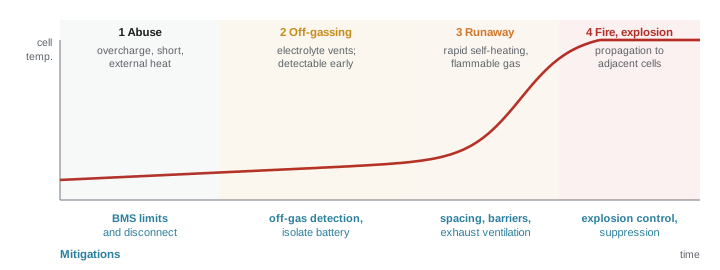
Protection is layered: the BMS prevents overcharge, over-discharge and overtemperature and disconnects the battery; off-gas detectors sense electrolyte vapour minutes before runaway so that the battery can be isolated; module design, spacing and barriers limit propagation; exhaust ventilation or explosion relief prevents gas build-up; and fire detection and suppression contain any fire. UL 9540 is the safety standard for energy storage systems, and UL 9540A is a test method that measures how a cell, module, unit and installation behave in thermal runaway, providing the data that authorities use to approve spacing, quantities and protection.
In Canada, battery installations are governed by the Canadian Electrical Code (Section 26 for storage batteries and Section 64 for energy storage systems), by the National Building Code and National Fire Code of Canada as adopted by each province, and by local fire authorities, which commonly ask for UL 9540A test data and may reference NFPA 855. Lithium-ion UPS systems are generally required to be listed to applicable CSA or UL standards and installed with the separation, detection and ventilation the authority approves.
Replacement and recycling
Lead-acid batteries are one of the most recycled products: nearly all the lead is recovered, and returning spent batteries is required in most jurisdictions. Lithium-ion batteries are recycled for cobalt, nickel, lithium and copper, though LFP has less valuable material. Battery replacement is a significant maintenance task for a large data centre: a 20 MW facility may have thousands of VRLA blocks to replace every five years, which is a major part of the business case for lithium-ion.
Lesson 4 extends storage beyond the central UPS to DC distribution and battery backup units inside the racks, and Lesson 10 covers how batteries are tested at commissioning.
Common mistakes
MistakeSizing UPS batteries from ampere-hour ratings.
InsteadUse constant-power discharge tables (W per cell to an end voltage), with aging, temperature and design factors.
MistakePlacing VRLA batteries in warm spaces.
InsteadKeep lead-acid at 20 to 25 °C; life halves for each 8 to 10 °C above 25 °C.
MistakeRelying on a single battery string.
InsteadUse parallel strings with individual breakers, and monitor every block, since one weak cell can disable a string.
MistakeAssuming LFP batteries cannot cause fires or explosions.
InsteadLFP is more stable but still vents flammable gas in thermal runaway; provide detection, ventilation and code-compliant spacing.
MistakeTreating an isolated battery as de-energized.
InsteadThe cells remain live; use insulated tools, DC arc-flash assessment and sectioning.
Summary and key terms
- Battery runtime covers generator start and transfer plus margin: typically 5 to 10 minutes for lead-acid, 3 to 5 minutes for lithium-ion.
- VRLA cells (2 V) need no watering but last only 4 to 10 years in UPS duty; vented cells last longer but need maintenance and containment.
- Lithium-ion (mainly LFP, 3.2 V) is lighter and smaller, lasts 10 to 15 years and has a BMS.
- Strings match the DC bus voltage; parallel strings with individual breakers add capacity and resilience.
- Size from constant-power tables with aging (1.25 for lead-acid), temperature and design factors.
- Lead-acid life roughly halves for every 8 to 10 °C above 25 °C.
- Monitor voltage, internal resistance, connections and temperature; replace at 80% capacity.
- Lead-acid releases hydrogen: ventilate to keep it below 1%; lithium-ion risks thermal runaway and flammable gas.
- Codes: CEC Sections 26 and 64, NBC and NFC as adopted provincially, UL 9540 and 9540A.
- VRLA
- Valve-regulated lead-acid battery with immobilized electrolyte.
- Vented (flooded) cell
- A lead-acid cell with liquid electrolyte and open vents.
- LFP
- Lithium iron phosphate, a thermally stable lithium-ion chemistry.
- NMC
- Lithium nickel manganese cobalt oxide, a higher-energy lithium-ion chemistry.
- BMS
- Battery management system that monitors and protects lithium-ion cells.
- End voltage
- The cell voltage at which a discharge is considered complete.
- Aging factor
- A sizing multiplier (1.25 for lead-acid) that ensures runtime at end of life.
- Float charge
- The constant voltage applied to keep a battery fully charged.
- Ohmic measurement
- Measurement of a cell's internal resistance, impedance or conductance to assess its health.
- Thermal runaway
- A self-heating failure of a cell that can propagate to others.
- Off-gas detection
- Sensing of electrolyte vapour released before thermal runaway.
- UL 9540A
- A test method for thermal runaway fire propagation in energy storage systems.
- Lower flammable limit
- The lowest concentration of a gas in air that can burn (about 4% for hydrogen).
Practice problems
Work each problem on paper first, then reveal the answer to check.
How much energy does a 2 MW load use in 6 minutes?
Show answer
2000 × 6/60 = 200 kWh.
How many LFP cells (3.2 V) are needed for a nominal 512 V DC bus?
Show answer
512/3.2 = 160 cells.
A UPS with 240 cells per string has a minimum DC voltage of 408 V. What is the end voltage per cell?
Show answer
408/240 = 1.70 V per cell.
A 300 kW UPS at 95% inverter efficiency uses 240 cells. What watts per cell are needed before correction factors?
Show answer
300,000/0.95/240 = 1316 W per cell.
With an aging factor of 1.25 and design margin of 1.15, and a block giving 450 W per cell, how many strings does the previous question need?
Show answer
1316 × 1.25 × 1.15 = 1892 W; 1892/450 = 4.2, so 5 strings.
A VRLA battery rated 10 years at 25 °C runs at 35 °C. Using halving every 10 °C, what life is expected?
Show answer
About 5 years.
Why are UPS batteries replaced at 80% capacity?
Show answer
Capacity falls rapidly after that point, and the aging factor of 1.25 assumes the battery still meets runtime at 80%.
Find the float ventilation for 480 VRLA cells of 150 Ah using IEC 62485-2.
Show answer
Q = 0.05 × 480 × 1 × 150 × 10⁻³ = 3.6 m³/h.
What warning does off-gas detection give, and what should it trigger?
Show answer
It detects electrolyte vapour minutes before thermal runaway; it should trigger alarms, isolation of the affected battery and ventilation.
Give three advantages of lithium-ion over VRLA for UPS duty.
Show answer
Smaller and lighter; 10 to 15 year life; tolerates higher temperatures; faster recharge; cell-level BMS monitoring.
Lesson quiz · 5 questions
Score 60% or more to complete this lesson.
Create a free account to save your progress, take quizzes and earn a certificate.