
COMP-119 · Lesson 9 of 12 · 27 min
Reading questions carefully
▶ Video coming soon A video version of this lesson is on the way.
After her first full-length practice test, Noor sat with Lorna and went through every question she had answered wrongly. The result surprised both of them. Of the eighteen she missed, nine were on topics she genuinely did not know yet. The other nine she could explain once she reread them. She had missed the word NOT in one, chosen an answer that was true but not the best in two, overlooked that a question asked for the first step in one, and picked one answer where the question asked for two in another. She had also clicked the wrong option twice while rushing and guessed two at the end when time ran short. Half of her lost points came from reading, rushing and timing, not from knowledge. Lorna says this is the most common pattern she sees in new candidates, and the most fixable. This lesson is about reading exam questions the way they are written.
The anatomy of a multiple-choice question
Every Tech+ question has the same parts. The stem is the question itself, often with a short scenario first. The scenario gives the facts you are allowed to use: who the user is, what they need, what has already been tried. The question line, usually the last sentence of the stem, says exactly what is being asked: the best choice, the first step, the most likely cause, or the item that does not belong. The options are the possible answers. One is the key, the correct answer; the rest are distractors, written to look plausible to someone who has not read carefully or who has a partial understanding. Good distractors are usually true statements in general but wrong for this question.
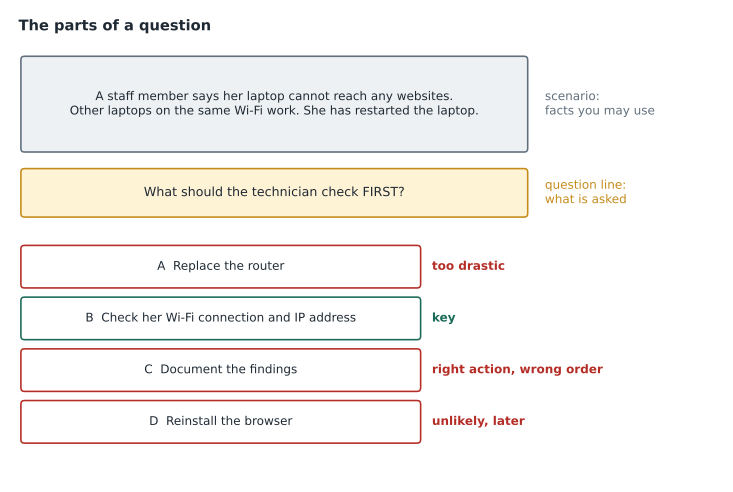
Read the question line first, then the scenario
A simple habit makes a large difference: read the last sentence of the stem before the scenario. Knowing that the question asks for the most likely cause, or the first thing to do, tells you what to look for in the scenario. Then read the scenario carefully, noting the facts that matter: the device, the symptom, what changed, and any limits such as cost or speed. Finally, read every option before choosing. Candidates who pick the first option that looks right often miss a better one further down.
Lorna teaches a four-word routine: ask, read, predict, check. Ask: what is the question line asking for? Read: what facts does the scenario give? Predict: before looking at the options, what answer would you give? Check: which option matches your prediction, and does each other option fail for a clear reason? Predicting first protects against distractors, because you approach the options with your own answer rather than letting the options suggest one.
Keywords that change the answer
A handful of words in the question line change what counts as correct, and exam writers use them deliberately. BEST means several options may work, and you must choose the one that works best for the situation described. FIRST or NEXT means the order of actions matters; the right answer may not be the most important action overall, only the one that comes first. MOST LIKELY means choose the most probable cause given the facts, not every possible cause. NOT, EXCEPT and LEAST reverse the question, so you are looking for the one option that does not fit. Some questions ask you to choose two or three answers; the number is stated in the question line, and choosing a different number of options is marked wrong.
| Keyword | What it means | How to handle it |
|---|---|---|
| BEST | More than one option may work | Compare the options against the scenario's specific need |
| FIRST or NEXT | Order matters | Place the options in sequence and pick the earliest that has not been done |
| MOST LIKELY | Choose the most probable cause | Use the facts given; prefer simple, common causes |
| NOT, EXCEPT, LEAST | The question is reversed | Mark each option true or false, then pick the odd one out |
| Choose two (or three) | A set number of answers is required | Select exactly that number |
Worked problem
A reversed question
Consider this practice question: "Which of the following is NOT a form of social engineering? A: Phishing. B: Tailgating. C: Ransomware. D: Vishing." How should Noor approach it?
Show solution
- Spot the word NOT: the question is reversed, so the answer is the one option that is not social engineering.
- Mark each option: phishing is social engineering (true), tailgating is social engineering (true), vishing is social engineering (true).
- Ransomware is malware, a type of software, not a technique for tricking people, so it is the odd one out.
- Check: if the word NOT had been missed, all three other options would have looked like correct answers, which is a clue the question is reversed.
Answer: C, ransomware. When three options seem correct, check whether the question is reversed.
Using only the facts given
Scenario questions are built from the facts in the stem, and the right answer follows from those facts. A common error is to add facts from experience: "in my branch, the printer is always the problem, so it must be the printer." The exam's scenario may say nothing of the kind. Another error is to ignore facts that rule an option out. If the scenario says other computers on the same network are working, a network-wide outage is not the most likely cause, however familiar it might be. Underline, mentally or on the whiteboard, the facts that rule options in or out.
A related skill is noticing what has already been done. If the scenario says the user has restarted the computer, "restart the computer" cannot be the next step, even though it is often the right first step in real life. If the scenario says the cable has been replaced, a cable problem is unlikely. Exam writers include these details precisely to rule out the most obvious answers.
Worked problem
A first-step question
"A user reports that her monitor shows no image. The computer's power light is on and the fans are running. She has already restarted the computer. What should the technician check FIRST? A: Replace the graphics card. B: Check that the monitor is powered on and its cable is connected. C: Reinstall the operating system. D: Update the monitor's firmware."
Show solution
- Ask: the question line asks for the FIRST check.
- Read: the computer has power and fans; the user has already restarted it, so restarting is ruled out.
- Predict: the simplest, most common cause of no image is the monitor itself being off or its cable loose, so check that before anything inside the computer.
- Check the options: A and C are drastic and come much later; D is unlikely and also later; B matches the prediction.
Answer: B. Check the simple, external causes first, especially when the computer itself appears to be working.
Eliminating distractors
When the answer is not obvious, eliminate options you can prove wrong. Each elimination raises the chance of choosing correctly. Some distractors are easy to remove: they are about a different topic, they contradict a fact in the scenario, or they are far too drastic for the problem, such as reinstalling an operating system to fix a printer setting. Options with absolute words such as always and never are often wrong, because few things in IT are always true, although this is a tendency, not a rule. If two options say almost the same thing, it is often the case that neither is correct, or that the difference between them is the point of the question.
Once you are down to two options, return to the question line. Which of the two answers exactly what is asked? If the question asks for the best protection against stolen passwords, both a longer password and multifactor authentication help, but MFA protects even when the password is known, so it is the better answer to that specific question. If you still cannot decide, choose the one that is simpler, safer or more standard practice, mark the question for review if the exam allows it, and move on.
| Distractor type | Example | Why it is wrong |
|---|---|---|
| True but irrelevant | Encryption protects data at rest (when the question is about phishing) | Correct statement, different problem |
| Right action, wrong order | Document the findings (as a first step) | Correct action, but it comes last |
| Too drastic | Reinstall the operating system (for a browser setting) | Far more than the problem needs |
| Contradicts the scenario | The whole network is down (when other computers work) | Ruled out by a stated fact |
| Almost right | WPA instead of WPA3 | A similar term with a key difference |
Multiple-response questions
Some questions ask for more than one answer. CompTIA describes the Tech+ exam as multiple choice, and multiple-choice questions on CompTIA exams can ask candidates to choose more than one option; the question line says how many. Treat each option as a true-or-false statement about the scenario, then select exactly the number requested. If a question asks for two and three options seem right, the scenario usually contains a fact that rules one out. Read it again.
Worked problem
Choosing two
"A small office wants to make its wireless network more secure. Which TWO actions would help most? A: Change the router's default administrator password. B: Use WPA3 with a long passphrase. C: Increase the screen brightness on staff laptops. D: Switch the network to WEP. E: Rename the network to the office's street address."
Show solution
- The question line asks for TWO actions that improve wireless security.
- A helps: default administrator passwords are well known and must be changed.
- B helps: WPA3 is the current standard, and a long passphrase resists guessing.
- C is irrelevant; D makes security worse because WEP is obsolete; E adds no security and could reveal the location.
Answer: A and B.
Look-alike terms and overthinking
Entry-level exams test many pairs of terms that look or sound alike, and a quick reader can swap them without noticing. Mbps and MBps, WPA and WPA3, authentication and authorization, primary key and foreign key, IaaS and PaaS, compiled and interpreted, virus and worm: each pair differs by one idea, and each pair makes a perfect distractor. Noor keeps a list of the pairs she has confused in practice and reads it aloud once a day. When one of those terms appears in a question, she slows down deliberately and says the distinguishing idea to herself before choosing.
The opposite problem is overthinking. Some candidates, especially those with real-world experience, imagine unusual situations in which the obvious answer would be wrong: "but what if the DNS server is also the DHCP server and the cable is half broken?" Exam questions are written to have one defensible best answer from the facts given, and that answer is usually the standard, textbook one. If an answer requires assumptions that the scenario does not state, it is probably not the intended answer. Lorna puts it bluntly: answer the question that was asked, about the situation that was described, using the method in the objectives.
A last reading trap is the answer that is too broad or too narrow. If a question asks which device connects wireless devices to the wired network, "a network device" is too broad to be the best answer and "a 6 GHz radio" is too narrow; "an access point" is exactly right. Prefer the option that matches the level of detail in the question line.
Building the habit
Careful reading is a habit, and habits come from practice. Noor adds a step to every practice session. For each question she answers, right or wrong, she writes down the keyword in the question line and the one fact in the scenario that decided the answer. Lorna expects the routine to feel automatic within two weeks; in cert club members who use it, reading errors usually fall sharply by the next practice test. She also points out that careful reading also speeds her up rather than slowing her down, because she spends less time going back and forth between options when she has predicted the answer first.
Common mistakes
MistakeReading the options before the question line.
InsteadRead the question line first, then the scenario, then predict.
MistakeMissing NOT or EXCEPT.
InsteadIf three options look correct, check whether the question is reversed.
MistakeChoosing a true statement that answers a different question.
InsteadMatch the option to exactly what the question line asks.
MistakeAdding facts from your own experience.
InsteadUse only the facts in the scenario.
MistakeSelecting the wrong number of answers.
InsteadChoose exactly as many options as the question asks for.
Summary and key terms
- Many lost points come from misreading, not missing knowledge.
- A question has a stem, a question line, a key and distractors.
- Read the question line first, then the scenario, then predict before checking options.
- Keywords such as BEST, FIRST, MOST LIKELY and NOT change what counts as correct.
- Use only the scenario's facts, and note what has already been tried.
- Eliminate distractors that are irrelevant, out of order, too drastic or contradicted by the scenario.
- Stem
- The question and any scenario that comes before the answer options.
- Key
- The correct answer to a multiple-choice question.
- Distractor
- A plausible but incorrect answer option.
- Question line
- The sentence in the stem that states exactly what is being asked.
- Reversed question
- A question using NOT, EXCEPT or LEAST that asks for the option that does not fit.
- Multiple-response question
- A question that asks for a stated number of correct options.
Practice problems
Work each problem on paper first, then reveal the answer to check.
What part of a question should you read first?
Show answer
The question line, the last sentence of the stem.
Three options seem correct. What should you check?
Show answer
Whether the question is reversed with NOT, EXCEPT or LEAST.
What does FIRST in a question line mean?
Show answer
Order matters; choose the earliest action that has not already been done.
A scenario says the user restarted the computer. Can restarting be the answer to what to do next?
Show answer
No; it has already been done.
Name three distractor types.
Show answer
True but irrelevant; right action in the wrong order; too drastic (also: contradicts the scenario, almost right).
What are the four steps of the reading routine?
Show answer
Ask, read, predict, check.
How many options should you choose on a question that says choose two?
Show answer
Exactly two.
Lesson quiz · 5 questions
Score 60% or more to complete this lesson.
Create a free account to save your progress, take quizzes and earn a certificate.