
COMP-119 · Lesson 12 of 12 · 24 min
Your final week plan
▶ Video coming soon A video version of this lesson is on the way.
The last cert club session before the winter break is about the end of the road. Noor's exam is planned for the second week of March 2027, and Lorna wants her to leave with a written plan for the final seven days: what to study, what to stop studying, what to check, and how to arrive at the exam rested and calm. Jun, the teen volunteer whose school program has booked him a Tech+ exam at a test centre in the spring, joins the session too, so the plan covers both delivery methods. Lorna starts with a principle: the final week is for consolidation, not for learning large new topics. Anything still unknown a week out is better handled with a focused summary than a deep dive.
What the final week is for
By the final week, the work of learning should be largely done. The objectives checklist should be marked known on nearly every line, practice tests should show consistent results across domains, and the error log should be dominated by occasional misreads rather than knowledge gaps. The final week has four jobs: keep knowledge fresh through short retrieval sessions, close the last one or two small gaps, rehearse exam conditions once more, and remove every practical risk from exam day. Rest is part of the plan. Sleep consolidates memory, and a tired candidate reads questions badly, which, as lesson 9 showed, is where many points are lost.
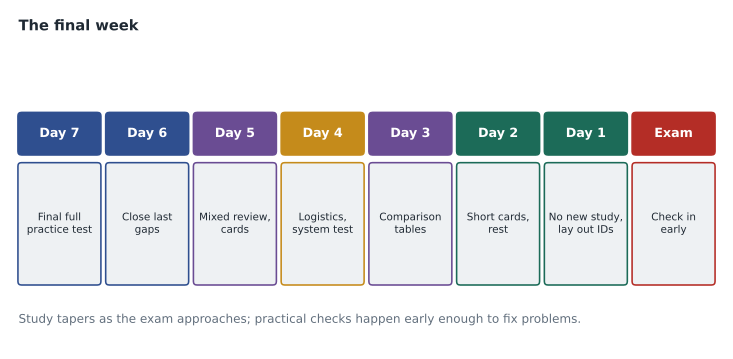
Day by day
Seven days out, take one final full practice test under exam conditions, with the timer, the pacing checkpoints and no interruptions. Review it the same day with the error log. This is the last test that should influence study; taking more full tests in the final days tends to raise anxiety more than it raises knowledge.
Six days out, close the last gaps from that test. Choose no more than two or three objectives, write a short explanation for each in your own words, and answer a handful of fresh questions on them. If a whole domain still feels weak at this point, that is a signal to consider rescheduling rather than cramming, as lesson 11 discussed.
Five days out, do mixed review: flash cards across every domain and a short set of mixed questions using the ask, read, predict, check routine. Mixing domains keeps all of them fresh and mirrors the exam.
Four days out, check logistics while there is still time to fix problems. For an online exam, run the Pearson VUE system test on the exact computer and network to be used, check the room, and reread the current OnVUE rules. For a test centre, confirm the address, the route, the travel time and parking or transit. For both, check the confirmation email for the exam code and appointment time, and confirm that the names on the CompTIA account and both IDs match exactly and that neither ID has expired.
Three days out, review the comparison tables made during the course: one page per domain. Two days out, a short card review and an early night. The day before the exam, do no new study. Lay out both IDs, set two alarms, prepare the room or the travel bag, and do something relaxing. Lorna is firm on this point: the night before an exam is not the time to discover a new topic.
| Days before | Study | Practical tasks |
|---|---|---|
| 7 | Final full practice test; error log review | None |
| 6 | Close two or three last gaps | None |
| 5 | Mixed review and flash cards | None |
| 4 | Light review | System test or route check; confirm code, time, names and IDs |
| 3 | Comparison tables, one page per domain | Reread current delivery rules |
| 2 | Short card review | Early night |
| 1 | No new study | Lay out IDs; set alarms; prepare room or bag |
One-page summaries
The best final-week study material is material you made yourself. Lorna asks Noor to compress each domain onto a single page: the comparison tables, the few facts that keep tripping her up, and one or two worked examples. Making the page is itself a strong review, because deciding what fits forces her to judge what matters. On the final days, reading six pages takes twenty minutes and touches every domain. The pages for her weakest domains, software development and data, are the ones she reads twice.
| Domain | What Noor puts on her page |
|---|---|
| IT concepts | Binary place values, hex digits, bits versus bytes, the troubleshooting steps in order |
| Infrastructure | Bottleneck table, file system limits, network device roles, private IP ranges, 169.254, Wi-Fi bands and WPA3, cloud models |
| Applications | OS functions, licence types, extensions, cache and cookies, private browsing limits, AI risks |
| Software development | Language categories, sequence, branching and looping, data types, variables and constants, properties and methods |
| Data | Records, fields, schema, primary and foreign keys, relational versus non-relational, structured versus unstructured |
| Security | CIA, AAA, MFA categories, passphrases, malware and social engineering types, 3-2-1 backups |
Worked problem
Checking ID and booking details
Four days before his test centre exam, Jun checks his details. His booking says "Jun Park". His student card says "Jun Park" and has his photo and signature. His passport says "Jun-ho Park". He also has a provincial ID card that says "Jun Park" with a photo. What should he do?
Show solution
- CompTIA requires two original, valid, unexpired IDs, one government-issued with name and photo, and the first and last names must match the registration exactly.
- The passport's first name, "Jun-ho", does not match "Jun" on the booking, so it should not be relied on.
- The government ID card ("Jun Park", with a photo) can serve as the primary ID, and the student card ("Jun Park", with photo and signature) as the secondary, provided both are original and unexpired.
- He should still confirm the current ID policy on the Pearson VUE CompTIA page, and if there is any doubt, contact Pearson VUE well before exam day; exceptions must be approved in advance.
Answer: Use the government ID card and the student card, whose names match exactly, check the current policy, and resolve any doubt with Pearson VUE days in advance.
Fitting the plan around real life
A final week plan has to survive contact with an ordinary week. Noor works shifts at the central library, including one evening and a Saturday every few weeks, and Lorna asks her to place the plan on her real calendar before agreeing to it. The heavier tasks, the full practice test and the gap-closing session, go on her two days off. The logistics check goes on a short morning before a late shift. The lighter tasks, cards and one-page summaries, fit into lunch breaks and the bus ride home. If an unexpected shift appears, the rule is to drop study, never sleep: a skipped card session costs almost nothing, while a short night before the exam can cost several careless errors.
Worked problem
Placing the plan on a calendar
Noor's planned exam is on a Friday morning. She works Saturday to Wednesday that week, with Thursday off, and has the previous Thursday and Friday off as well. Where should the full practice test, the gap-closing session and the logistics check go?
Show solution
- The full practice test needs an uninterrupted hour about seven days out: the previous Friday, a day off, fits exactly.
- Gap closing needs a focused block soon after the test: the Saturday morning before her shift, or split across Saturday and Sunday lunch breaks.
- The logistics check (system test, room, code, time, names and IDs) needs to happen with time to fix problems: Monday or Tuesday morning before work.
- Thursday, her day off before the exam, is for rest, laying out IDs and preparing the room, with no new study.
Answer: Practice test on the previous Friday, gap closing over the weekend, logistics early in the week, and a rest day on Thursday.
Last-minute worry
Almost everyone feels a wave of doubt in the final days: a sudden sense that some topic has been forgotten entirely. Lorna suggests a simple test. Open the objectives checklist, pick five lines at random and explain each one aloud in a sentence or two. Nearly always, the explanations come, and the feeling passes. If one does not, that line goes on the next day's short review, and the worry has become a small, specific task instead of a vague fear. She also reminds the club that a passing score has room for mistakes. No candidate needs to know every detail of every objective; they need a steady performance across all six domains, careful reading and a pace that finishes with time to spare.
Jun's version of the plan differs only in the practical details. His exam is at a test centre on a weekday after school, so his logistics check includes the bus route, the time it takes, and a message to his school program coordinator confirming the booking and the exam code. He will not need a system test or a cleared room, but he will need to arrive early, store his phone and bag as the centre directs, and follow the proctor's instructions at check-in. Everything else, from the final practice test to the one-page summaries and the early night, is the same.
Exam morning
On the morning of the exam, follow the backward plan from lesson 10. Eat a normal breakfast, drink some water, and use the restroom before check-in. For an online exam, close every other program, put the phone and any watch or earbuds out of arm's reach, clear the desk, and begin check-in as soon as it opens, 30 minutes before the appointment. For a test centre, leave with a generous margin and arrive early. In the minutes before the exam, glance at the one-page summaries if it helps, but do not start new questions; a single hard practice question can shake confidence for no benefit.
When the exam starts, read the tutorial screens, note the timer, and take the first few questions slowly as a warm-up. Use the checkpoints: at least 44 minutes left after question 20, 29 after question 40, 13 after question 60. Answer, work out, or guess and flag. Use the review time for flagged questions, and change answers only for a specific reason. When the last question is answered and reviewed, end the exam and read the score report.
After the exam
A pass is the start of something, not only the end. The certification appears in the candidate's CompTIA account after processing, and a digital badge can be shared on professional profiles. If the exam was FC0-U71-CE, note its five-year validity and the renewal rule. For Noor, the plan already continues: A+ Core 1 and Core 2 later in 2027, using the same weight-and-gap planning, the same error log and the same reading routine, adapted for an exam that adds performance-based questions. Much of what she learned for Tech+, especially infrastructure, applications and the troubleshooting method, carries directly into A+.
If the result is not a pass, the plan is equally clear. Save the score report, note the weakest domains, rest for a day or two, and then rebuild the priority list from the report, as lesson 11 described. A targeted plan built from the report gives the best chance on the next attempt. Either way, Lorna asks every cert club member to write a short note within a day of the exam about what went well, what surprised them and what they would change, because those notes become advice for the next person. Noor promises to write hers in March for Jun, who will be sitting his own exam soon afterward.
Common mistakes
MistakeLearning large new topics in the final days.
InsteadUse the final week to consolidate, close small gaps and rest.
MistakeTaking a full practice test every day of the final week.
InsteadTake one final full test about a week out, then taper.
MistakeRunning the OnVUE system test for the first time on exam morning.
InsteadRun it days ahead on the same computer and network.
MistakeAssuming a passport will always work as ID.
InsteadThe name must match the booking exactly; check both IDs.
MistakeStudying late into the night before the exam.
InsteadNo new study the day before; sleep consolidates memory.
Summary and key terms
- The final week is for consolidation, small gap closing, rehearsal, logistics and rest.
- Take one final full practice test about seven days out, then taper study.
- Check logistics early: system test or route, exam code, time, names and IDs.
- One-page domain summaries are the best final review material.
- On exam morning, follow the backward plan and begin check-in as soon as it opens.
- After the exam, either plan the next certification or rebuild the priority list from the score report.
- Consolidation
- Strengthening what is already learned through short reviews and retrieval.
- Taper
- Gradually reducing study load as the exam approaches.
- One-page summary
- A self-made single page per domain covering its key comparisons and facts.
- System test
- Pearson VUE's check that a computer and network meet OnVUE requirements.
- Digital badge
- An online record of a certification that can be shared and verified.
Practice problems
Work each problem on paper first, then reveal the answer to check.
What are the four jobs of the final week?
Show answer
Keep knowledge fresh, close the last small gaps, rehearse exam conditions, and remove practical risks; plus rest.
When should the last full practice test be taken?
Show answer
About seven days before the exam.
Why check logistics four days out rather than the day before?
Show answer
So there is time to fix problems such as a failed system test or a name mismatch.
What should you do the day before the exam?
Show answer
No new study: lay out IDs, set alarms, prepare the room or bag and rest.
What goes on a one-page domain summary?
Show answer
Comparison tables, the facts that keep tripping you up and one or two worked examples.
What carries over from Tech+ into A+ preparation?
Show answer
Domain knowledge, especially infrastructure and troubleshooting, plus the planning, error log and reading routine.
What should you do within a day of the exam, whatever the result?
Show answer
Write a short note about what went well, what surprised you and what to change.
Lesson quiz · 5 questions
Score 60% or more to complete this lesson.
Create a free account to save your progress, take quizzes and earn a certificate.