
CIV-230 · Lesson 8 of 12 · 21 min
Steel corrosion and protection
Corrosion is the slow return of refined metal to the oxide it was made from. For steel, it is the most expensive deterioration problem in civil infrastructure: it eats through exposed girders and bearings, splits the concrete over corroding reinforcement, weakens anchor rods and prestressing tendons, and shortens the lives of pipes, culverts, piles and towers. National studies have put the cost of corrosion at a few per cent of gross domestic product in industrial economies. Most of that cost is avoidable with the right materials, details, coatings and maintenance, and civil engineers make many of those choices.
Tamarack's work on the interchange includes a condition survey of the old bridge being replaced, whose deck was chloride-contaminated after decades of road salt. The cores and half-cell survey from that bridge are a good lesson in what the new deck's mix design, cover and reinforcement are meant to prevent.
The electrochemistry of corrosion
Corrosion of steel is an electrochemical process. It needs four things: an anode, where iron dissolves and releases electrons; a cathode, where those electrons are consumed, usually by oxygen and water; an electrical path through the metal connecting the two; and an electrolyte, such as moisture or the pore solution of concrete, that carries ions between them. Remove any one and corrosion stops.
The iron ions and hydroxide ions combine and react further with oxygen to form rust, a mixture of hydrated iron oxides. Rust occupies two to six times the volume of the steel it replaces. On an exposed girder, it flakes off and exposes fresh steel; inside concrete, the expanding rust cracks and spalls the cover, opening a fast path for more water and chlorides.
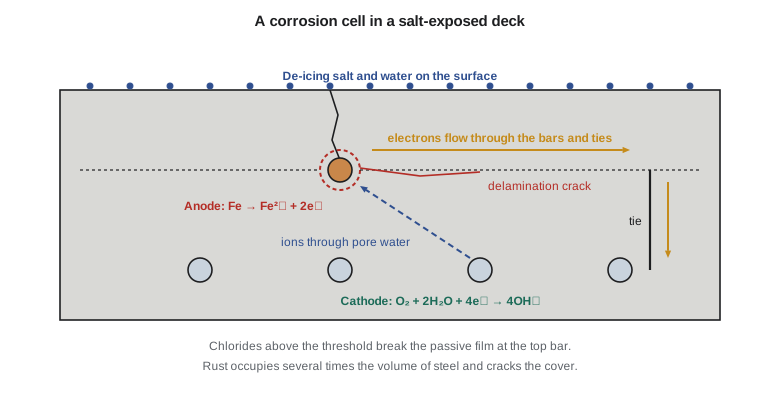
In clean, uncarbonated concrete, steel is passive: the high pH of the pore solution (about 12.5 to 13.5) forms a thin, stable oxide film that slows corrosion to an insignificant rate. As lesson 6 explained, chlorides above a threshold concentration or carbonation that lowers the pH destroy this film. Chloride attack produces local pits that can sever a bar or a prestressing wire with little visible warning, while carbonation causes more general corrosion.
Galvanic corrosion and the galvanic series
When two different metals are in electrical contact in an electrolyte, the more active one corrodes faster and protects the more noble one. The galvanic series ranks metals in sea water from active (magnesium, zinc, aluminium, carbon steel) to noble (stainless steel in its passive state, copper alloys, titanium). Bolting aluminium railings directly to steel, or using copper or stainless fasteners in galvanized steel, can create aggressive galvanic couples, especially when the more active metal has a small area. The same principle is put to good use in zinc coatings and sacrificial anodes.
Corrosion rates and how they are measured
Corrosion rates are expressed as metal thickness lost per year (micrometres or mils per year) or as mass loss. Atmospheric corrosivity varies enormously: ISO 9223 classes environments from C1 (very low, heated interiors) to C5 and CX (very high, marine splash zones and aggressive industrial sites). Carbon steel might lose well under 1 µm a year in a heated building, tens of micrometres a year in an industrial or coastal atmosphere, and much more in a splash zone or under a leaking expansion joint wet with salt water.
Because corrosion is the flow of an electric current, Faraday's law relates the mass of metal lost to the current and time:
where \(I\) is the corrosion current, \(t\) the time, \(M\) the atomic mass (55.85 g/mol for iron), \(n\) the number of electrons transferred (2 for iron) and \(F\) Faraday's constant (96 485 C/mol). Corrosion engineers measure corrosion current density in concrete with polarization techniques and use it to estimate section loss.
Worked problem
Section loss on a deck bar
A corrosion survey estimates a corrosion current density of 1.0 µA/cm² on the top bars of the old deck, which are 15M bars (16 mm diameter). If corrosion were uniform around the bar, how much would the diameter shrink in 10 years? The density of steel is 7.85 g/cm³.
Show solution
- Mass lost per square centimetre per year: \(m = (1.0\times10^{-6})(3.156\times10^{7})(55.85)/(2 \times 96\,485) = 9.13\times10^{-3}\ \text{g}\).
- \[\text{thickness loss} = \frac{9.13\times10^{-3}}{7.85} = 1.16\times10^{-3}\ \text{cm/yr} = 11.6\ \mu\text{m/yr}\]
- In 10 years the radius shrinks by about 0.116 mm, so the diameter shrinks by about 0.23 mm.
Answer: Uniformly, that is only about 1.5 per cent of the diameter, yet it is more than enough rust to crack the cover: studies suggest that a few tens of micrometres of corrosion penetration can crack typical covers. And because chloride corrosion concentrates in pits, the local loss at a pit can be several times the average.
F, M_FE, N, RHO = 96485.0, 55.85, 2, 7.85      # C/mol, g/mol, electrons, g/cm3
YEAR = 3.156e7                                  # s

def loss_um_per_year(i_uA_cm2):
    grams = i_uA_cm2 * 1e-6 * YEAR * M_FE / (N * F)    # per cm2 per year
    return grams / RHO * 1e4                            # cm -> micrometres

def remaining_area(d_mm, i_uA_cm2, years, pit_factor=1.0):
    x = loss_um_per_year(i_uA_cm2) * years / 1000 * pit_factor   # mm of penetration
    d = max(d_mm - 2 * x, 0.0)
    return 100 * (d / d_mm) ** 2

for i in (0.1, 0.5, 1.0, 2.0):
    print(f"i = {i:3.1f} uA/cm2: {loss_um_per_year(i):5.1f} um/yr; "
          f"16 mm bar after 25 yr: {remaining_area(16, i, 25):5.1f} % area (uniform), "
f"{remaining_area(16, i, 25, pit_factor=6):5.1f} % (pitting)")i = 0.1 uA/cm2: 1.2 um/yr; 16 mm bar after 25 yr: 99.3 % area (uniform), 95.7 % (pitting) i = 0.5 uA/cm2: 5.8 um/yr; 16 mm bar after 25 yr: 96.4 % area (uniform), 79.4 % (pitting) i = 1.0 uA/cm2: 11.6 um/yr; 16 mm bar after 25 yr: 92.9 % area (uniform), 61.1 % (pitting) i = 2.0 uA/cm2: 23.3 um/yr; 16 mm bar after 25 yr: 86.0 % area (uniform), 31.8 % (pitting)
Corrosion engineers often treat current densities below about 0.1 µA/cm² as negligible and above about 1 µA/cm² as high. With pitting (modelled crudely here as six times the average penetration), the local loss exceeds a third of the bar's area within 25 years at a current density of 1 µA/cm² or more, which is why chloride-contaminated decks are repaired or replaced long before the uniform-loss arithmetic suggests.
Protecting exposed steel: coatings
Paint systems protect steel by barrier action, by inhibiting pigments, or by sacrificial zinc. Modern high-performance bridge and industrial systems use three coats: a zinc-rich primer (organic or inorganic) that protects sacrificially at scratches and edges, an epoxy intermediate coat that builds barrier thickness, and a polyurethane or polysiloxane topcoat that resists ultraviolet light and keeps its colour. Total dry film thickness is typically 200 to 300 µm.
Surface preparation decides the life of any coating. Mill scale, rust, oil and salts must be removed, usually by abrasive blast cleaning to a specified cleanliness and surface profile; for zinc-rich primers, near-white or white metal blast cleaning is common. Inspectors check the blast cleanliness against visual standards, measure the profile, record air temperature, humidity, surface temperature and dew point (coating is not applied when the steel is less than about 3 °C (5 °F) above the dew point), and measure dry film thickness of each coat. Soluble salts left on the steel, especially chlorides, cause blistering under the coating and are tested for and removed on maintenance work.
Hot-dip galvanizing and metallizing
Hot-dip galvanizing dips cleaned steel into molten zinc at about 450 °C, forming metallurgically bonded zinc–iron alloy layers topped by pure zinc, typically 85 µm or more thick on structural steel under CSA G164 or ASTM A123. Zinc protects in two ways: as a barrier that corrodes far more slowly than steel, and sacrificially, protecting exposed steel at cuts and scratches. Galvanizing gives decades of maintenance-free life in most atmospheres and is common for light standards, railings, sign structures, transmission towers and reinforcing bars. Thermal-sprayed zinc or zinc–aluminium (metallizing) gives similar protection to members too big for the galvanizing kettle.
Because zinc corrodes roughly linearly with time in a given atmosphere, the time to first maintenance can be estimated as the coating thickness divided by the zinc corrosion rate, with an allowance for when about 5 per cent of the surface shows rust. In a rural or suburban atmosphere where zinc loses about 1 µm a year, an 85 µm coating can last well over half a century; in a severe industrial or marine atmosphere losing 4 µm a year, about 20 years.
Weathering steel
Weathering steels contain small amounts of copper, chromium, nickel and phosphorus that make the rust layer dense and adherent, so after a few years it slows further corrosion to a low rate. Unpainted weathering steel girders save the cost of painting and repainting and are widely used for highway bridges. They perform well only where the surface goes through wet and dry cycles and is not continually damp or salt-laden. They are not recommended in marine splash zones, under leaking deck joints, in tunnels, or where de-icing salt spray from traffic beneath reaches the girders, and details must drain water away and avoid places where debris collects.
Cathodic protection
Cathodic protection makes the steel the cathode of a deliberately created cell. In sacrificial (galvanic) systems, anodes of zinc, aluminium or magnesium connected to the steel corrode instead of it; they are used on pipelines, piles, tanks and, as small embedded zinc anodes, in concrete patch repairs to prevent new corrosion around the edges of a patch (the ring or halo effect). In impressed current systems, a direct current power supply drives protective current from inert anodes, such as titanium mesh in a concrete overlay, into the steel. Impressed current systems can protect whole decks and marine structures but need monitoring and power for their whole life.
Protecting reinforcement in concrete
For reinforcement, the first line of defence is the concrete itself: adequate cover, low permeability, SCMs and good curing (lessons 4 to 6). Additional measures are used where chloride exposure is severe:
- Epoxy-coated bars delay corrosion as long as the coating is intact, but damage during handling and placing, and disbondment over time in some environments, have reduced confidence in them, and some agencies have moved to other options.
- Galvanized bars resist higher chloride levels than plain bars and protect at small coating breaks.
- Stainless steel bars resist chlorides at many times the threshold of carbon steel; they cost more initially but are used in the most exposed zones of decks, barriers and marine structures where life-cycle cost favours them.
- Glass-fibre-reinforced polymer (GFRP) bars do not corrode at all. They are lighter and have lower stiffness than steel, cannot be bent on site, and are designed under their own standards; they have become common in bridge decks and barriers in several provinces and states.
- Corrosion-inhibiting admixtures, sealers and waterproofing membranes with asphalt overlays reduce chloride ingress or raise the threshold.
Designing out corrosion
Good detailing prevents more corrosion than any coating. Water should drain away from steel: avoid pockets and ledges that hold water and debris, provide drain holes in stiffeners and box sections, seal box members completely or make them fully accessible, and keep deck joints to a minimum (jointless and integral abutment bridges remove the most common source of salt water on bearings and girder ends). Avoid crevices between faying surfaces, isolate dissimilar metals, and specify access for inspection and maintenance painting.
Common mistakes
MistakePainting over rust and salts to save time.
InsteadBlast clean to the specified standard and test for soluble salts; coatings fail first where preparation was poor.
MistakeUsing weathering steel under a leaking deck joint or in salt spray.
InsteadWeathering steel needs wet–dry cycling and clean surfaces; detail to keep salt water off it or use a coating.
MistakePatching spalled concrete around corroding bars without addressing the cause.
InsteadRemove contaminated concrete behind the bars, consider embedded anodes, and reduce water and chloride exposure.
MistakeConnecting stainless or copper fittings directly to galvanized or carbon steel in wet locations.
InsteadIsolate dissimilar metals with non-conductive washers and sleeves, or choose compatible metals.
Summary and key terms
- Corrosion needs an anode, a cathode, a metallic path and an electrolyte; remove one and it stops.
- Rust occupies several times the volume of steel, so corroding reinforcement cracks and spalls concrete.
- Concrete passivates steel by its high pH; chlorides above a threshold or carbonation destroy the passive film.
- Faraday's law links corrosion current to metal loss; pitting concentrates loss locally.
- Coatings, galvanizing and metallizing, weathering steel and cathodic protection protect exposed steel.
- Cover, dense concrete, corrosion-resistant bars and good drainage details protect reinforcement.
- Anode
- The region where metal oxidizes and dissolves, releasing electrons.
- Cathode
- The region where electrons are consumed, typically by oxygen reduction.
- Passive film
- A thin protective oxide layer on steel in alkaline concrete.
- Galvanic corrosion
- Accelerated corrosion of the more active of two connected dissimilar metals.
- Hot-dip galvanizing
- Coating steel with zinc by immersion in molten zinc.
- Weathering steel
- Low-alloy steel whose adherent rust layer slows further corrosion in suitable environments.
- Cathodic protection
- Protecting steel by making it the cathode, with sacrificial anodes or impressed current.
- Delamination
- A horizontal crack in a concrete deck caused by expanding corrosion products at the reinforcement.
Practice problems
Work each problem on paper first, then reveal the answer to check.
Name the four elements needed for corrosion.
Show answer
An anode, a cathode, a metallic connection between them and an electrolyte.
Why does corroding reinforcement crack concrete?
Show answer
Rust occupies two to six times the volume of the steel it replaces, generating tensile stresses in the cover.
A zinc coating is 100 µm thick and zinc corrodes at 2 µm per year. Roughly how long until first maintenance?
Show answer
About \(100/2 = 50\) years, somewhat less to the 5 per cent rust stage.
Why is paint not applied when steel is near the dew point?
Show answer
Moisture condenses on the surface, causing poor adhesion and early failure.
What is the halo or ring effect in patch repairs?
Show answer
Corrosion accelerating in the old contaminated concrete around a new patch; embedded zinc anodes help prevent it.
Give two limitations of GFRP reinforcement.
Show answer
Lower stiffness than steel and it cannot be bent on site (also different design rules and fire behaviour).
Lesson quiz · 5 questions
Score 60% or more to complete this lesson.
Create a free account to save your progress, take quizzes and earn a certificate.