
CIV-230 · Lesson 4 of 12 · 21 min
Concrete mix design
A concrete mix design chooses the proportions of cement, supplementary materials, water, fine and coarse aggregate, air and admixtures so that the concrete is workable when fresh, strong and durable when hardened, and as economical and low-carbon as possible. The designer starts from the specification, which sets the strength, the exposure class, the maximum aggregate size and the slump, and works through a sequence of choices, each based on a well-established relationship. The result is a recipe for one cubic metre (or cubic yard) that is then checked by trial batches.
For the interchange deck, the provincial specification calls for a specified compressive strength of 35 MPa at 28 days, exposure class C-1 (reinforced concrete exposed to chlorides and freezing and thawing), 20 mm nominal maximum aggregate, a slump of 80 ± 30 mm at the point of discharge, and air content of 5 to 8 per cent. Tamarack reviews the supplier's submitted mix and checks it with trial batches.
The goals of mix design
Every mix balances competing goals. More water makes concrete easier to place but weaker and more permeable. More cement raises strength but adds cost, heat, shrinkage and carbon. Larger aggregate reduces paste demand but cannot fit between closely spaced reinforcement. Air entrainment protects against frost but each per cent of air lowers strength by roughly 5 per cent. A good designer meets every requirement with the least paste and the lowest practical water content.
Specifications increasingly allow performance-based requirements, where the producer chooses the proportions freely as long as tested properties (strength, chloride penetration resistance, shrinkage) meet stated limits, instead of prescriptive limits on cement content and water–cement ratio. Most work, however, still combines a few prescriptive durability limits with a specified strength.
Step 1: the required average strength
As lesson 1 explained, test results scatter, so the mix must average more than the specified strength. Acceptance rules in both Canadian and US practice say, in essence, that the average of any three consecutive strength tests must equal or exceed the specified strength, and that no single test may fall more than a set amount below it (3.5 MPa, or 500 psi, for ordinary strengths). Requiring that each criterion be failed no more than about once in a hundred times leads to the familiar formulas for the required average strength when the producer has a reliable standard deviation \(s\):
These are the ACI 318 formulas for specified strengths up to 35 MPa; CSA A23.1's acceptance criteria lead to very similar margins, and Canadian producers commonly use the same approach. The constants come from the normal distribution: 1.34 is 2.33 divided by the square root of 3, because an average of three tests has a standard deviation \(s/\sqrt{3}\). When no standard deviation is available, larger fixed margins (for example 8.5 MPa for strengths of 21 to 35 MPa) apply until enough data are gathered.
Step 2: the water–cementing materials ratio
The water–cementing materials ratio (w/cm) is the mass of water divided by the total mass of cement plus SCMs. It is chosen as the smaller of two values: the ratio needed for strength, read from the producer's own strength versus w/cm curve or from published tables, and the maximum ratio allowed for durability by the exposure class.
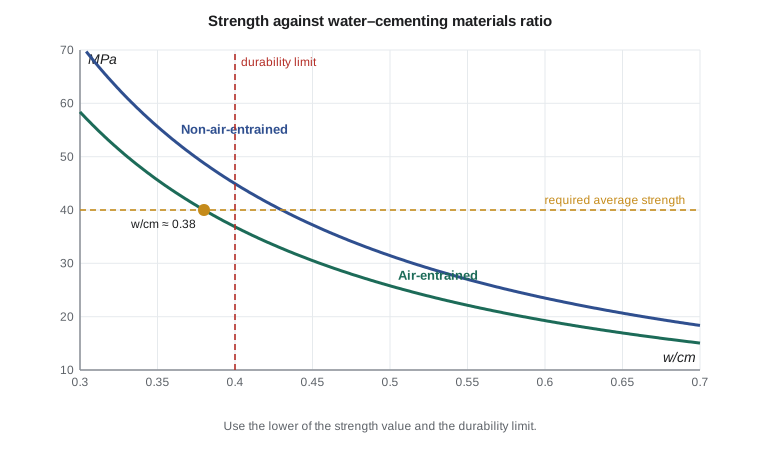
CSA A23.1 assigns exposure classes such as C-XL, C-1, C-2, F-1 and S-1 and sets a maximum w/cm, a minimum specified strength and an air content range for each. Class C-1, for structurally reinforced concrete exposed to chlorides with or without freezing and thawing, is the usual class for bridge decks and parking structures, and it carries a maximum w/cm of 0.40 and a minimum strength of 35 MPa.
The w/cm needed for strength depends on the materials. Each producer develops its own curve from trial batches, because cement brand, SCM type and aggregate change the relationship. Air-entrained concrete needs a lower w/cm than non-air-entrained concrete for the same strength.
Step 3: water content and air
The water needed for a given slump depends mainly on the maximum aggregate size and shape and on the air content. Larger and rounder aggregate needs less water. Published tables (such as those in ACI 211.1, the widely used guide for proportioning normal-weight concrete) give typical water contents; for 20 mm (3/4 in) crushed aggregate, air-entrained concrete at 75 to 100 mm (3 to 4 in) slump needs roughly 180 kg/m³ (305 lb/yd³) before admixtures. A normal-range water reducer cuts this by 5 to 10 per cent and a high-range one by 12 to 30 per cent.
The air content target comes from the exposure class and the aggregate size: smaller aggregate means more paste and therefore more air is needed to protect the paste. For 20 mm aggregate and severe exposure, a target of about 6 to 6.5 per cent is common, within a specified range such as 5 to 8 per cent.
Step 4: cementing materials content
The mass of cementing materials follows from the water content and the w/cm. The designer then splits it between cement and SCMs according to the specification and the exposure. Some specifications also set a minimum cementing materials content, though modern practice discourages unnecessarily high cement contents because they add heat, shrinkage and carbon without improving durability.
Step 5: coarse aggregate content
The volume of coarse aggregate per unit volume of concrete is read from a table based on the nominal maximum size of the coarse aggregate and the fineness modulus of the sand: coarser sand and larger coarse aggregate allow more coarse aggregate. For 20 mm aggregate and a sand with FM 2.80, a typical value is 0.62 cubic metres of dry-rodded coarse aggregate per cubic metre of concrete. Multiplying by the dry-rodded bulk density gives the oven-dry mass.
Step 6: fine aggregate by absolute volume
Everything else in the cubic metre is sand. The absolute volume of each ingredient is its mass divided by its density (relative density times the density of water). The sand volume is whatever is left after subtracting the volumes of water, cementing materials, air and coarse aggregate from one cubic metre.
Finally, the masses are converted to batch masses by correcting for the aggregates' moisture, as in lesson 2, and admixture doses are set from manufacturers' recommendations and trial batches.
Worked problem
Proportioning the deck mix
Design the 35 MPa, C-1 deck mix. The producer's standard deviation is 3.5 MPa. Its trial-batch curve for this cement and SCM blend gives 40 MPa at w/cm 0.38 with 6.5 per cent air. Use 160 kg/m³ of water (with a water reducer), cementing materials of 70 per cent GUL cement (relative density 3.15), 25 per cent slag (2.90) and 5 per cent silica fume (2.20), 6.5 per cent air, coarse aggregate with dry-rodded density 1650 kg/m³ and bulk relative density 2.68 (oven-dry), a coarse-aggregate volume factor of 0.62, and sand with bulk relative density 2.62.
Show solution
- \[f'_{cr} = \max(35 + 1.34 \times 3.5,\ 35 + 2.33 \times 3.5 - 3.5) = \max(39.7,\ 39.7) = 39.7\ \text{MPa}\]
- The trial curve gives about 40 MPa at 0.38, below the durability limit of 0.40, so use w/cm = 0.38.
- \[m_{cm} = 160/0.38 = 421\ \text{kg}: \ \text{cement } 295,\ \text{slag } 105,\ \text{silica fume } 21\ \text{kg}\]
- Coarse aggregate (oven-dry): \(0.62 \times 1650 = 1023\ \text{kg}\).
- \[V = 0.160 + \frac{295}{3150} + \frac{105}{2900} + \frac{21}{2200} + 0.065 + \frac{1023}{2680} = 0.746\ \text{m}^3\]
- \[m_{\text{sand}} = (1 - 0.746) \times 2620 = 665\ \text{kg (oven-dry)}\]
Answer: Per cubic metre: 160 kg water, 295 kg GUL, 105 kg slag, 21 kg silica fume, 1023 kg coarse and 665 kg fine aggregate (oven-dry), 6.5 per cent air. The fresh density is about 2270 kg/m³, a typical value for air-entrained concrete. Batch masses are then corrected for aggregate moisture and absorption.
Lucie programs the absolute volume method so that Tamarack can quickly check suppliers' submittals and see how changing one choice, such as the air content or SCM blend, affects the rest of the mix.
def absolute_volume_mix(water, wcm, blend, air, ca_factor, ca_rodded, g_ca, g_fa):
    """Returns oven-dry masses (kg per m3) by the absolute volume method."""
    cm = water / wcm
    masses = {name: frac * cm for name, (frac, g) in blend.items()}
    vol = water / 1000 + air
    vol += sum(masses[n] / (g * 1000) for n, (frac, g) in blend.items())
    ca = ca_factor * ca_rodded
    vol += ca / (g_ca * 1000)
    fa = (1 - vol) * g_fa * 1000
    return {"water": water, **masses, "coarse": ca, "fine": fa}

blend = {"GUL": (0.70, 3.15), "slag": (0.25, 2.90), "silica fume": (0.05, 2.20)}
for air in (0.055, 0.065, 0.075):
    mix = absolute_volume_mix(160, 0.38, blend, air, 0.62, 1650, 2.68, 2.62)
    density = sum(mix.values())
    parts = ", ".join(f"{k} {v:.0f}" for k, v in mix.items())
print(f"air {100*air:.1f} %: {parts}; density {density:.0f} kg/m3")air 5.5 %: water 160, GUL 295, slag 105, silica fume 21, coarse 1023, fine 691; density 2295 kg/m3 air 6.5 %: water 160, GUL 295, slag 105, silica fume 21, coarse 1023, fine 665; density 2269 kg/m3 air 7.5 %: water 160, GUL 295, slag 105, silica fume 21, coarse 1023, fine 639; density 2243 kg/m3
Raising the air from 5.5 to 7.5 per cent removes about 50 kg of sand from each cubic metre and lowers the density. It also lowers the strength, which is why the producer controls air content closely and why the field technician measures it on every acceptance sample.
Trial batches and adjustments
Calculated proportions are a starting point. The mix is checked in the laboratory or plant by trial batches that measure slump, air content, density (to check the yield) and strength at several ages. If the slump is low, water reducer is adjusted rather than water, so the w/cm stays fixed. If the yield is off, meaning a batch intended to make one cubic metre makes noticeably more or less, the aggregate masses are corrected. For important projects, trial batches also test durability properties such as rapid chloride permeability or bulk resistivity, freeze–thaw resistance and shrinkage.
Reviewing a submitted mix design
On most projects the engineer does not design the mix; the ready-mix supplier submits one, and the engineer or testing firm reviews it. Amara's checklist is short. Does the w/cm meet the exposure limit, calculated with all cementing materials and all water, including water in admixtures and free water on aggregates? Is the air content target inside the specified range? Are the SCM proportions allowed for the exposure and the season? Is there field data, from at least fifteen to thirty tests on a similar mix, showing the producer's standard deviation and that the mix has met the required average strength? Do the stated volumes add up to one cubic metre? Are the aggregates from approved sources with current test reports, including alkali reactivity? A submission that cannot answer these questions goes back for revision before the first truck is ordered, because problems are far cheaper to fix on paper than in a deck.
Special concretes
- High-performance concrete for decks and marine structures uses low w/cm (0.35 to 0.40), silica fume or slag, and high-range water reducers to reach very low permeability.
- Self-consolidating concrete flows into forms without vibration. It uses more fine material, a high-range water reducer and often a viscosity-modifying admixture, and it is tested by slump flow rather than slump.
- Mass concrete uses low-heat cements and high SCM contents, larger aggregate and sometimes cooling pipes to control temperature.
- Lightweight concrete uses expanded shale, clay or slate aggregate to reduce dead load, at densities of about 1600 to 1900 kg/m³ (100 to 120 lb/ft³).
- Fibre-reinforced concrete adds steel, synthetic or glass fibres to control cracking or replace some reinforcement in slabs on grade and shotcrete.
Common mistakes
MistakeDesigning to the specified strength instead of the required average strength.
InsteadAdd the statistical margin: the mix must average well above the specified strength.
MistakeChoosing w/cm from the strength curve and ignoring the exposure class.
InsteadUse the lower of the strength value and the durability limit.
MistakeAdding water on site to recover slump.
InsteadWater raises the w/cm; adjust with water reducer within the approved limits, and record any permitted retempering.
MistakeUsing oven-dry masses as batch masses.
InsteadCorrect for stockpile moisture and absorption before batching.
Summary and key terms
- Mix design proportions concrete for workability, strength, durability, economy and low carbon.
- The required average strength adds a statistical margin to the specified strength.
- The w/cm is the lower of the value needed for strength and the maximum allowed for the exposure class.
- Water content depends on aggregate size and shape, slump and admixtures; cementing materials follow from water and w/cm.
- Coarse aggregate volume comes from aggregate size and sand fineness modulus; sand fills the remaining absolute volume.
- Trial batches confirm slump, air, yield and strength before production.
- Required average strength
- The average strength a mix must be designed to achieve so that acceptance criteria are met with high probability.
- Water–cementing materials ratio
- The mass of water divided by the mass of cement plus supplementary cementing materials.
- Exposure class
- A category of service environment that sets durability limits such as maximum w/cm and air content.
- Absolute volume
- The volume occupied by the solid particles of an ingredient, its mass divided by its density.
- Yield
- The volume of concrete produced by a batch, checked by measuring fresh density.
- Trial batch
- A test batch made to confirm the properties of a proposed mix.
- Self-consolidating concrete
- Highly fluid concrete that fills forms without vibration and resists segregation.
- Retempering
- Adding water or admixture to concrete after initial mixing to restore workability.
Practice problems
Work each problem on paper first, then reveal the answer to check.
Specified strength 30 MPa, s = 3.0 MPa. What is the required average strength?
Show answer
\(\max(30 + 4.0,\ 30 + 7.0 - 3.5) = 34.0\ \text{MPa}\).
Water 170 kg/m³ and w/cm 0.42. How much cementing material is needed?
Show answer
\(170/0.42 = 405\ \text{kg/m}^3\).
Why does each per cent of entrained air matter for strength?
Show answer
Each per cent of air lowers compressive strength by roughly 5 per cent, so air must be controlled.
A batch designed for 1 m³ has a measured fresh density that shows it made 1.03 m³. What should be adjusted?
Show answer
Reduce the aggregate masses (usually the sand) so the batch yields 1 m³.
Why is the strength curve for w/cm specific to each producer?
Show answer
Cement, SCMs, aggregates and admixtures all affect strength at a given w/cm.
Which test replaces the slump test for self-consolidating concrete?
Show answer
The slump flow test, which measures the spread diameter.
Lesson quiz · 5 questions
Score 60% or more to complete this lesson.
Create a free account to save your progress, take quizzes and earn a certificate.