
CIV-230 · Lesson 7 of 12 · 21 min
Structural steel: production, properties and grades
Steel is the second great structural material of civil engineering. It is strong in both tension and compression, ductile, reliable, recyclable and quick to erect. It frames buildings, spans bridges, reinforces concrete, prestresses girders and forms piles, towers and pipelines. Its properties are far more consistent than those of concrete or wood because it is made in a controlled industrial process, but they still depend on chemistry, processing and temperature, and an engineer who specifies or inspects steel needs to understand all three.
On the sports complex job, Tamarack reviews mill test certificates for the wide-flange columns and roof trusses, checks the weld procedures of the fabricator, and witnesses ultrasonic testing of the complete-penetration welds in the moment frames. The structural drawings call for CSA G40.21 grade 350W for most members and 350WT, a notch-tough grade, for the exposed exterior truss chords.
Making steel
Steel is iron with a small amount of carbon, usually less than 0.3 per cent in structural grades, plus manganese and other deliberately added elements. Two routes produce almost all modern steel. In the integrated route, iron ore, coke and limestone are smelted in a blast furnace to make molten pig iron, which is refined in a basic oxygen furnace by blowing oxygen through it to burn off excess carbon. In the electric arc furnace (EAF) route, steel scrap, sometimes with directly reduced iron, is melted by electric arcs from graphite electrodes. Most structural shapes and reinforcing bars in North America are now made by the EAF route from recycled scrap, which uses far less energy and emits far less carbon dioxide per tonne than the blast furnace route, especially where the electricity is low-carbon.
After refining and alloying in a ladle, the liquid steel is cast continuously into slabs, blooms or beam blanks, which are then hot rolled through a series of stands into plates, wide-flange shapes, channels, angles, bars or coils. The temperature at which rolling finishes and the rate of cooling affect grain size, and therefore strength and toughness; thermomechanically controlled processing and quenching with self-tempering produce high strengths with low carbon contents. Hollow structural sections are formed from flat strip and welded along a seam, then sometimes heat treated.
Chemistry and its effects
| Element | Typical role in structural steel |
|---|---|
| Carbon (C) | Main strengthening element; more carbon raises strength but lowers ductility, toughness and weldability |
| Manganese (Mn) | Adds strength, combines with sulphur, improves hardenability |
| Silicon (Si) | Deoxidizer during steelmaking; adds some strength |
| Vanadium, niobium (V, Nb) | Microalloying elements that refine grain size and add strength in small amounts |
| Copper, nickel, chromium (Cu, Ni, Cr) | Improve atmospheric corrosion resistance in weathering steels; Ni improves toughness |
| Phosphorus, sulphur (P, S) | Impurities that reduce ductility and toughness; strictly limited |
Weldability is often judged by the carbon equivalent, which combines the hardening effect of the alloying elements into one number. A commonly used form, from the International Institute of Welding, is:
Steels with a CE below about 0.40 to 0.45 are generally easy to weld; higher values call for preheat and controlled welding procedures to avoid hard, crack-prone zones next to the weld. Welding codes base their preheat requirements on the steel's chemistry and thickness.
The stress–strain curve of structural steel
Mild and high-strength low-alloy structural steels have a characteristic stress–strain curve. It rises linearly with a modulus of about 200 GPa (29 000 ksi) to the yield point, then runs nearly flat along a yield plateau to a strain of roughly 10 to 20 times the yield strain, then rises again by strain hardening to the tensile strength, and finally falls as the specimen necks before fracture at elongations of 20 per cent or more.
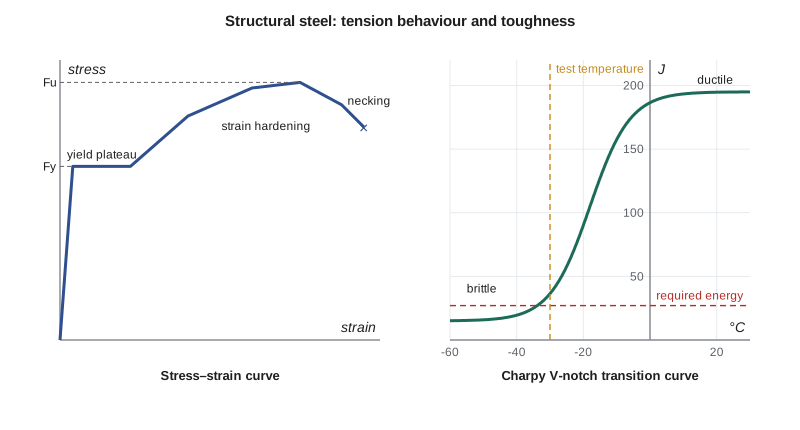
The yield plateau and strain hardening are what make steel structures forgiving. A locally overstressed region yields and sheds load to neighbouring regions instead of breaking, and plastic hinges can form in beams, allowing the structure to redistribute moments and absorb energy in an earthquake. Design codes rely on this ductility, and that is why they limit the ratio of yield to tensile strength for seismic members and set minimum elongation requirements.
Grades of structural steel
In Canada, structural steel is specified under CSA G40.20 (general requirements) and CSA G40.21 (grades). The grade name gives the minimum yield strength in megapascals and a letter for the type: W for weldable, WT for weldable notch-tough (with a Charpy category), A for atmospheric corrosion resistant (weathering) and AT for weathering notch-tough. Common grades are 350W for most plates and shapes, 345WM for wide-flange shapes (harmonized with the US A992 grade so that mills can certify both), and 350A or 350AT for unpainted weathering steel bridges. Hollow structural sections are usually 350W Class C (cold-formed) or Class H (stress-relieved).
| Product | Common Canadian grade | Minimum yield | Minimum tensile |
|---|---|---|---|
| Wide-flange shapes | CSA G40.21 345WM / 350W | 345–350 MPa | 450 MPa |
| Plates, angles, channels | CSA G40.21 350W / 300W | 350 / 300 MPa | 450 / 440 MPa |
| Hollow structural sections | CSA G40.21 350W Class C or H | 350 MPa | 450 MPa |
| Reinforcing bars | CSA G30.18 400W / 500W | 400 / 500 MPa | 540 / 625 MPa |
Toughness and brittle fracture
Ductility in a slow tension test does not guarantee that steel will behave in a ductile way under every condition. At low temperatures, high loading rates and where there are sharp notches, cracks or thick plates, steel can fracture in a brittle manner with little warning. The famous brittle failures of welded ships in the 1940s and of several bridges and buildings since were caused by this combination.
Toughness is measured by the Charpy V-notch test, in which a small notched bar is struck by a swinging pendulum and the energy absorbed in breaking it is recorded. Testing at several temperatures traces a transition curve: high energy on the upper (ductile) shelf, low energy on the lower (brittle) shelf, and a transition region in between. Specifications for bridges, exposed members in cold climates and fracture-critical members require a minimum Charpy energy at a test temperature related to the lowest service temperature, such as 27 J at −30 °C (20 ft·lb at −20 °F) for some categories.
Reinforcing and prestressing steel
Reinforcing bars are hot-rolled with deformations (ribs) that grip the concrete. CSA G30.18 covers carbon-steel bars in grades 400 and 500 (yield in MPa), with the W suffix for weldable chemistry and controlled ductility, and bar sizes 10M to 55M, where the number is roughly the nominal diameter in millimetres. Corrosion-resistant options include epoxy-coated, galvanized, stainless and glass-fibre-reinforced polymer (GFRP) bars, the last widely used in Canadian bridge decks.
Prestressing strand is made of high-carbon cold-drawn wires twisted into seven-wire strand, with a tensile strength of about 1860 MPa (270 ksi), roughly four times that of mild steel. Its stress–strain curve has no yield plateau, so its yield is defined by an offset or extension method. Low-relaxation strand is stress-relieved under tension so that it loses less force over time.
Mill test certificates and inspection
Every heat of steel is tested at the mill, and a mill test certificate (or material test report) records the heat number, specification and grade, chemical analysis, yield and tensile strength, elongation and, where required, Charpy results. The heat number is marked on the product so the material can be traced. Reviewing certificates is a routine job for inspectors, who check that each property meets the specified grade, that the heat numbers on the steel match the documents, and that supplementary requirements such as toughness were tested.
Worked problem
Reviewing a mill certificate
A certificate for W360 columns, specified as CSA G40.21 345WM, reports: C 0.08, Mn 1.10, Cr 0.08, Mo 0.02, V 0.03, Ni 0.10, Cu 0.25 (per cent); yield 392 MPa; tensile 488 MPa; elongation 24 per cent. Check the strength, the yield-to-tensile ratio (limit 0.85 for this harmonized grade) and the carbon equivalent.
Show solution
- Yield 392 MPa is at least 345 MPa, and tensile 488 MPa is at least 450 MPa.
- \[\frac{F_y}{F_u} = \frac{392}{488} = 0.80 \le 0.85\]
- \[CE = 0.08 + \frac{1.10}{6} + \frac{0.08 + 0.02 + 0.03}{5} + \frac{0.10 + 0.25}{15} = 0.08 + 0.183 + 0.026 + 0.023 = 0.31\]
Answer: The steel meets the strength and ratio limits, and its carbon equivalent of 0.31 indicates good weldability, so no special preheat beyond the welding code minimum is expected for normal thicknesses.
def carbon_equivalent(c):
    return c["C"] + c["Mn"]/6 + (c["Cr"] + c["Mo"] + c["V"])/5 + (c["Ni"] + c["Cu"])/15

def review(cert, fy_min, fy_max, fu_min, ratio_max):
    notes = []
    if not fy_min <= cert["fy"] <= fy_max: notes.append("yield out of range")
    if cert["fu"] < fu_min: notes.append("tensile below minimum")
    if cert["fy"] / cert["fu"] > ratio_max: notes.append("Fy/Fu too high")
    return notes

certs = [
    {"heat": "H41872", "fy": 392, "fu": 488, "chem": dict(C=0.08, Mn=1.10, Cr=0.08, Mo=0.02, V=0.03, Ni=0.10, Cu=0.25)},
    {"heat": "H41903", "fy": 455, "fu": 505, "chem": dict(C=0.11, Mn=1.35, Cr=0.12, Mo=0.04, V=0.05, Ni=0.15, Cu=0.35)},
]
for c in certs:
    ce = carbon_equivalent(c["chem"])
    notes = review(c, 345, 450, 450, 0.85)
print(f"{c['heat']}: CE = {ce:.2f}, Fy/Fu = {c['fy']/c['fu']:.2f}, {'OK' if not notes else '; '.join(notes)}")H41872: CE = 0.31, Fy/Fu = 0.80, OK H41903: CE = 0.41, Fy/Fu = 0.90, yield out of range; Fy/Fu too high
The second heat has a yield strength above the 450 MPa (65 ksi) maximum, a yield-to-tensile ratio of 0.90, above the limit, and a higher carbon equivalent of 0.41, so Tamarack would ask the supplier for replacement material or an engineering review before it is used in the moment frames, where ductility matters most.
Residual stresses, cold work and fatigue
Hot-rolled shapes cool unevenly: flange tips and web centres cool first, and the slower-cooling junctions are left in residual tension while the tips are in residual compression. These locked-in stresses, often 30 per cent or more of the yield strength, do not change the strength of a member in tension, but they make columns yield earlier at the flange tips and reduce buckling resistance, which is why column design curves differ for hot-rolled, welded and stress-relieved sections. Welding also leaves residual stresses near the weld that can reach the yield strength.
Cold working, such as bending a bar or cold-forming a hollow section, raises the yield strength locally but reduces ductility, and if the steel later ages, especially after welding near the cold-worked zone, it can become brittle. Reinforcing bar bend radii are therefore limited, and bars should not be re-bent cold in the field without approval. Under repeated loading, cracks can start at weld toes, bolt holes and abrupt changes of section and grow slowly with each cycle; fatigue design of bridges and crane girders limits the stress range at each detail according to its category, and inspectors look for fatigue cracks at those details throughout a bridge's life.
Steel at high and low temperatures
Steel loses strength and stiffness as it heats: by about 550 to 600 °C (1000 to 1100 °F) its yield strength has fallen to roughly half the room-temperature value, which is why building codes require fire protection by sprayed or board insulation, intumescent coatings or concrete encasement, or a performance-based fire design. Thermal expansion of steel, about 12 millionths per degree Celsius, is almost the same as that of concrete, which is one reason reinforced concrete works.
Common mistakes
MistakeAssuming any steel with the right yield strength is acceptable for a cold, exposed or fracture-critical member.
InsteadCheck toughness: specify and verify Charpy energy at a suitable test temperature.
MistakeWelding high-carbon-equivalent steel without preheat.
InsteadUse the welding code's preheat and procedure requirements based on chemistry and thickness.
MistakeAccepting steel whose heat numbers do not match the certificates.
InsteadTrace every piece to a certificate; untraceable steel must be tested or rejected.
MistakeUsing regular bars where weldable bars are needed.
InsteadSpecify weldable grades (W in Canada, A706 in the US) where bars will be welded or high ductility is required.
Summary and key terms
- Most North American structural steel and rebar is now made from scrap in electric arc furnaces, then cast and hot rolled.
- Carbon raises strength but reduces ductility, toughness and weldability; the carbon equivalent screens weldability.
- Structural steel has a linear region, a yield plateau, strain hardening and large elongation, giving ductile behaviour.
- Grades specify minimum yield and tensile strength; some limit maximum yield and the yield-to-tensile ratio.
- Charpy V-notch tests measure toughness and the ductile-to-brittle transition, important in cold climates.
- Mill certificates document chemistry and properties for each heat and are checked against the specification.
- Electric arc furnace
- A furnace that melts scrap steel with electric arcs; the main route for structural steel in North America.
- Yield plateau
- The nearly flat portion of the stress–strain curve after yielding, before strain hardening.
- Strain hardening
- The rise in stress after the yield plateau as the steel deforms plastically.
- Carbon equivalent
- A number combining the hardening effects of carbon and alloying elements to indicate weldability.
- Charpy V-notch test
- An impact test measuring the energy absorbed in breaking a notched specimen.
- Notch toughness
- Resistance of steel to brittle fracture in the presence of notches or cracks.
- Mill test certificate
- A document reporting the chemistry and mechanical properties of a heat of steel.
- Weathering steel
- Low-alloy steel that forms a protective, adherent rust layer in suitable environments.
Practice problems
Work each problem on paper first, then reveal the answer to check.
A steel has C 0.15, Mn 1.20, Cr 0, Mo 0, V 0.02, Ni 0.05, Cu 0.10. What is its carbon equivalent?
Show answer
\(0.15 + 0.20 + 0.004 + 0.010 = 0.36\).
Why do seismic codes limit the yield-to-tensile ratio?
Show answer
A lower ratio gives more strain hardening, spreading yielding along the member and improving ductility.
What does the Charpy transition curve show?
Show answer
How absorbed energy changes with temperature, from a brittle lower shelf to a ductile upper shelf.
What happens to steel's yield strength at about 600 °C?
Show answer
It falls to roughly half its room-temperature value.
Why is EAF steel lower in carbon emissions than blast-furnace steel?
Show answer
It melts recycled scrap with electricity instead of smelting ore with coke.
What information on a mill certificate allows a piece of steel to be traced?
Show answer
The heat number, which is also marked on the product.
Lesson quiz · 5 questions
Score 60% or more to complete this lesson.
Create a free account to save your progress, take quizzes and earn a certificate.