
CIV-230 · Lesson 3 of 12 · 22 min
Portland cement, hydration and supplementary cementing materials
Cement is the glue of concrete. Mixed with water, it forms a paste that coats the aggregate, fills the spaces between particles and hardens into a strong, stone-like solid. Although cement is only 10 to 15 per cent of a typical concrete by mass, it dominates the cost, the strength development, the heat generated and the carbon footprint of the mix. This lesson explains how portland cement is made, what happens chemically when it hydrates, how the types of cement differ, and how fly ash, slag, silica fume and limestone are used to replace part of it.
How portland cement is made
Portland cement is made by heating a finely ground blend of limestone (the source of calcium) with clay or shale (sources of silica, alumina and iron oxide) in a long rotating kiln to about 1450 °C. At that temperature the raw materials partly melt and react to form nodules called clinker. The clinker is cooled, then ground very finely together with a few per cent of gypsum, which controls the setting time. The result is a grey powder with particles mostly smaller than 50 µm.
Two features of this process explain cement's large carbon footprint. First, heating limestone drives off carbon dioxide chemically (calcination, \(\text{CaCO}_3 \to \text{CaO} + \text{CO}_2\)), which accounts for roughly 60 per cent of the emissions no matter how clean the fuel. Second, the kiln burns large amounts of fuel. Together these release very roughly 0.8 to 0.9 tonnes of carbon dioxide per tonne of clinker, which is why the industry's main decarbonization strategy is to use less clinker per tonne of cement and less cement per cubic metre of concrete.
Cement compounds
Clinker contains four main compounds, written in cement chemists' shorthand (C = CaO, S = SiO₂, A = Al₂O₃, F = Fe₂O₃):
| Compound | Shorthand | Typical share | Role |
|---|---|---|---|
| Tricalcium silicate | C₃S (alite) | 50–70 % | Hydrates quickly; early strength and much of the heat |
| Dicalcium silicate | C₂S (belite) | 15–30 % | Hydrates slowly; strength gain after a week |
| Tricalcium aluminate | C₃A | 5–10 % | Reacts very fast; controlled by gypsum; vulnerable to sulphate attack |
| Tetracalcium aluminoferrite | C₄AF (ferrite) | 5–15 % | Little strength; gives grey colour |
Changing the proportions of these compounds produces cements with different behaviour. More C₃S and finer grinding give faster strength gain and more early heat. Less C₃A improves resistance to sulphates in soil and groundwater. More C₂S and less C₃S lower the heat of hydration for massive pours.
Hydration
When cement meets water, the compounds dissolve and new solid products precipitate, a process called hydration. The two silicates produce calcium silicate hydrate (C-S-H), a poorly crystalline gel that makes up about half to two-thirds of the hardened paste and supplies most of its strength, and calcium hydroxide (CH), a crystalline by-product that contributes little strength but keeps the pore solution highly alkaline, which protects reinforcing steel from corrosion.
The aluminates react with gypsum to form ettringite, needles that coat the aluminate grains and slow their reaction; without gypsum, C₃A would react almost instantly and the concrete would set before it could be placed (a flash set). Later, as gypsum is used up, ettringite converts to monosulphate.
Hydration releases heat, and the rate of heat release follows a characteristic pattern that can be measured with a calorimeter. There is a short burst of heat on wetting, then a dormant period of a few hours during which the concrete stays plastic and can be transported and placed, then a main peak as C₃S hydrates rapidly, initial and final set occur and strength starts to develop, then a slow decline over days and weeks.
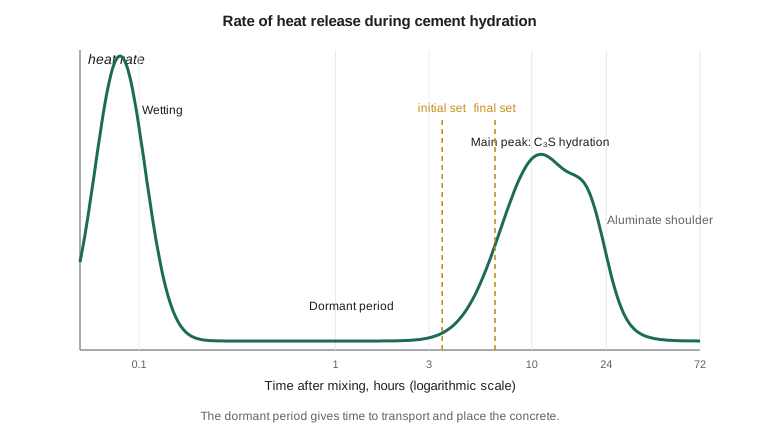
The total heat matters in thick members. In a large footing or bridge pier, the core heats up while the surface cools, and if the temperature difference becomes too large, the surface cracks. Mass concrete is therefore placed with low-heat cements, high proportions of slag or fly ash, chilled water or ice, and insulation, and specifications limit the peak temperature and the core-to-surface difference.
Water and the extent of hydration
Complete hydration needs only about 0.25 kg of chemically combined water per kilogram of cement, plus water held in the gel pores, so a water–cement ratio of roughly 0.38 to 0.42 is enough for full hydration in a sealed system. Concrete is usually mixed with more water than that to make it workable. Water beyond what hydration uses leaves capillary pores when it evaporates, and these pores are the main reason that strength falls and permeability rises as the water–cement ratio increases. This relationship, first stated by Duff Abrams around 1918, is the most important single rule of concrete technology, and lesson 4 builds the mix design on it.
Hydration also needs time and moisture. If the concrete dries out early, hydration stops at the surface, leaving a weak, porous layer that dusts, scales and lets chlorides in. Curing, covered in lesson 5, keeps the concrete moist and warm long enough for the paste to develop.
Types of cement
In Canada, cements are specified under CSA A3001. Portland cements are designated by their intended use, and blended cements add a letter for the supplementary materials they contain.
| Use | Canadian designation (CSA A3001) | US designation (ASTM C150 / C595) |
|---|---|---|
| General use | GU | Type I (often sold as Type I/II) |
| Moderate sulphate resistance or moderate heat | MS, MH | Type II, II(MH) |
| High early strength | HE | Type III |
| Low heat of hydration | LH | Type IV |
| High sulphate resistance | HS | Type V |
| Portland-limestone (up to about 15 % limestone) | GUL and other "L" types | Type IL |
| Blended with slag, fly ash or pozzolan | GUb and other "b" types | Types IS, IP, IT |
Portland-limestone cement, GUL in Canada, replaces part of the clinker with finely ground limestone. It performs similarly to GU in most applications while cutting the carbon footprint by roughly 10 per cent, and it has become the default general-use cement from many Canadian producers.
Supplementary cementing materials
Supplementary cementing materials (SCMs) are fine powders that react in concrete to form additional C-S-H. Most are industrial by-products, so replacing part of the portland cement with them reduces cost and carbon emissions and usually improves long-term strength and durability.
Pozzolans contain reactive silica that does not hydrate on its own but reacts with the calcium hydroxide released by cement hydration (the pozzolanic reaction):
This converts a weak by-product into strong gel and refines the pore structure, which lowers permeability. Slag, by contrast, is latent hydraulic: it contains its own calcium and hydrates when activated by the alkaline cement paste.
- Fly ash is the fine ash collected from coal-fired power station flue gases. Low-calcium (Class F, or Type F) fly ash is a classic pozzolan; high-calcium (Class C, or Type CI and CH in Canada) fly ash is partly cementitious itself. Fly ash spheres improve workability and reduce water demand. Typical replacement is 15 to 30 per cent of the cementing materials. As coal plants close, supplies are tightening, and reclaimed (harvested) ash from old ponds and landfills is becoming more important.
- Ground granulated blast-furnace slag is a glassy by-product of iron making, quenched and ground. It is used at 25 to 50 per cent replacement for general work and up to 70 per cent or more in mass concrete. It lowers heat, improves resistance to chlorides and sulphates, and gives concrete a slightly bluish green tint when freshly broken.
- Silica fume is an extremely fine by-product of silicon metal production, about a hundred times finer than cement. Used at 5 to 10 per cent, it produces dense, high-strength, low-permeability concrete for bridge decks, parking structures and high-rise columns, but it makes the mix sticky and very sensitive to curing.
- Natural pozzolans, including calcined clays and shales and some volcanic materials, are attracting renewed interest as alternatives to fly ash. Calcined clay combined with limestone (LC³-type cements) can replace a large share of clinker.
SCMs slow early strength gain, especially in cold weather, because their reactions are slower than that of C₃S. Specifications often allow acceptance at 56 days rather than 28 for high-SCM mixes, and contractors must protect and cure such concrete longer. On the other hand, they greatly improve resistance to alkali–silica reaction, sulphate attack and chloride penetration, which is why bridge deck and marine specifications often require them.
Worked problem
Cementing materials and carbon for a deck mix
The bridge deck mix uses 380 kg/m³ of cementing materials: 70 per cent GUL cement, 25 per cent slag and 5 per cent silica fume. Using rough emission factors of 0.82 kg CO₂ per kg for GUL, 0.10 for slag and 0.05 for silica fume (illustrative values only; real factors come from environmental product declarations), compare the emissions with a mix of 380 kg/m³ of GU cement at 0.92 kg CO₂ per kg.
Show solution
- Masses: cement \(0.70 \times 380 = 266\ \text{kg}\); slag \(95\ \text{kg}\); silica fume \(19\ \text{kg}\).
- \[\text{CO}_2 = 266(0.82) + 95(0.10) + 19(0.05) = 218.1 + 9.5 + 1.0 = 228.6\ \text{kg/m}^3\]
- \[\text{GU mix: } 380 \times 0.92 = 349.6\ \text{kg/m}^3\]
Answer: The blended mix emits roughly 35 per cent less carbon dioxide from its binder, while also improving resistance to chlorides from de-icing salts. The trade-off is slower early strength, so the contractor must plan longer curing and later form stripping.
Admixtures
Chemical admixtures are added in small doses, usually measured in millilitres per 100 kg of cement, to modify fresh or hardened concrete.
- Water reducers and high-range water reducers (superplasticizers) disperse cement particles so the same workability is reached with less water, raising strength or allowing a flowing or self-consolidating mix.
- Air-entraining admixtures create billions of tiny, stable air bubbles that protect concrete against freezing and thawing (lesson 6). They are essential for exterior concrete in cold climates.
- Retarders delay setting in hot weather or for long hauls; accelerators speed setting and early strength in cold weather. Calcium chloride is an effective accelerator but promotes corrosion of reinforcement, so it is prohibited in reinforced and prestressed concrete; non-chloride accelerators are used instead.
- Specialty admixtures include corrosion inhibitors, shrinkage reducers, viscosity modifiers and products that reduce alkali–silica reaction.
Storing and handling cement
Cement is delivered in bulk tankers and stored in silos at the plant, or in bags on small jobs. It must be kept dry: moisture from humid air or a leaking silo starts hydration on the particle surfaces, forming lumps that do not break up with finger pressure and that reduce strength. Bags should be stacked off the ground, covered and used in the order received. Plants keep cements and SCMs in separate, clearly labelled silos, because batching slag into a silo meant for cement, or the reverse, has caused more than one failed pour. Mill test reports accompany each shipment and state the chemical composition, fineness, setting time and strength at several ages; the testing firm keeps them on file so that unusual strength results can be traced to a change in the cement. Hot cement straight from the mill can make concrete set faster in summer, so plants may let it cool in storage before use.
# Approximate heat of hydration (kJ/kg of cement) from compound composition,
# using commonly quoted ultimate heat values for each compound (illustrative).
heat = {"C3S": 500, "C2S": 260, "C3A": 870, "C4AF": 420}   # kJ/kg of compound

cements = {
    "General use":     {"C3S": 0.57, "C2S": 0.16, "C3A": 0.08, "C4AF": 0.09},
    "High early":      {"C3S": 0.62, "C2S": 0.11, "C3A": 0.09, "C4AF": 0.08},
    "Low heat":        {"C3S": 0.42, "C2S": 0.32, "C3A": 0.04, "C4AF": 0.15},
    "SO4 resisting":  {"C3S": 0.58, "C2S": 0.18, "C3A": 0.03, "C4AF": 0.12},
}
for name, mix in cements.items():
    q = sum(heat[c] * f for c, f in mix.items())
print(f"{name:16s} potential heat about {q:4.0f} kJ/kg")General use potential heat about 434 kJ/kg High early potential heat about 450 kJ/kg Low heat potential heat about 391 kJ/kg SO4 resisting potential heat about 413 kJ/kg
The rough estimate shows why low-heat cement has more C₂S and less C₃S and C₃A: its potential heat is noticeably lower. Real heat of hydration is measured by calorimetry, and the rate of heat release matters as much as the total.
Common mistakes
MistakeThinking the extra mixing water helps hydration.
InsteadHydration needs only about 0.4 water–cement ratio; extra water leaves capillary pores that reduce strength and durability.
MistakeUsing calcium chloride to speed up a reinforced concrete pour in cold weather.
InsteadChlorides promote corrosion of steel; use a non-chloride accelerator, heated materials and insulation.
MistakeJudging a high-slag mix as deficient at 7 days.
InsteadSCM mixes gain strength more slowly; compare with the specified age, often 56 days.
MistakeAssuming all cement is the same grey powder.
InsteadCement types differ in composition, heat, sulphate resistance and carbon footprint; specify the type for the exposure.
Summary and key terms
- Portland cement is made by burning limestone and clay to clinker and grinding it with gypsum.
- Calcination and fuel make cement carbon intensive; reducing clinker content is the main decarbonization lever.
- C₃S gives early strength and heat, C₂S later strength, and C₃A fast reaction and sulphate vulnerability.
- Hydration forms C-S-H gel, which gives strength, and calcium hydroxide, which keeps the paste alkaline.
- Water beyond what hydration needs leaves capillary pores, so strength falls as the water–cement ratio rises.
- Fly ash, slag, silica fume, limestone and calcined clays replace part of the cement, cutting carbon and improving durability.
- Admixtures reduce water, entrain air, and control setting time.
- Clinker
- Nodules produced in the cement kiln, ground with gypsum to make portland cement.
- Hydration
- The chemical reaction of cement with water that forms the hardened paste.
- C-S-H
- Calcium silicate hydrate, the gel that provides most of the strength of cement paste.
- Pozzolan
- A siliceous material that reacts with calcium hydroxide in the presence of water to form C-S-H.
- Dormant period
- The hours after mixing when hydration is slow and concrete remains workable.
- Flash set
- Rapid stiffening caused by uncontrolled reaction of C₃A when gypsum is lacking.
- Portland-limestone cement
- Cement in which part of the clinker is replaced by ground limestone.
- Superplasticizer
- A high-range water-reducing admixture.
Practice problems
Work each problem on paper first, then reveal the answer to check.
Which cement compound is limited to improve sulphate resistance?
Show answer
Tricalcium aluminate, C₃A.
What does the pozzolanic reaction consume and produce?
Show answer
It consumes calcium hydroxide and reactive silica and produces additional C-S-H.
Why is gypsum ground with clinker?
Show answer
To control the reaction of C₃A and prevent flash setting.
Name two reasons slag is popular in bridge deck concrete.
Show answer
It improves resistance to chlorides and lowers heat and carbon emissions.
Roughly what share of cement's process emissions come from calcination rather than fuel?
Show answer
About 60 per cent.
Why is calcium chloride banned in reinforced concrete?
Show answer
Chloride ions break down the passive film on steel and cause corrosion.
Lesson quiz · 5 questions
Score 60% or more to complete this lesson.
Create a free account to save your progress, take quizzes and earn a certificate.