
CIV-230 · Lesson 10 of 12 · 23 min
Asphalt mixtures: design and testing
An asphalt mixture, called asphalt concrete or hot-mix asphalt, combines aggregate, binder and air in proportions that must be right within a fraction of a per cent. Too little binder and the pavement is dry, permeable and ravels or cracks early; too much and it bleeds, flushes and ruts. Too few air voids after compaction under traffic and the mix becomes unstable; too many and water and air get in, stripping the binder and ageing it fast. Mix design finds the balance, and field testing makes sure the contractor builds it.
On the interchange, the paving contractor submits a Superpave mix design for a 12.5 mm surface course and a 19 mm base course, prepared by its own laboratory. Tamarack checks the design, then samples loose mix and cuts cores during paving for the province's acceptance tests.
Types of asphalt mixtures
- Dense-graded mixes, with a well-graded aggregate near the maximum density line, are the workhorse of road paving. They are impermeable when properly compacted and are used for surface, binder and base courses.
- Stone matrix asphalt (SMA) uses a gap-graded aggregate that creates stone-on-stone contact, with the voids filled by a rich mastic of binder, filler and stabilizing fibres. It is very rut resistant and durable and is used on heavily trafficked highways.
- Open-graded friction courses and porous asphalt have an open, uniform gradation with 15 to 20 per cent or more air voids that drain water from the surface, reducing spray and improving wet skid resistance and noise. They need careful maintenance in freezing climates.
- Specialty mixes include high-modulus base mixes, rich-bottom fatigue layers, thin overlays and cold mixes made with emulsions or foamed binder.
Volumetric properties
Superpave mix design is based on volumes rather than masses, because volumes determine how the mix behaves. A compacted specimen is pictured as three phases: aggregate, binder and air, with some of the binder absorbed into the aggregate pores.
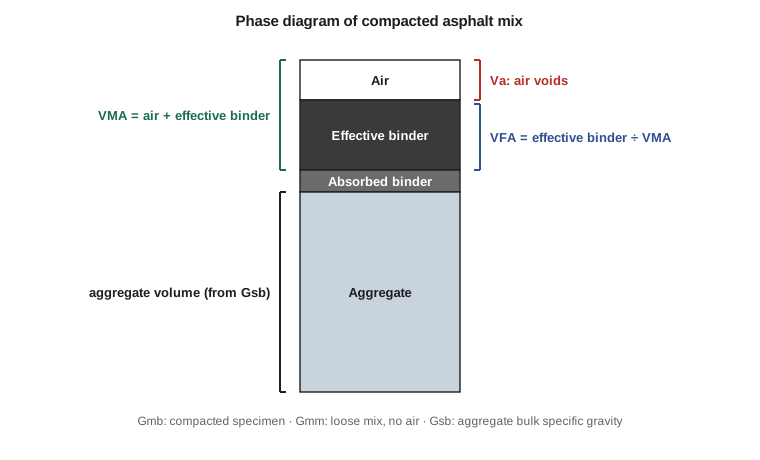
Three specific gravities are needed. The bulk specific gravity of the compacted mix, \(G_{mb}\), is measured by weighing a specimen dry, in water and saturated surface-dry. The theoretical maximum specific gravity, \(G_{mm}\), is measured on loose mix with all air removed by vacuum (the Rice test). The bulk specific gravity of the combined aggregate, \(G_{sb}\), comes from the aggregate tests in lesson 2. From these:
where \(P_s\) is the percentage of aggregate in the mix by total mass (100 minus the binder content). The voids in mineral aggregate (VMA) is the space between the aggregate particles; it must be large enough to hold enough effective binder for durability plus the design air voids. The voids filled with asphalt (VFA) is the percentage of that space occupied by binder.
Typical Superpave criteria are a design air void content of 4.0 per cent, a minimum VMA that depends on the nominal maximum aggregate size (about 13 per cent for 19 mm, 14 per cent for 12.5 mm and 15 per cent for 9.5 mm mixes), a VFA range that depends on traffic (for example 65 to 75 per cent for heavy traffic), and a dust-to-binder ratio, the percentage passing 75 µm divided by the effective binder content, of roughly 0.6 to 1.2.
The Superpave mix design procedure
1. Select materials: binder grade (lesson 9) and aggregates meeting consensus properties (coarse aggregate angularity, fine aggregate angularity, flat and elongated particles, clay content) and agency source properties.
2. Select a design aggregate structure: blend stockpiles to make two or three trial gradations that pass the control points, compact trial specimens, and choose the blend that best meets volumetric criteria.
3. Select the design binder content: compact specimens at several binder contents (for example 4.5, 5.0, 5.5 and 6.0 per cent) in the Superpave gyratory compactor to the design number of gyrations \(N_{des}\), which rises with traffic level (commonly 50 to 125 gyrations). The design binder content is the one that gives 4.0 per cent air voids, provided VMA, VFA and dust ratio are acceptable.
4. Evaluate moisture sensitivity and performance: test the design mix for resistance to moisture damage, rutting and, increasingly, cracking.
The gyratory compactor kneads the specimen with a small tilt angle under a constant vertical pressure while rotating, simulating the orientation of aggregate under rollers and traffic better than impact compaction. It records specimen height at each gyration, so the density at an initial number of gyrations (to detect tender mixes that compact too easily) and at a maximum number (to check that the mix will not over-densify under traffic) can also be checked.
Worked problem
Volumetrics at a trial binder content
A trial 12.5 mm mix at 5.2 per cent binder has \(G_{mb} = 2.371\) after compaction to \(N_{des}\) and \(G_{mm} = 2.468\). The combined aggregate has \(G_{sb} = 2.655\). Find the air voids, VMA and VFA, and judge them against 4.0 per cent air, 14 per cent minimum VMA and 65 to 75 per cent VFA.
Show solution
- \[V_a = 100\,(1 - 2.371/2.468) = 3.93\ \%\]
- \[VMA = 100 - \frac{2.371 \times 94.8}{2.655} = 100 - 84.66 = 15.34\ \%\]
- \[VFA = 100 \times \frac{15.34 - 3.93}{15.34} = 74.4\ \%\]
Answer: Air voids 3.9 per cent are very close to the 4.0 per cent target, VMA of 15.3 per cent exceeds the 14 per cent minimum, and VFA of 74 per cent is inside the range, though near its upper end. This binder content is a good candidate for the design.
Lucie writes a routine that takes the results at several trial binder contents, interpolates to the binder content that gives 4.0 per cent air voids, and reports the volumetrics there.
Gsb = 2.655
trials = {   # binder %: (Gmb, Gmm)
    4.6: (2.338, 2.492),
    5.0: (2.360, 2.476),
    5.4: (2.380, 2.460),
    5.8: (2.393, 2.445),
}

def vols(pb, gmb, gmm):
    va = 100 * (1 - gmb / gmm)
    vma = 100 - gmb * (100 - pb) / Gsb
    vfa = 100 * (vma - va) / vma
    return va, vma, vfa

rows = [(pb, *vols(pb, *g)) for pb, g in sorted(trials.items())]
for pb, va, vma, vfa in rows:
    print(f"Pb {pb:.1f} %: Va {va:4.2f} %, VMA {vma:5.2f} %, VFA {vfa:4.1f} %")

# Linear interpolation of binder content at 4.0 % air voids
for (p1, a1, m1, f1), (p2, a2, m2, f2) in zip(rows, rows[1:]):
    if a1 >= 4.0 >= a2:
        k = (a1 - 4.0) / (a1 - a2)
        pb = p1 + k * (p2 - p1); vma = m1 + k * (m2 - m1); vfa = f1 + k * (f2 - f1)
print(f"Design binder content about {pb:.2f} %: VMA {vma:.1f} %, VFA {vfa:.1f} %")Pb 4.6 %: Va 6.18 %, VMA 15.99 %, VFA 61.4 % Pb 5.0 %: Va 4.68 %, VMA 15.56 %, VFA 69.9 % Pb 5.4 %: Va 3.25 %, VMA 15.20 %, VFA 78.6 % Pb 5.8 %: Va 2.13 %, VMA 15.10 %, VFA 85.9 % Design binder content about 5.19 %: VMA 15.4 %, VFA 74.1 %
The interpolated design binder content of about 5.2 per cent matches the hand calculation above. Note how VMA passes through a shallow minimum as binder content rises: on the dry side of that minimum, adding binder lubricates the aggregate and lets it pack more densely; beyond it, extra binder pushes the particles apart. Designs on the wet side of the VMA minimum are prone to rutting and flushing, so a designer whose 4 per cent air voids falls there usually adjusts the gradation instead of accepting the binder content.
Mix distresses and their causes
Reading a pavement's distress tells a materials engineer a lot about its mix. Rutting confined to the asphalt layers, with humps beside the wheel paths, points to a mix with too much binder, too soft a binder, rounded aggregate or too few air voids. Fatigue (alligator) cracking in the wheel paths suggests an overloaded or too-thin structure, or a brittle mix. Transverse cracks at regular spacing on Prairie and northern highways are usually thermal cracks from a binder too stiff for the winter. Ravelling, the loss of aggregate from the surface, comes from low density, aged or insufficient binder, or stripping. Flushing or bleeding, a shiny binder-rich surface, comes from excess binder or air voids that have collapsed under traffic. Each distress maps back to a property tested in this lesson or lesson 9.
Moisture damage and performance tests
Water can strip binder from aggregate, especially some siliceous aggregates, causing ravelling and potholes. Moisture susceptibility is checked by the tensile strength ratio (TSR) test: one set of specimens is conditioned by vacuum saturation and a freeze–thaw cycle, another set is kept dry, and the ratio of their indirect tensile strengths must usually be at least 0.80. Hydrated lime or liquid anti-strip additives improve the bond when needed.
Volumetric criteria alone do not guarantee performance, so agencies have adopted balanced mix design, adding mechanical tests to the volumetric design.
- Rutting: the Hamburg wheel-tracking test rolls a steel wheel back and forth over specimens submerged in hot water and measures rut depth after a set number of passes; it also reveals stripping. Asphalt pavement analyzer and flow number tests are alternatives.
- Cracking: simple indirect tension tests such as the IDEAL cracking test, the semicircular bend test and the disc-shaped compact tension test at low temperatures measure fracture resistance and help guard against dry, brittle mixes, especially those with high recycled content.
- Stiffness: the dynamic modulus test measures how mix stiffness varies with temperature and loading frequency, the key input for mechanistic-empirical pavement design.
The Marshall method
Before Superpave, most agencies designed mixes by the Marshall method, which compacts specimens with a drop hammer (typically 75 blows per face for heavy traffic) and tests them for stability (the maximum load in a loading head at 60 °C) and flow (the deformation at that load), along with air voids and VMA. Some municipalities, airports and smaller agencies still use Marshall, and its volumetric concepts carry straight into Superpave.
Production and placement
Asphalt plants, either batch plants or drum plants, dry and heat the aggregate, add RAP, meter the binder and mix. The mix is hauled in insulated, tarped trucks to a paver that lays a uniform mat, then compacted by a train of rollers (often a breakdown vibratory steel roller, an intermediate pneumatic-tired roller, and a finish steel roller) while the mix is hot enough to densify. Placing temperature, mat thickness, roller pattern and the time available for compaction, which shortens in cold, windy weather and for thin lifts, are planned and monitored.
Field acceptance
Acceptance usually rests on three or four measured properties of each lot: binder content and gradation from samples of loose mix (by ignition oven or solvent extraction), volumetrics of plant-produced mix compacted in the laboratory, and in-place density from cores. In-place density is reported as a percentage of \(G_{mm}\); typical requirements are around 92 to 93 per cent minimum, meaning roughly 7 to 8 per cent in-place air voids, which traffic then reduces toward the design 4 per cent. Each per cent of extra in-place air voids shortens pavement life noticeably, so many agencies now pay bonuses for higher density and apply penalties for low density, and pay attention to longitudinal joints, which are the most common weak spot.
Worked problem
In-place density from a core
A core from the surface course has a dry mass of 1182.4 g, a mass in water of 690.1 g and an SSD mass of 1188.0 g. The lot's \(G_{mm}\) is 2.468. Find the in-place density as a percentage of \(G_{mm}\).
Show solution
- \[G_{mb} = \frac{1182.4}{1188.0 - 690.1} = \frac{1182.4}{497.9} = 2.375\]
- \[\%G_{mm} = 100 \times 2.375/2.468 = 96.2\ \%\]
Answer: The core is at 96.2 per cent of maximum density, 3.8 per cent air voids, well above a 92 per cent minimum; in fact it is denser than usual for a new mat, which might prompt a check that the mix is not too rich or tender.
Common mistakes
MistakeChoosing the binder content at the maximum stability or by eye.
InsteadIn Superpave, choose the binder content that gives the design air voids, then check VMA, VFA, dust ratio and performance.
MistakeUsing the apparent rather than the bulk aggregate specific gravity to compute VMA.
InsteadVMA uses the bulk specific gravity of the aggregate.
MistakeAccepting low in-place density at joints because the mat interior passed.
InsteadJoints are the weakest zone; specify and test joint density.
MistakeRaising binder content to cure every compaction problem.
InsteadCheck temperature, rolling pattern, lift thickness and gradation first; excess binder causes rutting and bleeding.
Summary and key terms
- Asphalt mixtures balance aggregate, binder and air; small changes in proportions have large effects.
- Volumetrics (air voids, VMA, VFA, dust ratio) are computed from Gmb, Gmm and Gsb.
- Superpave compacts trial mixes in a gyratory compactor and picks the binder content giving 4 per cent air voids.
- Moisture sensitivity, rutting and cracking tests complement volumetrics in balanced mix design.
- Plants, pavers and rollers must keep temperature, thickness and compaction under control.
- Acceptance is based on binder content, gradation, volumetrics and in-place density, often with pay adjustments.
- Air voids
- The volume of air in a compacted mix as a percentage of total volume.
- VMA
- Voids in mineral aggregate: the intergranular space between aggregate particles in a compacted mix.
- VFA
- Voids filled with asphalt: the percentage of VMA occupied by effective binder.
- Gmm
- Theoretical maximum specific gravity of a loose mix with no air voids.
- Gmb
- Bulk specific gravity of a compacted mix specimen or core.
- Gyratory compactor
- A laboratory device that compacts asphalt specimens by kneading under pressure while rotating at a small angle.
- Tensile strength ratio
- The ratio of conditioned to dry indirect tensile strength, a measure of moisture susceptibility.
- Stone matrix asphalt
- A gap-graded mix with stone-on-stone contact and a rich binder mastic.
Practice problems
Work each problem on paper first, then reveal the answer to check.
A specimen has Gmb 2.350 and Gmm 2.450. What are the air voids?
Show answer
\(100(1 - 2.350/2.450) = 4.08\) per cent.
Why must VMA be above a minimum?
Show answer
To leave room for enough binder film thickness for durability plus the design air voids.
A mix has VMA 14.5 per cent and Va 4.0 per cent. What is the VFA?
Show answer
\(100(14.5 - 4.0)/14.5 = 72.4\) per cent.
What does the Hamburg wheel-tracking test detect besides rutting?
Show answer
Moisture damage (stripping), seen as a sharp increase in rut rate.
In-place density is 91.0 per cent of Gmm. What are the in-place air voids?
Show answer
9.0 per cent, which is too high for most specifications.
Why does gyratory compaction better represent field compaction than impact compaction?
Show answer
Its kneading action under pressure orients aggregate as rollers and traffic do.
Lesson quiz · 5 questions
Score 60% or more to complete this lesson.
Create a free account to save your progress, take quizzes and earn a certificate.