
CIV-230 · Lesson 6 of 12 · 22 min
Hardened concrete: strength, testing and durability
Once concrete has hardened, two questions matter: is it strong enough, and will it last? Strength is checked by testing cylinders made from fresh samples, and when those are in doubt, by cores drilled from the structure. Durability, the ability to resist weathering, chemical attack, abrasion and corrosion of the reinforcement over the design life, depends far more on the quality of the paste and the cover concrete than on the strength number alone. Many of the most expensive concrete failures in Canada and the northern United States, from scaled sidewalks to delaminated bridge decks and crumbling parking garages, are durability failures in concrete that met its specified strength.
Compressive strength testing
Acceptance samples of fresh concrete are cast into cylinders, usually 100 × 200 mm, rodded or vibrated, kept at the site under controlled initial curing for up to 48 hours, then moved to the laboratory and moist-cured at about 23 °C until testing. A strength test is the average of two (or more) cylinders tested at the same age, normally 28 days, and at 56 days for many high-SCM mixes. Cylinders are capped or ground flat and loaded to failure in a compression machine at a specified rate.
The concrete passes if the average of every three consecutive strength tests equals or exceeds the specified strength, and no individual test falls below the specified strength by more than 3.5 MPa (500 psi) for ordinary strengths. A failure of either criterion does not mean the structure is unsafe; it triggers an investigation, which may include reviewing the sampling and curing records, testing reserve cylinders, nondestructive testing and coring.
Worked problem
Checking acceptance on a run of tests
The deck pour produced these 28-day strength tests (each the average of two cylinders), in MPa: 38.1, 36.4, 34.4, 34.6, 37.2, 31.0, 36.8. The specified strength is 35 MPa. Do they comply?
Show solution
- Running averages of three: 36.3, 35.1, 35.4, 34.3, 35.0 MPa.
- The fourth average, \((34.6 + 37.2 + 31.0)/3 = 34.3\), is below 35 MPa, so the first criterion fails for that group.
- Individual tests: the lowest is 31.0 MPa, which is below \(35 - 3.5 = 31.5\) MPa, so the second criterion also fails for that test.
Answer: The low test and the low running average both trace to the same truckload. Jonah checks the field record and finds that those cylinders sat in an unheated site box during a cold night. The engineer orders cores from the part of the deck that load went into, because cylinder results damaged by poor handling do not represent the in-place concrete.
Lucie's acceptance program checks both criteria automatically each time a new result is entered, so problems are flagged within a day of testing rather than at the end of a project.
def check_acceptance(tests, fc, tol=3.5):
    issues = []
    for i in range(2, len(tests)):
        avg = round(sum(tests[i-2:i+1]) / 3, 2)
        if avg < fc:
            issues.append(f"tests {i-1}-{i+1}: running average {avg:.1f} < {fc}")
    for i, t in enumerate(tests, 1):
        if t < fc - tol:
            issues.append(f"test {i}: {t} is more than {tol} below {fc}")
    return issues or ["all criteria met"]

deck = [38.1, 36.4, 34.4, 34.6, 37.2, 31.0, 36.8]
for msg in check_acceptance(deck, 35.0):
print(msg)tests 4-6: running average 34.3 < 35.0 test 6: 31.0 is more than 3.5 below 35.0
Cores
Cores drilled from the structure are the usual way to settle a strength dispute. They are usually 100 mm (4 in) or larger in diameter, with a length about twice the diameter, conditioned as the standard requires, and tested in compression. Because coring damages the concrete slightly and in-place concrete is cured less ideally than standard cylinders, the criteria are relaxed: in both ACI 318 and CSA A23.1, concrete in the area represented is considered structurally adequate if the average of three cores is at least 85 per cent of the specified strength and no single core is below 75 per cent.
Strength gain and curing
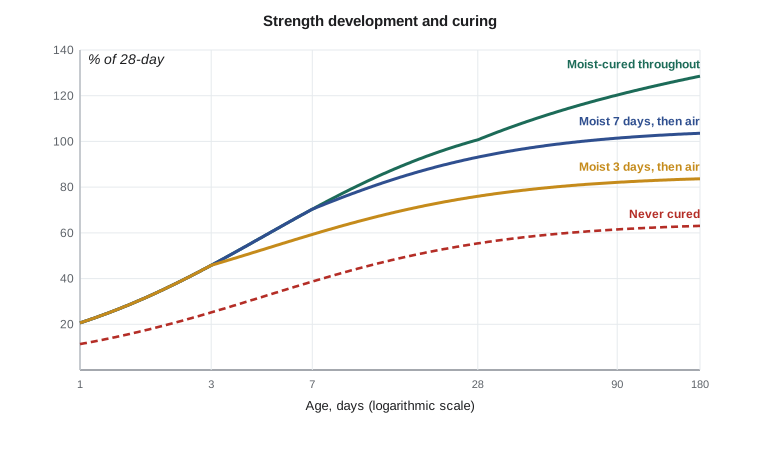
Concrete keeps gaining strength for months or years if moisture is available. A typical general-use mix reaches roughly 65 to 70 per cent of its 28-day strength at 7 days, and SCM mixes less; continued moist curing adds strength well past 28 days. Concrete that dries out early stops gaining strength, and its surface layer remains permanently weaker and more porous.
Other mechanical properties
- Tensile strength of concrete is only about a tenth of its compressive strength. It is measured indirectly by the splitting tensile test, in which a cylinder is loaded along its length on its side, or by the flexural test on a beam, which gives the modulus of rupture used in pavement design.
- In CSA A23.3 the modulus of rupture is taken as about \(0.6\lambda\sqrt{f'_c}\) MPa for cracking calculations, and the modulus of elasticity of normal-density concrete as about \(4500\sqrt{f'_c}\) MPa, so 35 MPa concrete has \(E_c \approx 26\,600\) MPa. Measured values vary with aggregate type.
- Creep and drying shrinkage depend on paste volume, w/cm, aggregate stiffness and member size. Typical ultimate drying shrinkage strains are 400 to 800 millionths, which in a 30 m (100 ft) slab without joints would mean a shortening of 12 to 24 mm (about half to one inch), enough to cause serious cracking if the slab is restrained.
Nondestructive testing
Nondestructive tests (NDT) help locate weak or damaged areas before coring. The rebound hammer measures surface hardness and gives a rough strength comparison between areas; ultrasonic pulse velocity detects cracks, voids and changes in quality; cover meters and ground-penetrating radar locate reinforcement and measure cover depth; impact-echo and chain dragging find delaminations in decks; and half-cell potential surveys identify areas where reinforcement is likely corroding. None replaces cores for strength, but they make the coring plan much better targeted.
Durability: the role of permeability
Almost every deterioration mechanism in concrete needs water, and most need dissolved substances such as chlorides, sulphates or alkalis to move into the concrete. Low permeability, achieved by a low w/cm, SCMs, good consolidation and thorough curing, is therefore the foundation of durability. Permeability-related properties are measured by tests such as rapid chloride ion penetrability (the charge passed through a slice in six hours), bulk or surface electrical resistivity, and water sorptivity. Many agencies now specify resistivity because it is fast and repeatable.
Freezing and thawing, and scaling
When water in saturated capillary pores freezes, it expands about 9 per cent and generates pressure in the remaining unfrozen water. Repeated cycles crack the paste, a process that destroys non-air-entrained concrete exposed to wet freezing. Entrained air bubbles, tiny and closely spaced, give the water somewhere to go: the bubbles act as pressure-relief chambers. What matters is not just the total air but the spacing factor, the typical distance from any point in the paste to the nearest bubble, which should be about 0.2 mm (0.008 in) or less.
Salt scaling is surface flaking caused by freezing in the presence of de-icing salts. It is aggravated by poor air-void systems, finishing with bleed water on the surface, inadequate curing and early salt exposure. Air entrainment, a low w/cm, proper finishing, curing and a period of air drying before the first winter of salting all help.
Alkali–aggregate reaction
Some aggregates contain forms of silica that react with the alkaline pore solution of concrete, producing a gel that absorbs water and swells, cracking the concrete in a characteristic map pattern. This alkali–silica reaction (ASR) has damaged dams, bridges and pavements across North America. A rarer alkali–carbonate reaction affects certain dolomitic limestones.
Prevention follows CSA A23.2-27A, which sets the level of preventive action from the aggregate's reactivity (measured by the concrete prism or accelerated mortar bar tests), the size and exposure of the structure, and its design life. Measures include limiting the alkali content of the concrete, using enough fly ash, slag or silica fume, or avoiding the reactive aggregate altogether.
Sulphate attack and other chemical attack
Sulphates in soils, groundwater and some industrial wastes react with the aluminate phases and calcium hydroxide of cement paste, forming expansive products such as ettringite and gypsum that crack and soften the concrete. The western Prairies and northern Great Plains have many sulphate-rich soils, so footings and foundation walls there are often specified with sulphate-resistant cement (low C₃A), SCMs and a low w/cm. Acids, including those produced in sewers by bacteria, dissolve cement paste; specialized concretes or linings are used in those environments.
Chlorides, carbonation and corrosion
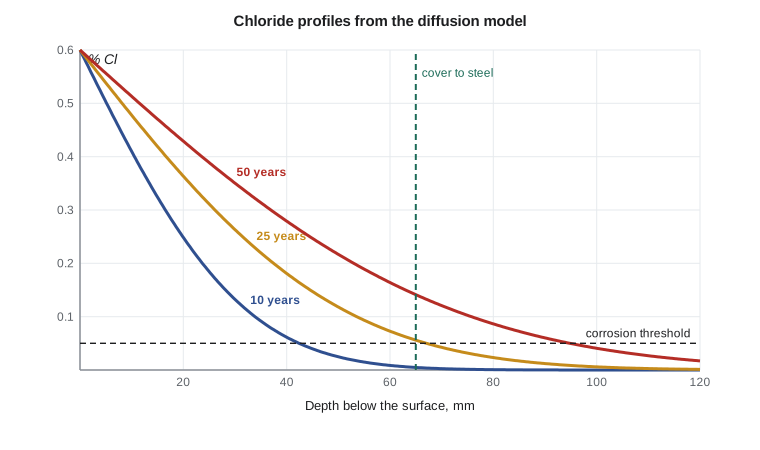
Concrete protects steel by its high alkalinity, which forms a thin passive oxide film on the bar. Two processes destroy that protection. Carbonation, the slow reaction of atmospheric carbon dioxide with calcium hydroxide, lowers the pH of the cover concrete; when the carbonation front reaches the steel, the bar can corrode. Chlorides from de-icing salts or seawater diffuse through the cover; when the chloride concentration at the bar exceeds a threshold, roughly 0.2 to 0.4 per cent of the cement mass for ordinary steel, the passive film breaks down locally. Lesson 8 covers corrosion in detail; here it is enough to see how cover and permeability control the time until corrosion starts.
Chloride ingress is often modelled with Fick's second law of diffusion. For a constant surface concentration \(C_s\) and diffusion coefficient \(D\), the chloride content at depth \(x\) after time \(t\) is:
from math import erf, sqrt

def chloride(x_mm, t_yr, Cs, D_mm2_per_yr):
    return Cs * (1 - erf(x_mm / (2 * sqrt(D_mm2_per_yr * t_yr))))

def years_to_threshold(cover, Cs, D, Ct, tmax=200):
    for t in range(1, tmax + 1):
        if chloride(cover, t, Cs, D) >= Ct:
            return t
    return None

Cs, Ct = 0.60, 0.05   # % chloride by mass of concrete: surface and threshold (illustrative)
for label, D in [("ordinary mix", 30.0), ("slag + silica fume mix", 8.0)]:
    for cover in (50, 65):
        t = years_to_threshold(cover, Cs, D, Ct)
        txt = f"{t} years" if t else "more than 200 years"
print(f"{label:23s} cover {cover} mm: corrosion starts after {txt}")ordinary mix cover 50 mm: corrosion starts after 14 years ordinary mix cover 65 mm: corrosion starts after 24 years slag + silica fume mix cover 50 mm: corrosion starts after 53 years slag + silica fume mix cover 65 mm: corrosion starts after 89 years
With the illustrative values, an ordinary mix with 50 mm of cover reaches the threshold in about 14 years, while the dense slag and silica fume mix with 65 mm of cover holds out for nearly 90 years. The comparison, not the exact numbers, is the point: the two changes together multiply the time to corrosion by about six.
Abrasion, fire and other exposures
Floors in warehouses, parking structures and hydraulic structures such as spillways wear by abrasion and erosion; resistance improves with higher strength, hard aggregate, good finishing and curing, and sometimes surface hardeners. Concrete performs well in fire because it is non-combustible and conducts heat slowly, but at high temperatures it loses strength, and dense, high-strength concrete can spall explosively as moisture turns to steam; polypropylene fibres that melt and leave escape channels reduce that risk. Concrete in contact with sea water, manure, food processing wastes or industrial chemicals needs a case-by-case review of the exposure, and the relevant standards list additional exposure classes for these environments.
The model is simplified (real diffusion coefficients decrease with age, surface concentrations build up over time, and cracks provide short cuts), but its message is reliable: lowering the diffusion coefficient with a dense, SCM-rich mix and adding cover both delay corrosion dramatically. That is why bridge deck specifications combine a low w/cm, slag or silica fume, generous cover, and often corrosion-resistant reinforcement.
Common mistakes
MistakeConcluding that a structure is unsafe because one cylinder test was low.
InsteadInvestigate sampling and curing records first, then use NDT and cores to assess the in-place concrete.
MistakeJudging durability by compressive strength alone.
InsteadDurability depends on permeability, air-void quality, cover and curing; strong concrete can still scale or corrode.
MistakeTreating total air content as proof of frost resistance.
InsteadThe spacing and size of the air voids matter; a high air content of large bubbles may not protect the paste.
MistakeIgnoring soil chemistry for foundations.
InsteadTest soils and groundwater for sulphates and specify cement type, SCMs and w/cm accordingly.
Summary and key terms
- Compressive strength is accepted on running averages of three tests and a limit on individual low tests.
- Cores are judged at 85 per cent of the specified strength on average with no core below 75 per cent.
- Tensile strength is about a tenth of compressive strength; codes relate modulus of rupture and modulus of elasticity to the square root of strength.
- Low permeability, from low w/cm, SCMs, consolidation and curing, is the basis of durability.
- Air entrainment with a small spacing factor protects against freezing and thawing; scaling needs good finishing and curing too.
- ASR, sulphate attack, carbonation and chloride ingress are controlled by materials selection, mix design and cover.
- Strength test
- The average strength of two or more cylinders made from the same sample and tested at the same age.
- Modulus of rupture
- The flexural tensile strength of concrete, measured on a beam in bending.
- Spacing factor
- An index of the maximum distance from any point in the paste to the nearest air void.
- Scaling
- Flaking of the concrete surface, usually caused by freezing with de-icing salts.
- Alkali–silica reaction
- A reaction between reactive silica in aggregate and alkalis in the pore solution that forms an expansive gel.
- Sulphate attack
- Deterioration of paste by sulphates that form expansive reaction products.
- Carbonation
- Reaction of carbon dioxide with calcium hydroxide that lowers the pH of concrete.
- Chloride threshold
- The chloride concentration at the steel above which corrosion can begin.
Practice problems
Work each problem on paper first, then reveal the answer to check.
Three cores average 30.5 MPa with the lowest at 27.0 MPa. The specified strength is 35 MPa. Is the concrete structurally adequate?
Show answer
\(0.85 \times 35 = 29.75\) and \(0.75 \times 35 = 26.25\); 30.5 and 27.0 meet both limits, so yes.
Why does water expanding on freezing damage concrete, and how do air bubbles help?
Show answer
Expansion pressurizes water in saturated pores; nearby air voids give the water space and relieve the pressure.
Name three measures that delay chloride-induced corrosion.
Show answer
Low w/cm, SCMs such as slag or silica fume, and more cover (also good curing and corrosion-resistant bars).
What pattern of cracking is typical of ASR?
Show answer
Map cracking, often with gel at the cracks, in members exposed to moisture.
What does a half-cell potential survey indicate?
Show answer
Areas where reinforcement is likely to be actively corroding.
Why are high-SCM mixes often accepted at 56 days?
Show answer
They gain strength more slowly, and their later strength and durability are what matter.
Lesson quiz · 5 questions
Score 60% or more to complete this lesson.
Create a free account to save your progress, take quizzes and earn a certificate.