
CHEM-261 · Lesson 9 of 12 · 23 min
Nucleophilic substitution: SN2 and SN1
Nucleophilic substitution at a saturated carbon is the reaction in which a nucleophile replaces a leaving group on an sp³ carbon: Nu⁻ + R–LG → R–Nu + LG⁻. It converts haloalkanes into alcohols, ethers, nitriles, amines and thiols, and it is one of the most used reactions in synthesis and in biochemistry, where methyl groups are transferred by substitution in the reactions of S-adenosylmethionine. It is also the reaction through which Christopher Ingold and Edward Hughes, working at University College London in the 1930s, established much of the modern theory of mechanism. They showed that substitution follows two distinct pathways, which they named SN2 and SN1, and that the choice between them depends on the structure of the substrate, the nucleophile, the leaving group and the solvent.
The substrate and the leaving group
The substrate is the molecule that undergoes substitution, usually a haloalkane, R–X. The carbon bearing the leaving group is the electrophilic centre, δ+ because of the polar C–X bond. The leaving group departs with the bonding pair of electrons, so good leaving groups are species that are stable with a negative charge: weak bases. The halides follow the order I⁻ > Br⁻ > Cl⁻ ≫ F⁻, the reverse of their basicity, and fluoroalkanes are practically inert to substitution. Sulfonate esters such as tosylates (TsO⁻) and mesylates (MsO⁻) are excellent leaving groups because their conjugate acids are strong acids (pKa about −2), and they are made from alcohols. Hydroxide, alkoxides and amide ions are very poor leaving groups; an alcohol becomes a substrate only after the OH is protonated, so that water leaves, or converted into a sulfonate. A good rule is that a group whose conjugate acid has a pKa below about 5 is a reasonable leaving group, and one whose conjugate acid has a pKa above about 14 almost never leaves.
The SN2 mechanism
The kinetics of the reaction of bromomethane with hydroxide show that the rate depends on the concentrations of both reactants:
The rate law is second order, and Hughes and Ingold called the mechanism SN2: substitution, nucleophilic, bimolecular. It is a single concerted step. The nucleophile approaches the carbon from the side opposite the leaving group, the backside, and the new bond forms as the old one breaks. In the transition state the carbon is partly bonded to both the nucleophile and the leaving group, which sit on a line through the carbon, while the other three groups lie in a plane perpendicular to that line. As the reaction completes, those three groups flip over to the other side, like an umbrella turning inside out in the wind.
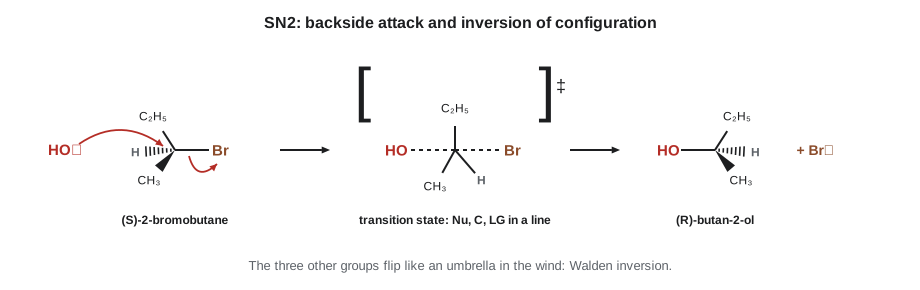
The geometry has a striking stereochemical consequence. If the carbon is a stereocentre, its configuration is inverted: (S)-2-bromobutane gives (R)-butan-2-ol. Paul Walden had observed such inversions in 1896, before anyone knew their cause, and the umbrella flip is still called Walden inversion. The SN2 reaction is stereospecific: each enantiomer of the substrate gives a single enantiomer of the product. (The R/S label usually changes, as here, but not always, since the priorities of the incoming and outgoing groups may differ.)
Why backside attack? The nucleophile's electron pair must enter the empty σ* orbital of the C–LG bond, the antibonding orbital whose occupation weakens and breaks the bond. The largest lobe of σ* points away from the leaving group, behind the carbon. Attack from the front would meet the electron-rich leaving group and the small lobe of σ*.
Structure and SN2 rate
Because the nucleophile must reach the back of the carbon, the SN2 reaction is very sensitive to crowding. Relative rates for reaction with a common nucleophile fall sharply with substitution: methyl > primary > secondary ≫ tertiary. Tertiary substrates do not react by SN2 at all. Branching next to the reacting carbon also slows the reaction: neopentyl bromide, (CH₃)₃CCH₂Br, is primary yet reacts about 10⁵ times more slowly than bromoethane, because the tert-butyl group blocks the backside. Vinyl and aryl halides, with the leaving group on an sp² carbon, also do not undergo SN2.
| Substrate | Type | Relative SN2 rate |
|---|---|---|
| CH₃Br | methyl | about 30 |
| CH₃CH₂Br | primary | 1 |
| CH₃CH₂CH₂Br | primary | 0.4 |
| (CH₃)₂CHBr | secondary | 0.02 |
| (CH₃)₃CCH₂Br | primary, neopentyl | 0.00001 |
| (CH₃)₃CBr | tertiary | negligible |
Nucleophiles and solvents in SN2
The rate of an SN2 reaction is proportional to the strength of the nucleophile. Within a row of the periodic table, nucleophilicity parallels basicity: CH₃O⁻ > HO⁻ > CH₃COO⁻ > H₂O, and NH₂⁻ > NH₃. An anion is a better nucleophile than its neutral conjugate acid. Down a group in protic solvents such as water and alcohols, nucleophilicity increases even though basicity falls: I⁻ > Br⁻ > Cl⁻ > F⁻ and RS⁻ > RO⁻. Small anions such as F⁻ are tightly wrapped in a shell of hydrogen-bonded solvent molecules that must be stripped away before they can attack, while large, polarizable anions are weakly solvated and their electron clouds deform easily toward the carbon.
Polar aprotic solvents, which are polar but have no O–H or N–H bonds, change this picture. Dimethyl sulfoxide (DMSO), N,N-dimethylformamide (DMF), acetonitrile and acetone dissolve salts by solvating the cations well, through their negative ends, but solvate anions poorly. The anions are left bare and highly reactive. SN2 reactions can be thousands to millions of times faster in DMSO than in methanol, and in these solvents the halide order reverses toward the basicity order, F⁻ becoming a good nucleophile.
The SN1 mechanism
Tertiary haloalkanes do react with nucleophiles, but by a different path. 2-Bromo-2-methylpropane (tert-butyl bromide) reacts with water to give tert-butanol, and the rate depends only on the concentration of the substrate:
The rate law is first order, and Hughes and Ingold called this mechanism SN1: substitution, nucleophilic, unimolecular. It has two steps. In the slow, rate-determining first step the C–Br bond breaks heterolytically, giving a carbocation and bromide. In the fast second step the nucleophile attacks the carbocation; if the nucleophile is neutral, as water is, a final proton transfer gives the neutral product. Because the nucleophile is not involved in the slow step, its concentration and strength do not affect the rate. When the nucleophile is the solvent, as in the reaction with water or ethanol, the SN1 reaction is called a solvolysis.
Since the rate-determining step forms a carbocation, and by the Hammond postulate the transition state resembles it, the SN1 rate follows carbocation stability: tertiary > secondary ≫ primary, methyl. This is the opposite of the SN2 order. Allylic and benzylic substrates, whose carbocations are stabilized by resonance, react readily by SN1 even when primary. Polar protic solvents speed the SN1 reaction greatly, because they stabilize both the developing carbocation and the leaving anion by solvation and hydrogen bonding: tert-butyl chloride solvolyses about 10⁵ times faster in water than in ethanol.
Stereochemistry and rearrangement in SN1
The carbocation intermediate is planar, sp², and the nucleophile can attack either face. Starting from a single enantiomer of a chiral tertiary or secondary substrate, the product is therefore largely racemized. Racemization is often incomplete, with a modest excess of inversion, because the departing leaving group stays close to one face for a moment as an ion pair and partly shields it. The second consequence of a carbocation intermediate is rearrangement. A carbocation can become more stable if a hydrogen or alkyl group on a neighbouring carbon shifts over with its bonding pair, a 1,2-hydride or 1,2-alkyl shift. 2-Bromo-3-methylbutane, a secondary halide, gives mainly 2-methylbutan-2-ol in water, through a hydride shift that converts the secondary carbocation into a tertiary one. Lesson 11 returns to rearrangements in alkene additions.
Substitution in synthesis
Because a haloalkane can be converted into so many other groups, substitution is one of the first tools of synthesis. With a primary or methyl substrate and the right nucleophile, the SN2 reaction makes alcohols (with hydroxide), ethers (with alkoxides), nitriles (with cyanide, adding one carbon to the chain), thiols and sulfides (with hydrosulfide and thiolates), azides (with azide ion, later reduced to amines) and alkynes (with acetylide ions, lesson 12). The ether-forming reaction is the Williamson ether synthesis, described by Alexander Williamson in 1850 and still the standard way to make unsymmetrical ethers. Because the alkoxide is also a strong base, the halide must be primary or methyl; a secondary or tertiary halide gives mainly elimination (lesson 10). To make tert-butyl methyl ether, therefore, react potassium tert-butoxide with iodomethane, not sodium methoxide with tert-butyl bromide.
In the Finkelstein reaction, a chloro- or bromoalkane is heated with sodium iodide in acetone. Sodium iodide is soluble in acetone but sodium chloride and sodium bromide are not, so they precipitate and drive the equilibrium toward the iodoalkane, a useful example of Le Chatelier's principle in synthesis. The appearance of a precipitate is also a simple qualitative test for primary haloalkanes, which react quickly, against tertiary ones, which do not.
Alcohols are converted into haloalkanes by reagents that first turn the OH into a better leaving group. Concentrated HBr or HCl protonates the alcohol, and water leaves by SN1 for tertiary alcohols or is displaced by SN2 for primary ones. Thionyl chloride, SOCl₂, and phosphorus tribromide, PBr₃, convert primary and secondary alcohols into chlorides and bromides under milder conditions without carbocations, so without rearrangement. Converting the alcohol into a tosylate with tosyl chloride keeps the configuration of the carbon, because the C–O bond is not broken; a subsequent SN2 then inverts it cleanly.
Substitution in biology
Living cells use SN2 reactions constantly. The main biological methylating agent is S-adenosylmethionine (SAM), in which a methyl group is attached to a positively charged sulfur. A sulfonium ion is an excellent leaving group, and enzymes direct nucleophiles such as the oxygen of a phenol, the nitrogen of an amine or a carbon of a DNA base to attack the methyl carbon by backside displacement. The same chemistry explains why some small alkylating agents are hazardous: compounds such as iodomethane and other reactive alkyl halides and sulfonates can transfer alkyl groups to DNA bases without enzymes, which damages DNA. They are handled in the laboratory with gloves in a fume hood, and their use is controlled by occupational exposure rules.
SN1 or SN2?
The structure of the substrate is usually decisive. Methyl and primary substrates react by SN2 (unless allylic or benzylic and under SN1 conditions). Tertiary substrates react by SN1 (or eliminate, lesson 10). Secondary substrates can go either way, and the conditions choose: a strong nucleophile at high concentration in a polar aprotic solvent favours SN2; a weak nucleophile in a polar protic solvent favours SN1.
| Factor | Favours SN2 | Favours SN1 |
|---|---|---|
| Substrate | methyl, primary (secondary) | tertiary, allylic, benzylic (secondary) |
| Nucleophile | strong, often anionic, concentrated | weak, often neutral (solvent) |
| Solvent | polar aprotic (DMSO, DMF, acetone) | polar protic (water, alcohols, acids) |
| Leaving group | good | very good |
| Rate law | second order | first order |
| Stereochemistry | inversion | racemization (some excess inversion) |
| Rearrangement | never | possible |
Worked problem
Predicting mechanism and product
Predict the mechanism and product of (R)-2-bromobutane with sodium cyanide in DMSO, and of (R)-3-bromo-3-methylhexane in methanol.
Show solution
- First reaction: secondary substrate, strong anionic nucleophile (CN⁻), polar aprotic solvent: SN2.
- SN2 inverts the stereocentre: the product is 2-methylbutanenitrile with the cyano group on the opposite face; the descriptor is (S), since CN replaces Br and keeps the same priority rank.
- Second reaction: tertiary substrate, weak neutral nucleophile that is also the solvent, polar protic: SN1 (solvolysis).
- The planar carbocation is attacked on both faces by methanol, then loses a proton.
Answer: (S)-2-Methylbutanenitrile by SN2; racemic (or nearly racemic) 3-methoxy-3-methylhexane by SN1, accompanied by some elimination product.
import math

def simulate(mech, sub0, nu0, k, t_end, steps=20000):
    """Euler integration of [substrate] for SN2 (rate = k[S][Nu]) or SN1 (rate = k[S])."""
    s, nu, dt = sub0, nu0, t_end / steps
    for _ in range(steps):
        rate = k * s * nu if mech == 'SN2' else k * s
        s -= rate * dt
        nu -= rate * dt
    return s

# doubling each concentration: the experiment that tells the mechanisms apart
for mech, k in (('SN2', 0.05), ('SN1', 0.05)):
    base = (0.10 - simulate(mech, 0.10, 0.10, k, 1.0)) / 1.0
    dbl_sub = (0.20 - simulate(mech, 0.20, 0.10, k, 1.0)) / 1.0
    dbl_nu = (0.10 - simulate(mech, 0.10, 0.20, k, 1.0)) / 1.0
    print(f'{mech}: initial rate x{dbl_sub / base:.2f} when [substrate] doubles,'
          f' x{dbl_nu / base:.2f} when [nucleophile] doubles')

# first-order SN1 half-life is independent of concentration
k1 = 1.0e-4
print(f'SN1 half-life with k = {k1:g}/s: {math.log(2) / k1 / 60:.0f} min at any starting concentration')

# relative SN2 rates converted to barrier differences (25 C)
RT = 2.479
for name, rel in [('methyl', 30), ('ethyl', 1), ('isopropyl', 0.02), ('neopentyl', 1e-5)]:
print(f'{name:10s} relative rate {rel:8g} barrier vs ethyl {-RT * math.log(rel):+6.1f} kJ/mol')SN2: initial rate x2.00 when [substrate] doubles, x2.00 when [nucleophile] doubles SN1: initial rate x2.00 when [substrate] doubles, x1.00 when [nucleophile] doubles SN1 half-life with k = 0.0001/s: 116 min at any starting concentration methyl relative rate 30 barrier vs ethyl -8.4 kJ/mol ethyl relative rate 1 barrier vs ethyl -0.0 kJ/mol isopropyl relative rate 0.02 barrier vs ethyl +9.7 kJ/mol neopentyl relative rate 1e-05 barrier vs ethyl +28.5 kJ/mol
The simulation reproduces the Hughes–Ingold diagnostic: for SN2 the initial rate doubles when either concentration doubles, while for SN1 it doubles only when the substrate concentration does. The last lines translate the relative rates into barrier differences: the neopentyl group raises the SN2 barrier by about 29 kJ/mol over ethyl, purely by blocking the backside.
Common mistakes
MistakeHydroxide is a good leaving group.
InsteadIt is a strong base and a poor leaving group; protonate the alcohol or convert it to a sulfonate first.
MistakeTertiary halides react fastest by SN2.
InsteadTertiary carbons are too crowded for backside attack; they react by SN1 or elimination.
MistakeSN1 reactions give inversion like SN2.
InsteadThe planar carbocation gives largely racemic products.
MistakeA stronger nucleophile speeds an SN1 reaction.
InsteadThe nucleophile is not in the rate-determining step; SN1 rates depend only on the substrate.
MistakeFluoride is always a weak nucleophile.
InsteadIn protic solvents it is heavily solvated, but in polar aprotic solvents it is quite reactive.
MistakeSN2 always changes R to S.
InsteadThe geometry always inverts, but the descriptor depends on the priorities of the new and old groups.
Summary and key terms
- Good leaving groups are weak bases: I⁻ > Br⁻ > Cl⁻, sulfonates and water; HO⁻ and RO⁻ do not leave.
- SN2: one concerted step, rate = k[RX][Nu], backside attack and inversion; methyl > 1° > 2°, not 3°.
- SN2 is favoured by strong nucleophiles and polar aprotic solvents; nucleophilicity rises down a group in protic solvents.
- SN1: rate-determining ionization to a carbocation, rate = k[RX]; 3°, allylic and benzylic substrates; polar protic solvents.
- SN1 gives racemization and possible hydride or alkyl shifts to more stable carbocations.
- Substrate structure usually decides the mechanism; for secondary substrates the nucleophile and solvent decide.
- SN2
- Bimolecular nucleophilic substitution, a concerted backside displacement.
- SN1
- Unimolecular nucleophilic substitution through a carbocation intermediate.
- Leaving group
- The group that departs with the bonding electron pair.
- Walden inversion
- Inversion of configuration at a carbon undergoing SN2 substitution.
- Solvolysis
- A substitution in which the solvent is the nucleophile.
- Polar aprotic solvent
- A polar solvent without O–H or N–H bonds, such as DMSO or DMF.
- Carbocation rearrangement
- A 1,2-shift of hydride or alkyl that converts a carbocation into a more stable one.
Practice problems
Work each problem on paper first, then reveal the answer to check.
Rank by SN2 rate with NaI in acetone: 1-bromobutane, 2-bromobutane, 2-bromo-2-methylpropane, 1-bromo-2,2-dimethylpropane.
Show answer
1-Bromobutane > 2-bromobutane > 1-bromo-2,2-dimethylpropane (neopentyl) > 2-bromo-2-methylpropane (essentially no SN2).
Which reacts faster by SN1 in water: (CH₃)₃CCl or (CH₃)₂CHCl? Why?
Show answer
(CH₃)₃CCl: it ionizes to a tertiary carbocation, more stable than the secondary one.
Predict the product of (S)-2-iodooctane with sodium azide, NaN₃, in DMF.
Show answer
SN2 with inversion: (R)-2-azidooctane.
Explain why converting an alcohol to its tosylate allows SN2 substitution.
Show answer
TsO⁻ is a very weak base (conjugate acid pKa about −2) and an excellent leaving group, unlike HO⁻.
2-Bromo-3-methylbutane in ethanol gives mainly 2-ethoxy-2-methylbutane. Explain.
Show answer
SN1: the secondary carbocation undergoes a 1,2-hydride shift to a tertiary carbocation, which ethanol traps.
Doubling the concentration of NaOH doubles the rate of a substitution of a haloalkane. What mechanism is operating?
Show answer
SN2: the rate depends on the nucleophile concentration.
Lesson quiz · 5 questions
Score 60% or more to complete this lesson.
Create a free account to save your progress, take quizzes and earn a certificate.