
CHEM-261 · Lesson 6 of 12 · 23 min
Stereochemistry I: chirality, enantiomers and the R/S system
Your left and right hands are mirror images, but they are not the same: a left glove does not fit a right hand. Many molecules have the same property. They exist in two forms, mirror images of each other, that cannot be superimposed. Such molecules are chiral, from the Greek for hand, and the two forms are enantiomers. Enantiomers have identical physical properties in most respects, the same melting point, boiling point and solubility, yet they can smell different, taste different and act very differently as drugs, because the receptors and enzymes of living things are themselves chiral. This lesson explains how chirality arises, how to recognize it, and how to name each enantiomer unambiguously with the Cahn–Ingold–Prelog R/S system. It also introduces the E/Z system for alkenes, which uses the same priority rules.
Chirality and stereocentres
An object is chiral if it is not superimposable on its mirror image. It is achiral if it is. The test for molecules is the same as for objects: build or draw the mirror image and see whether any rotation brings it into coincidence with the original. A molecule is achiral if it has a mirror plane or a centre of inversion (more precisely, any improper rotation axis, as CHEM-241 showed with point groups); if it has none, it is chiral.
The most common source of chirality in organic molecules is a carbon atom bonded to four different groups, a stereocentre (also called a stereogenic centre, chiral centre or asymmetric carbon). Swapping any two groups on such a carbon produces the other enantiomer. Butan-2-ol, CH₃CH(OH)CH₂CH₃, has one: C2 carries H, OH, CH₃ and CH₂CH₃. Propan-2-ol, (CH₃)₂CHOH, has none, because C2 carries two identical methyl groups, and it has a mirror plane through H, C2 and O.
Recognizing stereocentres quickly is a skill worth practising. Ignore CH₂ and CH₃ carbons, which have two or three identical hydrogens; ignore sp² and sp carbons, which have fewer than four groups; and for each remaining carbon, ask whether its four groups are all different, comparing them atom by atom outward along each branch. In rings, follow the ring in each direction from the carbon in question: in 3-methylcyclohexanol C1 and C3 are both stereocentres, but in 4-methylcyclohexanol neither is, because the two paths around the ring from C1 are identical.
Stereocentres are not the only source of chirality. Molecules can be chiral because of restricted rotation, as in some biaryls with bulky groups, or because of their overall twist, as in helicenes. But nearly all the chiral molecules in this course have stereocentres.
Drawing three-dimensional structures
To show the arrangement around a stereocentre, chemists use wedge and dash bonds. A solid wedge comes toward the viewer, a hashed wedge (dash) goes away from the viewer, and plain lines lie in the plane of the page. The standard way to draw a tetrahedral carbon is with two plain bonds in the plane, at about 110° to each other, and one wedge and one dash between them on the other side. If two bonds at a stereocentre are swapped in the drawing, the configuration inverts. If the whole molecule is rotated in the plane, nothing changes.
Fischer projections, introduced by Emil Fischer in 1891 for sugars, show stereocentres as crosses: horizontal lines point toward the viewer and vertical lines away. They are compact for molecules with several adjacent stereocentres, and they remain standard for carbohydrates and amino acids (CHEM-263 and BIOC-200). A Fischer projection may be rotated by 180° in the plane but not by 90°, which would invert every centre.
The Cahn–Ingold–Prelog priority rules
To name a stereocentre, first assign priorities to its four groups using the rules published by Robert Cahn, Christopher Ingold and Vladimir Prelog in 1956 and refined in 1966 and 1982:
1. Look at the atoms directly attached to the stereocentre. Higher atomic number gets higher priority. For isotopes, higher mass wins: D > H.
2. If two atoms tie, move outward. List the three atoms attached to each tied atom in decreasing order of atomic number and compare the lists at the first point of difference. Keep moving outward along the highest-priority branches until the tie breaks.
3. Multiple bonds are treated as if each bond were to a separate atom: a C=O counts as C bonded to (O, O), and the O as bonded to (C); a C≡N counts as C bonded to (N, N, N). The added atoms are duplicates that carry no further substituents.
For example, at C2 of butan-2-ol: OH has O (atomic number 8), the highest. H is lowest. CH₃ and CH₂CH₃ both start with C, so compare their substituents: CH₃ has (H, H, H) and CH₂CH₃ has (C, H, H). At the first point of difference C beats H, so ethyl outranks methyl. The order is OH > CH₂CH₃ > CH₃ > H.
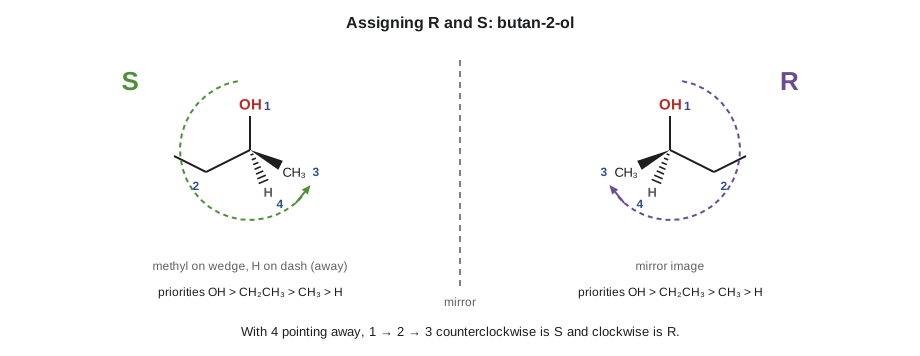
Assigning R and S
With priorities assigned, orient the molecule so that the lowest-priority group (usually H) points away from you, then trace the path from priority 1 to 2 to 3. If the path runs clockwise, the stereocentre is R (rectus, right); if counterclockwise, it is S (sinister, left). The descriptor goes in parentheses before the name: (R)-butan-2-ol and (S)-butan-2-ol.
When the lowest-priority group is not on a dash, you do not need to redraw the molecule. Three shortcuts help. If the lowest group is on a wedge, pointing toward you, trace 1 → 2 → 3 and reverse the answer. If the lowest group is in the plane, swap it with the group on the dash; the swap inverts the configuration, so assign the swapped drawing and reverse the result. And remember that swapping any two groups always inverts, while swapping two pairs restores the original.
Worked problem
Assigning R or S to alanine
Natural alanine has the amino group on a wedge, the carboxylic acid group to the left in the plane, the methyl to the right in the plane and H on the dash. Assign R or S.
Show solution
- Priorities: NH₂ (N, atomic number 7) is 1. COOH: C bonded to (O, O, O) is 2. CH₃: C bonded to (H, H, H) is 3. H is 4.
- H is on the dash, pointing away, so read the path directly.
- From NH₂ (on the wedge, toward the viewer and drawn at the top) to COOH (left) to CH₃ (right): top to left to right is counterclockwise.
Answer: S. Natural L-alanine is (S)-alanine, as are nearly all the amino acids in proteins; cysteine is the exception, (R), because its CH₂SH group outranks COOH.
R and S are names, not physical properties. They describe the arrangement of atoms by a rule; they do not predict which way an enantiomer rotates polarized light (lesson 7), and a reaction that leaves the bonds to a stereocentre untouched can still change its descriptor if the priorities of the groups change.
Properties of enantiomers
Enantiomers have identical melting points, boiling points, densities, solubilities in achiral solvents, and spectra. They react at the same rate with achiral reagents. They differ in two ways: they rotate the plane of polarized light by equal amounts in opposite directions (lesson 7), and they interact differently with other chiral substances. A chiral receptor in the nose distinguishes the enantiomers of carvone: (R)-carvone smells of spearmint and (S)-carvone of caraway seed. Limonene's enantiomers have different odours too. Enzymes are chiral catalysts and usually act on only one enantiomer of a substrate.
The stakes are highest in medicine. The two enantiomers of a chiral drug can differ in activity, side effects and how the body handles them. The anti-inflammatory drug ibuprofen is sold as a mixture of both enantiomers, but only (S)-ibuprofen is active; the body converts much of the (R) form into (S). Thalidomide, prescribed as a sedative and for morning sickness from 1957 until its withdrawal in 1961, caused severe birth defects in thousands of children. Its (R) enantiomer is the sedative and its (S) enantiomer the teratogen, but the two interconvert in the body, so giving a single enantiomer would not have prevented the harm. The disaster led to far stricter testing of drugs, and since the 1990s regulators have required that the enantiomers of a new chiral drug be studied separately. Many drugs are now sold as single enantiomers.
Cis–trans isomers of alkenes and the E/Z system
Because a C=C bond cannot rotate, an alkene with two different groups on each carbon exists as two stereoisomers. In but-2-ene, the methyls can be on the same side (cis) or opposite sides (trans). These are diastereomers, stereoisomers that are not mirror images, and they have different physical properties. Cis and trans are ambiguous when an alkene carries three or four different groups, so IUPAC uses the E/Z system. On each carbon of the double bond, assign priorities to the two groups by the CIP rules. If the two higher-priority groups are on the same side, the alkene is Z (zusammen, together); if on opposite sides, it is E (entgegen, opposite).
For example, in 1-bromo-1-chloropropene, BrClC=CHCH₃, Br outranks Cl on C1 and CH₃ outranks H on C2. The isomer with Br and CH₃ on the same side is (Z)-1-bromo-1-chloropropene. For simple alkenes Z usually corresponds to cis and E to trans, but not always: the correspondence fails when the higher-priority group on one carbon is not the one used to define cis.
Stereocentres other than carbon
Nitrogen with three different groups and a lone pair is pyramidal, but it inverts rapidly, like an umbrella turning inside out, with a barrier of about 25 kJ/mol, so simple amines cannot be resolved. A quaternary ammonium ion, with four different groups, can. Phosphines invert slowly and can be chiral, and sulfoxides, with a lone pair as the fourth group, are configurationally stable; the stomach-acid drug esomeprazole is the (S) enantiomer of a chiral sulfoxide.
Z = {'H': 1, 'D': 1.5, 'C': 6, 'N': 7, 'O': 8, 'F': 9, 'S': 16, 'Cl': 17, 'Br': 35, 'I': 53}

def key(group):
    """A group is (first atom, [substituent sets going outward, one per sphere]).
    Each sphere is a list of atoms; duplicates for multiple bonds are included."""
    atom, spheres = group
    return [Z[atom]] + [sorted((Z[a] for a in s), reverse=True) for s in spheres]

def rank(groups):
    return sorted(groups, key=lambda name: key(groups[name]), reverse=True)

# butan-2-ol at C2
butanol = {'OH': ('O', [['H']]), 'CH2CH3': ('C', [['C', 'H', 'H']]),
           'CH3': ('C', [['H', 'H', 'H']]), 'H': ('H', [])}
print('butan-2-ol  ', rank(butanol))

# alanine at C2: COOH counts as C(O,O,O) because C=O is duplicated
alanine = {'NH2': ('N', [['H', 'H']]), 'COOH': ('C', [['O', 'O', 'O']]),
           'CH3': ('C', [['H', 'H', 'H']]), 'H': ('H', [])}
print('alanine     ', rank(alanine))

# cysteine at C2: CH2SH reaches S before COOH reaches anything heavier than O
cysteine = {'NH2': ('N', [['H', 'H']]), 'COOH': ('C', [['O', 'O', 'O']]),
            'CH2SH': ('C', [['S', 'H', 'H']]), 'H': ('H', [])}
print('cysteine    ', rank(cysteine))

# a harder case: CH(CH3)2 against CH2CH2CH2CH3 (isopropyl beats butyl)
groups = {'isopropyl': ('C', [['C', 'C', 'H']]), 'butyl': ('C', [['C', 'H', 'H'], ['C', 'H', 'H']])}
print('alkyl groups', rank(groups))

def r_or_s(order_clockwise_when_H_back):
    return 'R' if order_clockwise_when_H_back else 'S'
print('alanine, path NH2 -> COOH -> CH3 counterclockwise with H back:', r_or_s(False))butan-2-ol ['OH', 'CH2CH3', 'CH3', 'H'] alanine ['NH2', 'COOH', 'CH3', 'H'] cysteine ['NH2', 'CH2SH', 'COOH', 'H'] alkyl groups ['isopropyl', 'butyl'] alanine, path NH2 -> COOH -> CH3 counterclockwise with H back: S
The program compares groups sphere by sphere, exactly as rule 2 says: the first atoms, then the sorted list of atoms attached to them, then the next sphere. A full implementation must follow branches in order of priority and handle rings and duplicated atoms carefully, which is why cheminformatics software such as RDKit uses carefully tested algorithms. The cysteine result is the classic surprise: sulfur's atomic number of 16 beats oxygen's 8 at the second sphere, so the priority order changes and natural L-cysteine is (R).
Common mistakes
MistakeAny carbon with four bonds is a stereocentre.
InsteadIt must carry four different groups; CH₂ and CH₃ carbons never are.
MistakePriority depends on the size or mass of the whole group.
InsteadCompare atomic numbers at the first point of difference, atom by atom outward.
MistakeA C=O carbon counts as bonded to one O.
InsteadMultiple bonds are duplicated: C=O counts as C(O, O).
MistakeAssigning R or S with the lowest priority group toward the viewer and not reversing.
InsteadIf the lowest group is on a wedge, trace 1 → 2 → 3 and reverse the answer.
MistakeR means the compound rotates light to the right.
InsteadR/S is a naming rule; the sign of rotation must be measured.
MistakeZ always means cis.
InsteadZ is defined by CIP priorities and does not always match cis.
Summary and key terms
- A chiral molecule is not superimposable on its mirror image; the two forms are enantiomers.
- A carbon with four different groups is a stereocentre; a mirror plane or inversion centre makes a molecule achiral.
- Wedges come toward the viewer and dashes go away; swapping two groups inverts a stereocentre.
- CIP rules rank groups by atomic number at the first point of difference, with multiple bonds duplicated.
- With the lowest priority away, clockwise 1 → 2 → 3 is R and counterclockwise is S.
- Enantiomers share physical properties but differ in optical rotation and in interactions with chiral partners such as receptors and enzymes.
- Alkene stereoisomers are named E (opposite) or Z (together) from the same priority rules.
- Chiral
- Not superimposable on its mirror image.
- Enantiomers
- A pair of stereoisomers that are non-superimposable mirror images.
- Stereocentre
- An atom at which swapping two groups produces a stereoisomer; in practice usually a carbon with four different groups.
- CIP rules
- The Cahn–Ingold–Prelog rules for ranking groups to assign stereodescriptors.
- R and S
- Descriptors for clockwise and counterclockwise priority order with the lowest priority group away.
- Fischer projection
- A drawing of stereocentres as crosses, with horizontal bonds toward the viewer.
- E and Z
- Descriptors for alkenes with the higher-priority groups on opposite or the same sides.
Practice problems
Work each problem on paper first, then reveal the answer to check.
Which of these have a stereocentre: 2-chlorobutane, 1-chlorobutane, 3-methylhexane, 3-methylpentane?
Show answer
2-Chlorobutane (C2) and 3-methylhexane (C3) are chiral. 1-Chlorobutane has no carbon with four different groups; in 3-methylpentane C3 carries two identical ethyls.
Rank by CIP priority: –CH=CH₂, –CH(CH₃)₂, –C≡CH and –CH₂OH.
Show answer
–CH₂OH first: its carbon carries (O, H, H). Next –C≡CH, whose carbon carries (C, C, C) counting the duplicates. –CH=CH₂ and –CH(CH₃)₂ both carry (C, C, H), so move outward: the real CH₂ of vinyl carries (C, H, H), the duplicate atom included, while each methyl of isopropyl carries only (H, H, H). Vinyl wins. Order: –CH₂OH > –C≡CH > –CH=CH₂ > –CH(CH₃)₂.
Assign R or S to (CH₃)(H)C(Br)(Cl) drawn with H on a wedge and Br, Cl, CH₃ going clockwise.
Show answer
Priorities Br > Cl > CH₃ > H. Clockwise with H toward the viewer means reverse: S.
Name the two stereoisomers of pent-2-ene with E/Z.
Show answer
(E)-pent-2-ene, with CH₃ and CH₂CH₃ on opposite sides, and (Z)-pent-2-ene, with them on the same side.
Explain why simple amines with three different groups cannot be separated into enantiomers.
Show answer
Pyramidal nitrogen inverts through a planar transition state with a barrier of only about 25 kJ/mol, so the enantiomers interconvert rapidly.
Is cis-1,2-dichloroethene chiral? Explain.
Show answer
No. It is planar, and its molecular plane is a mirror plane. Cis and trans isomers of it are diastereomers, not enantiomers.
Lesson quiz · 5 questions
Score 60% or more to complete this lesson.
Create a free account to save your progress, take quizzes and earn a certificate.