
CHEM-261 · Lesson 11 of 12 · 23 min
Alkenes I: structure, stability and electrophilic addition
Alkenes, hydrocarbons with a carbon–carbon double bond, are among the most useful compounds in chemistry. Ethylene and propylene are the two largest-volume organic chemicals made by industry, the starting points for polyethylene, polypropylene, ethylene glycol, propylene oxide and much else. In living things, double bonds give unsaturated fats their kinks, carry the light-sensitive chemistry of vision in retinal, and form the skeletons of terpenes such as limonene and the carotenoids. Chemically, the π bond is a store of loosely held electrons that reacts with electrophiles, and the addition reactions that result convert alkenes into haloalkanes, alcohols, dihalides and many other products. This lesson covers the structure and stability of alkenes and the mechanism of electrophilic addition, with its regiochemistry (Markovnikov's rule), its carbocation rearrangements and its stereochemistry. Lesson 12 continues with additions that avoid carbocations, with oxidation and polymerization, and with alkynes.
Structure and stability
The carbons of a C=C bond are sp² hybridized, with the double bond and the four attached atoms all in one plane and bond angles near 120°. The π bond, formed by sideways overlap of p orbitals above and below that plane, prevents rotation, which gives rise to cis–trans (E/Z) isomerism (lesson 6). The degree of unsaturation of an alkene CₙH₂ₙ is 1.
Alkenes differ in stability, and the differences can be measured from heats of hydrogenation. Adding H₂ across a C=C, with a platinum or palladium catalyst, is exothermic, and alkenes that give the same alkane can be compared directly: the less heat released, the more stable the alkene. The three butenes all give butane:
| Alkene | Substitution | ΔH of hydrogenation (kJ/mol) |
|---|---|---|
| But-1-ene | monosubstituted | −126 |
| (Z)-But-2-ene (cis) | disubstituted | −119 |
| (E)-But-2-ene (trans) | disubstituted | −115 |
| 2-Methylpropene | disubstituted (geminal) | −118 |
| 2-Methylbut-2-ene | trisubstituted | −112 |
| 2,3-Dimethylbut-2-ene | tetrasubstituted | −110 |
Two trends appear. First, stability increases with the number of alkyl groups on the double-bond carbons: tetrasubstituted > trisubstituted > disubstituted > monosubstituted. Alkyl groups stabilize the π system by hyperconjugation and because a bond between an sp² and an sp³ carbon is stronger than one between two sp³ carbons. Second, trans alkenes are more stable than cis, by about 4 kJ/mol for but-2-ene, because the two alkyl groups on the same side of a cis alkene crowd each other. These stability differences explain Zaitsev's rule in lesson 10.
Electrophilic addition: the mechanism
The characteristic reaction of alkenes is addition, in which the π bond breaks and two new σ bonds form, one to each carbon. The overall change is favourable, because a π bond (about 270 kJ/mol) is weaker than the two σ bonds that replace it. The best-studied addition is that of a hydrogen halide. Ethene and HBr give bromoethane by a two-step polar mechanism:
Step 1, rate-determining. The π electrons, acting as a nucleophile, attack the proton of HBr; the H–Br bond breaks heterolytically, and a carbocation and bromide ion form. One carbon gains the hydrogen, and the other becomes the positively charged carbon.
Step 2, fast. Bromide, a nucleophile, attacks the carbocation, forming the C–Br bond.
The rate law is first order in alkene and in HX, and the energy diagram has two transition states, the first higher, with the carbocation as intermediate. Because the first step forms a carbocation, everything about this reaction, its rate, its regiochemistry and its rearrangements, follows from carbocation stability.
Markovnikov's rule
When HX adds to an unsymmetrical alkene such as propene, two products are possible: 1-bromopropane and 2-bromopropane. In 1870 Vladimir Markovnikov observed that the hydrogen adds to the carbon of the double bond that already has more hydrogens, and the halogen to the carbon with more alkyl groups. Propene gives 2-bromopropane almost exclusively. The mechanism explains the rule. Protonation can give either a primary carbocation (H on C2) or a secondary one (H on C1). The secondary carbocation is much more stable, and by the Hammond postulate the transition state leading to it is lower in energy, so it forms far faster. The modern statement of Markovnikov's rule is mechanistic: in electrophilic addition, the electrophile adds so as to form the more stable carbocation.
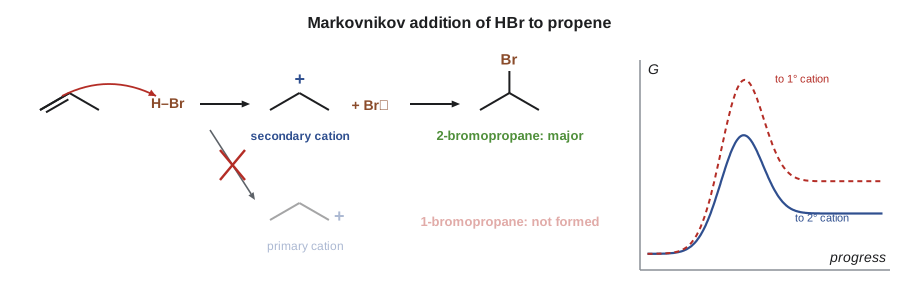
Reactions like this one, in which one of two possible orientations of addition is strongly favoured, are called regioselective. Markovnikov addition of HCl, HBr and HI is regioselective for the reason given. A notable exception is the addition of HBr in the presence of peroxides, which goes by a radical chain mechanism and gives the anti-Markovnikov product, 1-bromopropane. Morris Kharasch discovered this peroxide effect in 1933, resolving years of contradictory results that had come from traces of peroxides in alkene samples left standing in air. It works only for HBr.
Carbocation stability and rearrangements
The stability order of carbocations, tertiary > secondary > primary > methyl, is the key to this whole family of reactions. Alkyl groups donate electron density to the empty p orbital by hyperconjugation: each C–H or C–C bond on an adjacent carbon that is aligned with the empty orbital shares a little of its electron density with it. Gas-phase measurements show the size of the effect: removing a hydride ion from 2-methylpropane to make the tert-butyl cation costs roughly 330 kJ/mol less than removing one from methane to make the methyl cation. In solution the differences are smaller but still decisive. Resonance adds more: an allylic or benzylic carbocation, with its charge delocalized, is about as stable as a simple tertiary one.
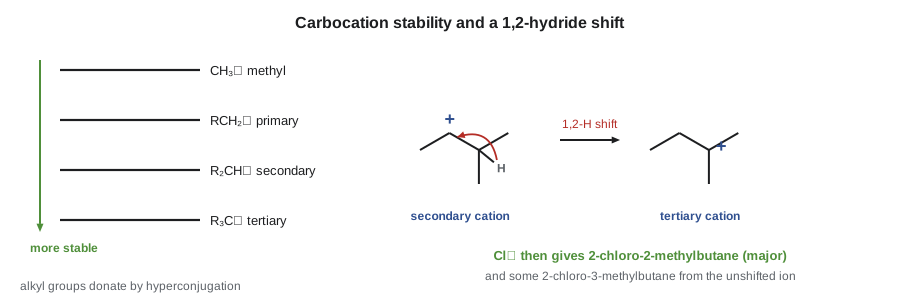
Because carbocations seek greater stability, they rearrange when a nearby group can shift to create a more stable ion. Frank Whitmore proposed carbocation rearrangements in the 1930s to explain products that seemed to come from nowhere. Adding HCl to 3-methylbut-1-ene gives two products: the expected 2-chloro-3-methylbutane and, as the major product, 2-chloro-2-methylbutane. The secondary carbocation formed first undergoes a 1,2-hydride shift: the hydrogen on the neighbouring tertiary carbon moves over with its bonding pair, and the positive charge moves to the carbon it left, which is now tertiary. When no hydrogen is suitably placed, an alkyl group can shift instead, as in 3,3-dimethylbut-1-ene, whose secondary carbocation undergoes a 1,2-methyl shift. Rearrangements are fast, often faster than capture by a nucleophile, and whenever a reaction involves a carbocation you should check whether a shift could give a more stable one.
Acid-catalysed hydration
Water adds to alkenes in the presence of a strong acid catalyst, usually dilute sulfuric acid, to give alcohols. The mechanism mirrors HX addition: protonation of the alkene gives the more stable carbocation, water attacks it to give a protonated alcohol, and loss of a proton regenerates the acid catalyst. The reaction follows Markovnikov's rule, propene giving propan-2-ol, and can be accompanied by rearrangement. It is the reverse of the E1 dehydration of lesson 10, and the two are governed by one equilibrium: a large excess of water and moderate temperature favour the alcohol, while concentrated acid, heat and removal of the alkene favour dehydration. Industrially, ethanol for solvents and fuel blending is made both by fermentation and by the vapour-phase hydration of ethylene over a phosphoric acid catalyst.
Addition of halogens
Bromine and chlorine add to alkenes to give vicinal dihalides, with the two halogens on adjacent carbons. The disappearance of the reddish-brown colour of a dilute bromine solution is a classic test for a C=C. The mechanism is different from HX addition in an instructive way. As Br₂ approaches the π bond, the Br–Br bond becomes polarized; the π electrons attack the nearer bromine, which at the same time uses one of its lone pairs to bond to the other carbon, and bromide leaves. The intermediate is a cyclic bromonium ion, a three-membered ring containing a positively charged bromine. Irving Roberts and George Kimball proposed it in 1937, and George Olah observed bromonium ions directly by NMR in superacid solution in the 1960s.
The bridged ion has two consequences. There is no open carbocation, so there are no rearrangements. And the bromide ion that completes the addition must attack from the face opposite the bridging bromine, by an SN2-like backside opening of the ring, so the two bromines end up on opposite faces: anti addition. Cyclopentene gives only trans-1,2-dibromocyclopentane, as a racemic mixture. Applied to stereoisomeric alkenes, anti addition is stereospecific: (E)-but-2-ene gives meso-2,3-dibromobutane, and (Z)-but-2-ene gives the racemic (2R,3R)/(2S,3S) pair, the stereoisomers of lesson 7.
When the halogenation is carried out in water, water, present in large excess, competes with bromide for the bromonium ion. The product is a halohydrin, with Br and OH on adjacent carbons and anti to each other. Water attacks the more substituted carbon of the bromonium ion, the one that carries more of the positive charge, so the OH ends up on the more substituted carbon, a Markovnikov-type orientation. Propene with Br₂ in water gives 1-bromopropan-2-ol.
Electrophilic additions in practice
These additions are among the most dependable reactions in synthesis, provided their limitations are kept in mind. Because the first step forms a carbocation, any alkene whose carbocation can rearrange should be expected to give mixtures with HX or aqueous acid, and for clean hydration chemists use the carbocation-free methods of lesson 12. Because the alkene's π electrons are the nucleophile, electron-rich alkenes with more alkyl groups react faster than ethylene, and alkenes bearing electron-withdrawing groups, such as the C=C of an α,β-unsaturated ketone, react slowly with electrophiles and instead accept nucleophiles. And because a new stereocentre is usually created from an achiral alkene and an achiral reagent, the products are racemic, as lesson 7 predicts. A test with dilute bromine remains a quick way to detect unsaturation in an unknown sample, although modern laboratories rely mainly on infrared and NMR spectroscopy (CHEM-282).
Worked problem
Predicting the products of electrophilic additions
Give the major product of each reaction of 1-methylcyclohexene: (a) HBr; (b) H₂O, H₂SO₄ catalyst; (c) Br₂ in CH₂Cl₂; (d) Br₂ in water.
Show solution
- (a) H adds to C2 (the CH of the double bond), giving the tertiary carbocation at C1; bromide attacks it: 1-bromo-1-methylcyclohexane.
- (b) Same carbocation, captured by water: 1-methylcyclohexan-1-ol.
- (c) Bromonium ion, opened anti by bromide: trans-1,2-dibromo-1-methylcyclohexane, racemic.
- (d) Bromonium ion opened by water at the more substituted C1: trans-2-bromo-1-methylcyclohexan-1-ol, racemic.
Answer: 1-Bromo-1-methylcyclohexane; 1-methylcyclohexan-1-ol; trans-1,2-dibromo-1-methylcyclohexane; trans-2-bromo-1-methylcyclohexan-1-ol.
# Alkene stability from heats of hydrogenation, and a Markovnikov predictor
HYDROG = {'but-1-ene': -126, '(Z)-but-2-ene': -119, '(E)-but-2-ene': -115,
          '2-methylpropene': -118}
ranked = sorted(HYDROG, key=lambda a: HYDROG[a], reverse=True)
print('most to least stable C4H8 alkene:', ', '.join(ranked))
print(f'cis/trans difference for but-2-ene: {HYDROG["(Z)-but-2-ene"] - HYDROG["(E)-but-2-ene"]} kJ/mol')

CLASS = {0: 'methyl', 1: 'primary', 2: 'secondary', 3: 'tertiary'}

def markovnikov(alkyls_on_c1, alkyls_on_c2):
    """Given the number of alkyl groups on each alkene carbon, decide where the
    electrophile (H+) goes: to the carbon that leaves the more substituted cation."""
    cation_if_H_on_c1 = alkyls_on_c2 + 1   # C2 becomes cationic; C1 is now one more alkyl group on it
    cation_if_H_on_c2 = alkyls_on_c1 + 1
    if cation_if_H_on_c1 > cation_if_H_on_c2:
        return 'H to C1', CLASS[min(cation_if_H_on_c1, 3)] + ' cation at C2'
    if cation_if_H_on_c2 > cation_if_H_on_c1:
        return 'H to C2', CLASS[min(cation_if_H_on_c2, 3)] + ' cation at C1'
    return 'no preference', CLASS[min(cation_if_H_on_c1, 3)] + ' cation either way'

for name, a1, a2 in [('propene CH2=CH-CH3', 0, 1), ('2-methylpropene CH2=C(CH3)2', 0, 2),
                     ('1-methylcyclohexene (C1 has CH3 and ring)', 2, 1), ('(E)-but-2-ene', 1, 1)]:
print(f'{name:44s} -> {markovnikov(a1, a2)}')most to least stable C4H8 alkene: (E)-but-2-ene, 2-methylpropene, (Z)-but-2-ene, but-1-ene
cis/trans difference for but-2-ene: -4 kJ/mol
propene CH2=CH-CH3 -> ('H to C1', 'secondary cation at C2')
2-methylpropene CH2=C(CH3)2 -> ('H to C1', 'tertiary cation at C2')
1-methylcyclohexene (C1 has CH3 and ring) -> ('H to C2', 'tertiary cation at C1')
(E)-but-2-ene -> ('no preference', 'secondary cation either way')The predictor encodes the mechanistic form of Markovnikov's rule: count the alkyl groups that each carbon of the double bond would carry as a carbocation and send the proton to the other carbon. For a symmetric alkene such as but-2-ene there is no preference, and the product is the same either way.
Common mistakes
MistakeThe halogen of HX adds to the carbon with more hydrogens.
InsteadThe hydrogen goes to the carbon with more hydrogens, giving the more stable carbocation; the halogen ends up on the more substituted carbon.
MistakeMarkovnikov's rule applies to HBr under all conditions.
InsteadWith peroxides, HBr adds by a radical mechanism and gives the anti-Markovnikov product.
MistakeBromine addition goes through an open carbocation.
InsteadIt goes through a bridged bromonium ion, which prevents rearrangement and gives anti addition.
MistakeA cis alkene is more stable than its trans isomer.
InsteadThe trans isomer is usually more stable, by about 4 kJ/mol for but-2-ene.
MistakeCarbocations never rearrange in additions to alkenes.
Instead1,2-Hydride and alkyl shifts to more stable carbocations are common.
MistakeHalohydrin formation puts OH on the less substituted carbon.
InsteadWater opens the bromonium ion at the more substituted carbon.
Summary and key terms
- Alkenes are planar at the sp² carbons; the π bond prevents rotation and gives E/Z isomers.
- Heats of hydrogenation show that more substituted alkenes and trans alkenes are more stable.
- Electrophilic addition of HX: protonation to the more stable carbocation (rate-determining), then capture by X⁻.
- Markovnikov's rule: the electrophile adds to give the more stable carbocation; HBr with peroxides is the anti-Markovnikov exception.
- Carbocation intermediates can rearrange by 1,2-hydride or alkyl shifts.
- Acid-catalysed hydration gives Markovnikov alcohols and is the reverse of E1 dehydration.
- Br₂ and Cl₂ add anti through a halonium ion; in water the products are halohydrins with OH on the more substituted carbon.
- Heat of hydrogenation
- The enthalpy change when H₂ adds to a C=C, a measure of alkene stability.
- Electrophilic addition
- Addition to a π bond initiated by an electrophile.
- Markovnikov's rule
- In addition of HX, H adds to the carbon with more hydrogens; mechanistically, the more stable carbocation forms.
- Regioselective
- Favouring one orientation of bond formation over another.
- 1,2-Hydride shift
- Migration of a hydrogen with its bonding pair to an adjacent carbocation centre.
- Bromonium ion
- A three-membered cyclic intermediate with a positively charged bromine bridging two carbons.
- Anti addition
- Addition of two groups to opposite faces of a π bond.
- Halohydrin
- A compound with a halogen and an OH group on adjacent carbons.
Practice problems
Work each problem on paper first, then reveal the answer to check.
Predict the major product of HCl with 2-methylbut-2-ene.
Show answer
2-Chloro-2-methylbutane, through the tertiary carbocation.
Explain why 3,3-dimethylbut-1-ene with HBr gives mainly 2-bromo-2,3-dimethylbutane.
Show answer
Protonation gives a secondary carbocation; a 1,2-methyl shift gives a tertiary one, which bromide captures.
Give the stereochemistry of the product of Br₂ with (Z)-but-2-ene.
Show answer
Anti addition gives the racemic pair (2R,3R)- and (2S,3S)-2,3-dibromobutane.
Rank by heat of hydrogenation, most exothermic first: 2,3-dimethylbut-2-ene, hex-1-ene, (E)-hex-3-ene.
Show answer
Hex-1-ene (monosubstituted) > (E)-hex-3-ene (disubstituted) > 2,3-dimethylbut-2-ene (tetrasubstituted).
What product forms from propene, HBr and a peroxide?
Show answer
1-Bromopropane, by radical (anti-Markovnikov) addition.
Predict the product of cyclohexene with Cl₂ in water.
Show answer
trans-2-Chlorocyclohexan-1-ol, racemic.
Lesson quiz · 5 questions
Score 60% or more to complete this lesson.
Create a free account to save your progress, take quizzes and earn a certificate.