
CHEM-261 · Lesson 7 of 12 · 22 min
Stereochemistry II: diastereomers, meso compounds, optical activity and resolution
A molecule with one stereocentre has two stereoisomers, a pair of enantiomers. A molecule with two or more has more, and the relationships among them introduce new ideas: diastereomers, which are stereoisomers that are not mirror images, and meso compounds, which have stereocentres yet are achiral. This lesson extends stereochemistry to molecules with several stereocentres, explains how chirality is detected through optical activity, introduces the measures used to describe mixtures of enantiomers, and shows how chemists separate enantiomers, a problem Louis Pasteur first solved in 1848.
Two stereocentres: enantiomers and diastereomers
Consider 2-bromo-3-chlorobutane, CH₃CHBrCHClCH₃. C2 and C3 are both stereocentres, and each can be R or S, so there are four combinations: (2R,3R), (2S,3S), (2R,3S) and (2S,3R). The (2R,3R) and (2S,3S) isomers are mirror images, an enantiomeric pair; so are (2R,3S) and (2S,3R). Any other pairing, such as (2R,3R) with (2R,3S), gives stereoisomers that are not mirror images: diastereomers. Enantiomers have opposite configurations at every stereocentre; diastereomers differ at some but not all.
With n stereocentres a molecule can have at most 2ⁿ stereoisomers, arranged in 2ⁿ⁻¹ pairs of enantiomers. Cholesterol has eight stereocentres and so 256 possible stereoisomers, of which nature makes just one. The rule gives a maximum, because symmetry can reduce the number, as the next section shows.
Unlike enantiomers, diastereomers have different physical properties: different melting and boiling points, solubilities, spectra and reactivity. They can be separated by ordinary methods such as distillation, crystallization or chromatography. The cis and trans isomers of alkenes and of disubstituted rings are diastereomers too. The sugars glucose and galactose are diastereomers that differ only at C4, yet one is the body's main fuel and the other must first be converted by a dedicated set of enzymes.
Meso compounds
Tartaric acid, HOOC–CH(OH)–CH(OH)–COOH, has two stereocentres but only three stereoisomers. The (2R,3R) and (2S,3S) forms are enantiomers. The (2R,3S) form, however, is identical to its mirror image, (2S,3R): the molecule has an internal mirror plane between C2 and C3, which reflects one half onto the other. A compound that contains stereocentres but is achiral because of internal symmetry is a meso compound. Meso-tartaric acid is optically inactive and is a diastereomer of the other two.
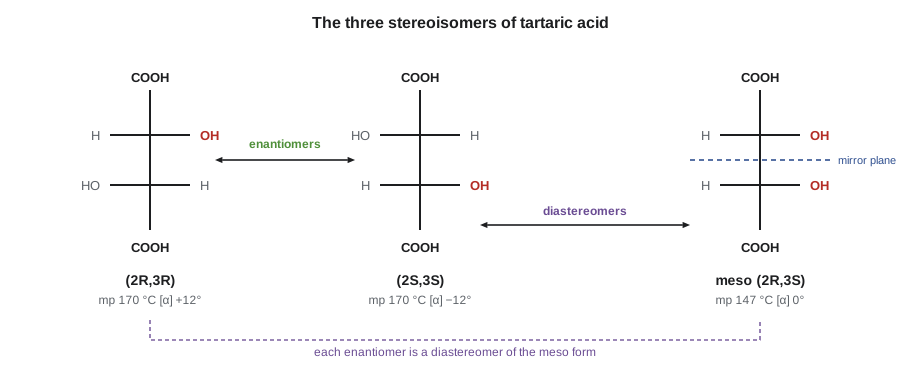
Meso compounds arise whenever two stereocentres carry the same set of groups and have opposite configurations, R and S, in a symmetric molecule. cis-1,2-Dimethylcyclohexane is meso; the trans isomer is chiral and exists as a pair of enantiomers. To decide whether a structure is meso, look for an internal mirror plane in some conformation, often most easily seen in a Fischer projection or an eclipsed drawing, or check whether its descriptors are R,S with mirror-related halves.
Optical activity
Ordinary light has electric fields oscillating in all directions perpendicular to its travel. A polarizer passes only light oscillating in one plane: plane-polarized light. In 1815 Jean-Baptiste Biot found that some organic substances, such as sucrose solutions and turpentine, rotate the plane of polarization. Such substances are optically active. Rotation clockwise as seen by the observer facing the light source is dextrorotatory, given the sign (+) or the old prefix d-; counterclockwise rotation is levorotatory, (−) or l-.
A polarimeter measures the observed rotation α. Because α depends on the concentration of the sample, the length of the tube, the wavelength of light and the temperature, chemists report the specific rotation:
where l is the path length in decimetres, c is the concentration in grams per millilitre, and the subscript D refers to the sodium D line at 589 nm. Specific rotation is a physical constant of a pure enantiomer under stated conditions, such as +12.0° for (2R,3R)-tartaric acid in water or +66.5° for sucrose. The other enantiomer has exactly the opposite value. There is no simple connection between the R/S label and the sign of rotation: (R)-butan-2-ol is (−) and (R)-lactic acid is (−), but (R)-glyceraldehyde is (+), and the sign of a compound can even change with the solvent.
Racemic mixtures and enantiomeric excess
A 50:50 mixture of two enantiomers is a racemic mixture or racemate, written (±) or rac-. Its rotations cancel, so it is optically inactive even though every molecule in it is chiral. Racemates form whenever a chiral product is made from achiral starting materials without any chiral influence, because the two enantiomeric pathways have exactly the same energy. Adding HBr to but-1-ene, for example, gives racemic 2-bromobutane (lesson 11).
A mixture enriched in one enantiomer is described by its enantiomeric excess, the excess of the major enantiomer over the minor as a fraction of the whole. If a mixture contains 80 per hundred (R) and 20 per hundred (S), its ee is 60 per hundred. For an ideal mixture the ee equals the optical purity, the ratio of the observed specific rotation to that of the pure enantiomer:
Today ee is usually measured by chiral chromatography, in which the two enantiomers interact differently with a chiral stationary phase and come off the column at different times. Optical rotation is still useful for checking identity and approximate purity.
Worked problem
Enantiomeric excess from optical rotation
A sample of (S)-ibuprofen made by an asymmetric synthesis has [α]D = +51.2° (in ethanol). Pure (S)-ibuprofen has [α]D = +57.0° under the same conditions. Find the ee and the proportion of each enantiomer.
Show solution
- ee = 51.2/57.0 = 0.898, or 89.8 per hundred.
- If the major enantiomer is x and the minor 1 − x, then x − (1 − x) = 0.898, so 2x = 1.898 and x = 0.949.
Answer: ee ≈ 90 per hundred; the sample is about 95 per hundred (S) and 5 per hundred (R).
Absolute and relative configuration
The R/S descriptor states the absolute configuration, the actual three-dimensional arrangement. For decades chemists could not determine it; they could only relate configurations of different compounds to each other by reactions that did not touch the stereocentre. Emil Fischer arbitrarily assigned (+)-glyceraldehyde the configuration now called D, with a 50 per hundred chance of being right, and related the sugars to it. In 1951 Johannes Bijvoet used X-ray diffraction with anomalous scattering on sodium rubidium tartrate to establish the absolute configuration directly; Fischer's guess proved correct. The D/L labels, based on the configuration of glyceraldehyde, survive in the names of sugars and amino acids: natural sugars are D and natural amino acids L.
Stereochemistry and reactions
Stereochemistry matters most when molecules react. Three terms describe what a reaction does to stereoisomers, and they recur in lessons 9 to 12. A reaction is stereoselective if it forms one stereoisomer in preference to others when several are possible, such as an elimination that gives mainly the E alkene. It is stereospecific if stereoisomeric starting materials give stereoisomerically different products by the mechanism itself: the SN2 reaction converts (R)-2-bromobutane into (S)-butan-2-ol and the (S) bromide into the (R) alcohol, always with inversion. Every stereospecific reaction is stereoselective, but not the reverse. Finally, a reaction is enantioselective if it gives one enantiomer in excess, which requires a chiral reagent, catalyst or environment, and diastereoselective if it favours one diastereomer.
A useful principle follows from symmetry: achiral reagents reacting with achiral or racemic starting materials always give achiral or racemic products. Optically active products never emerge from optically inactive reactants unless something chiral, an enzyme, a chiral catalyst or a resolving agent, takes part. When a reaction creates a new stereocentre in a molecule that already has one, however, the two possible products are diastereomers, not enantiomers, and they usually form in unequal amounts, because the transition states leading to them are themselves diastereomeric and differ in energy. This is the basis of much of modern stereoselective synthesis.
Homochirality in nature
Living things are built almost entirely from one enantiomer of each chiral building block: L-amino acids and D-sugars. A protein made with even one wrong amino acid enantiomer folds differently, and the enzymes that make and use these molecules are chiral and highly selective. Why life chose one hand is still an open question. Proposals include an initial small excess, from circularly polarized light in space or from the slight parity violation of the weak force, amplified by autocatalytic reactions such as the one Kenso Soai reported in 1995, in which a chiral product catalyses its own formation and multiplies a tiny ee into a large one. Some meteorites, such as the Murchison meteorite that fell in Australia in 1969, contain amino acids with a small excess of the L forms.
Resolution: separating enantiomers
Because enantiomers have identical physical properties, they cannot be separated by ordinary distillation or crystallization. Separating them, resolution, needs a chiral influence. In 1848 Pasteur noticed that crystals of sodium ammonium tartrate made from racemic (paratartaric) acid came in two mirror-image shapes. Working with tweezers and a lens, he separated them by hand and showed that their solutions rotated light in opposite directions. It was the discovery of molecular chirality, and it was helped by luck: this salt crystallizes as separate enantiomeric crystals only below about 27 °C.
The general method, also introduced by Pasteur, is to convert the enantiomers into diastereomers. A racemic acid is treated with a single enantiomer of a chiral base, such as the natural alkaloid brucine or (R)-1-phenylethylamine, to form two diastereomeric salts, (R)-acid·(R)-base and (S)-acid·(R)-base. These have different solubilities and can be separated by crystallization. Treating each salt with strong acid then releases the pure enantiomers of the acid and recovers the resolving agent. Modern alternatives include chiral chromatography, enzymatic resolution (an enzyme that converts one enantiomer selectively) and, increasingly, asymmetric synthesis, which makes one enantiomer directly with a chiral catalyst and avoids discarding half the material. William Knowles, Ryoji Noyori and Barry Sharpless shared the 2001 Nobel Prize for asymmetric catalysis, and Benjamin List and David MacMillan the 2021 prize for asymmetric organocatalysis.
from itertools import product

def ee_from_rotation(observed, pure):
    return observed / pure

def composition(ee):
    major = (1 + ee) / 2
    return major, 1 - major

e = ee_from_rotation(51.2, 57.0)
maj, mnr = composition(e)
print(f'ee = {100 * e:.1f} per hundred: major {100 * maj:.1f}, minor {100 * mnr:.1f}')

def specific_rotation(alpha, length_dm, conc_g_per_mL):
    return alpha / (length_dm * conc_g_per_mL)
print(f'[alpha] = {specific_rotation(+7.38, 1.0, 0.111):.1f} deg (0.111 g/mL sucrose, 1 dm tube)')

def stereoisomers(n, symmetric=False):
    """Count distinct stereoisomers of a chain with n stereocentres.
    If symmetric, a configuration and its reverse are the same molecule."""
    seen = set()
    for c in product('RS', repeat=n):
        key = c
        if symmetric:
            key = min(c, c[::-1])
        seen.add(key)
    distinct = sorted(seen)
    flip = {'R': 'S', 'S': 'R'}
    meso = []
    for c in distinct:
        mirror = tuple(flip[x] for x in c)
        if symmetric:
            mirror = min(mirror, mirror[::-1])
        if mirror == c:
            meso.append(''.join(c))
    return len(distinct), meso

print('2-bromo-3-chlorobutane (2 centres, unsymmetric):', stereoisomers(2))
print('tartaric acid (2 centres, symmetric):           ', stereoisomers(2, True))
print('hexaric acid type (4 centres, symmetric): ', stereoisomers(4, True))ee = 89.8 per hundred: major 94.9, minor 5.1 [alpha] = 66.5 deg (0.111 g/mL sucrose, 1 dm tube) 2-bromo-3-chlorobutane (2 centres, unsymmetric): (4, []) tartaric acid (2 centres, symmetric): (3, ['RS']) hexaric acid type (4 centres, symmetric): (10, ['RRSS', 'RSRS'])
The counting program treats a symmetric molecule, such as tartaric acid, as identical to itself read backwards, and calls a stereoisomer meso if its mirror image (all descriptors inverted) is the same molecule. For tartaric acid it finds three stereoisomers, one of them meso, RS. For a symmetric molecule with four stereocentres in a row, such as the six-carbon diacids HOOC(CHOH)₄COOH formed by oxidizing hexose sugars, it finds ten stereoisomers, two of them meso, which matches the ten aldaric acids known from the sixteen aldohexoses. One caution: when a symmetric molecule has an odd number of stereocentres, the middle carbon can be pseudoasymmetric, a special case labelled r or s in the CIP system, and this simple counting no longer applies; pentane-2,3,4-triol, for instance, has four stereoisomers, two of them meso.
Common mistakes
MistakeDiastereomers have identical physical properties, like enantiomers.
InsteadDiastereomers differ in all physical properties and can be separated by ordinary methods.
MistakeEvery molecule with stereocentres is chiral.
InsteadMeso compounds have stereocentres but are achiral because of an internal mirror plane.
MistakeA compound with n stereocentres always has 2ⁿ stereoisomers.
Instead2ⁿ is a maximum; meso forms reduce the number.
MistakeR compounds are dextrorotatory.
InsteadThe sign of rotation has no simple relation to R/S and must be measured.
MistakeA racemic mixture contains achiral molecules.
InsteadEvery molecule is chiral; the rotations of the two enantiomers cancel.
MistakeEnantiomers can be separated by crystallization from an ordinary solvent.
InsteadThey need a chiral influence; convert them into diastereomers or use a chiral phase.
Summary and key terms
- With n stereocentres there are at most 2ⁿ stereoisomers; enantiomers differ at every centre, diastereomers at some.
- Diastereomers have different physical properties; enantiomers have the same properties except toward chiral influences.
- Meso compounds have stereocentres and an internal mirror plane and are achiral.
- Specific rotation [α] = α/(l c) characterizes a pure enantiomer; there is no link between its sign and R/S.
- A racemate is a 50:50 mixture and is optically inactive; ee = ([R] − [S])/([R] + [S]).
- Bijvoet's X-ray work (1951) fixed absolute configurations; D/L labels survive for sugars and amino acids.
- Resolution converts enantiomers into separable diastereomers or uses chiral chromatography, enzymes or asymmetric synthesis.
- Diastereomers
- Stereoisomers that are not mirror images of each other.
- Meso compound
- An achiral compound that contains stereocentres, because of internal symmetry.
- Optical activity
- Rotation of the plane of polarized light by a chiral substance.
- Specific rotation
- The observed rotation corrected for path length and concentration.
- Racemic mixture
- A 50:50 mixture of two enantiomers.
- Enantiomeric excess
- The difference between the fractions of two enantiomers in a mixture.
- Resolution
- The separation of a racemic mixture into its enantiomers.
- Absolute configuration
- The actual three-dimensional arrangement of atoms at a stereocentre.
Practice problems
Work each problem on paper first, then reveal the answer to check.
How many stereoisomers does 2,3-dibromopentane have, and are any meso?
Show answer
Two different stereocentres in an unsymmetric molecule: 2² = 4, two pairs of enantiomers, no meso form.
Explain why 2,3-dibromobutane has only three stereoisomers.
Show answer
The molecule is symmetric; the (2R,3S) form has a mirror plane and is meso, identical to (2S,3R). The others are the (R,R)/(S,S) pair.
A solution of 0.25 g/mL of a pure compound in a 1.0 dm tube rotates light by −3.10°. What is [α]?
Show answer
[α] = −3.10/(1.0 × 0.25) = −12.4°.
A sample is 70 per hundred (R) and 30 per hundred (S). What are its ee and its expected specific rotation if pure (R) has [α] = +20.0°?
Show answer
ee = 40 per hundred; [α] = 0.40 × 20.0 = +8.0°.
Is trans-1,2-dichlorocyclopentane chiral? Is the cis isomer?
Show answer
Trans is chiral (a pair of enantiomers, no mirror plane); cis is meso, with a mirror plane through C4 and the midpoint of C1–C2.
Outline how you would resolve racemic 2-phenylpropanoic acid.
Show answer
React it with one enantiomer of a chiral amine to form diastereomeric salts, separate them by crystallization, then acidify each to recover the acid enantiomers.
Lesson quiz · 5 questions
Score 60% or more to complete this lesson.
Create a free account to save your progress, take quizzes and earn a certificate.