
CHEM-261 · Lesson 2 of 12 · 23 min
Structure and bonding: hybridization, resonance and formal charge
To predict how an organic molecule behaves, you need to know where its electrons are. Are they shared evenly or pulled toward one atom? Are they held between two atoms or spread over several? Is an atom electron-poor and hungry for a pair, or does it carry a lone pair to offer? CHEM-101 introduced Lewis structures, formal charge, VSEPR and hybridization for small molecules. This lesson applies those tools to organic structures and adds the idea that matters most for reactivity: resonance, the delocalization of electrons over several atoms. By the end you should be able to look at a structure and say, for each atom, what its hybridization and geometry are, whether it carries a charge, and where electron density is high or low.
Lewis structures and formal charge
A Lewis structure shows every valence electron as a bond or a lone pair. For organic molecules the rules are simple: hydrogen gets two electrons, and carbon, nitrogen, oxygen and the halogens get an octet. The formal charge on an atom compares the electrons it owns in the structure with the valence electrons of the free atom:
where V is the number of valence electrons of the free atom, N the number of nonbonding electrons on the atom, and B the number of bonding electrons around it. In practice it is faster to compare the number of bonds with the usual valence. A carbon with four bonds is neutral; a carbon with three bonds and no lone pair is a carbocation, with a formal charge of +1; a carbon with three bonds and a lone pair is a carbanion, −1. A nitrogen with four bonds is +1; an oxygen with three bonds and one lone pair, as in the hydronium ion or a protonated alcohol, is +1; an oxygen with one bond and three lone pairs, as in an alkoxide, is −1.
| Atom | Bonds | Lone pairs | Formal charge | Example |
|---|---|---|---|---|
| C | 4 | 0 | 0 | CH₄ |
| C | 3 | 0 | +1 | CH₃⁺, a carbocation |
| C | 3 | 1 | −1 | CH₃⁻, a carbanion |
| C | 3 | 0 (one unpaired electron) | 0 | CH₃·, a radical |
| N | 4 | 0 | +1 | NH₄⁺, CH₃NH₃⁺ |
| N | 2 | 2 | −1 | NH₂⁻, the amide ion |
| O | 3 | 1 | +1 | H₃O⁺, CH₃OH₂⁺ |
| O | 1 | 3 | −1 | HO⁻, CH₃O⁻ |
Formal charges are bookkeeping, not real charges. In the ammonium ion the positive charge is spread over the whole ion, and the nitrogen, being more electronegative than hydrogen, actually carries a slight negative partial charge. But formal charges are invaluable for checking structures and, as we shall see, for choosing among resonance forms and for following electrons in mechanisms.
Hybridization and geometry
The shape of a molecule follows from the number of electron domains around each atom, the steric number, which counts bonded atoms plus lone pairs (a double or triple bond counts once). Four domains give a tetrahedral arrangement with angles near 109.5°, three give trigonal planar at 120°, and two give linear at 180°. Valence bond theory describes these arrangements with hybrid orbitals: sp³ for four domains, sp² for three and sp for two. An sp² carbon keeps one unhybridized p orbital perpendicular to its plane, and an sp carbon keeps two, at right angles to each other. Overlap of these p orbitals sideways forms π bonds.
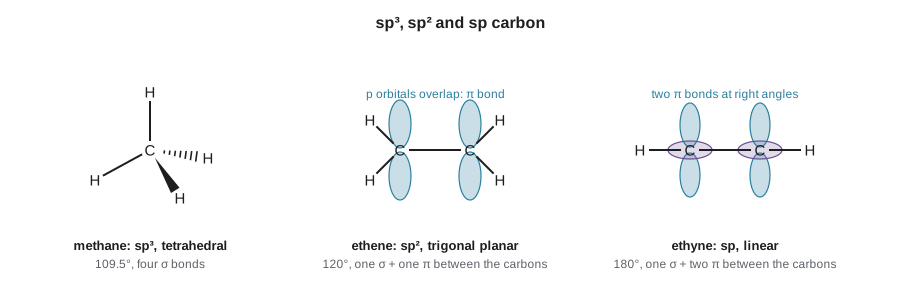
Hybridization also explains trends in bond length, bond strength and acidity. The more s character an orbital has, the closer its electrons are held to the nucleus. An sp orbital is 50 per hundred s, sp² is 33 and sp³ is 25. Bonds made with sp orbitals are shorter and stronger, and a lone pair in an sp orbital is held more tightly, which is why ethyne (pKa about 25) is far more acidic than ethene (about 44) and ethane (about 50).
| Bond | Carbon hybridization | Length (pm) | Bond energy (kJ/mol) |
|---|---|---|---|
| C–C in ethane | sp³–sp³ | 154 | 376 |
| C=C in ethene | sp²–sp² | 134 | 728 |
| C≡C in ethyne | sp–sp | 120 | 965 |
| C–H in ethane | sp³–s | 109 | 423 |
| C–H in ethene | sp²–s | 108 | 464 |
| C–H in ethyne | sp–s | 106 | 558 |
A π bond is weaker than a σ bond. The C=C bond energy of about 728 kJ/mol is less than twice the C–C single bond, and the energy needed to break only the π bond, measured from the barrier to rotation about the double bond, is about 270 kJ/mol. The π electrons sit above and below the bond axis, farther from the nuclei and more exposed. That is why alkenes react with electrophiles while alkanes do not, a theme of lessons 11 and 12. The π bond also prevents rotation: twisting one end of a double bond by 90° would destroy the p–p overlap, so alkenes can exist as cis and trans isomers, while the ends of a single bond rotate freely.
Polar bonds and electronegativity
Bonds between atoms of different electronegativity are polar. On the Pauling scale carbon is 2.55, hydrogen 2.20, nitrogen 3.04, oxygen 3.44, fluorine 3.98, chlorine 3.16 and bromine 2.96. A C–O or C–Cl bond is polarized with a partial positive charge δ+ on carbon and a partial negative charge δ− on the heteroatom. A carbon bonded to a metal, as in a Grignard reagent, is polarized the other way and carries δ−. These partial charges tell you where reactions happen: nucleophiles attack the δ+ carbon of a C–X bond, and electrophiles attack the δ− carbon of a C–Mg bond. The inductive effect is the pull of electron density through σ bonds by an electronegative atom; it falls off rapidly, by roughly half per bond, and is the main reason chloroacetic acid is a stronger acid than acetic acid (lesson 4).
Resonance
Some molecules cannot be described by a single Lewis structure. The acetate ion, CH₃CO₂⁻, can be drawn with the negative charge on either oxygen, one C=O and one C–O⁻. Neither drawing is correct on its own. Experiment shows that the two C–O bonds are identical, 127 pm long, between a typical C=O (123 pm) and C–O (136 pm), and that the two oxygens carry equal charge. The real ion is a resonance hybrid, a single structure that is a weighted average of the contributing structures, called resonance forms or resonance contributors. The double-headed arrow ↔ between resonance forms does not mean that the molecule flips between them; it means that the true structure lies between them.
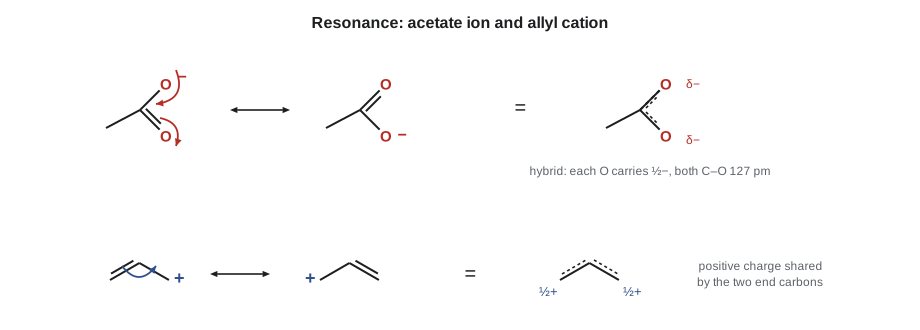
Resonance forms differ only in the placement of π electrons and lone pairs; the atoms stay where they are. You move electrons between resonance forms with curved arrows, from a lone pair or a π bond to an adjacent position. A useful set of patterns covers most cases: a lone pair next to a π bond (as in acetate or an enolate), a positive charge next to a π bond (the allyl cation), a negative charge next to a π bond (the allyl anion), a π bond between atoms of different electronegativity (the C=O group, which has a minor resonance form C⁺–O⁻), and alternating π bonds around a ring (benzene).
Not all resonance forms contribute equally. The more stable a form would be on its own, the more it contributes to the hybrid. The rules, in rough order of importance, are:
1. Forms in which every second-row atom has an octet are much more important than forms with an electron-deficient atom.
2. Forms with fewer formal charges are better than forms with more charges, and forms with charge separation are minor.
3. A negative charge is better on the more electronegative atom, and a positive charge on the less electronegative one.
4. Equivalent forms contribute equally, and a molecule with several equivalent forms is especially stabilized.
The extra stability that delocalization brings is the resonance energy. It is large for benzene, about 150 kJ/mol, and for carboxylate ions, and it explains a great deal of organic chemistry: why carboxylic acids are acidic (lesson 4), why allylic and benzylic carbocations form easily (lesson 9), why amides are planar and unreactive, and why conjugated dienes absorb light at longer wavelengths than isolated alkenes.
Worked problem
Ranking resonance forms of an amide
Draw the two main resonance forms of acetamide, CH₃CONH₂, and decide which contributes more. What does the minor form predict about the C–N bond?
Show solution
- Form A: neutral, with C=O and C–N single bond; nitrogen has a lone pair. Every atom has an octet and there are no charges.
- Form B: the nitrogen lone pair forms a C=N π bond and the C=O π electrons move onto oxygen: C(–O⁻)=N⁺H₂. Every atom still has an octet, but there are two formal charges.
- Form A contributes more because it has no charge separation, but form B is significant because the negative charge sits on the most electronegative atom, oxygen.
- Form B gives the C–N bond partial double-bond character.
Answer: The hybrid is mostly A, with an important contribution from B. The C–N bond is shorter than a normal single bond (about 134 pm against 147), the amide group is planar, rotation about C–N is slow (barrier about 75 kJ/mol), and the nitrogen lone pair is far less basic than in an amine.
Molecular orbital view of delocalization
Molecular orbital theory, introduced in CHEM-101 and developed in CHEM-241, describes resonance more naturally. In the allyl system, three adjacent p orbitals combine to make three π molecular orbitals: a bonding orbital spread over all three carbons, a nonbonding orbital with a node at the central carbon and large lobes on the two ends, and an antibonding orbital. In the allyl cation the two π electrons fill only the bonding orbital, and the empty nonbonding orbital is where the positive charge resides: on the end carbons, exactly as the resonance forms predict. The two pictures agree; resonance is the language organic chemists use day to day because it can be drawn quickly with Lewis structures.
Reading skeletal structures for electron density
With these tools you can mark any structure for reactivity. Look for lone pairs (potential nucleophiles or bases), polar bonds with a δ+ carbon (potential electrophiles), π bonds (electron-rich, attacked by electrophiles), formal charges, and delocalization that spreads charge. The C=O group of a ketone, for example, has a δ+ carbon both because oxygen is electronegative and because of the minor resonance form C⁺–O⁻; it is attacked at carbon by nucleophiles. The oxygen has two lone pairs and is weakly basic. This kind of reading becomes automatic with practice and is the basis of all the mechanisms in the second half of the course.
# Formal charge and hybridization from a simple description of each atom.
VALENCE = {'H': 1, 'C': 4, 'N': 5, 'O': 6, 'F': 7, 'Cl': 7, 'Br': 7, 'S': 6}

def formal_charge(element, bonds, lone_pairs):
    """bonds = number of bonds (a double bond counts 2); lone_pairs = pairs."""
    return VALENCE[element] - 2 * lone_pairs - bonds

def hybridization(nbrs, lone_pairs):
    domains = nbrs + lone_pairs
    return {4: 'sp3, tetrahedral', 3: 'sp2, trigonal planar', 2: 'sp, linear'}.get(domains, '?')

atoms = [
    ('C of methane',         'C', 4, 0, 4),
    ('C of a carbocation',   'C', 3, 0, 3),
    ('C of a carbanion',     'C', 3, 1, 3),
    ('N of ammonium',        'N', 4, 0, 4),
    ('O of hydronium',       'O', 3, 1, 3),
    ('O of methoxide',       'O', 1, 3, 1),
    ('C of C=O in acetone',  'C', 4, 0, 3),
    ('O of C=O in acetone',  'O', 2, 2, 1),
    ('N of acetonitrile',    'N', 3, 1, 1),
]
for name, el, bonds, lp, nbrs in atoms:
    fc = formal_charge(el, bonds, lp)
print(f'{name:22s} FC = {fc:+d} {hybridization(nbrs, lp)}')C of methane FC = +0 sp3, tetrahedral C of a carbocation FC = +1 sp2, trigonal planar C of a carbanion FC = -1 sp3, tetrahedral N of ammonium FC = +1 sp3, tetrahedral O of hydronium FC = +1 sp3, tetrahedral O of methoxide FC = -1 sp3, tetrahedral C of C=O in acetone FC = +0 sp2, trigonal planar O of C=O in acetone FC = +0 sp2, trigonal planar N of acetonitrile FC = +0 sp, linear
The program uses the shortcut that the steric number is neighbours plus lone pairs. Note the nitrogen of acetonitrile, CH₃C≡N: one neighbour and one lone pair make two domains, so it is sp hybridized and linear, like the carbon it is bonded to. One caution applies to the shortcut: a nitrogen or oxygen whose lone pair is delocalized into a π system, as in an amide, behaves as sp² and planar even though the count suggests sp³, because the lone pair occupies a p orbital to overlap with the π bond.
Common mistakes
MistakeResonance forms are different molecules that interconvert.
InsteadThey are drawings of one molecule; the real structure is the hybrid, which never changes between them.
MistakeMoving an atom gives a new resonance form.
InsteadOnly electrons (lone pairs and π bonds) move; moving an atom gives a different compound, such as a tautomer.
MistakeAll resonance forms contribute equally.
InsteadForms with full octets, fewer charges and negative charge on electronegative atoms contribute most.
MistakeFormal charge equals the real charge on an atom.
InsteadIt is a bookkeeping device; real charge is spread by electronegativity and delocalization.
MistakeA double bond is twice as strong as a single bond.
InsteadThe π component is weaker than the σ, so C=C (728 kJ/mol) is less than twice C–C (376).
MistakeAn amide nitrogen is sp³ because it has three neighbours and a lone pair.
InsteadDelocalization puts the lone pair in a p orbital, so the nitrogen is sp² and planar.
Summary and key terms
- Formal charge = V − N − B/2; in practice compare an atom's bonds with its usual valence.
- Steric number 4, 3 and 2 gives sp³ (109.5°), sp² (120°) and sp (180°); unhybridized p orbitals form π bonds.
- More s character means shorter, stronger bonds and more tightly held lone pairs.
- Polar bonds give δ+ and δ− atoms that mark sites of electrophilic and nucleophilic reactivity.
- Resonance describes delocalized electrons; the real molecule is a hybrid of its resonance forms.
- Octets, few charges and negative charge on electronegative atoms make a resonance form important.
- Delocalization stabilizes molecules and ions and controls acidity, basicity and reactivity.
- Formal charge
- The charge assigned to an atom in a Lewis structure by comparing owned and valence electrons.
- Steric number
- The number of atoms bonded to an atom plus its lone pairs.
- Hybrid orbital
- A combination of atomic orbitals on one atom pointing in a particular direction.
- π bond
- A bond formed by sideways overlap of p orbitals, with electron density above and below the bond axis.
- Inductive effect
- Polarization of σ bonds by an electronegative atom, decreasing with distance.
- Resonance hybrid
- The real structure of a molecule that requires more than one Lewis structure to describe.
- Resonance energy
- The extra stability a molecule gains from delocalization of its electrons.
- Delocalization
- Spreading of electrons over more than two atoms.
Practice problems
Work each problem on paper first, then reveal the answer to check.
Give the formal charge on each atom other than H in CH₃NO₂, nitromethane, drawn with one N=O and one N–O.
Show answer
C 0; N has four bonds, +1; the double-bonded O 0; the single-bonded O (one bond, three lone pairs) −1. Net charge 0.
State the hybridization of each carbon in propene, CH₂=CH–CH₃, and in propyne, HC≡C–CH₃.
Show answer
Propene: sp², sp², sp³. Propyne: sp, sp, sp³.
Draw the resonance forms of the enolate ion CH₂=CH–O⁻ and decide which is more important.
Show answer
CH₂=CH–O⁻ and ⁻CH₂–CH=O. The form with the charge on oxygen contributes more because oxygen is more electronegative; both have octets.
Why is the C–O bond length in acetate (127 pm) between those of C=O and C–O?
Show answer
Each C–O bond is a double bond in one resonance form and a single bond in the other; the hybrid has bond order 1.5.
Explain why ethyne is far more acidic than ethane.
Show answer
The conjugate base of ethyne has its lone pair in an sp orbital (50 per hundred s), held close to the nucleus; ethane's has it in sp³ (25 per hundred s).
Which carbon of the allyl cation, CH₂=CH–CH₂⁺, carries positive charge in the hybrid?
Show answer
Both end carbons share the positive charge equally; the central carbon carries none, as both resonance forms and the nonbonding MO show.
Lesson quiz · 5 questions
Score 60% or more to complete this lesson.
Create a free account to save your progress, take quizzes and earn a certificate.