
CHEM-261 · Lesson 10 of 12 · 22 min
Elimination: E2 and E1, and the competition with substitution
A nucleophile that attacks carbon in an SN2 reaction is also, almost always, a base. Instead of attacking the electrophilic carbon, it can remove a proton from the carbon next door. When it does, the leaving group departs, a π bond forms between the two carbons, and the product is an alkene. This is β-elimination, the reverse of the additions in lessons 11 and 12, and it is the main way of making alkenes in the laboratory. Like substitution, elimination has a concerted bimolecular pathway, E2, and a stepwise unimolecular one, E1. Substitution and elimination compete in nearly every reaction of a haloalkane with a nucleophile, and predicting which wins is one of the central practical skills of this course.
The vocabulary of elimination
The carbon bearing the leaving group is the α carbon, and its neighbours are β carbons. In a β-elimination the base removes a hydrogen from a β carbon (a β-hydrogen) and the leaving group departs from the α carbon, giving a C=C between them. Overall, H and X are lost from adjacent carbons; when X is a halogen the reaction is a dehydrohalogenation, and when an alcohol loses water it is a dehydration. If a substrate has β-hydrogens on more than one carbon, more than one alkene can form, and the question of which is favoured, regioselectivity, arises.
The E2 mechanism
The reaction of 2-bromopropane with sodium ethoxide in ethanol gives propene with a rate proportional to the concentrations of both the substrate and the base, rate = k[RBr][EtO⁻]. The mechanism is E2: elimination, bimolecular. It is one concerted step in which three things happen at once: the base removes the β-hydrogen, the C–H bonding pair moves in to form the π bond, and the leaving group departs with its bonding pair. Three curved arrows describe it.
Evidence for the concerted mechanism includes the kinetic isotope effect. Replacing the β-hydrogens with deuterium slows an E2 reaction by a factor of about 3 to 7, because the C–D bond, with its lower zero-point energy, is harder to break, and the effect appears only if the C–H bond is broken in the rate-determining step. The E2 reaction is also stereospecific, which is the most useful clue to its geometry.
Anti-periplanar geometry
For the C–H σ bond to become the π bond smoothly as the C–LG bond breaks, the orbitals must line up. The best arrangement is anti-periplanar: the H and the leaving group lie in the same plane, on opposite sides of the C–C bond, at a dihedral angle of 180°, as in the anti conformation of butane. In this geometry the filled σ C–H orbital overlaps directly with the back lobe of the empty σ* C–LG orbital. A syn-periplanar arrangement, at 0°, is possible but much less favourable, and other angles do not work.
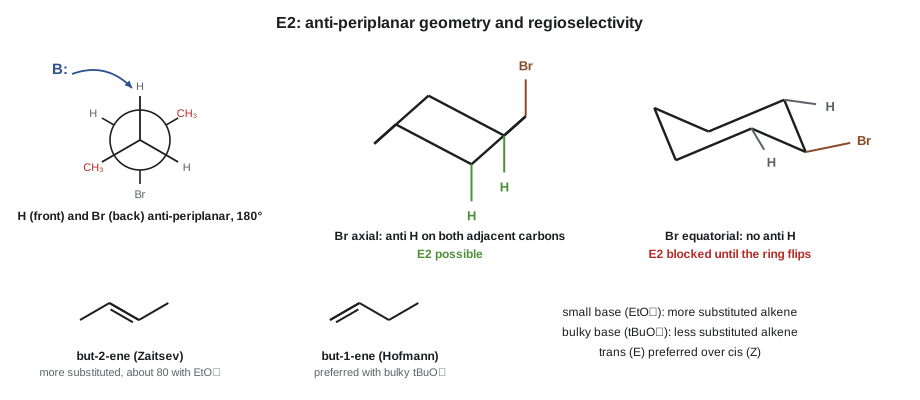
The anti-periplanar requirement has visible consequences. When the β carbon is a stereocentre, the geometry of the alkene follows from the configuration of the substrate: the two diastereomers of 2-bromo-3-phenylbutane give different stereoisomers of 2-phenylbut-2-ene, each giving only one. In cyclohexanes the effect is dramatic. A ring hydrogen and a leaving group on adjacent carbons are anti-periplanar only when both are axial, trans-diaxial. If the leaving group is equatorial, no adjacent C–H is anti to it, and E2 cannot occur until the ring flips to put the leaving group axial. Menthyl chloride, whose bulky groups lock the chloride equatorial in the more stable chair, eliminates about 200 times more slowly than its diastereomer neomenthyl chloride, whose chloride is axial in the preferred chair, and the two give different alkenes.
Regioselectivity: Zaitsev and Hofmann
When a substrate can eliminate toward two different β carbons, the more substituted, more stable alkene usually predominates. This is Zaitsev's rule, from the Russian chemist Alexander Zaitsev (1875). 2-Bromobutane with sodium ethoxide gives about 80 per hundred but-2-ene (mostly trans) and 20 per hundred but-1-ene. Alkene stability increases with the number of alkyl groups on the double bond, as heats of hydrogenation show (lesson 11), and the E2 transition state, which has partial double-bond character, shares some of that stability.
A bulky base reverses the preference. Potassium tert-butoxide finds it hard to reach a hydrogen on an internal, more hindered carbon and takes one from the less hindered terminal CH₃ instead. The less substituted alkene, called the Hofmann product after August Wilhelm von Hofmann's eliminations of quaternary ammonium salts in the 1850s, then predominates: 2-bromo-2-methylbutane with tert-butoxide gives mainly 2-methylbut-1-ene, while with ethoxide it gives mainly 2-methylbut-2-ene. Poor leaving groups such as fluoride and trimethylamine also favour the Hofmann product. With choice of base, the chemist can choose the alkene.
| Substrate | Base | Major alkene | Minor alkene |
|---|---|---|---|
| 2-Bromobutane | NaOCH₂CH₃ | but-2-ene (about 80, mostly E) | but-1-ene (about 20) |
| 2-Bromo-2-methylbutane | NaOCH₂CH₃ | 2-methylbut-2-ene (about 70) | 2-methylbut-1-ene (about 30) |
| 2-Bromo-2-methylbutane | KOC(CH₃)₃ | 2-methylbut-1-ene (about 72) | 2-methylbut-2-ene (about 28) |
Among Zaitsev products, the E (trans) isomer is usually favoured over Z, because the alkyl groups in the transition state leading to the cis alkene crowd each other. The reaction is therefore also stereoselective.
The E1 mechanism
Tertiary haloalkanes in polar protic solvents with weak bases, the conditions of SN1, also give alkenes. The mechanism is E1: elimination, unimolecular. It shares its slow first step with SN1, ionization to a carbocation, and the rate is first order, k[RX]. In the fast second step, a weak base, usually the solvent, removes a proton from a carbon next to the carbocation. Because the carbocation is planar and the proton is removed afterwards, E1 has no anti-periplanar requirement and is not stereospecific. It follows Zaitsev's rule, giving the more stable alkene, and because it passes through a carbocation it can be accompanied by rearrangements. E1 and SN1 always occur together; heating favours E1, because elimination produces two particles from one and has a more positive entropy change, and higher temperature magnifies the TΔS term.
Acid-catalysed dehydration of alcohols is the most important E1 reaction. Heating a secondary or tertiary alcohol with concentrated sulfuric or phosphoric acid protonates the OH, water leaves to give a carbocation, and loss of a proton gives the alkene, which is often distilled out as it forms to drive the equilibrium. Tertiary alcohols dehydrate at lower temperatures than secondary ones, and primary alcohols need harsh conditions and proceed by an E2-like path.
Other eliminations
Two eliminations in a row turn a dihalide into an alkyne. A vicinal dibromide, made by adding bromine to an alkene (lesson 11), loses two molecules of HBr when heated with excess sodium amide, first giving a vinyl bromide and then the triple bond. The sequence alkene → dibromide → alkyne is a standard way to convert one functional group into the other, and lesson 12 uses alkynes extensively. The second elimination needs the very strong base because the C–H and C–Br bonds of a vinyl bromide are both harder to break.
A third mechanism, E1cB (elimination, unimolecular, conjugate base), operates when the β-hydrogen is unusually acidic and the leaving group poor. The base first removes the proton to form a carbanion, often an enolate stabilized by a neighbouring carbonyl group, and the leaving group departs in a second step. It is the reverse order of events from E1. E1cB eliminations complete the aldol condensation in CHEM-263 and appear in several steps of metabolism.
Living cells perform eliminations constantly, usually dehydrations catalysed by enzymes that hold the substrate in the right geometry and supply acidic and basic groups at exactly the right places. In glycolysis, the enzyme enolase removes water from 2-phosphoglycerate to give phosphoenolpyruvate, and in the citric acid cycle fumarase interconverts fumarate and malate by adding and removing water across a C=C. The fumarase reaction is strictly stereospecific, an anti addition and elimination, just like an E2 in the laboratory.
On the largest scale of all, alkenes are made industrially not by these laboratory eliminations but by steam cracking, in which ethane, propane or naphtha is heated briefly to about 850 °C with steam. Radical reactions break C–C and C–H bonds and eliminate hydrogen, giving ethylene, propylene and butadiene. The process is an elimination in the broad sense, driven by the large entropy gain of making several small molecules from one, which becomes dominant at high temperature, exactly the effect that favours E1 over SN1 in a heated flask.
Substitution versus elimination
The decisive factors are the structure of the substrate and the basicity and size of the nucleophile, with temperature as a tie-breaker. A practical scheme:
1. Methyl substrates cannot eliminate (no β carbon): SN2 only.
2. Primary substrates give SN2 with good nucleophiles that are weak or moderate bases (I⁻, Br⁻, CN⁻, N₃⁻, RS⁻, RCOO⁻) and even with strong unhindered bases such as hydroxide and methoxide. Only a strong, bulky base such as tert-butoxide gives mainly E2.
3. Secondary substrates give SN2 with good nucleophiles that are weak bases, especially in polar aprotic solvents, but mainly E2 with strong bases such as hydroxide and alkoxides. With weak nucleophiles in protic solvents they react slowly by SN1 and E1.
4. Tertiary substrates give E2 with any strong base, and SN1 with E1 with weak bases and nucleophiles in protic solvents; heating favours E1.
5. Higher temperature favours elimination over substitution in all cases.
Worked problem
Predicting substitution or elimination
Predict the major organic product of each reaction: (a) 1-bromopropane with NaCN in DMSO; (b) 2-bromopropane with NaOCH₂CH₃ in ethanol; (c) 2-bromo-2-methylpropane in ethanol at 25 °C; (d) 1-bromo-2-methylpropane with KOC(CH₃)₃.
Show solution
- (a) Primary substrate, good nucleophile that is a weak base, aprotic solvent: SN2, giving butanenitrile.
- (b) Secondary substrate, strong unhindered base: mainly E2, propene (about 80 per hundred), with some 2-ethoxypropane by SN2.
- (c) Tertiary substrate, weak nucleophile and base, protic solvent, room temperature: SN1 gives mainly 2-ethoxy-2-methylpropane, with some 2-methylpropene by E1.
- (d) Primary substrate but strong bulky base: E2, 2-methylpropene.
Answer: Butanenitrile; propene; 2-ethoxy-2-methylpropane (with some 2-methylpropene); 2-methylpropene.
import math
RT = 2.479            # kJ/mol at 25 C

def ratio_from_ddG(ddG):
    return math.exp(ddG / RT)

def share(major_over_minor):
    return 100 * major_over_minor / (1 + major_over_minor)

# Zaitsev : Hofmann ratios as barrier differences
for label, pct in [('2-bromobutane, ethoxide', 80), ('2-bromo-2-methylbutane, tert-butoxide (Hofmann)', 72)]:
    r = pct / (100 - pct)
    print(f'{label:46s} {pct}:{100 - pct}  ->  ddG++ = {RT * math.log(r):.1f} kJ/mol')

def predict(substrate, base_strength, bulky, solvent, hot=False):
    """A rule-of-thumb predictor of the main pathway."""
    if substrate == 'methyl':
        return 'SN2'
    if substrate == 'primary':
        return 'E2' if (base_strength == 'strong' and bulky) else 'SN2'
    if substrate == 'secondary':
        if base_strength == 'strong':
            return 'E2'
        return 'SN2' if solvent == 'aprotic' else ('E1' if hot else 'SN1 (+E1)')
    if substrate == 'tertiary':
        if base_strength == 'strong':
            return 'E2'
        return 'E1' if hot else 'SN1 (+E1)'

cases = [('1-bromopropane + CN-, DMSO', 'primary', 'weak', False, 'aprotic'),
         ('2-bromopropane + EtO-, EtOH', 'secondary', 'strong', False, 'protic'),
         ('2-bromopropane + N3-, DMF', 'secondary', 'weak', False, 'aprotic'),
         ('tert-butyl bromide, EtOH, 25 C', 'tertiary', 'weak', False, 'protic'),
         ('tert-butyl bromide, EtOH, 80 C', 'tertiary', 'weak', False, 'protic', True),
         ('isobutyl bromide + tBuO-', 'primary', 'strong', True, 'protic')]
for c in cases:
print(f'{c[0]:32s} -> {predict(*c[1:])}')2-bromobutane, ethoxide 80:20 -> ddG++ = 3.4 kJ/mol 2-bromo-2-methylbutane, tert-butoxide (Hofmann) 72:28 -> ddG++ = 2.3 kJ/mol 1-bromopropane + CN-, DMSO -> SN2 2-bromopropane + EtO-, EtOH -> E2 2-bromopropane + N3-, DMF -> SN2 tert-butyl bromide, EtOH, 25 C -> SN1 (+E1) tert-butyl bromide, EtOH, 80 C -> E1 isobutyl bromide + tBuO- -> E2
Rules of thumb like these are a starting point, not a substitute for thinking about each case. Real reactions often give mixtures, and the proportions depend on temperature, solvent and concentration. But the logic, crowding at carbon, basicity and size of the reagent, stability of possible carbocations, and the entropy gained in elimination, will predict the main product correctly in the great majority of cases.
Common mistakes
MistakeE2 can remove any β-hydrogen.
InsteadThe β-hydrogen must be anti-periplanar to the leaving group; in cyclohexanes both must be axial.
MistakeZaitsev's rule always applies.
InsteadBulky bases and poor leaving groups give the less substituted Hofmann alkene.
MistakeE1 is stereospecific like E2.
InsteadE1 passes through a planar carbocation and has no geometric requirement.
MistakeTertiary halides with strong bases give SN2 products.
InsteadThey cannot do SN2; strong bases give E2.
MistakeRaising the temperature favours substitution.
InsteadElimination has a more positive entropy change and is favoured by heat.
MistakePrimary halides with hydroxide give mainly alkenes.
InsteadUnhindered primary substrates give mainly SN2 even with strong bases; only bulky bases switch them to E2.
Summary and key terms
- β-Elimination removes H and a leaving group from adjacent carbons to form an alkene.
- E2: one concerted step, rate = k[RX][base], requires anti-periplanar H and leaving group (trans-diaxial in cyclohexanes).
- Zaitsev's rule: the more substituted alkene is usually favoured; bulky bases give the less substituted Hofmann alkene.
- E1: carbocation intermediate, rate = k[RX], accompanies SN1, follows Zaitsev and may rearrange; acid-catalysed dehydration of alcohols is E1.
- Substrate class and base strength and size decide between substitution and elimination; heat favours elimination.
- β-Elimination
- Loss of a leaving group and a hydrogen from adjacent carbons to form a π bond.
- E2
- Bimolecular, concerted elimination with anti-periplanar geometry.
- E1
- Unimolecular elimination through a carbocation intermediate.
- Anti-periplanar
- A 180° dihedral arrangement of two bonds on adjacent atoms.
- Zaitsev product
- The more substituted alkene from an elimination.
- Hofmann product
- The less substituted alkene, favoured by bulky bases.
- Dehydration
- Elimination of water from an alcohol to give an alkene.
- Kinetic isotope effect
- The change in rate when an atom is replaced by an isotope, evidence for bond breaking in the slow step.
Practice problems
Work each problem on paper first, then reveal the answer to check.
Give the major product of 2-bromo-2-methylbutane with sodium ethoxide and with potassium tert-butoxide.
Show answer
Ethoxide: 2-methylbut-2-ene (Zaitsev). tert-Butoxide: 2-methylbut-1-ene (Hofmann).
Why does cis-1-bromo-4-tert-butylcyclohexane undergo E2 with ethoxide much faster than the trans isomer?
Show answer
With the tert-butyl equatorial, the cis isomer has Br axial, anti to axial β-hydrogens; the trans isomer has Br equatorial and must flip into a very unfavourable chair.
Predict the product of heating 2-methylbutan-2-ol with concentrated H₃PO₄.
Show answer
E1 dehydration: 2-methylbut-2-ene as the major (Zaitsev) product.
Explain why heating a solvolysis of tert-butyl bromide in ethanol increases the yield of 2-methylpropene.
Show answer
Elimination forms more particles and has a larger positive ΔS; raising T makes −TΔS more negative, favouring E1 over SN1.
Predict the main pathway of 1-bromobutane with NaOH in water and with KOC(CH₃)₃.
Show answer
NaOH: SN2, butan-1-ol. KOC(CH₃)₃: E2, but-1-ene.
A deuterated substrate eliminates 6.5 times more slowly than the normal one. What does this suggest?
Show answer
A primary kinetic isotope effect: the C–H bond is broken in the rate-determining step, consistent with E2.
Lesson quiz · 5 questions
Score 60% or more to complete this lesson.
Create a free account to save your progress, take quizzes and earn a certificate.