
CHEM-261 · Lesson 5 of 12 · 22 min
Alkanes and cycloalkanes: conformations, strain and Newman projections
Alkanes are the simplest organic compounds, made only of carbon and hydrogen joined by single bonds. They are the main components of natural gas, gasoline, diesel fuel and paraffin wax, and their skeletons are the frameworks on which functional groups sit. Alkanes are not static. Rotation about each C–C single bond is fast at room temperature, and the molecule continually changes shape. The different shapes are conformations, and their energies control the shapes of every flexible molecule, from fatty acids to proteins. Rings add strain, and the cyclohexane chair, the most important ring in organic chemistry, has a geometry you must be able to draw and analyse. This lesson covers conformational analysis, ring strain and the properties and few reactions of alkanes.
Physical properties of alkanes
Alkanes are nonpolar, so the only forces between their molecules are London dispersion forces, which grow with molecular size and surface area. Methane to butane are gases at room temperature, pentane to about C₁₇ are liquids, and larger alkanes are waxy solids. Boiling points rise by roughly 20 to 30 °C per added CH₂ in the low range. Branching lowers the boiling point because a more compact molecule has less surface in contact with its neighbours: pentane boils at 36 °C, 2-methylbutane at 28 °C and 2,2-dimethylpropane at 10 °C. Alkanes are insoluble in water and less dense than it, which is why oil floats.
Conformations of ethane
Looking along the C–C bond of ethane, the hydrogens on the front carbon can be lined up with those on the back carbon (eclipsed) or set between them (staggered). The angle between a front C–H and a back C–H, viewed along the bond, is the dihedral or torsion angle. Two drawing conventions show this. In a sawhorse drawing, the C–C bond is drawn at an angle with the back carbon up and to the right. In a Newman projection, invented by Melvin Newman in 1952, you look straight down the bond: the front carbon is a point where three bonds meet, and the back carbon is a circle with three bonds coming from its edge.
The staggered conformation is lower in energy than the eclipsed by about 12 kJ/mol, or 4 kJ/mol for each pair of eclipsed C–H bonds. This energy difference is torsional strain. Its origin is debated, but the main contributions are repulsion between the bonding electron pairs of the eclipsed bonds and, in the staggered form, a stabilizing overlap between a filled σ C–H orbital on one carbon and an empty σ* C–H orbital on the other (hyperconjugation). A barrier of 12 kJ/mol is small compared with the thermal energy available at room temperature, so the groups of ethane turn past each other some 10¹⁰ to 10¹¹ times per second; the conformations cannot be separated.
Conformations of butane
Butane, CH₃CH₂CH₂CH₃, is more interesting. Looking along the C2–C3 bond, each carbon carries a methyl and two hydrogens. As the back carbon rotates, the molecule passes through six distinct conformations every 360°. The lowest is anti, with the two methyls 180° apart. At 60° the methyls are gauche, staggered but next to each other, and 3.8 kJ/mol higher because the methyls crowd each other; this is steric strain, repulsion between atoms forced closer than the sum of their van der Waals radii. The eclipsed conformations at 120° (methyl eclipsing H) are about 15 kJ/mol above anti, and the fully eclipsed conformation at 0°, with methyl eclipsing methyl, is highest, about 19 kJ/mol.
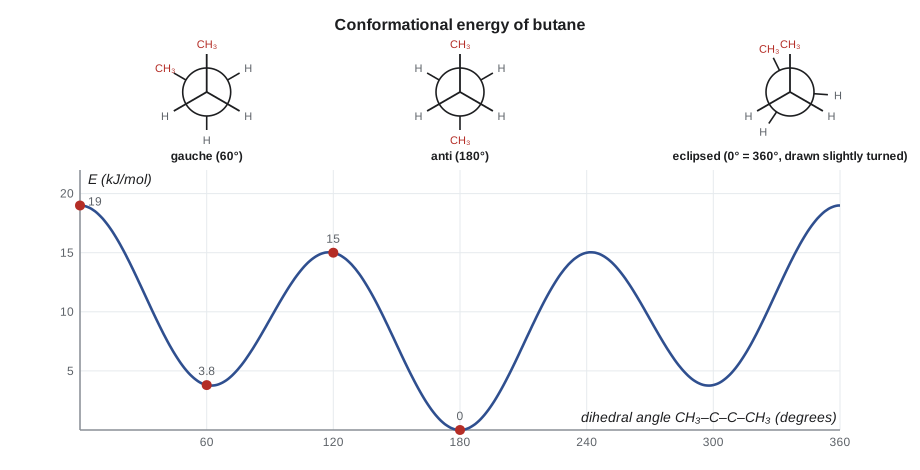
At room temperature butane is about 70 per hundred anti and 30 per hundred gauche (the two gauche conformations, at 60° and 300°, together). The eclipsed forms are only transition states between them. Long chains therefore prefer the zigzag shape with all anti conformations, which is why skeletal drawings show chains as zigzags, but gauche kinks are common, and a chain in solution is a mixture of many shapes.
The populations follow the Boltzmann distribution. For two conformations of energy difference ΔE, the ratio of their populations is the ratio of their degeneracies times e^(−ΔE/RT). With one anti and two gauche conformations, the gauche-to-anti ratio at 298 K is 2 × e^(−3800/(8.314 × 298)) = 2 × 0.216 = 0.43, giving 70 per hundred anti. The code below generalizes this calculation to the whole torsion curve.
Rings and ring strain
In a cycloalkane, CₙH₂ₙ, the ring forces the C–C–C angles away from 109.5° and some of the C–H bonds into eclipsing positions. Adolf von Baeyer proposed in 1885 that rings are strained in proportion to the deviation of their angles from tetrahedral, assuming the rings were planar. He was right about the small rings and wrong about the larger ones, because rings larger than cyclopropane pucker. The total ring strain can be measured from heats of combustion: each CH₂ in a strain-free chain releases about 658.6 kJ/mol on combustion, and any excess per CH₂ in a ring is strain.
| Ring | Heat of combustion per CH₂ (kJ/mol) | Total strain (kJ/mol) | Shape |
|---|---|---|---|
| Cyclopropane | 697 | 115 | planar, 60° angles |
| Cyclobutane | 681 | 110 | slightly folded |
| Cyclopentane | 664 | 27 | envelope |
| Cyclohexane | 659 | 0 | chair |
| Cycloheptane | 662 | 27 | twist-chair |
| Cyclodecane | 664 | 50 | crowded crown |
Cyclopropane has angle strain (60° instead of 109.5°) and torsional strain from six eclipsed pairs of C–H bonds. Its bonds are bent, with the orbitals pointing outside the line between the nuclei, and it reacts in ways ordinary alkanes do not, opening its ring with hydrogen or bromine. Cyclobutane folds by about 25° to relieve some eclipsing. Cyclopentane adopts an envelope shape. Cyclohexane, remarkably, is free of strain.
The chair conformation of cyclohexane
Cyclohexane avoids all angle and torsional strain by adopting the chair conformation, with C–C–C angles of about 111° and every C–H bond staggered with its neighbours. Odd Hassel's electron diffraction work and Derek Barton's 1950 paper applying the chair to the reactions of steroids founded conformational analysis; they shared the 1969 Nobel Prize in Chemistry. Each carbon of the chair has one axial bond, parallel to the ring's axis and pointing alternately up and down, and one equatorial bond, pointing outward roughly in the plane of the ring.
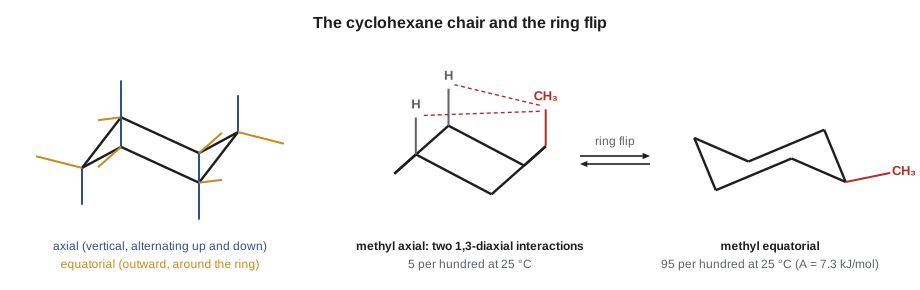
Drawing a chair well takes practice. Draw two parallel lines slanting slightly upward, offset from each other; join the top ends with a peak pointing up on one side and the bottom ends with a point down on the other. The axial bonds are then vertical, up at the up-pointing carbons and down at the down-pointing ones. Each equatorial bond is parallel to the ring bonds one removed from it. When the drawing is right, opposite sides of the chair are parallel.
The chair is not rigid. A ring flip converts one chair into the other through a higher-energy half-chair and a twist-boat; the barrier is about 45 kJ/mol, so at room temperature the ring flips about 10⁵ times per second. In the flip, every axial bond becomes equatorial and every equatorial bond becomes axial, but up stays up: a substituent that was axial and pointing up becomes equatorial and still points somewhat up. The boat conformation, with both ends raised, is about 30 kJ/mol above the chair because of eclipsing along its sides and a clash between the two flagpole hydrogens.
Substituted cyclohexanes
In methylcyclohexane the two chairs are no longer equal. An axial methyl is close to the two axial hydrogens on the same side of the ring, three carbons away (1,3-diaxial interactions); each interaction is equivalent to a gauche butane interaction, about 3.8 kJ/mol, so an axial methyl should cost about 7.6 kJ/mol, close to the measured value of 7.3. An equatorial methyl points away from the ring and has no such interactions. The energy difference between axial and equatorial for a substituent is its A-value. The equilibrium constant follows from ΔG° = −RT ln K. For methyl, K = e^(7600/(8.314 × 298)) = 21, so about 95 per hundred of the molecules have the methyl equatorial.
| Substituent | A-value (kJ/mol) | Equatorial at 25 °C (per hundred) |
|---|---|---|
| F | 1.0 | 60 |
| Cl | 2.2 | 71 |
| OH | 3.9 | 83 |
| CH₃ | 7.3 | 95 |
| CH₂CH₃ | 7.5 | 95 |
| CH(CH₃)₂ | 9.2 | 98 |
| C(CH₃)₃ | about 20 | more than 99.9 |
| C₆H₅ | 11.7 | 99 |
A tert-butyl group is so large that it effectively locks the ring with the tert-butyl equatorial. Chemists use this to study the separate reactivity of axial and equatorial groups, and lesson 10 uses it to show that E2 elimination needs an axial leaving group.
Worked problem
The more stable chair of a disubstituted cyclohexane
Which chair conformation of cis-1-tert-butyl-4-methylcyclohexane is preferred, and roughly what is the energy difference?
Show solution
- In a cis-1,4 compound both groups point to the same face of the ring (both up). In any chair, one of them is then axial and the other equatorial, at 1,4 positions.
- Chair A: tert-butyl equatorial, methyl axial. Cost: the methyl A-value, about 7.3 kJ/mol.
- Chair B: tert-butyl axial, methyl equatorial. Cost: the tert-butyl A-value, about 20 kJ/mol.
- Chair A is lower by about 13 kJ/mol, so K ≈ e^(13000/2478) ≈ 190.
Answer: The chair with tert-butyl equatorial and methyl axial dominates, more than 99 per hundred. Large groups go equatorial even at the cost of forcing a smaller group axial.
Cis and trans isomers of disubstituted rings are stereoisomers, not conformations: changing one into the other requires breaking bonds, not just a ring flip. For 1,2- and 1,4-disubstitution, the trans isomer can have both groups equatorial; for 1,3, the cis isomer can. That isomer is usually the more stable one.
Reactions of alkanes: combustion and radical halogenation
Alkanes were once called paraffins, from the Latin for having little affinity, because they react with few reagents. Two reactions matter. Combustion releases large amounts of heat and is the reason alkanes are fuels; octane releases about 5470 kJ/mol. Radical halogenation replaces hydrogen with chlorine or bromine when a mixture of the alkane and halogen is heated or irradiated. It is a chain reaction with three stages: initiation, in which light or heat splits Cl₂ into two chlorine atoms; propagation, in which Cl· abstracts a hydrogen to give HCl and an alkyl radical, and the alkyl radical reacts with Cl₂ to give the chloroalkane and a new Cl·; and termination, when two radicals combine. Each initiation event can lead to thousands of propagation cycles.
Radical stability follows the order tertiary > secondary > primary > methyl, because alkyl groups stabilize the half-filled orbital by hyperconjugation; bond dissociation energies show this, from 439 kJ/mol for CH₃–H to 400 for a tertiary C–H. Chlorination is fast and unselective: the chlorine atom reacts with almost any C–H, preferring tertiary over primary by only about 5 to 1 per hydrogen at room temperature. Bromination is far more selective, about 1600 to 1 for tertiary over primary, because the hydrogen-abstraction step is endothermic for bromine and its transition state resembles the radical, as the Hammond postulate of lesson 8 explains. This is why bromination is used when a single product is wanted.
import math
R, T = 8.314, 298.15

def butane_energy(phi_deg):
    """Torsion energy of butane (kJ/mol), a three-term Fourier fit with
    anti at 180 deg = 0, gauche = 3.8, H/CH3 eclipsed = 15, CH3/CH3 eclipsed ~ 19."""
    p = math.radians(phi_deg)
    v1, v2, v3 = 5.2, -0.13, 13.8
    return 0.5 * (v1 * (1 + math.cos(p)) + v2 * (1 - math.cos(2 * p)) + v3 * (1 + math.cos(3 * p)))

for phi in (0, 60, 120, 180):
    print(f'phi = {phi:3d} deg   E = {butane_energy(phi):5.1f} kJ/mol')

# Boltzmann populations over the whole torsion curve (1-degree grid)
w = [math.exp(-butane_energy(a) * 1000 / (R * T)) for a in range(360)]
anti = sum(w[a] for a in range(120, 241)) / sum(w)
print(f'anti region population at 25 C: {100 * anti:.0f} per hundred')

# chair equilibria from A-values
for group, a_val in [('Cl', 2.2), ('OH', 3.9), ('CH3', 7.3), ('iPr', 9.2), ('tBu', 20.0)]:
    K = math.exp(a_val * 1000 / (R * T))
print(f'{group:4s} A = {a_val:4.1f} K = {K:9.1f} equatorial = {100 * K / (1 + K):6.2f} per hundred')phi = 0 deg E = 19.0 kJ/mol phi = 60 deg E = 3.8 kJ/mol phi = 120 deg E = 15.0 kJ/mol phi = 180 deg E = 0.0 kJ/mol anti region population at 25 C: 69 per hundred Cl A = 2.2 K = 2.4 equatorial = 70.84 per hundred OH A = 3.9 K = 4.8 equatorial = 82.83 per hundred CH3 A = 7.3 K = 19.0 equatorial = 95.00 per hundred iPr A = 9.2 K = 40.9 equatorial = 97.61 per hundred tBu A = 20.0 K = 3191.9 equatorial = 99.97 per hundred
The Fourier form, a sum of cosine terms in the dihedral angle, is the same kind of function used in the molecular mechanics force fields that computational chemists use to calculate conformations of large molecules such as proteins.
Common mistakes
MistakeConformations are isomers that can be separated.
InsteadThey interconvert by rotation in nanoseconds at room temperature and are not normally separable.
MistakeThe gauche conformation of butane is eclipsed.
InsteadGauche is staggered; its strain comes from the two methyls being 60° apart.
MistakeCyclohexane is planar with 120° angles.
InsteadIt adopts the strain-free chair with angles near 111° and all bonds staggered.
MistakeA ring flip turns an up substituent into a down substituent.
InsteadAxial and equatorial interchange, but up stays up and down stays down.
MistakeCis and trans isomers interconvert by ring flips.
InsteadThey are stereoisomers; only bond breaking interconverts them.
MistakeChlorination is selective for tertiary hydrogens.
InsteadChlorination is unselective; bromination is highly selective.
Summary and key terms
- Alkanes are nonpolar; boiling points rise with size and fall with branching.
- Newman projections show conformations; staggered ethane is 12 kJ/mol below eclipsed.
- Butane: anti lowest, gauche +3.8, eclipsed up to about 19 kJ/mol; populations follow the Boltzmann distribution.
- Ring strain combines angle, torsional and steric strain; cyclopropane and cyclobutane are strained, cyclohexane is not.
- The cyclohexane chair has axial and equatorial positions that interchange on a ring flip.
- Substituents prefer equatorial positions by their A-values; ΔG° = −RT ln K gives the ratio.
- Radical halogenation is a chain reaction; bromination is far more selective than chlorination.
- Conformation
- One of the shapes a molecule takes by rotation about single bonds.
- Newman projection
- A drawing that looks straight down a bond, with the back carbon as a circle.
- Torsional strain
- Strain from eclipsing of bonds on adjacent atoms.
- Steric strain
- Strain from atoms forced closer than their van der Waals radii allow.
- Anti and gauche
- Staggered conformations with two groups at 180° and at 60°.
- Axial and equatorial
- The two kinds of position on a cyclohexane chair, parallel to and around the ring axis.
- A-value
- The free energy difference between axial and equatorial positions of a substituent.
- 1,3-Diaxial interaction
- Steric strain between an axial group and the axial hydrogens two carbons away.
Practice problems
Work each problem on paper first, then reveal the answer to check.
Draw Newman projections of the anti and gauche conformations of 1,2-dibromoethane along C1–C2.
Show answer
Anti: the Br atoms at 180°; gauche: at 60°. The anti form also has no net dipole, while the gauche form is polar.
Calculate the proportion of axial chlorocyclohexane at 25 °C (A = 2.2 kJ/mol).
Show answer
K = e^(2200/2478) = 2.43 (eq/ax); axial = 1/(1 + 2.43) = 29 per hundred.
Which is more stable, cis- or trans-1,2-dimethylcyclohexane? Explain.
Show answer
Trans: it can place both methyls equatorial. The cis isomer always has one axial methyl.
Why does cyclopropane react with H₂ over a catalyst to give propane while cyclohexane does not?
Show answer
Opening the ring releases about 115 kJ/mol of strain.
How many monochlorination products does 2-methylpropane give, and which is favoured by bromination?
Show answer
Two: 1-chloro-2-methylpropane and 2-chloro-2-methylpropane. Bromination gives almost exclusively 2-bromo-2-methylpropane, by tertiary selectivity.
Rank pentane, 2-methylbutane and hexane by boiling point and explain.
Show answer
Hexane (69 °C) > pentane (36) > 2-methylbutane (28): larger and less branched molecules have stronger dispersion forces.
Lesson quiz · 5 questions
Score 60% or more to complete this lesson.
Create a free account to save your progress, take quizzes and earn a certificate.