
CHEM-102 · Lesson 8 of 12 · 32 min
Solubility and precipitation equilibria
Kidney stones, the scale inside a kettle, the white crust on a showerhead and the stalactites of a limestone cave all form when an ionic solid precipitates from solution. Barium sulfate, swallowed as a suspension, lets radiologists image the digestive tract even though barium ions are toxic, because so little of it dissolves. Mining companies precipitate metals out of process water before releasing it. All of these depend on solubility equilibria, the equilibria between an ionic solid and its dissolved ions. CHEM-101 used simple solubility rules to predict whether a precipitate forms; this lesson makes those predictions quantitative.
The solubility product
When a sparingly soluble salt is placed in water, a small amount dissolves until the solution is saturated. At that point the dissolved ions are in dynamic equilibrium with the solid. For silver chloride,
The equilibrium constant is called the solubility product, K_sp. As for any heterogeneous equilibrium (lesson 7), the solid is left out. For a salt with more than one ion of a kind, each concentration is raised to the power of its coefficient: for calcium fluoride, CaF₂(s) ⇌ Ca²⁺ + 2 F⁻, K_sp = [Ca²⁺][F⁻]².
| Compound | K_sp at 25 °C | Compound | K_sp at 25 °C |
|---|---|---|---|
| AgCl | 1.8 × 10⁻¹⁰ | CaCO₃ (calcite) | 3.4 × 10⁻⁹ |
| AgBr | 5.0 × 10⁻¹³ | CaF₂ | 3.9 × 10⁻¹¹ |
| AgI | 8.3 × 10⁻¹⁷ | Ca₃(PO₄)₂ | 2.1 × 10⁻³³ |
| Ag₂CrO₄ | 1.1 × 10⁻¹² | BaSO₄ | 1.1 × 10⁻¹⁰ |
| PbCl₂ | 1.7 × 10⁻⁵ | Mg(OH)₂ | 5.6 × 10⁻¹² |
| PbI₂ | 9.8 × 10⁻⁹ | Fe(OH)₃ | 2.8 × 10⁻³⁹ |
| CaSO₄ | 4.9 × 10⁻⁵ | Cu(OH)₂ | 2.2 × 10⁻²⁰ |
From solubility to K_sp and back
The molar solubility, s, is the number of moles of a salt that dissolve per litre of saturated solution. The relation between s and K_sp depends on the formula. For a 1 : 1 salt like AgCl, each mole that dissolves gives s of each ion, so K_sp = s². For a 1 : 2 salt like CaF₂, it gives s of Ca²⁺ and 2s of F⁻, so K_sp = s(2s)² = 4s³.
Worked problem
K_sp from measured solubility
The solubility of lead(II) iodide is 0.54 g/L at 25 °C. Find K_sp. (PbI₂: 461.0 g/mol.)
Show solution
- Molar solubility: s = 0.54/461.0 = 1.17 × 10⁻³ mol/L.
- PbI₂(s) ⇌ Pb²⁺ + 2 I⁻: [Pb²⁺] = s, [I⁻] = 2s.
- K_sp = s(2s)² = 4s³ = 4(1.17 × 10⁻³)³ = 6.4 × 10⁻⁹.
Answer: K_sp ≈ 6.4 × 10⁻⁹, the same order of magnitude as the tabulated value. Measured solubilities rarely reproduce K_sp exactly, because ion pairing and activity effects make real solutions non-ideal.
Worked problem
Solubility from K_sp
Calculate the molar solubility of silver chromate, Ag₂CrO₄, K_sp = 1.1 × 10⁻¹², and compare it with silver chloride.
Show solution
- Ag₂CrO₄(s) ⇌ 2 Ag⁺ + CrO₄²⁻: K_sp = (2s)²(s) = 4s³.
- s = (K_sp/4)^(1/3) = (2.75 × 10⁻¹³)^(1/3) = 6.5 × 10⁻⁵ M.
- For AgCl: s = √(1.8 × 10⁻¹⁰) = 1.3 × 10⁻⁵ M.
Answer: Silver chromate is about five times more soluble than silver chloride, even though its K_sp is smaller. K_sp values can be compared directly only for salts with the same ion ratio.
# Molar solubility from Ksp for salts of formula MxAy:  Ksp = (x s)^x (y s)^y
salts = {"AgCl": (1, 1, 1.8e-10), "CaF2": (1, 2, 3.9e-11), "Ag2CrO4": (2, 1, 1.1e-12),
         "BaSO4": (1, 1, 1.1e-10), "Ca3(PO4)2": (3, 2, 2.1e-33), "Fe(OH)3": (1, 3, 2.8e-39)}
for name, (x, y, Ksp) in salts.items():
    s = (Ksp / (x ** x * y ** y)) ** (1 / (x + y))
print(f"{name:10s} Ksp = {Ksp:.1e} molar solubility = {s:.2e} M")AgCl Ksp = 1.8e-10 molar solubility = 1.34e-05 M CaF2 Ksp = 3.9e-11 molar solubility = 2.14e-04 M Ag2CrO4 Ksp = 1.1e-12 molar solubility = 6.50e-05 M BaSO4 Ksp = 1.1e-10 molar solubility = 1.05e-05 M Ca3(PO4)2 Ksp = 2.1e-33 molar solubility = 1.14e-07 M Fe(OH)3 Ksp = 2.8e-39 molar solubility = 1.01e-10 M
Will a precipitate form?
The ion product, Q, has the same form as K_sp but uses the actual concentrations in a solution. Comparing it with K_sp predicts precipitation, exactly as Q and K predicted direction in lesson 7. If Q < K_sp, the solution is unsaturated and no precipitate forms (more solid would dissolve). If Q = K_sp, the solution is saturated. If Q > K_sp, the solution is supersaturated and a precipitate forms until Q falls to K_sp. Supersaturated solutions can persist for a while if there is nothing for crystals to grow on, which is why seed crystals are added in industrial crystallization.
Worked problem
Mixing two solutions
100.0 mL of 0.0020 M Pb(NO₃)₂ is mixed with 100.0 mL of 0.0040 M NaI. Does PbI₂ (K_sp = 9.8 × 10⁻⁹) precipitate?
Show solution
- After mixing, the volume doubles: [Pb²⁺] = 0.0010 M and [I⁻] = 0.0020 M.
- Q = [Pb²⁺][I⁻]² = (0.0010)(0.0020)² = 4.0 × 10⁻⁹.
- Q = 4.0 × 10⁻⁹ < K_sp = 9.8 × 10⁻⁹.
Answer: No precipitate forms. Remember to account for dilution on mixing; forgetting it would give Q = 3.2 × 10⁻⁸ and the wrong conclusion.
The common-ion effect
A salt is less soluble in a solution that already contains one of its ions. Dissolving silver chloride in a solution of sodium chloride, for instance, means the chloride concentration is already high; by Le Châtelier's principle, the equilibrium AgCl ⇌ Ag⁺ + Cl⁻ shifts left, and less silver chloride dissolves. This common-ion effect is used to precipitate ions as completely as possible and to control the solubility of medicines and minerals.
Worked problem
Solubility in the presence of a common ion
Find the molar solubility of AgCl (K_sp = 1.8 × 10⁻¹⁰) in 0.10 M NaCl.
Show solution
- Initial: [Cl⁻] = 0.10 M from NaCl. AgCl dissolves to give s of Ag⁺ and s more Cl⁻.
- K_sp = s(0.10 + s). Because s is tiny, 0.10 + s ≈ 0.10.
- s = 1.8 × 10⁻¹⁰/0.10 = 1.8 × 10⁻⁹ M. (Check: s is far below 5 % of 0.10.)
Answer: 1.8 × 10⁻⁹ M, about 7,000 times less than in pure water (1.3 × 10⁻⁵ M).
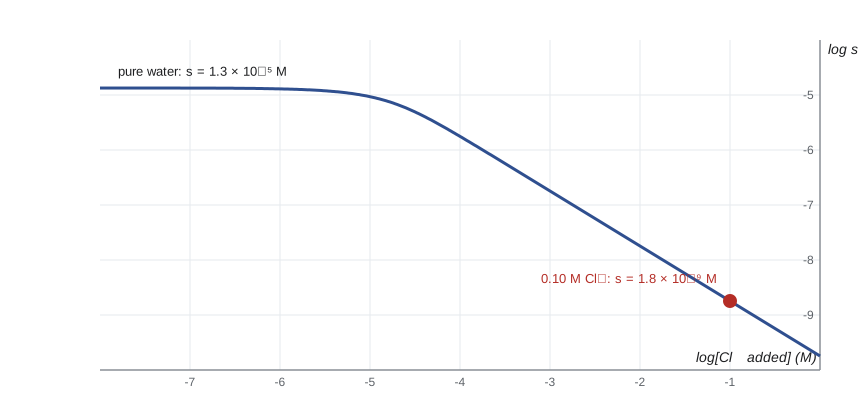
At very high chloride concentrations the trend reverses slightly, because silver forms soluble complex ions such as AgCl₂⁻. Complex-ion formation is an equilibrium too, and it is how ammonia dissolves silver chloride and how cyanide extracts gold from ore, a process used, under strict regulation, at gold mines in Ontario, Quebec, Nevada and elsewhere.
pH and solubility
Salts whose anions are bases dissolve better in acid. Hydroxides are the clearest case: in Mg(OH)₂(s) ⇌ Mg²⁺ + 2 OH⁻, adding acid removes hydroxide ions as water, pulling the equilibrium to the right. That is how milk of magnesia neutralizes stomach acid. Carbonates, phosphates, sulfides and fluorides behave similarly, because their anions combine with H⁺. Tooth enamel, mostly hydroxyapatite, Ca₅(PO₄)₃OH, dissolves when bacteria in plaque produce acid; fluoride converts part of it to the less soluble and more acid-resistant fluorapatite, which is why fluoride toothpaste and community water fluoridation reduce tooth decay. Fluoridation is decided locally in both countries. Health Canada's recommended optimal level is 0.7 mg/L, the value the US Public Health Service also set in 2015; in both countries some communities have stopped fluoridating, and in the US some states have restricted it and federal guidance has been under review since 2025, so check current policy where you live.
# Solubility of Mg(OH)2 (Ksp = 5.6e-12) at different pH values
Ksp = 5.6e-12
for pH in (12.0, 11.0, 10.0, 9.5, 9.0):
    OH = 10 ** -(14 - pH)
    s = Ksp / OH ** 2          # [Mg2+] that can exist at this hydroxide concentration
    note = " (above 1 M: dissolves completely in practice)" if s > 1 else ""
print(f"pH {pH:4.1f}: [OH-] = {OH:.1e} M, solubility of Mg(OH)2 = {s:.1e} M{note}")pH 12.0: [OH-] = 1.0e-02 M, solubility of Mg(OH)2 = 5.6e-08 M pH 11.0: [OH-] = 1.0e-03 M, solubility of Mg(OH)2 = 5.6e-06 M pH 10.0: [OH-] = 1.0e-04 M, solubility of Mg(OH)2 = 5.6e-04 M pH 9.5: [OH-] = 3.2e-05 M, solubility of Mg(OH)2 = 5.6e-03 M pH 9.0: [OH-] = 1.0e-05 M, solubility of Mg(OH)2 = 5.6e-02 M
Each unit drop in pH multiplies the solubility of a hydroxide like Mg(OH)₂ by 100, because [OH⁻] appears squared in K_sp.
Selective precipitation
Because salts differ greatly in solubility, a reagent can precipitate one ion while leaving another in solution. Adding chloride slowly to a solution of Ag⁺ and Pb²⁺ precipitates AgCl long before PbCl₂, because AgCl's K_sp is so much smaller. The classical qualitative analysis scheme taught in many first-year labs separates groups of metal ions this way, and the same principle underlies industrial separations.
Worked problem
Which precipitates first?
A solution is 0.010 M in both Cl⁻ and CrO₄²⁻. Silver nitrate is added slowly. Which precipitates first, AgCl or Ag₂CrO₄, and what is [Cl⁻] when Ag₂CrO₄ begins to form?
Show solution
- [Ag⁺] needed for AgCl: K_sp/[Cl⁻] = 1.8 × 10⁻¹⁰/0.010 = 1.8 × 10⁻⁸ M.
- [Ag⁺] needed for Ag₂CrO₄: √(K_sp/[CrO₄²⁻]) = √(1.1 × 10⁻¹²/0.010) = 1.05 × 10⁻⁵ M.
- AgCl needs far less silver, so it precipitates first.
- When [Ag⁺] reaches 1.05 × 10⁻⁵ M, [Cl⁻] = 1.8 × 10⁻¹⁰/1.05 × 10⁻⁵ = 1.7 × 10⁻⁵ M.
Answer: AgCl precipitates first; by the time red Ag₂CrO₄ appears, only 0.17 % of the chloride remains in solution. This is the basis of the Mohr titration for chloride, where the red colour signals the end point (CHEM-211 covers it in detail).
Solubility in the environment and industry
Hard water contains dissolved calcium and magnesium, picked up as rain and groundwater flow through limestone and dolomite, which are common across the Canadian Shield's margins, southern Ontario, the Prairies and much of the US Midwest. When hard water is heated, CO₂ escapes and calcium carbonate precipitates as scale in kettles, water heaters and pipes. Water softeners exchange the calcium and magnesium for sodium.
In caves, the process runs both ways: groundwater rich in CO₂ dissolves limestone, and where it drips into air and loses CO₂, calcium carbonate precipitates as stalactites and stalagmites. The overall equilibrium is
This same equilibrium governs ocean acidification and shell formation, the subject of lesson 12's capstone.
Mining and industry use precipitation to clean wastewater. Raising the pH with lime precipitates dissolved metals as hydroxides, whose K_sp values are tiny (Fe(OH)₃ is about 10⁻³⁹). Mines in Canada must meet the federal Metal and Diamond Mining Effluent Regulations, and US mines meet effluent limits under the Clean Water Act; lime treatment is one of the main tools for both. Because some metal hydroxides, such as aluminum and zinc hydroxides, redissolve at high pH by forming hydroxide complexes, plants control the pH carefully rather than simply adding as much lime as possible.
Common mistakes
MistakeA smaller K_sp always means a less soluble salt.
InsteadOnly for salts with the same ion ratio; otherwise compare molar solubilities.
MistakeFor CaF₂, K_sp = s × 2s.
InsteadEach concentration is raised to its coefficient: K_sp = s(2s)² = 4s³.
MistakeIgnore dilution when two solutions are mixed.
InsteadRecalculate each ion's concentration in the combined volume before finding Q.
MistakeAdding a common ion increases solubility because there are more ions in solution.
InsteadA common ion shifts the equilibrium toward the solid, decreasing solubility.
MistakeThe solid appears in the K_sp expression.
InsteadPure solids have activity 1 and are omitted.
Summary and key terms
- K_sp is the equilibrium constant for a sparingly soluble salt dissolving into its ions; the solid is omitted.
- For MₓAᵧ, K_sp = (xs)^x(ys)^y, where s is the molar solubility.
- Compare K_sp values directly only for salts with the same ion ratio.
- If the ion product Q exceeds K_sp a precipitate forms; if Q < K_sp the solution is unsaturated.
- A common ion lowers solubility (Le Châtelier).
- Salts of basic anions, such as hydroxides, carbonates and phosphates, dissolve better in acid.
- Differences in K_sp allow selective precipitation of one ion in the presence of another.
- solubility product
- The equilibrium constant K_sp for the dissolution of a sparingly soluble ionic solid.
- molar solubility
- The moles of a substance that dissolve per litre of saturated solution.
- saturated solution
- A solution in equilibrium with undissolved solute.
- supersaturated solution
- A solution holding more dissolved solute than equilibrium allows.
- ion product
- The K_sp expression evaluated with actual concentrations, Q.
- common-ion effect
- The decrease in solubility of a salt in a solution already containing one of its ions.
- selective precipitation
- Separating ions by precipitating one while others stay in solution.
- complex ion
- A metal ion bonded to surrounding molecules or ions, such as Ag(NH₃)₂⁺.
- hard water
- Water containing dissolved calcium and magnesium ions.
- scale
- Deposits of calcium carbonate and similar salts formed when hard water is heated.
Practice problems
Work each problem on paper first, then reveal the answer to check.
Write K_sp for Ca₃(PO₄)₂.
Show answer
K_sp = [Ca²⁺]³[PO₄³⁻]².
BaSO₄ has K_sp = 1.1 × 10⁻¹⁰. Find its molar solubility.
Show answer
√(1.1 × 10⁻¹⁰) = 1.0 × 10⁻⁵ M.
What mass of BaSO₄ (233.4 g/mol) dissolves in 1.0 L of water?
Show answer
1.0 × 10⁻⁵ × 233.4 = 2.4 mg.
Mg(OH)₂ has K_sp = 5.6 × 10⁻¹². Find its molar solubility in pure water.
Show answer
s = (5.6 × 10⁻¹²/4)^(1/3) = 1.1 × 10⁻⁴ M.
Does CaSO₄ (K_sp = 4.9 × 10⁻⁵) precipitate when [Ca²⁺] = [SO₄²⁻] = 0.0050 M?
Show answer
Q = 2.5 × 10⁻⁵ < K_sp; no.
Find the solubility of CaF₂ (K_sp = 3.9 × 10⁻¹¹) in 0.010 M NaF.
Show answer
s = 3.9 × 10⁻¹¹/(0.010)² = 3.9 × 10⁻⁷ M.
Why is BaSO₄ safe to swallow for X-rays while BaCl₂ is poisonous?
Show answer
BaSO₄ is so insoluble that very little Ba²⁺ dissolves; BaCl₂ is soluble.
Which dissolves better in acid, CaCO₃ or AgCl? Why?
Show answer
CaCO₃; carbonate is a base that reacts with H⁺, while chloride is not.
A solution has 0.10 M Ba²⁺ and 0.10 M Ca²⁺. Which sulfate precipitates first?
Show answer
BaSO₄, with the much smaller K_sp.
Why does kettle scale form when hard water is boiled?
Show answer
CO₂ is driven off, shifting the bicarbonate equilibrium toward CaCO₃, which precipitates.
Lesson quiz · 5 questions
Score 60% or more to complete this lesson.
Create a free account to save your progress, take quizzes and earn a certificate.