
CHEM-102 · Lesson 7 of 12 · 32 min
Chemical equilibrium
Many reactions do not run to completion. Mix nitrogen and hydrogen over a hot iron catalyst and some ammonia forms, but the reaction stops while plenty of nitrogen and hydrogen remain. Seal some brown nitrogen dioxide in a flask and its colour fades to a steady intermediate shade as some of it forms colourless dinitrogen tetroxide. These systems have reached chemical equilibrium. This lesson explains what equilibrium is, how the equilibrium constant describes it, how to calculate equilibrium concentrations, how equilibrium responds to change (Le Châtelier's principle), and how K connects to the free energy of lesson 3. Lessons 8 to 10 apply these ideas to solubility, acids and bases.
Dynamic equilibrium
Equilibrium is dynamic, not static. Consider N₂O₄(g) ⇌ 2 NO₂(g). Start with pure N₂O₄: the forward reaction begins at its maximum rate and slows as N₂O₄ is used up; the reverse reaction starts at zero and speeds up as NO₂ accumulates. Eventually the two rates become equal. From then on, both reactions continue, but each molecule of NO₂ formed is matched by one consumed, so concentrations no longer change. The double arrow ⇌ signals a reaction that can reach equilibrium.
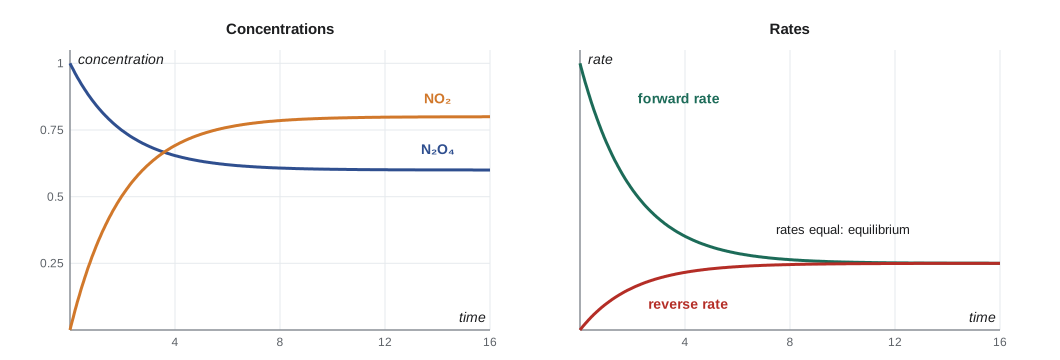
Equilibrium can be approached from either direction. Starting with pure NO₂ instead, at the same temperature and total amount of nitrogen and oxygen, the system reaches the same equilibrium composition. This shows that equilibrium is a property of the system, not of its history.
The equilibrium constant
In 1864 the Norwegian chemists Cato Guldberg and Peter Waage found that at equilibrium a particular ratio of concentrations is constant at a given temperature, whatever the starting amounts. For a general reaction a A + b B ⇌ c C + d D, the law of mass action defines the equilibrium constant in terms of concentrations:
Products go in the numerator and reactants in the denominator, each raised to the power of its coefficient. Strictly, the terms are activities, dimensionless ratios relative to the standard state, so K has no units; for dilute solutions and ideal gases, activities are approximated by molar concentrations (relative to 1 M) or partial pressures (relative to 1 bar). Pure solids and liquids have activity 1 and are left out of the expression, because their concentrations do not change. For example, for CaCO₃(s) ⇌ CaO(s) + CO₂(g), K_c = [CO₂].
For gas reactions, an equilibrium constant can also be written with partial pressures, K_p. The two are related through the ideal gas law, where Δn is the change in moles of gas (products minus reactants) and R = 0.08314 L·bar/(mol·K) when pressures are in bar.
Worked problem
Calculating K from equilibrium concentrations
At 400 °C, an equilibrium mixture of H₂(g) + I₂(g) ⇌ 2 HI(g) contains [H₂] = 0.0064 M, [I₂] = 0.0016 M and [HI] = 0.0250 M. Find K_c and K_p.
Show solution
- K_c = [HI]²/([H₂][I₂]) = (0.0250)²/((0.0064)(0.0016)) = 6.25 × 10⁻⁴ / 1.024 × 10⁻⁵ = 61.
- Δn = 2 − 2 = 0, so K_p = K_c(RT)⁰ = K_c.
Answer: K_c = K_p ≈ 61 at 400 °C.
What the size of K means
The magnitude of K shows how far a reaction goes. When K is very large (say 10¹⁰), products dominate at equilibrium and the reaction effectively goes to completion; the combustion of fuels and the neutralization of strong acids are examples. When K is very small (10⁻¹⁰), almost no products form; nitrogen and oxygen in air barely react at room temperature (K_c for N₂ + O₂ ⇌ 2 NO is about 10⁻³⁰ at 25 °C). When K is near 1, significant amounts of both reactants and products are present.
Equilibrium constants obey simple rules when equations are manipulated, much like the Hess's law rules for ΔH. Reversing an equation inverts K (K′ = 1/K). Multiplying all coefficients by n raises K to the power n. Adding equations multiplies their K values.
The reaction quotient
The reaction quotient, Q, has the same form as K but uses the concentrations at any moment, not necessarily at equilibrium. Comparing Q with K predicts which way a reaction will shift.
| Comparison | Meaning | Direction of net reaction |
|---|---|---|
| Q < K | Too few products for equilibrium | Forward, making more products |
| Q = K | At equilibrium | No net change |
| Q > K | Too many products for equilibrium | Reverse, making more reactants |
Worked problem
Which way will it shift?
For N₂(g) + 3 H₂(g) ⇌ 2 NH₃(g), K_c = 0.105 at 472 °C. A vessel contains [N₂] = 0.50 M, [H₂] = 0.40 M and [NH₃] = 0.15 M. Is the system at equilibrium? If not, which way will it shift?
Show solution
- Q = [NH₃]²/([N₂][H₂]³) = (0.15)²/((0.50)(0.40)³) = 0.0225/(0.50 × 0.064) = 0.0225/0.032 = 0.70.
- Q = 0.70 > K = 0.105.
Answer: Q > K, so there is too much ammonia; the reaction shifts in reverse, decomposing some NH₃ into N₂ and H₂ until Q falls to 0.105.
Calculating equilibrium concentrations: ICE tables
The most common equilibrium problem gives the starting concentrations and K and asks for the equilibrium concentrations. An ICE table organizes the work: a row for Initial concentrations, a row for the Change (written in terms of an unknown x and the coefficients), and a row for Equilibrium concentrations (initial plus change). Substituting the equilibrium row into the K expression gives an equation for x.
Worked problem
An ICE table solved with the quadratic formula
For H₂(g) + I₂(g) ⇌ 2 HI(g), K_c = 50.5 at 448 °C. If 0.200 mol of H₂ and 0.200 mol of I₂ are placed in a 2.00 L flask, find the equilibrium concentrations.
Show solution
- Initial: [H₂] = [I₂] = 0.100 M, [HI] = 0.
- Change: −x, −x, +2x. Equilibrium: 0.100 − x, 0.100 − x, 2x.
- K_c = (2x)²/(0.100 − x)² = 50.5. Taking square roots: 2x/(0.100 − x) = 7.106.
- 2x = 0.7106 − 7.106x, so 9.106x = 0.7106 and x = 0.0780.
- Equilibrium: [H₂] = [I₂] = 0.022 M; [HI] = 0.156 M.
Answer: [H₂] = [I₂] = 0.022 M and [HI] = 0.156 M. Check: (0.156)²/(0.022)² = 50.3, matching K within rounding. Here a perfect square made the algebra easy; usually the quadratic formula is needed.
In general the ICE equation is a polynomial in x, and only one root is physically sensible: it must keep every concentration positive. The code below solves a general case numerically and checks the answer.
import numpy as np

# PCl5(g) <=> PCl3(g) + Cl2(g), Kc = 0.0420 at 250 C. Start with 0.100 M PCl5 only.
Kc, c0 = 0.0420, 0.100
# Kc = x^2 / (c0 - x)  ->  x^2 + Kc*x - Kc*c0 = 0
roots = np.roots([1, Kc, -Kc * c0])
x = [r.real for r in roots if 0 < r.real < c0][0]
print(f"roots: {np.round(roots.real, 5)}; physical root x = {x:.5f} M")
print(f"[PCl5] = {c0 - x:.4f} M, [PCl3] = [Cl2] = {x:.4f} M")
print(f"check K = {x * x / (c0 - x):.4f}; percent dissociated = {100 * x / c0:.1f} %")

# the small-x approximation x = sqrt(Kc*c0) and the 5 % test
x_approx = (Kc * c0) ** 0.5
print(f"small-x estimate = {x_approx:.4f} M ({100 * x_approx / c0:.0f} % of c0: approximation fails)")roots: [-0.08912 0.04712]; physical root x = 0.04712 M [PCl5] = 0.0529 M, [PCl3] = [Cl2] = 0.0471 M check K = 0.0420; percent dissociated = 47.1 % small-x estimate = 0.0648 M (65 % of c0: approximation fails)
The small-x approximation
When K is small compared with the initial concentrations, x is small and the term (c₀ − x) can be replaced by c₀, avoiding the quadratic. The approximation is accepted if x turns out to be less than 5 % of c₀, a test you should always check. In the PCl₅ example K is not small enough: the approximation gives x equal to 65 % of c₀, far beyond 5 %, and the quadratic is required. The approximation becomes essential for weak acids and bases in lesson 9, where K values are often 10⁻⁵ or smaller.
Le Châtelier's principle
In 1884 the French chemist Henri Le Châtelier stated a principle that predicts how equilibria respond to disturbances: if a system at equilibrium is disturbed, it shifts in the direction that partly counteracts the disturbance. It is a qualitative summary of what comparing Q and K shows quantitatively.
Changing a concentration. Adding a reactant (or removing a product) makes Q < K, and the reaction shifts forward. Adding a product shifts it in reverse. Industrial processes exploit this by continuously removing a product; ammonia plants cool the gas stream to condense ammonia out, letting more form.
Changing pressure by changing volume. Compressing a gas mixture increases all partial pressures. The system shifts toward the side with fewer moles of gas, which reduces the pressure. For N₂ + 3 H₂ ⇌ 2 NH₃ (4 mol of gas becoming 2), high pressure favours ammonia, which is why Haber–Bosch plants run at about 150 to 300 bar. Adding an inert gas at constant volume changes no partial pressure and has no effect.
Changing temperature. Temperature is different: it changes the value of K itself. Treat heat as a product of an exothermic reaction and a reactant of an endothermic one. Raising the temperature shifts an exothermic reaction in reverse (K falls) and an endothermic one forward (K rises). The N₂O₄ ⇌ 2 NO₂ reaction is endothermic as written, so a sealed tube of the gas turns darker brown when warmed and paler when chilled in ice, a classic demonstration.
Adding a catalyst. A catalyst speeds forward and reverse reactions equally, so it does not shift equilibrium; it only gets there faster.
| Disturbance (for N₂ + 3 H₂ ⇌ 2 NH₃, ΔH < 0) | Shift | Effect on K |
|---|---|---|
| Add N₂ or H₂ | Forward | None |
| Remove NH₃ | Forward | None |
| Increase pressure by compressing | Forward (fewer moles of gas) | None |
| Add argon at constant volume | No shift | None |
| Raise temperature | Reverse | K decreases |
| Add a catalyst | No shift (equilibrium reached faster) | None |
Free energy and the equilibrium constant
Lesson 3 noted that ΔG for a reaction depends on composition. The link is exact.
At equilibrium, ΔG = 0 and Q = K, which gives the second equation. It connects the thermodynamic tables of lesson 3 to equilibrium compositions. A negative ΔG° means K > 1 and products are favoured; a positive ΔG° means K < 1. Because the relationship is logarithmic, each 5.7 kJ/mol of ΔG° at 25 °C changes K by a factor of 10.
from math import exp, log

R, T = 8.314, 298.15
for dG0 in (-40, -11.4, -5.7, 0, 5.7, 11.4, 40):   # kJ/mol
    K = exp(-dG0 * 1000 / (R * T))
    print(f"dG0 = {dG0:6.1f} kJ/mol  ->  K = {K:.2e}")

# Haber-Bosch at 298 K from dG0f(NH3) = -16.4 kJ/mol
dG0 = 2 * -16.4
K = exp(-dG0 * 1000 / (R * T))
print(f"N2 + 3 H2 <=> 2 NH3 at 298 K: dG0 = {dG0:.1f} kJ, K = {K:.1e}")dG0 = -40.0 kJ/mol -> K = 1.02e+07 dG0 = -11.4 kJ/mol -> K = 9.94e+01 dG0 = -5.7 kJ/mol -> K = 9.97e+00 dG0 = 0.0 kJ/mol -> K = 1.00e+00 dG0 = 5.7 kJ/mol -> K = 1.00e-01 dG0 = 11.4 kJ/mol -> K = 1.01e-02 dG0 = 40.0 kJ/mol -> K = 9.82e-08 N2 + 3 H2 <=> 2 NH3 at 298 K: dG0 = -32.8 kJ, K = 5.6e+05
At room temperature, ammonia synthesis has a large K, about 6 × 10⁵, yet it does not happen without a catalyst because it is far too slow. At the 700 K or so of an industrial reactor, the exothermic reaction's K is far smaller, but the rate is acceptable. The plant operates at high pressure to push the equilibrium back toward ammonia and recycles the unreacted gases. This interplay between thermodynamics, kinetics and Le Châtelier's principle is the classic case study of industrial chemistry, and the Haber–Bosch process still produces most of the nitrogen fertilizer used on Canadian and American farms.
The van ’t Hoff equation
How much K changes with temperature depends on ΔH°. Combining ΔG° = ΔH° − TΔS° with ΔG° = −RT ln K gives the van ’t Hoff equation, which has the same form as the Arrhenius equation and the Clausius–Clapeyron equation from CHEM-101.
Worked problem
K at a new temperature
For N₂O₄(g) ⇌ 2 NO₂(g), K_p = 0.15 at 25 °C and ΔH° = +57.2 kJ. Estimate K_p at 100 °C.
Show solution
- 1/T₂ − 1/T₁ = 1/373.15 − 1/298.15 = 2.6799 × 10⁻³ − 3.3540 × 10⁻³ = −6.741 × 10⁻⁴ K⁻¹.
- ln(K₂/K₁) = −(57,200/8.314)(−6.741 × 10⁻⁴) = 4.638.
- K₂ = 0.15 × e^4.638 = 0.15 × 103 = 15.5.
Answer: K_p ≈ 15 at 100 °C, about a hundred times larger, consistent with the darker brown colour of the hot gas.
Common mistakes
MistakeAt equilibrium the forward and reverse reactions stop.
InsteadBoth continue at equal rates; concentrations stay constant because the rates match.
MistakeAt equilibrium, reactant and product concentrations are equal.
InsteadTheir ratio equals K; the concentrations themselves can be very different.
MistakePure solids and liquids appear in the K expression.
InsteadThey have activity 1 and are omitted.
MistakeRaising the pressure changes K.
InsteadPressure (volume) changes shift the position of equilibrium but not K; only temperature changes K.
MistakeA catalyst increases the equilibrium yield.
InsteadA catalyst only helps the system reach equilibrium faster.
Summary and key terms
- Equilibrium is dynamic: forward and reverse rates are equal, so concentrations are constant.
- K_c = [products]^coefficients/[reactants]^coefficients; pure solids and liquids are omitted.
- K_p = K_c(RT)^Δn for gas reactions; reversing a reaction inverts K and multiplying it raises K to a power.
- Comparing Q with K predicts the direction of change: Q < K shifts forward, Q > K shifts in reverse.
- ICE tables give equilibrium concentrations; check the small-x approximation with the 5 % rule.
- Le Châtelier: equilibria shift to counteract concentration and pressure changes; temperature changes K itself.
- ΔG° = −RT ln K links thermodynamic tables to equilibrium; the van ’t Hoff equation gives K at other temperatures.
- chemical equilibrium
- The state in which forward and reverse reaction rates are equal and concentrations are constant.
- equilibrium constant
- The value of the mass-action ratio of products to reactants at equilibrium.
- law of mass action
- At equilibrium, the ratio of product to reactant concentrations, each raised to its coefficient, is constant.
- reaction quotient
- The mass-action ratio for a mixture at any moment, compared with K to predict direction.
- ICE table
- A table of initial, change and equilibrium concentrations used to solve equilibrium problems.
- Le Châtelier's principle
- A system at equilibrium shifts to partly counteract a disturbance.
- heterogeneous equilibrium
- An equilibrium involving more than one phase.
- small-x approximation
- Neglecting x compared with an initial concentration when K is small; valid if x is under 5 % of it.
- van 't Hoff equation
- An equation giving how K changes with temperature, depending on ΔH°.
- activity
- The effective, dimensionless concentration of a species relative to its standard state.
Practice problems
Work each problem on paper first, then reveal the answer to check.
Write K_c for 2 SO₂(g) + O₂(g) ⇌ 2 SO₃(g).
Show answer
K_c = [SO₃]²/([SO₂]²[O₂]).
Write K_c for C(s) + H₂O(g) ⇌ CO(g) + H₂(g).
Show answer
K_c = [CO][H₂]/[H₂O].
If K = 4.0 for A ⇌ 2 B, what is K for 2 B ⇌ A?
Show answer
1/4.0 = 0.25.
If K = 4.0 for A ⇌ 2 B, what is K for 2 A ⇌ 4 B?
Show answer
4.0² = 16.
For N₂ + 3 H₂ ⇌ 2 NH₃ at 500 K, K_c = 0.060. Find K_p, using R = 0.08314 L·bar/(mol·K).
Show answer
Δn = −2, so K_p = 0.060 × (0.08314 × 500)⁻² = 3.5 × 10⁻⁵.
For a reaction with K = 10, Q = 2. Which way does it shift?
Show answer
Forward, since Q < K.
For CO(g) + H₂O(g) ⇌ CO₂(g) + H₂(g), K_c = 4.0. Starting with 1.0 M CO and 1.0 M H₂O, find [CO₂] at equilibrium.
Show answer
x²/(1 − x)² = 4.0; x/(1 − x) = 2; x = 0.67 M.
How does raising the temperature affect K for an exothermic reaction?
Show answer
K decreases.
What is K at 25 °C for a reaction with ΔG° = −20.0 kJ/mol?
Show answer
e^(20,000/(8.314 × 298.15)) = 3.2 × 10³.
Why does compressing 2 NO₂ ⇌ N₂O₄ make the mixture paler?
Show answer
The equilibrium shifts toward fewer moles of gas, forming colourless N₂O₄.
Lesson quiz · 5 questions
Score 60% or more to complete this lesson.
Create a free account to save your progress, take quizzes and earn a certificate.