
CHEM-102 · Lesson 3 of 12 · 30 min
Entropy, free energy and spontaneity
Ice melts on a warm day, iron rusts, and a drop of food colouring spreads through a glass of water. None of these changes reverses by itself: melted water does not refreeze on a warm counter, rust does not turn back into shiny iron, and the colour does not gather back into a drop. Chemists call processes that happen on their own, without continuous outside help, spontaneous. Lessons 1 and 2 showed that many spontaneous reactions are exothermic, but not all are: ice melting and ammonium nitrate dissolving absorb heat, yet happen readily. Energy alone cannot predict direction. This lesson introduces entropy, the second law of thermodynamics and Gibbs free energy, which together answer the question "will it go?"
Spontaneous does not mean fast. The conversion of diamond to graphite is spontaneous at room conditions but immeasurably slow. Thermodynamics says whether a change can happen; kinetics (lessons 5 and 6) says how fast. CHEM-271 develops these ideas rigorously; here we build the working tools.
Entropy and the number of arrangements
Entropy, S, measures how widely energy and matter are dispersed in a system. The Austrian physicist Ludwig Boltzmann gave it a precise statistical meaning: entropy is related to the number of microscopic arrangements, W, that correspond to the same observable state.
A simple model shows why dispersal is favoured. Put four distinguishable molecules in a box divided into two halves. There is only one way to have all four on the left, but six ways to have two on each side. With a mole of molecules the numbers become astronomically lopsided: arrangements with the gas spread evenly outnumber those with it bunched in one half by a factor of about 2 raised to the power 6 × 10²³. A gas expands into a vacuum not because some force pushes it, but because the spread-out state can happen in overwhelmingly more ways.
from math import comb, log

# N molecules, each in the left or right half of a box: count arrangements W(n_left)
for N in (4, 10, 100):
    total = 2 ** N
    even = comb(N, N // 2)
    print(f"N = {N:3d}: all on left 1 way; half and half {even:,} ways; "
          f"P(all left) = {1 / total:.2e}")

# entropy change for doubling the volume of 1 mol of ideal gas: dS = R ln 2
R = 8.314
print(f"dS for 1 mol expanding to twice its volume = {R * log(2):.2f} J/K")N = 4: all on left 1 way; half and half 6 ways; P(all left) = 6.25e-02 N = 10: all on left 1 way; half and half 252 ways; P(all left) = 9.77e-04 N = 100: all on left 1 way; half and half 100,891,344,545,564,193,334,812,497,256 ways; P(all left) = 7.89e-31 dS for 1 mol expanding to twice its volume = 5.76 J/K
Predicting entropy changes
Several qualitative rules predict the sign of an entropy change.
Entropy increases from solid to liquid to gas, because the particles gain freedom to move. The jump on vaporization is especially large. Entropy increases when a gas expands into a larger volume and, for most solids, when they dissolve, because particles mix and spread. Entropy increases with temperature, because more energy levels become accessible. For reactions, entropy usually increases when the number of moles of gas increases; a reaction that turns 1 mol of gas into 3 mol of gas almost always has ΔS > 0. Larger and more complex molecules have higher entropies than smaller ones in the same phase, because they have more ways to vibrate and rotate.
| Process | Sign of ΔS | Reason |
|---|---|---|
| H₂O(s) → H₂O(l) | + | Solid becomes liquid |
| H₂O(l) → H₂O(g) | + (large) | Liquid becomes gas |
| N₂(g) + 3 H₂(g) → 2 NH₃(g) | − | Moles of gas fall from 4 to 2 |
| CaCO₃(s) → CaO(s) + CO₂(g) | + | A gas forms from a solid |
| NaCl(s) → Na⁺(aq) + Cl⁻(aq) | + (small) | Ions disperse, partly offset by ordering of water |
| A gas cools from 300 K to 250 K | − | Fewer energy levels are occupied |
Standard molar entropies
Unlike enthalpy, entropy has an absolute zero point. The third law of thermodynamics states that the entropy of a perfect crystal at absolute zero is zero: there is exactly one arrangement. Measuring heat capacities from near 0 K upward therefore gives absolute standard molar entropies, S°, in J/(mol·K). Note the units, joules rather than kilojoules, and note that S° is positive even for elements, unlike ΔH°f.
| Substance | S° (J/(mol·K)) | Substance | S° (J/(mol·K)) |
|---|---|---|---|
| C(diamond) | 2.4 | H₂O(l) | 70.0 |
| C(graphite) | 5.7 | H₂O(g) | 188.8 |
| Fe(s) | 27.3 | CO₂(g) | 213.8 |
| NaCl(s) | 72.1 | N₂(g) | 191.6 |
| CaCO₃(s) | 91.7 | H₂(g) | 130.7 |
| CaO(s) | 38.1 | O₂(g) | 205.2 |
| Fe₂O₃(s) | 87.4 | NH₃(g) | 192.8 |
| CH₄(g) | 186.3 | C₂H₅OH(l) | 160.7 |
Standard entropy changes of reaction follow the same products-minus-reactants pattern as enthalpies, except that elements do not contribute zero.
Worked problem
Entropy change for the Haber–Bosch reaction
Calculate ΔS° for N₂(g) + 3 H₂(g) → 2 NH₃(g).
Show solution
- Products: 2(192.8) = 385.6 J/K.
- Reactants: 191.6 + 3(130.7) = 191.6 + 392.1 = 583.7 J/K.
- ΔS° = 385.6 − 583.7 = −198.1 J/K.
Answer: −198.1 J/K, negative as predicted, since 4 mol of gas become 2 mol.
The second law of thermodynamics
The second law states that in any spontaneous process the total entropy of the universe increases. The system's entropy can fall, as when water freezes, provided the surroundings gain more. The surroundings gain entropy when the system releases heat into them; the gain is larger when the surroundings are cold, because a given amount of heat makes more difference to a cold body than to a hot one.
Freezing water shows the balance. The system loses entropy (ΔS ≈ −22.0 J/(mol·K)) but releases 6.01 kJ/mol of heat. At −10 °C (263 K) the surroundings gain 6,010/263 = +22.9 J/K, more than the system loses, so freezing is spontaneous. At +10 °C (283 K) they gain only 21.2 J/K, less than the system loses, so ice melts instead. At exactly 0 °C (273 K), the two terms balance and ice and water coexist at equilibrium.
Gibbs free energy
Tracking the surroundings is awkward. In 1876 the American physicist Josiah Willard Gibbs defined a property of the system alone that does the job at constant temperature and pressure: the Gibbs free energy, G = H − TS. Multiplying the second-law condition by −T gives the key result.
At constant temperature and pressure, a process is spontaneous if ΔG < 0, non-spontaneous (spontaneous in reverse) if ΔG > 0, and at equilibrium if ΔG = 0. The free energy change also has a physical meaning: −ΔG is the maximum useful work, other than pressure–volume work, that a process can do. A battery's electrical output (lesson 11) and a muscle's mechanical work are both limited by ΔG.
Temperature and the four cases
Because ΔH and ΔS can each be positive or negative, there are four combinations. The TΔS term grows with temperature, so temperature can decide the outcome when ΔH and ΔS have the same sign.
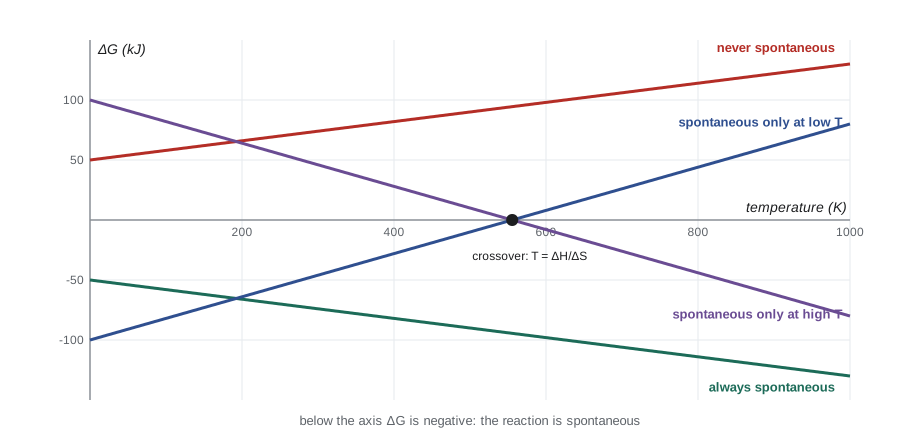
| ΔH | ΔS | ΔG = ΔH − TΔS | Example |
|---|---|---|---|
| − | + | Negative at all T: always spontaneous | Combustion of fuels; 2 H₂O₂ → 2 H₂O + O₂ |
| + | − | Positive at all T: never spontaneous | 3 O₂ → 2 O₃ (ozone formation) |
| − | − | Negative at low T only | Freezing water; Haber–Bosch synthesis of ammonia |
| + | + | Negative at high T only | Melting ice; decomposing limestone |
When ΔH and ΔS have the same sign, the crossover temperature where ΔG = 0 is T = ΔH/ΔS. Above or below it, the reaction changes direction. This assumes ΔH and ΔS do not change much with temperature, a good approximation over moderate ranges.
Worked problem
When does limestone decompose?
For CaCO₃(s) → CaO(s) + CO₂(g), ΔH° = +178.4 kJ (from lesson 2) and ΔS° = 38.1 + 213.8 − 91.7 = +160.2 J/K. Is the reaction spontaneous at 25 °C, and above what temperature does it become spontaneous under standard conditions?
Show solution
- At 298 K: ΔG° = 178.4 kJ − (298 K)(0.1602 kJ/K) = 178.4 − 47.7 = +130.7 kJ. Not spontaneous.
- Crossover: T = ΔH°/ΔS° = 178.4 kJ ÷ 0.1602 kJ/K = 1,114 K, or about 841 °C.
Answer: Limestone is stable at room temperature but decomposes above roughly 840 °C when CO₂ is at 1 bar, which is why lime and cement kilns run near 900 °C. Lime kilns in Ontario, Quebec and across the US Midwest operate on exactly this thermodynamics. Note the unit conversion: ΔS in J/K must be divided by 1,000 before combining with ΔH in kJ.
# dG = dH - T dS for the Haber-Bosch reaction at several temperatures
dH = -91.8          # kJ for N2 + 3 H2 -> 2 NH3 (2 x -45.9)
dS = -198.1 / 1000  # kJ/K, from the worked example
for T in (298, 400, 463, 500, 700):
    dG = dH - T * dS
    verdict = "spontaneous" if dG < 0 else "not spontaneous"
    print(f"T = {T:4d} K: dG = {dG:7.1f} kJ  ({verdict})")
print(f"crossover temperature = {dH / dS:.0f} K")T = 298 K: dG = -32.8 kJ (spontaneous) T = 400 K: dG = -12.6 kJ (spontaneous) T = 463 K: dG = -0.1 kJ (spontaneous) T = 500 K: dG = 7.2 kJ (not spontaneous) T = 700 K: dG = 46.9 kJ (not spontaneous) crossover temperature = 463 K
Ammonia synthesis is favoured at low temperature, yet industrial plants run at about 400 to 500 °C (roughly 670 to 770 K), above the crossover. They accept a less favourable equilibrium because at lower temperatures the reaction is far too slow, even with an iron catalyst. High pressure, as lesson 7 explains, pushes the equilibrium back toward ammonia. The compromise between thermodynamics and kinetics is a recurring theme in industrial chemistry.
Standard free energies of formation
Standard free energy changes can be calculated two ways: from ΔH° and ΔS° as above, or from tabulated standard free energies of formation, ΔG°f, which, like ΔH°f, are zero for elements in their standard states.
| Substance | ΔG°f (kJ/mol) | Substance | ΔG°f (kJ/mol) |
|---|---|---|---|
| H₂O(l) | −237.1 | CO₂(g) | −394.4 |
| H₂O(g) | −228.6 | CH₄(g) | −50.5 |
| NH₃(g) | −16.4 | NO(g) | +87.6 |
| Fe₂O₃(s) | −742.2 | C₂H₅OH(l) | −174.8 |
| CaCO₃(s) | −1,129 | CaO(s) | −604.0 |
Worked problem
Is rusting spontaneous?
Calculate ΔG° at 25 °C for 4 Fe(s) + 3 O₂(g) → 2 Fe₂O₃(s).
Show solution
- Products: 2(−742.2) = −1,484.4 kJ.
- Reactants: elements in standard states, 0.
- ΔG° = −1,484.4 kJ.
Answer: Strongly negative: rusting is highly spontaneous. Iron survives in bridges and cars only because the reaction is slow and because paint, galvanizing and cathodic protection (lesson 11) slow it further.
Free energy and the direction of change
A negative ΔG° means that, starting with all reactants and products at standard conditions, the reaction proceeds forward. Real mixtures are rarely at standard conditions, so the actual free energy change depends on composition. As a reaction proceeds, ΔG becomes less negative until it reaches zero at equilibrium. The link between free energy and the equilibrium constant, ΔG° = −RT ln K, is developed in lesson 7; it is one of the most useful equations in chemistry, because it lets thermodynamic tables predict how far a reaction will go.
Living organisms run on this logic. The hydrolysis of ATP has ΔG°′ ≈ −30.5 kJ/mol under biological standard conditions, and cells couple it to reactions with positive ΔG, so that the sum is negative. BIOL-107 introduced coupling; BIOC-330 follows it through metabolism.
Common mistakes
MistakeSpontaneous reactions are fast.
InsteadSpontaneity concerns direction, not rate; diamond turning to graphite is spontaneous but extremely slow.
MistakeAll exothermic reactions are spontaneous.
InsteadIf ΔS is negative, an exothermic reaction becomes non-spontaneous at high enough temperature.
MistakeS° for elements is zero, like ΔH°f.
InsteadAbsolute entropies are positive for all substances above 0 K; only ΔH°f and ΔG°f are zero for elements.
MistakeCalculate ΔG = ΔH − TΔS with ΔH in kJ and ΔS in J/K directly.
InsteadConvert ΔS to kJ/K (divide by 1,000) first.
MistakeA process that lowers the system's entropy cannot be spontaneous.
InsteadIt can, if the surroundings gain more entropy, as when water freezes below 0 °C.
Summary and key terms
- A spontaneous process occurs without continuous outside help; spontaneity says nothing about rate.
- Entropy measures dispersal of energy and matter; S = k_B ln W relates it to the number of arrangements.
- Entropy increases from solid to liquid to gas, with expansion, mixing, temperature and more moles of gas.
- Second law: ΔS_univ > 0 for spontaneous processes; ΔS_surr = −ΔH_sys/T.
- Gibbs free energy, ΔG = ΔH − TΔS, predicts spontaneity at constant T and P: ΔG < 0 means spontaneous.
- When ΔH and ΔS share a sign, the crossover temperature is T = ΔH/ΔS.
- ΔG°rxn can be calculated from ΔG°f values or from ΔH° and ΔS°.
- spontaneous process
- A change that occurs without continuous outside intervention.
- entropy
- A measure of the dispersal of energy and matter, related to the number of possible arrangements.
- second law of thermodynamics
- The entropy of the universe increases in any spontaneous process.
- third law of thermodynamics
- The entropy of a perfect crystal at absolute zero is zero.
- standard molar entropy
- The absolute entropy of one mole of a substance in its standard state.
- Gibbs free energy
- G = H − TS; its change predicts spontaneity at constant temperature and pressure.
- free energy of formation
- ΔG for forming one mole of a compound from its elements in their standard states.
- crossover temperature
- The temperature at which ΔG = 0 for a reaction with ΔH and ΔS of the same sign.
- coupled reactions
- Reactions linked so that a favourable one drives an unfavourable one.
- microstate
- A particular microscopic arrangement of particles and energy consistent with a macroscopic state.
Practice problems
Work each problem on paper first, then reveal the answer to check.
Predict the sign of ΔS for 2 SO₂(g) + O₂(g) → 2 SO₃(g).
Show answer
Negative: 3 mol of gas become 2.
Predict the sign of ΔS for dry ice subliming.
Show answer
Positive: solid becomes gas.
Calculate ΔS° for CH₄(g) + 2 O₂(g) → CO₂(g) + 2 H₂O(l).
Show answer
213.8 + 140.0 − 186.3 − 410.4 = −242.9 J/K.
A reaction has ΔH = −50 kJ and ΔS = −100 J/K. At what temperature does it stop being spontaneous?
Show answer
T = 50/0.100 = 500 K.
A reaction has ΔH = +30 kJ and ΔS = +120 J/K. Is it spontaneous at 25 °C?
Show answer
ΔG = 30 − 298(0.120) = −5.8 kJ, so yes.
Calculate ΔG° for CaCO₃ → CaO + CO₂ from ΔG°f values.
Show answer
−604.0 − 394.4 + 1,129 = +130.6 kJ (matches the ΔH − TΔS result).
Why does water freeze below 0 °C even though its entropy falls?
Show answer
The heat released raises the entropy of the surroundings by more than the system loses.
Calculate ΔG° for 2 NO(g) → N₂(g) + O₂(g).
Show answer
0 − 2(87.6) = −175.2 kJ; NO decomposition is spontaneous but slow.
What is the maximum non-expansion work from burning 1 mol of methane at 25 °C?
Show answer
ΔG° = −394.4 − 474.2 + 50.5 = −818.1 kJ, so at most 818 kJ.
Why do vehicles need catalytic converters if NO decomposition is spontaneous?
Show answer
The reaction is far too slow without a catalyst; spontaneity does not mean speed.
Lesson quiz · 5 questions
Score 60% or more to complete this lesson.
Create a free account to save your progress, take quizzes and earn a certificate.