
CHEM-102 · Lesson 1 of 12 · 37 min
Thermochemistry I: energy, heat and calorimetry
Every chemical change either releases energy or absorbs it. A natural gas furnace warms a house in a Canadian winter because burning methane releases energy; an instant cold pack cools a sprained ankle because dissolving ammonium nitrate absorbs it. Thermochemistry is the study of these energy changes. CHEM-101 explained what holds atoms together; this course asks what happens to energy when those bonds rearrange, how fast reactions go, how far they go, and how chemists use those answers. This first lesson builds the vocabulary of energy, heat and work, then shows how calorimetry measures heat flow in the laboratory.
Students who took CHEM-103 met thermochemistry in an engineering setting, with fuels, furnaces and materials. Here the treatment is fuller and more quantitative, as a foundation for the physical chemistry of CHEM-271.
Energy, system and surroundings
Energy is the capacity to do work or to transfer heat. Kinetic energy is the energy of motion, ½mv²; potential energy is stored energy that depends on position or arrangement. Chemical energy is a form of potential energy stored in the arrangement of electrons and nuclei: the attractions and repulsions in molecules. When a reaction forms stronger bonds than it breaks, potential energy falls and the difference appears as heat, light or work.
To keep track of energy, chemists divide the universe into the system, the part being studied (usually the reacting chemicals), and the surroundings, everything else. An open system exchanges both matter and energy with its surroundings, like a pot of boiling water without a lid. A closed system exchanges energy but not matter, like a sealed flask. An isolated system exchanges neither; a well-insulated, sealed vacuum flask comes close.
The SI unit of energy is the joule (J), equal to 1 kg·m²/s². A joule is small: lifting a 100 g apple by 1 m takes about 1 J. Chemical energies are usually given in kilojoules (kJ). The calorie, still used in nutrition, is the energy needed to warm 1 g of water by 1 °C; by definition 1 cal = 4.184 J exactly. A food Calorie (capital C) is a kilocalorie, so a 250 Calorie snack bar supplies about 1,050 kJ. Canadian nutrition labels list both Calories and kilojoules on some products; US labels list Calories only.
Heat, work and the first law
Energy moves between system and surroundings in two ways. Heat (q) is energy transferred because of a temperature difference; it always flows spontaneously from hotter to colder objects. Work (w) is energy transferred when a force acts through a distance; in chemistry the most common kind is pressure–volume work, done when a reacting gas pushes back the atmosphere.
The first law of thermodynamics states that energy is conserved: it can change form but cannot be created or destroyed. For a system, the change in internal energy (ΔU, written ΔE in some textbooks) equals the heat added to the system plus the work done on it.
The sign convention is the chemist's: everything is seen from the system's point of view. Heat absorbed by the system is positive; heat released is negative. Work done on the system (compression) is positive; work done by the system (expansion) is negative.
| Process | Sign of q | Sign of w | Effect on the system |
|---|---|---|---|
| System absorbs heat (endothermic) | + | Internal energy rises | |
| System releases heat (exothermic) | − | Internal energy falls | |
| Surroundings compress the system | + | Internal energy rises | |
| System expands against the surroundings | − | Internal energy falls |
Internal energy is a state function: its value depends only on the present state of the system (its temperature, pressure, composition and amount), not on how the system got there. The change ΔU between two states is therefore the same whatever path is taken. Heat and work, by contrast, are path functions: different paths between the same two states can divide the energy differently between q and w. Climbing a mountain is a good analogy. Your change in altitude is a state function, fixed by the start and the summit; the distance you walk depends on the trail.
Pressure–volume work
When a gas expands against a constant external pressure, it does work on the surroundings equal to the pressure times the change in volume.
The minus sign makes w negative when the volume increases. With pressure in kilopascals and volume in litres, the product is in joules, since 1 kPa·L = 1 J. (With pressure in atmospheres, 1 L·atm = 101.325 J.)
Worked problem
Work done by an expanding gas
A reaction in a cylinder fitted with a piston produces gas, and the volume increases from 1.50 L to 4.20 L against a constant external pressure of 101.3 kPa. At the same time the system absorbs 850 J of heat. Find w and ΔU.
Show solution
- ΔV = 4.20 − 1.50 = 2.70 L.
- w = −P_ext ΔV = −(101.3 kPa)(2.70 L) = −273.5 J. The system does work, so w is negative.
- ΔU = q + w = +850 J + (−273.5 J) = +576.5 J.
Answer: w = −274 J and ΔU = +577 J. The system gained 850 J as heat but spent 274 J pushing back the atmosphere, so its internal energy rose by 577 J.
Enthalpy
Most chemistry happens in open containers at the constant pressure of the atmosphere. Under those conditions it is convenient to use a quantity called enthalpy, H, defined as H = U + PV. Like internal energy, enthalpy is a state function. Its usefulness comes from a simple result: at constant pressure, when only pressure–volume work is possible, the change in enthalpy equals the heat exchanged.
A reaction with negative ΔH releases heat to the surroundings and is exothermic; one with positive ΔH absorbs heat and is endothermic. For reactions involving only solids and liquids, ΔV is tiny and ΔH and ΔU are nearly equal. For reactions that change the number of moles of gas, the two differ by the work term, which can be estimated from the ideal gas law.
Even then the difference is usually small compared with ΔH itself. For the combustion of methane, CH₄(g) + 2 O₂(g) → CO₂(g) + 2 H₂O(l), Δn_gas = 1 − 3 = −2, so at 298 K the difference is −2 × 8.314 × 298 J ≈ −5.0 kJ, less than 1 % of ΔH ≈ −890 kJ.
Thermochemical equations
A thermochemical equation is a balanced equation with its enthalpy change, written per mole of reaction as the equation is written. Physical states matter, because changing state involves energy too.
Three rules follow from the fact that enthalpy is a state function and an extensive property (one that scales with the amount of matter).
First, ΔH is proportional to the amount of reaction. Doubling every coefficient doubles ΔH; burning 2 mol of methane releases 1,780.6 kJ. Second, reversing a reaction changes the sign of ΔH. Forming 1 mol of methane and 2 mol of oxygen from carbon dioxide and liquid water would absorb 890.3 kJ. Third, ΔH depends on the states of reactants and products. If the water formed were vapour rather than liquid, less heat would be released, because 44 kJ per mole is needed to vaporize water at 25 °C: ΔH would be −890.3 + 2(44.0) = −802.3 kJ. Engineers call these two numbers the higher and lower heating values of a fuel.
Worked problem
Heat from burning a mass of fuel
How much heat is released when 1.00 kg of methane (16.04 g/mol) burns completely to carbon dioxide and liquid water?
Show solution
- Moles of CH₄: 1,000 g ÷ 16.04 g/mol = 62.34 mol.
- The thermochemical equation gives −890.3 kJ per mole of CH₄.
- Heat: 62.34 mol × (−890.3 kJ/mol) = −5.550 × 10⁴ kJ.
Answer: About 5.55 × 10⁴ kJ, or 55.5 MJ, is released. This is the higher heating value of methane, about 55.5 MJ/kg.
Heat capacity and specific heat
When heat flows into a substance without a chemical or phase change, its temperature rises. The heat capacity, C, of an object is the heat needed to raise its temperature by 1 K (or 1 °C, the same size of step). The specific heat capacity, c, is the heat capacity per gram, and the molar heat capacity is the heat capacity per mole.
Water has an unusually high specific heat, 4.184 J/(g·°C), about five times that of granite and ten times that of iron. That is why lakes warm slowly in spring and release heat slowly in fall, moderating the climate of cities like Toronto, Chicago and Vancouver, and why water is the working fluid in so many heating and cooling systems.
| Substance | Specific heat, J/(g·°C) |
|---|---|
| Water (liquid) | 4.184 |
| Ice (near 0 °C) | 2.09 |
| Steam (near 100 °C) | 2.0 |
| Ethanol | 2.44 |
| Aluminum | 0.897 |
| Granite (typical) | 0.79 |
| Iron | 0.449 |
| Copper | 0.385 |
Worked problem
Heat to warm water for tea
How much heat is needed to warm 350 g of water from 15.0 °C to 95.0 °C? If an electric kettle supplies 1.50 kW and 85 % of its energy goes into the water, how long does it take?
Show solution
- ΔT = 95.0 − 15.0 = 80.0 °C.
- q = (350 g)(4.184 J/(g·°C))(80.0 °C) = 1.172 × 10⁵ J = 117 kJ.
- Useful power: 0.85 × 1,500 W = 1,275 J/s. Time: 1.172 × 10⁵ J ÷ 1,275 J/s = 91.9 s.
Answer: 117 kJ of heat, delivered in about 92 seconds.
Calorimetry
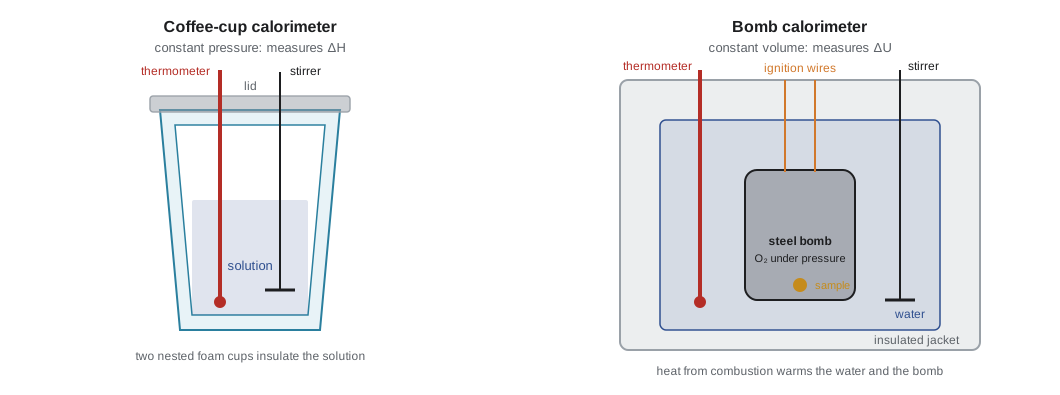
A calorimeter measures heat flow by measuring a temperature change. The reaction is carried out inside an insulated container, and the heat it releases or absorbs is taken up by the calorimeter and its contents. Because energy is conserved, the heat gained by the calorimeter equals the heat lost by the reaction.
Coffee-cup calorimetry
A coffee-cup calorimeter is two nested foam cups with a lid, a thermometer and a stirrer. It works at atmospheric pressure, so the heat measured is ΔH directly. It suits reactions in solution: neutralizations, dissolving salts, precipitations. The usual approximations are that the solution has the density and specific heat of water and that the cup absorbs negligible heat.
Worked problem
Enthalpy of neutralization
50.0 mL of 1.00 M HCl and 50.0 mL of 1.00 M NaOH, both at 21.0 °C, are mixed in a coffee-cup calorimeter. The temperature rises to 27.6 °C. Assume the 100.0 g of solution has c = 4.184 J/(g·°C). Find ΔH per mole of water formed.
Show solution
- q_solution = (100.0 g)(4.184)(27.6 − 21.0) = 2,761 J.
- q_reaction = −2,761 J.
- Moles of water formed: 0.0500 L × 1.00 M = 0.0500 mol (the reactants are in a 1 : 1 ratio).
- ΔH = −2,761 J ÷ 0.0500 mol = −5.52 × 10⁴ J/mol = −55.2 kJ/mol.
Answer: −55.2 kJ/mol, close to the accepted value of about −56 kJ/mol for H⁺ + OH⁻ → H₂O. The small shortfall comes from heat absorbed by the cup and lost to the air.
Bomb calorimetry
Combustion reactions are studied in a bomb calorimeter: a sealed, thick-walled steel vessel filled with oxygen at high pressure and immersed in a measured amount of water. A weighed sample is ignited electrically, and the temperature rise of the whole assembly is recorded. Because the volume is fixed, no pressure–volume work is done, and the heat measured is ΔU rather than ΔH. The calorimeter's total heat capacity is found first by burning a standard of known energy, usually benzoic acid.
Bomb calorimetry is how food energy values were first measured and how the heating values of fuels, from coal and wood pellets to biofuels, are certified. The code below calibrates a calorimeter with benzoic acid, then uses it to find the energy content of a sample.
# Bomb calorimetry: calibrate with benzoic acid, then measure an unknown fuel
dU_benzoic = -26.43          # kJ per gram, the certified energy of combustion

# Calibration run
m_std, T0, T1 = 1.0215, 22.418, 25.112      # g, deg C, deg C
q_std = -dU_benzoic * m_std                  # heat absorbed by the calorimeter, kJ
C_cal = q_std / (T1 - T0)
print(f"calorimeter constant C = {C_cal:.3f} kJ/K")

# Sample run: 0.8840 g of a dried wood-pellet sample
m, T0, T1 = 0.8840, 22.501, 24.253
q_cal = C_cal * (T1 - T0)                    # heat absorbed by the calorimeter
dU = -q_cal / m                              # energy of combustion of the sample
print(f"temperature rise = {T1 - T0:.3f} K")
print(f"energy of combustion = {dU:.2f} kJ/g ({-dU:.1f} MJ/kg released)")calorimeter constant C = 10.022 kJ/K temperature rise = 1.752 K energy of combustion = -19.86 kJ/g (19.9 MJ/kg released)
The result, a little under 20 MJ/kg, is typical of dry wood. Natural gas releases almost three times as much energy per kilogram, which is one reason it dominated home heating in much of North America through the twentieth century.
Thermal equilibrium problems
When objects at different temperatures are placed in contact, heat flows until they reach the same final temperature. If no heat is lost to the surroundings, the heat lost by the hot object equals the heat gained by the cold one. The sum of all heat flows is zero, which gives an equation for the final temperature.
def final_temperature(objects):
    """objects: list of (mass g, specific heat J/(g K), initial temperature C)."""
    num = sum(m * c * T for m, c, T in objects)
    den = sum(m * c for m, c, T in objects)
    return num / den

# A 150.0 g copper block at 98.0 C is dropped into 250.0 g of water at 18.0 C
Tf = final_temperature([(150.0, 0.385, 98.0), (250.0, 4.184, 18.0)])
print(f"final temperature = {Tf:.2f} C")

# Using the result in reverse to find an unknown specific heat:
# 120.0 g of metal at 100.0 C in 200.0 g of water at 20.0 C reaches 24.6 C
m, Th, mw, Tc, Tf2 = 120.0, 100.0, 200.0, 20.0, 24.6
c_metal = mw * 4.184 * (Tf2 - Tc) / (m * (Th - Tf2))
print(f"specific heat of the metal = {c_metal:.3f} J/(g K)")final temperature = 22.19 C specific heat of the metal = 0.425 J/(g K)
A specific heat near 0.43 J/(g·K) points to iron or a steel. Measurements like this, combined with density, are a quick first test in identifying an unknown metal.
Heat and phase changes
Heating a substance through a phase change requires extra energy at a constant temperature: the enthalpy of fusion to melt it, and the enthalpy of vaporization to boil it. CHEM-101 drew the heating curve of water; here we calculate it. For water, ΔH_fus = 6.01 kJ/mol at 0 °C and ΔH_vap = 40.7 kJ/mol at 100 °C (44.0 kJ/mol at 25 °C).
Worked problem
Heat to turn ice into steam
How much heat is needed to convert 50.0 g of ice at −10.0 °C into steam at 110.0 °C? Use c(ice) = 2.09, c(water) = 4.184 and c(steam) = 2.01 J/(g·°C).
Show solution
- Warm the ice: 50.0 × 2.09 × 10.0 = 1,045 J.
- Melt it: (50.0/18.02 mol) × 6.01 kJ/mol = 2.775 mol × 6.01 = 16.68 kJ.
- Warm the water: 50.0 × 4.184 × 100.0 = 20,920 J.
- Boil it: 2.775 mol × 40.7 kJ/mol = 112.9 kJ.
- Warm the steam: 50.0 × 2.01 × 10.0 = 1,005 J.
- Total: 1.05 + 16.68 + 20.92 + 112.9 + 1.01 = 152.6 kJ.
Answer: About 153 kJ. Boiling alone accounts for three-quarters of the total, which is why a steam burn is far worse than a burn from water at the same temperature: condensing steam releases its enthalpy of vaporization into the skin.
Energy in everyday chemistry
The same principles describe the energy budgets that matter to society. Space heating dominates household energy use in the cold climates of Canada and the northern United States. Hand warmers release heat from the slow oxidation of iron powder; instant cold packs absorb heat as ammonium nitrate dissolves in water (ΔH_soln ≈ +25.7 kJ/mol). Thermal energy storage systems store heat in water tanks, molten salts or phase-change materials for use hours later. In each case, the relevant numbers come from calorimetry.
Common mistakes
MistakeHeat and temperature are the same thing.
InsteadTemperature measures the average kinetic energy of particles; heat is energy transferred because of a temperature difference.
MistakeAn exothermic reaction has a positive ΔH because heat is produced.
InsteadSigns are from the system's point of view: heat leaves the system, so ΔH is negative.
MistakeA bomb calorimeter measures ΔH.
InsteadAt constant volume, q equals ΔU; ΔH follows from ΔH = ΔU + Δn_gas RT.
MistakeDoubling the amount of reactant doubles the temperature change in any calorimeter.
InsteadIt doubles q, but ΔT also depends on the heat capacity of what absorbs the heat.
MistakeHeat and work are state functions.
InsteadOnly U and H are state functions; q and w depend on the path.
Summary and key terms
- The system is the part of the universe under study; the surroundings are everything else.
- The first law: ΔU = q + w, with signs taken from the system’s point of view.
- Expansion against a constant pressure does work w = −P_ext ΔV; 1 kPa·L = 1 J.
- Enthalpy, H = U + PV, is a state function; at constant pressure ΔH equals the heat exchanged.
- Thermochemical equations scale with amount, change sign when reversed and depend on physical states.
- q = mcΔT relates heat to a temperature change; water’s specific heat is unusually high.
- Coffee-cup calorimeters measure ΔH at constant pressure; bomb calorimeters measure ΔU at constant volume.
- system
- The part of the universe chosen for study, usually the reacting substances.
- surroundings
- Everything outside the system that can exchange energy with it.
- first law of thermodynamics
- Energy is conserved: ΔU = q + w.
- state function
- A property whose change depends only on the initial and final states, not the path.
- enthalpy
- H = U + PV; its change equals the heat exchanged at constant pressure.
- exothermic
- Releasing heat to the surroundings; ΔH < 0.
- endothermic
- Absorbing heat from the surroundings; ΔH > 0.
- specific heat capacity
- The heat needed to raise the temperature of 1 g of a substance by 1 K.
- calorimeter
- A device that measures heat flow from a temperature change.
- thermochemical equation
- A balanced equation that includes the enthalpy change for the reaction as written.
Practice problems
Work each problem on paper first, then reveal the answer to check.
A gas absorbs 300 J of heat and does 120 J of work. What is ΔU?
Show answer
ΔU = +300 + (−120) = +180 J.
A gas is compressed by 450 J of work and releases 200 J of heat. What is ΔU?
Show answer
ΔU = −200 + 450 = +250 J.
What work is done when a gas expands from 2.0 L to 7.0 L against 100 kPa?
Show answer
w = −100 × 5.0 = −500 J.
Is the freezing of water exothermic or endothermic?
Show answer
Exothermic: liquid water releases its enthalpy of fusion as it freezes.
2 H₂(g) + O₂(g) → 2 H₂O(l), ΔH = −571.6 kJ. What is ΔH for forming 1 mol of water?
Show answer
−285.8 kJ.
For the same reaction, what is ΔH for decomposing 1 mol of liquid water?
Show answer
+285.8 kJ.
How much heat raises 2.00 kg of aluminum from 20 °C to 180 °C?
Show answer
2,000 × 0.897 × 160 = 2.87 × 10⁵ J = 287 kJ.
A 0.500 g sample in a bomb calorimeter (C = 10.2 kJ/K) raises the temperature by 1.60 K. What is the energy of combustion per gram?
Show answer
q = 16.3 kJ; ΔU = −32.6 kJ/g.
Why is ΔH close to ΔU for reactions of solids and liquids?
Show answer
Their volumes barely change, so the PV work term is negligible.
Why do foam cups work as calorimeters?
Show answer
Foam is a good insulator with a small heat capacity, so little heat escapes or is absorbed by the cup.
Lesson quiz · 5 questions
Score 60% or more to complete this lesson.
Create a free account to save your progress, take quizzes and earn a certificate.