
CHEM-102 · Lesson 5 of 12 · 33 min
Chemical kinetics I: rates and rate laws
Thermodynamics tells us whether a reaction can happen; it says nothing about how long it takes. Gasoline and air can sit together for years, yet a spark makes them react in milliseconds. Iron rusts over months, milk sours over days, and the decomposition of a drug in a pill bottle sets its expiry date. Chemical kinetics is the study of reaction rates and the factors that control them. This lesson defines rates, shows how to measure them and how to determine rate laws from experiments, and develops the integrated rate laws that predict concentrations over time. Lesson 6 explains rates at the molecular level and the role of temperature and catalysts.
What is a reaction rate?
The rate of a reaction is the change in concentration of a reactant or product per unit time. For reactants, whose concentrations fall, a minus sign makes the rate positive. Because the coefficients of a balanced equation fix the ratios in which substances are used and formed, the rate is divided by each coefficient so that a single rate describes the reaction. For a general reaction a A + b B → c C + d D,
Square brackets mean molar concentration. Rates are usually in mol/(L·s), written M/s.
Worked problem
Relating rates of different species
In the decomposition 2 N₂O₅(g) → 4 NO₂(g) + O₂(g), N₂O₅ is consumed at 4.0 × 10⁻⁵ M/s at a certain moment. At what rates are NO₂ and O₂ formed, and what is the rate of reaction?
Show solution
- Rate of reaction = −½ Δ[N₂O₅]/Δt = ½ × 4.0 × 10⁻⁵ = 2.0 × 10⁻⁵ M/s.
- NO₂ forms at 4 × 2.0 × 10⁻⁵ = 8.0 × 10⁻⁵ M/s.
- O₂ forms at 1 × 2.0 × 10⁻⁵ = 2.0 × 10⁻⁵ M/s.
Answer: NO₂ at 8.0 × 10⁻⁵ M/s and O₂ at 2.0 × 10⁻⁵ M/s; the rate of reaction is 2.0 × 10⁻⁵ M/s.
Rates usually change as a reaction proceeds, slowing as reactants are used up. The average rate over an interval is the change in concentration divided by the time taken; the instantaneous rate at a particular moment is the slope of the tangent to the concentration–time curve. The initial rate, measured at the very start before products accumulate, is especially useful because the concentrations are then known exactly.
Measuring rates
Any property that changes with concentration can follow a reaction. Spectrophotometry tracks a coloured reactant or product through its absorbance, which by the Beer–Lambert law is proportional to concentration. Pressure measurements follow gas-phase reactions that change the number of moles of gas. Conductivity follows reactions that produce or consume ions. Very fast reactions, finished in microseconds, are studied by stopped-flow mixing or by triggering them with a laser pulse; the 1999 Nobel Prize in Chemistry went to Ahmed Zewail for watching bonds break on femtosecond (10⁻¹⁵ s) time scales.
Factors that affect rates
Four factors control how fast a reaction goes. Concentration: more reactant particles per litre mean more frequent collisions, so rates usually increase with concentration. Temperature: rates rise steeply with temperature, often doubling for every 10 °C near room temperature (lesson 6). Surface area: for reactions involving a solid, a finely divided solid reacts faster, which is why flour dust and coal dust can explode while a sack of flour merely burns. Catalysts: substances that speed up a reaction without being consumed (lesson 6). The physical state of the reactants matters too; reactions in solution or the gas phase, where particles mix freely, are generally faster than reactions between solids.
Rate laws
The dependence of rate on concentration is expressed by a rate law, determined by experiment. For a reaction of A and B it usually takes the form
where k is the rate constant and the exponents m and n are the orders of reaction with respect to A and B. The overall order is m + n. Orders are usually small whole numbers (0, 1 or 2), though fractional and negative orders occur. Crucially, the orders are not the coefficients of the balanced equation in general; they must be found experimentally, because they reflect the reaction's mechanism (lesson 6), not its overall stoichiometry.
The meaning of each order is easy to see. If the reaction is zero order in A, changing [A] has no effect on the rate. If it is first order, doubling [A] doubles the rate. If it is second order, doubling [A] quadruples the rate. The units of k depend on the overall order, so that the rate always comes out in M/s.
| Overall order | Rate law example | Units of k | Effect of doubling [A] |
|---|---|---|---|
| 0 | rate = k | M/s | No change |
| 1 | rate = k[A] | 1/s | Rate doubles |
| 2 | rate = k[A]² or k[A][B] | 1/(M·s) | Rate quadruples (k[A]²) |
| 3 | rate = k[A]²[B] | 1/(M²·s) | Rate quadruples, if second order in A |
The method of initial rates
The most direct way to find a rate law is to run the reaction several times with different starting concentrations and measure the initial rate each time. Comparing two experiments in which only one concentration changes isolates the order with respect to that species.
Worked problem
Finding a rate law from initial rates
For 2 NO(g) + O₂(g) → 2 NO₂(g) at 25 °C: experiment 1, [NO] = 0.020 M, [O₂] = 0.010 M, initial rate 0.028 M/s; experiment 2, [NO] = 0.040 M, [O₂] = 0.010 M, rate 0.112 M/s; experiment 3, [NO] = 0.020 M, [O₂] = 0.020 M, rate 0.056 M/s. Find the rate law and k.
Show solution
- Experiments 1 and 2: [NO] doubles, [O₂] constant, rate goes from 0.028 to 0.112, a factor of 4 = 2². Second order in NO.
- Experiments 1 and 3: [O₂] doubles, [NO] constant, rate doubles. First order in O₂.
- Rate law: rate = k[NO]²[O₂], third order overall.
- k = rate/([NO]²[O₂]) = 0.028/((0.020)²(0.010)) = 0.028/(4.0 × 10⁻⁶) = 7.0 × 10³ M⁻²s⁻¹.
Answer: rate = k[NO]²[O₂], with k = 7.0 × 10³ M⁻² s⁻¹. Here the orders happen to match the coefficients, but that is a coincidence of this reaction’s mechanism, not a rule.
When the factor is not a neat power of 2, the order follows from logarithms: if the concentration changes by a factor f and the rate by a factor g, the order is ln g / ln f. The code below does this for every pair of experiments and reports the rate constant from each run, which should agree.
from math import log

# initial-rate data for A + B -> products: ([A], [B], rate in M/s)
runs = [(0.10, 0.10, 2.0e-4),
        (0.20, 0.10, 8.0e-4),
        (0.10, 0.30, 6.0e-4),
        (0.30, 0.20, 3.6e-3)]

# order in A from runs 1 and 2 (B constant); order in B from runs 1 and 3 (A constant)
m = log(runs[1][2] / runs[0][2]) / log(runs[1][0] / runs[0][0])
n = log(runs[2][2] / runs[0][2]) / log(runs[2][1] / runs[0][1])
m, n = round(m), round(n)
print(f"order in A = {m}, order in B = {n}, overall = {m + n}")
for A, B, r in runs:
    k = r / (A ** m * B ** n)
print(f"[A] = {A:.2f}, [B] = {B:.2f}: k = {k:.3f} M^-{m + n - 1} s^-1")order in A = 2, order in B = 1, overall = 3 [A] = 0.10, [B] = 0.10: k = 0.200 M^-2 s^-1 [A] = 0.20, [B] = 0.10: k = 0.200 M^-2 s^-1 [A] = 0.10, [B] = 0.30: k = 0.200 M^-2 s^-1 [A] = 0.30, [B] = 0.20: k = 0.200 M^-2 s^-1
The fourth run, where both concentrations change at once, is a check: the rate constant it gives agrees with the others, confirming the rate law.
Integrated rate laws
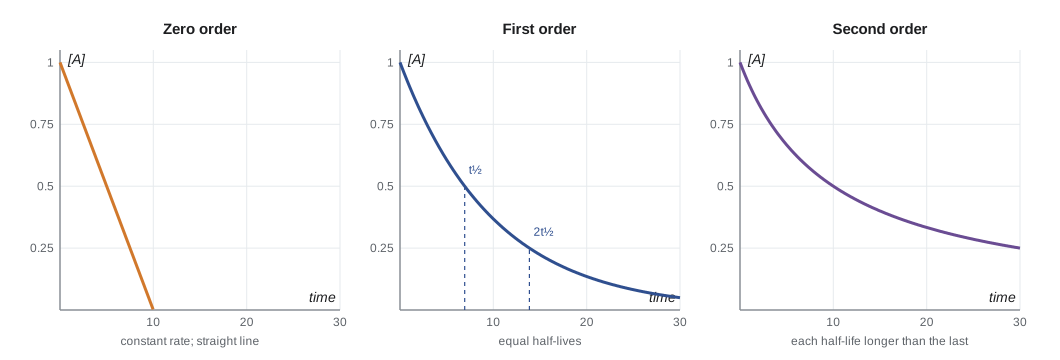
A rate law gives the rate at a particular composition. Integrating it gives concentration as a function of time, which answers practical questions: how much drug remains after 6 hours, or how long until a pollutant falls below a safe level. For a reaction with one reactant, A → products, each order has its own integrated form.
| Order | Rate law | Integrated rate law | Straight-line plot | Half-life |
|---|---|---|---|---|
| 0 | rate = k | [A] = [A]₀ − kt | [A] versus t (slope −k) | [A]₀/(2k) |
| 1 | rate = k[A] | ln[A] = ln[A]₀ − kt | ln[A] versus t (slope −k) | ln 2/k = 0.693/k |
| 2 | rate = k[A]² | 1/[A] = 1/[A]₀ + kt | 1/[A] versus t (slope +k) | 1/(k[A]₀) |
First-order reactions
First-order kinetics is the most common and the most important. Radioactive decay, many drug eliminations from the body, and simple unimolecular rearrangements are first order. Its integrated rate law can also be written in exponential form.
The half-life, the time for the concentration to fall to half its value, is constant for a first-order reaction: it takes the same time to go from 100 % to 50 % as from 50 % to 25 %. After n half-lives the fraction remaining is (½)ⁿ. After 10 half-lives less than 0.1 % remains, a common rule for when a substance is effectively gone.
Worked problem
Drug elimination
An antibiotic is eliminated by first-order kinetics with a half-life of 6.0 h. A dose gives an initial blood concentration of 12.0 mg/L. What is the concentration after 24.0 h, and how long until it falls to 1.0 mg/L?
Show solution
- k = 0.693/6.0 h = 0.1155 h⁻¹.
- After 24.0 h (four half-lives): 12.0 × (½)⁴ = 0.75 mg/L.
- Time to 1.0 mg/L: t = ln([A]₀/[A])/k = ln(12.0)/0.1155 = 2.485/0.1155 = 21.5 h.
Answer: 0.75 mg/L after 24 h; the concentration falls to 1.0 mg/L after about 21.5 h. Dosing schedules are designed from exactly this calculation, keeping levels within a therapeutic window.
Radioactive decay is always first order, and carbon-14 dating applies it. Living things keep the same ratio of carbon-14 to carbon-12 as the atmosphere; after death the carbon-14 decays with a half-life of about 5,730 years. Measuring the remaining fraction gives the age. Nuclear chemistry is beyond this course, but the mathematics is the first-order rate law.
Worked problem
Radiocarbon dating
Charcoal from an ancient hearth has 18.0 % of the carbon-14 activity of living wood. How old is it? (t½ = 5,730 years.)
Show solution
- k = 0.693/5,730 = 1.209 × 10⁻⁴ per year.
- t = ln(1/0.180)/k = 1.715/1.209 × 10⁻⁴ = 1.42 × 10⁴ years.
Answer: About 14,200 years, near the end of the last ice age, when the first people were spreading through the Americas. Real radiocarbon dates are calibrated against tree rings and other records, because atmospheric carbon-14 has varied over time.
Second- and zero-order reactions
For a second-order reaction, each successive half-life is twice as long as the one before, because the half-life is inversely proportional to the starting concentration. The dimerization of butadiene and the decomposition of NO₂ are second order. Zero-order reactions proceed at a constant rate until the reactant runs out. They occur when something other than the reactant concentration limits the rate: a catalyst surface that is fully covered, or an enzyme that is saturated with substrate. Alcohol is eliminated from the bloodstream at a roughly constant rate, close to zero order, because the liver enzyme that oxidizes it is saturated at typical blood levels.
Finding the order from concentration–time data
Often a single experiment gives concentrations at a series of times. To find the order, plot the data three ways: [A] against t, ln[A] against t and 1/[A] against t. Whichever plot is a straight line reveals the order, and its slope gives k. The code below fits all three with linear regression and compares how straight each is.
import numpy as np

# decomposition of a compound A at constant temperature: time (s) and [A] (M)
t = np.array([0, 50, 100, 150, 200, 300, 400])
A = np.array([0.1000, 0.0787, 0.0619, 0.0487, 0.0383, 0.0237, 0.0147])

def fit(x, y):
    slope, intercept = np.polyfit(x, y, 1)
    resid = y - (slope * x + intercept)
    r2 = 1 - (resid ** 2).sum() / ((y - y.mean()) ** 2).sum()
    return slope, r2

for label, y in (("zero order: [A] vs t", A), ("first order: ln[A] vs t", np.log(A)),
                 ("second order: 1/[A] vs t", 1 / A)):
    slope, r2 = fit(t, y)
    print(f"{label:27s} slope = {slope: .3e}  R^2 = {r2:.5f}")

k = -np.polyfit(t, np.log(A), 1)[0]
print(f"first order fits best: k = {k:.2e} s^-1, half-life = {np.log(2) / k:.0f} s")zero order: [A] vs t slope = -2.068e-04 R^2 = 0.92626 first order: ln[A] vs t slope = -4.795e-03 R^2 = 1.00000 second order: 1/[A] vs t slope = 1.414e-01 R^2 = 0.93143 first order fits best: k = 4.80e-03 s^-1, half-life = 145 s
Only the ln[A] plot is straight, so the decomposition is first order. With real, noisy data the differences can be subtler, and collecting data over at least two or three half-lives makes the curvature in the wrong plots easier to see.
Pseudo-first-order conditions
Rate laws with two reactants, such as rate = k[A][B], are harder to analyze from one experiment. A common trick is to make one reactant, say B, present in large excess, so that its concentration hardly changes. The rate law then behaves as rate = k′[A], with k′ = k[B]₀, a pseudo-first-order rate constant. Measuring k′ at several values of [B]₀ gives k. Hydrolysis reactions in water, where water is in enormous excess, are usually pseudo-first-order for this reason.
Kinetics in the environment and industry
Kinetics governs how long pollutants persist. The atmospheric lifetime of methane, about a decade, is set mainly by its first-order reaction with hydroxyl radicals; that of carbon dioxide is far longer and is not described by a single rate. Pharmaceutical companies run accelerated stability tests at elevated temperature, then use kinetics to set expiry dates; Health Canada and the US Food and Drug Administration both accept stability data based on the international ICH guideline Q1A. Lesson 6 shows how the temperature dependence of rates makes such predictions possible.
Common mistakes
MistakeThe orders in a rate law are the coefficients of the balanced equation.
InsteadOrders are found by experiment; they match the coefficients only for elementary steps.
MistakeA first-order reaction takes twice as long to go from 50 % to 25 % as from 100 % to 50 %.
InsteadFirst-order half-lives are constant; each takes the same time.
MistakeThe rate constant has the same units for every reaction.
InsteadThe units of k depend on the overall order.
MistakeThe rate of reaction is the same as the rate of change of any one species.
InsteadDivide each species' rate of change by its coefficient to get the single rate of reaction.
MistakeIf [A] versus t is curved, the reaction must be second order.
InsteadTest ln[A] and 1/[A] too; the straight-line plot identifies the order.
Summary and key terms
- Rate = (1/coefficient) × change in concentration per unit time; reactant terms carry a minus sign.
- Rates depend on concentration, temperature, surface area and catalysts.
- A rate law, rate = k[A]^m[B]^n, is found by experiment; its orders need not match the coefficients.
- The method of initial rates compares experiments in which one concentration changes at a time.
- Integrated rate laws give concentration versus time; the straight-line plot (zero, first or second order) identifies the order.
- First-order half-life is constant: t½ = 0.693/k; it describes radioactive decay and many drug eliminations.
- A large excess of one reactant gives pseudo-first-order kinetics.
- reaction rate
- The change in concentration of a reactant or product per unit time, divided by its coefficient.
- rate law
- An equation relating the rate of a reaction to the concentrations of reactants.
- rate constant
- The proportionality constant k in a rate law, which depends on temperature.
- order of reaction
- The exponent of a concentration in the rate law.
- initial rate
- The instantaneous rate at the start of a reaction.
- integrated rate law
- An equation giving concentration as a function of time.
- half-life
- The time for the concentration of a reactant to fall to half its value.
- first-order reaction
- A reaction whose rate is proportional to the concentration of one reactant.
- zero-order reaction
- A reaction whose rate does not depend on reactant concentration.
- pseudo-first-order
- Behaving as first order because another reactant is in large excess.
Practice problems
Work each problem on paper first, then reveal the answer to check.
For 4 PH₃ → P₄ + 6 H₂, PH₃ disappears at 0.048 M/s. How fast does H₂ form?
Show answer
0.048 × 6/4 = 0.072 M/s.
A reaction is second order in A. By what factor does the rate change if [A] triples?
Show answer
3² = 9.
What are the units of k for a reaction with rate = k[A][B]²?
Show answer
M⁻² s⁻¹.
A first-order reaction has k = 0.0231 min⁻¹. What is its half-life?
Show answer
0.693/0.0231 = 30.0 min.
What fraction of a first-order reactant remains after five half-lives?
Show answer
(½)⁵ = 1/32, about 3.1 %.
A second-order reaction has k = 0.50 M⁻¹ s⁻¹ and [A]₀ = 0.20 M. What is the first half-life?
Show answer
1/(0.50 × 0.20) = 10 s.
How long does the second half-life of that reaction take?
Show answer
1/(0.50 × 0.10) = 20 s, twice the first.
A zero-order reaction has k = 2.0 × 10⁻³ M/s and [A]₀ = 0.40 M. When is A used up?
Show answer
0.40/2.0 × 10⁻³ = 200 s.
Bone has 25 % of the carbon-14 of living tissue. How old is it?
Show answer
Two half-lives: about 11,460 years.
Why is the alcohol elimination rate roughly constant?
Show answer
The liver enzyme is saturated, so the reaction is close to zero order.
Lesson quiz · 5 questions
Score 60% or more to complete this lesson.
Create a free account to save your progress, take quizzes and earn a certificate.