
CHEM-102 · Lesson 6 of 12 · 28 min
Chemical kinetics II: temperature, mechanisms and catalysis
Lesson 5 described how rates depend on concentration. This lesson asks why reactions happen at the rates they do. Why does food spoil faster on a warm counter than in a refrigerator? Why does a catalytic converter clean a car's exhaust in a fraction of a second? Why do some reactions have rate laws that look nothing like their balanced equations? The answers come from collision theory, the idea of an activation energy, the Arrhenius equation, reaction mechanisms and catalysis.
Collision theory
For molecules to react, they must collide. But only a tiny fraction of collisions lead to reaction. In a gas at room temperature, each molecule collides billions of times per second; if every collision reacted, all gas reactions would be over almost instantly. Collision theory identifies two requirements. First, the colliding molecules must have enough energy, at least a minimum called the activation energy, Eₐ, to break existing bonds and start forming new ones. Second, they must collide with the right orientation, so that the atoms that need to bond actually meet.
The rate constant reflects all three factors: how often molecules collide, the fraction of collisions with enough energy, and the fraction with suitable orientation (the steric factor). For complex molecules the orientation requirement can be severe; in some reactions only one collision in a million is lined up correctly.
Activation energy and the transition state
As two molecules approach and react, their potential energy rises to a maximum and then falls as products form. A plot of energy against the progress of the reaction, the reaction coordinate, shows this as a hill. The top of the hill is the transition state, or activated complex: a fleeting arrangement in which old bonds are partly broken and new ones partly formed. It lasts about as long as a molecular vibration, around 10⁻¹³ s. The height of the hill above the reactants is the activation energy.
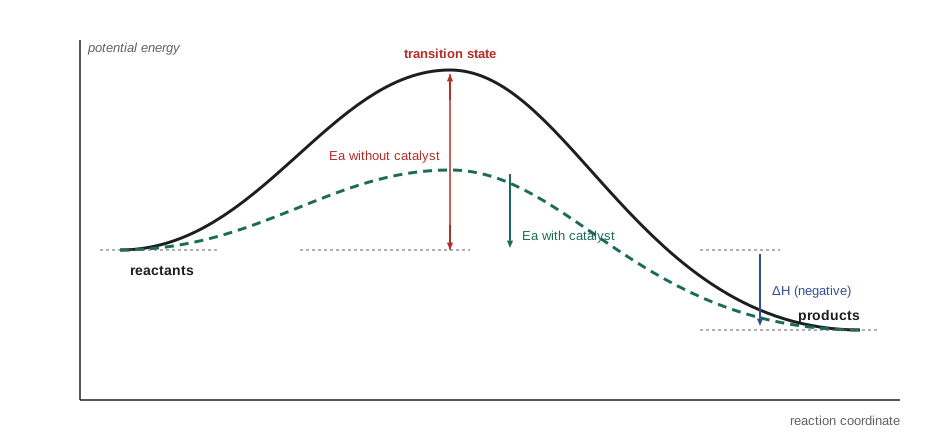
The activation energy is unrelated to whether a reaction is exothermic or endothermic. An exothermic reaction can have a large activation energy, which is why a mixture of hydrogen and oxygen is stable until a spark supplies the energy to get over the hill. The activation energy of the reverse reaction is the forward Eₐ minus ΔH (for an exothermic reaction, the reverse barrier is higher).
Why temperature matters so much
Raising the temperature increases collision frequency only slightly: the average speed of molecules grows as the square root of the absolute temperature, so going from 300 K to 310 K raises it by less than 2 %. Yet rates often double over such an interval. The reason is the energy distribution. At any temperature, molecular energies follow the Maxwell–Boltzmann distribution from CHEM-101, and only the high-energy tail exceeds the activation energy. That fraction is proportional to e^(−Eₐ/RT), which grows very steeply with T when Eₐ is much larger than RT (2.5 kJ/mol at room temperature).
from math import exp

R = 8.314e-3     # kJ/(mol K)
Ea = 50.0        # kJ/mol, a typical activation energy
for T in (273, 283, 293, 303, 313, 373):
    f = exp(-Ea / (R * T))
    print(f"T = {T} K: fraction with E > Ea = {f:.2e}")
ratio = exp(-Ea / (R * 310)) / exp(-Ea / (R * 300))
print(f"raising T from 300 K to 310 K multiplies the fraction by {ratio:.2f}")T = 273 K: fraction with E > Ea = 2.71e-10 T = 283 K: fraction with E > Ea = 5.90e-10 T = 293 K: fraction with E > Ea = 1.22e-09 T = 303 K: fraction with E > Ea = 2.40e-09 T = 313 K: fraction with E > Ea = 4.52e-09 T = 373 K: fraction with E > Ea = 9.95e-08 raising T from 300 K to 310 K multiplies the fraction by 1.91
For a barrier of 50 kJ/mol, a 10 K rise near room temperature nearly doubles the fraction of molecules able to react. This is the origin of the old rule of thumb that rates double for every 10 °C. It is only a rule of thumb: reactions with higher barriers are more sensitive to temperature, and those with low barriers less so.
The Arrhenius equation
In 1889 the Swedish chemist Svante Arrhenius proposed the equation that bears his name, which captures the temperature dependence of rate constants.
A, the pre-exponential factor (or frequency factor), combines the collision frequency and orientation; R is 8.314 J/(mol·K). The logarithmic form is a straight line when ln k is plotted against 1/T, with slope −Eₐ/R. Measuring k at two temperatures gives the activation energy directly.
Worked problem
Activation energy from two rate constants
A reaction has k = 3.2 × 10⁻⁴ s⁻¹ at 25 °C and k = 1.5 × 10⁻³ s⁻¹ at 45 °C. Find Eₐ.
Show solution
- T₁ = 298.15 K, T₂ = 318.15 K. 1/T₂ − 1/T₁ = 3.1432 × 10⁻³ − 3.3540 × 10⁻³ = −2.108 × 10⁻⁴ K⁻¹.
- ln(k₂/k₁) = ln(1.5 × 10⁻³ / 3.2 × 10⁻⁴) = ln(4.69) = 1.545.
- Eₐ = −R ln(k₂/k₁)/(1/T₂ − 1/T₁) = −8.314 × 1.545/(−2.108 × 10⁻⁴) = 6.09 × 10⁴ J/mol.
Answer: Eₐ ≈ 61 kJ/mol, a typical value for reactions that proceed at convenient rates near room temperature.
With more than two temperatures, the best estimate comes from fitting a line to ln k against 1/T. The code below does this for the decomposition of an organic compound, then predicts the rate constant at a temperature not measured.
import numpy as np

R = 8.314
T = np.array([300.0, 310.0, 320.0, 330.0, 340.0])          # K
k = np.array([1.10e-5, 3.05e-5, 8.02e-5, 2.00e-4, 4.76e-4])  # s^-1

slope, intercept = np.polyfit(1 / T, np.log(k), 1)
Ea = -slope * R
A = np.exp(intercept)
print(f"Ea = {Ea / 1000:.1f} kJ/mol, A = {A:.2e} s^-1")
for Tq in (298.15, 278.15):
    kq = A * np.exp(-Ea / (R * Tq))
print(f"predicted k at {Tq - 273.15:.0f} C = {kq:.2e} s^-1, half-life = {np.log(2) / kq / 3600:.1f} h")Ea = 79.9 kJ/mol, A = 8.85e+08 s^-1 predicted k at 25 C = 8.95e-06 s^-1, half-life = 21.5 h predicted k at 5 C = 8.82e-07 s^-1, half-life = 218.4 h
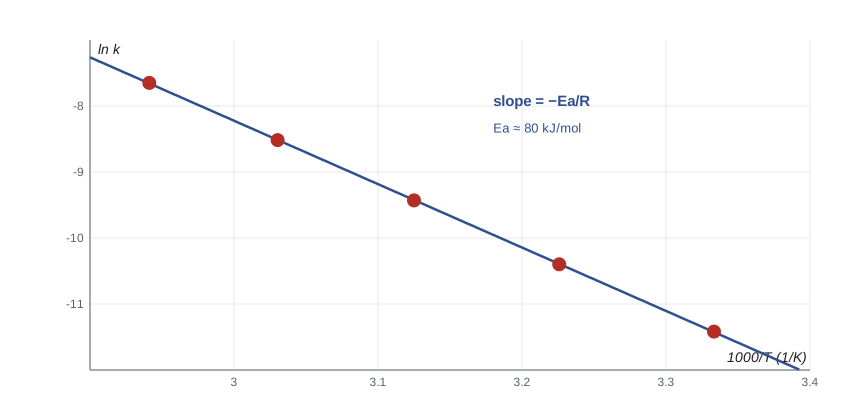
Arrhenius extrapolation is how shelf lives are estimated. A drug stored for a few weeks at 40 °C in an accelerated stability study gives rate constants that, with an activation energy, predict how fast it degrades at 25 °C or in a refrigerator. Refrigeration works for the same reason: lowering food from 22 °C to 4 °C slows most spoilage reactions, chemical and microbial, by a factor of roughly four to eight.
Reaction mechanisms
Most reactions do not happen in a single collision. They proceed through a sequence of simple steps called elementary steps, which together make up the reaction mechanism. An elementary step describes exactly which molecules collide or fall apart. Its molecularity is the number of reactant particles involved: unimolecular (one molecule rearranging or breaking apart), bimolecular (two colliding) or, rarely, termolecular (three colliding at once, which is improbable).
Unlike overall reactions, elementary steps have rate laws that can be written directly from their stoichiometry, because the step happens exactly as written. A unimolecular step A → products has rate = k[A]; a bimolecular step A + B → products has rate = k[A][B]; and 2 A → products has rate = k[A]².
Species that are formed in one step and consumed in a later step are intermediates. They do not appear in the overall equation, but they really exist, sometimes long enough to be detected. A valid mechanism must satisfy two conditions: its steps must add up to the overall balanced equation, and it must predict the experimentally observed rate law.
The rate-determining step
When one step in a mechanism is much slower than the others, it limits the overall rate, like the narrowest part of a highway at rush hour. This rate-determining step sets the rate law. Consider the reaction NO₂(g) + CO(g) → NO(g) + CO₂(g). Experiment shows that below about 225 °C the rate law is rate = k[NO₂]², with no dependence on CO at all. A proposed mechanism explains this.
The steps add up to the overall reaction (one NO₂ and the NO₃ intermediate cancel). The slow first step involves two NO₂ molecules, so its rate law, rate = k₁[NO₂]², is the overall rate law. CO enters only in the fast second step, so it does not affect the rate. The mechanism is consistent with experiment, though consistency does not prove it; chemists look for further evidence such as detecting the NO₃ intermediate.
When a fast step comes before the slow one, the rate law can involve the equilibrium of the fast step. For 2 NO + O₂ → 2 NO₂, whose rate law we found in lesson 5 to be rate = k[NO]²[O₂], a likely mechanism has a fast, reversible step 2 NO ⇌ N₂O₂ followed by a slow step N₂O₂ + O₂ → 2 NO₂. The slow step's rate is k₂[N₂O₂][O₂]; substituting [N₂O₂] = K₁[NO]² from the fast equilibrium gives rate = k₂K₁[NO]²[O₂], matching experiment without requiring an improbable three-body collision.
Catalysis
A catalyst speeds up a reaction without being consumed. It works by providing an alternative mechanism with a lower activation energy. It does not change ΔH, ΔG or the position of equilibrium; it speeds the forward and reverse reactions equally, so equilibrium is reached sooner but at the same composition.
Worked problem
How much does a catalyst speed a reaction?
A catalyst lowers the activation energy of a reaction from 75 kJ/mol to 55 kJ/mol at 298 K. If the pre-exponential factor is unchanged, by what factor does the rate increase?
Show solution
- Ratio = e^(−55,000/RT) / e^(−75,000/RT) = e^(20,000/RT).
- 20,000/(8.314 × 298) = 8.07.
- e^8.07 = 3.2 × 10³.
Answer: The reaction runs about 3,200 times faster. Because the dependence is exponential, even modest reductions in Eₐ produce large speed-ups.
Homogeneous catalysts are in the same phase as the reactants. Chlorine atoms from chlorofluorocarbons (CFCs) catalyze the destruction of stratospheric ozone in the gas phase: Cl + O₃ → ClO + O₂, followed by ClO + O → Cl + O₂. The chlorine atom is regenerated, so one atom can destroy many thousands of ozone molecules. The 1987 Montreal Protocol, negotiated in Montreal and ratified by every UN member, phased out CFCs, and the ozone layer is recovering; recent UN-backed scientific assessments project a return to 1980 levels over most of the world around the 2040s and over Antarctica around 2066.
Heterogeneous catalysts are in a different phase, usually a solid surface with gas or liquid reactants. Molecules adsorb on the surface, where their bonds are weakened, react, and then desorb. Most industrial catalysts are heterogeneous: iron in the Haber–Bosch process, vanadium(V) oxide in sulfuric acid manufacture, and nickel in the hydrogenation of vegetable oils. A car's catalytic converter uses platinum, palladium and rhodium on a ceramic honeycomb to oxidize carbon monoxide and unburned hydrocarbons to carbon dioxide and water and to reduce nitrogen oxides to nitrogen. Because lead coats and deactivates these metals, catalytic converters were one of the reasons leaded gasoline was phased out of North American road fuel by the 1990s.
Enzymes
Enzymes are biological catalysts, mostly proteins, of extraordinary power and selectivity. Catalase, which decomposes hydrogen peroxide in cells, speeds that reaction by a factor of more than 10¹²; one catalase molecule can process millions of peroxide molecules per second. The substrate binds at the enzyme's active site, a pocket shaped to fit it and to stabilize the transition state. At low substrate concentrations, enzyme-catalyzed rates are roughly first order in substrate; at high concentrations the enzyme becomes saturated and the rate levels off at a maximum, giving the Michaelis–Menten behaviour introduced in BIOL-107 and developed in BIOC-320.
Enzymes are also sensitive to temperature in a way ordinary catalysts are not. Rates rise with temperature up to an optimum, often near body temperature for human enzymes, then fall sharply as the protein unfolds and loses its shape. That denaturation is why cooking an egg changes it irreversibly, and why fevers above about 42 °C are dangerous.
Common mistakes
MistakeA catalyst shifts the equilibrium toward products.
InsteadA catalyst speeds the forward and reverse reactions equally; equilibrium is reached faster, at the same composition.
MistakeExothermic reactions have low activation energies.
InsteadΔH and Eₐ are independent; many exothermic reactions need a spark or flame to start.
MistakeTemperature speeds reactions mainly by making collisions more frequent.
InsteadIt mainly increases the fraction of collisions with energy above Eₐ.
MistakeThe rate law of an overall reaction can be written from its coefficients.
InsteadOnly elementary steps have rate laws that follow directly from stoichiometry.
MistakeAn intermediate and a transition state are the same thing.
InsteadAn intermediate is a real species at an energy minimum between steps; a transition state is the fleeting maximum of a step.
Summary and key terms
- Reactions require collisions with enough energy (at least Eₐ) and the right orientation.
- The transition state is the energy maximum along the reaction coordinate; Eₐ is its height above the reactants.
- Rates rise steeply with temperature because the fraction of molecules with E > Eₐ grows exponentially.
- Arrhenius equation: k = Ae^(−Eₐ/RT); a plot of ln k against 1/T has slope −Eₐ/R.
- Mechanisms are sequences of elementary steps; their steps must sum to the overall equation and predict the rate law.
- The slowest, rate-determining step controls the rate law.
- Catalysts lower Eₐ by providing a new mechanism; they do not change ΔH, ΔG or equilibrium.
- activation energy
- The minimum energy colliding molecules need to react.
- transition state
- The highest-energy arrangement of atoms along the path from reactants to products.
- collision theory
- The model in which rates depend on the frequency, energy and orientation of collisions.
- Arrhenius equation
- k = Ae^(−Eₐ/RT), relating the rate constant to temperature.
- pre-exponential factor
- The term A in the Arrhenius equation, reflecting collision frequency and orientation.
- elementary step
- A single molecular event in a reaction mechanism.
- molecularity
- The number of reactant particles in an elementary step.
- intermediate
- A species formed in one step of a mechanism and consumed in a later step.
- rate-determining step
- The slowest step of a mechanism, which controls the overall rate.
- catalyst
- A substance that increases the rate of a reaction without being consumed, by lowering Eₐ.
Practice problems
Work each problem on paper first, then reveal the answer to check.
For an exothermic reaction with ΔH = −80 kJ and Eₐ = 50 kJ, what is Eₐ for the reverse reaction?
Show answer
50 + 80 = 130 kJ.
k doubles from 20 °C to 30 °C. Estimate Eₐ.
Show answer
Eₐ = R ln 2/(1/293.15 − 1/303.15) = 51 kJ/mol.
A reaction has Eₐ = 100 kJ/mol. By what factor does k increase from 25 °C to 35 °C?
Show answer
e^((100,000/8.314)(1/298.15 − 1/308.15)) = e^1.31 = 3.7.
Write the rate law for the elementary step NO + O₃ → NO₂ + O₂.
Show answer
rate = k[NO][O₃].
Why are termolecular steps rare?
Show answer
Three particles must collide at once with the right energy and orientation, which is improbable.
In the mechanism Cl + O₃ → ClO + O₂; ClO + O → Cl + O₂, identify the catalyst and the intermediate.
Show answer
Cl is the catalyst (regenerated); ClO is the intermediate.
A mechanism has a slow first step A + B → C and a fast second step C + B → D. Predict the rate law.
Show answer
rate = k[A][B].
Does a catalyst change ΔH for a reaction?
Show answer
No; it changes only the path and the activation energy.
Why does food keep longer in a freezer than in a refrigerator?
Show answer
Lower temperature further reduces the fraction of molecules with enough energy to react, slowing chemical and microbial spoilage.
Why does an enzyme-catalyzed rate fall above an optimum temperature?
Show answer
The enzyme denatures, losing the shape of its active site.
Lesson quiz · 5 questions
Score 60% or more to complete this lesson.
Create a free account to save your progress, take quizzes and earn a certificate.