
CHEM-102 · Lesson 4 of 12 · 35 min
Solutions and colligative properties
Seawater freezes at about −1.9 °C rather than 0 °C. Salt spread on a winter sidewalk melts ice that would otherwise stay frozen. Antifreeze keeps a car's cooling system liquid at −37 °C. A red blood cell placed in pure water swells and bursts. All of these effects depend on the number of dissolved particles rather than their identity, and they are called colligative properties (from the Latin for "bound together"). This lesson describes how solutions form, how concentration is expressed, and how dissolved particles change vapour pressure, boiling point, freezing point and osmotic pressure. It builds on CHEM-101's intermolecular forces and lesson 3's entropy.
How solutions form
A solution is a homogeneous mixture of a solute dissolved in a solvent. Whether a substance dissolves depends on the balance of intermolecular forces and on entropy. Dissolving requires separating solute particles from each other and separating solvent molecules to make room, both of which absorb energy, and then forming solute–solvent attractions, which release energy. Mixing almost always increases entropy, so dissolving is favoured whenever the energy cost is small. The rule of thumb "like dissolves like" follows: polar and ionic solutes dissolve in polar solvents such as water, and nonpolar solutes such as oils dissolve in nonpolar solvents such as hexane, because similar forces are replaced by similar forces.
Solubility, the maximum amount of solute that dissolves at a given temperature, usually increases with temperature for solids, though there are exceptions (cerium sulfate and, slightly, some calcium salts). For gases the opposite holds: gases are less soluble in warm water, which is why warm lakes and rivers hold less dissolved oxygen and why fish kills are more common in hot summers. The solubility of a gas is proportional to its partial pressure above the liquid, a relationship known as Henry's law.
A carbonated drink is bottled under high CO₂ pressure; when opened, the pressure falls and the gas fizzes out of solution. Scuba divers face the same physics in their blood: nitrogen dissolved at depth comes out as bubbles if they rise too fast, causing decompression sickness.
Worked problem
Henry's law: oxygen in a lake
At 20 °C the Henry's law constant for O₂ in water is about 1.3 × 10⁻³ mol/(L·atm). Air is 20.9 % O₂. What is the concentration of dissolved oxygen in water in equilibrium with air at 1.00 atm, in mg/L?
Show solution
- P(O₂) = 0.209 × 1.00 atm = 0.209 atm.
- S = (1.3 × 10⁻³)(0.209) = 2.7 × 10⁻⁴ mol/L.
- Mass: 2.7 × 10⁻⁴ mol/L × 32.00 g/mol = 8.7 × 10⁻³ g/L = 8.7 mg/L.
Answer: About 9 mg/L, typical of a healthy, well-mixed lake. Many fish need at least 5 to 6 mg/L, so warm, stagnant water that falls below that becomes stressful.
Concentration units
CHEM-101 used molarity (mol of solute per litre of solution). Colligative properties need units that do not change with temperature, because volumes expand when heated. Two are common: molality, m, the moles of solute per kilogram of solvent, and mole fraction, χ, the moles of a component divided by the total moles.
Mass percent and parts per million (ppm, mg of solute per kg of solution, roughly mg/L for dilute aqueous solutions) are used for environmental and commercial work. Health Canada and the US Environmental Protection Agency both express drinking water limits in mg/L; for example, both set the guideline for nitrate as nitrogen at 10 mg/L.
Worked problem
Converting between concentration units
A solution is made by dissolving 20.0 g of ethylene glycol (C₂H₆O₂, 62.07 g/mol) in 80.0 g of water. Find the molality, the mole fraction of ethylene glycol and the mass percent.
Show solution
- Moles of glycol: 20.0/62.07 = 0.3222 mol. Moles of water: 80.0/18.02 = 4.440 mol.
- Molality: 0.3222 mol ÷ 0.0800 kg = 4.03 mol/kg.
- Mole fraction: 0.3222 ÷ (0.3222 + 4.440) = 0.0677.
- Mass percent: 20.0 ÷ 100.0 × 100 % = 20.0 %.
Answer: m = 4.03 mol/kg, χ = 0.0677, 20.0 % by mass.
Vapour pressure lowering: Raoult's law
A liquid in a closed container evaporates until its vapour reaches the equilibrium vapour pressure. When a nonvolatile solute is dissolved, fewer solvent molecules sit at the surface, and the solution has more entropy than the pure solvent, so the solvent has less tendency to escape. The vapour pressure falls. For an ideal solution, Raoult's law states that the solvent's vapour pressure is proportional to its mole fraction.
When both components are volatile, each contributes according to its own mole fraction, and the total vapour pressure is the sum. The vapour is richer in the more volatile component than the liquid is, which is the basis of fractional distillation, used everywhere from oil refineries in Alberta and Texas to craft distilleries.
# Raoult's law for an ideal mixture of hexane and heptane at 25 C
P0 = {"hexane": 20.2, "heptane": 6.1}   # kPa, approximate pure vapour pressures
for x_hex in (0.0, 0.25, 0.50, 0.75, 1.0):
    p_hex = x_hex * P0["hexane"]
    p_hep = (1 - x_hex) * P0["heptane"]
    total = p_hex + p_hep
    y_hex = p_hex / total             # mole fraction of hexane in the vapour
print(f"liquid x(hexane) = {x_hex:.2f}: P = {total:5.2f} kPa, vapour y(hexane) = {y_hex:.2f}")liquid x(hexane) = 0.00: P = 6.10 kPa, vapour y(hexane) = 0.00 liquid x(hexane) = 0.25: P = 9.62 kPa, vapour y(hexane) = 0.52 liquid x(hexane) = 0.50: P = 13.15 kPa, vapour y(hexane) = 0.77 liquid x(hexane) = 0.75: P = 16.67 kPa, vapour y(hexane) = 0.91 liquid x(hexane) = 1.00: P = 20.20 kPa, vapour y(hexane) = 1.00
Real solutions deviate from Raoult's law when solute–solvent attractions differ from the attractions in the pure liquids. Acetone and chloroform attract each other more strongly than either attracts itself, through a weak hydrogen bond, so their mixture has a lower vapour pressure than predicted (a negative deviation). Ethanol and hexane attract each other less strongly, giving a positive deviation. Large deviations produce azeotropes, mixtures that boil without changing composition; ethanol and water form one at about 95.6 % ethanol by mass, which is why distillation alone cannot make pure ethanol.
Boiling point elevation and freezing point depression
Because a nonvolatile solute lowers the vapour pressure, the solution must be heated to a higher temperature before its vapour pressure reaches atmospheric pressure: the boiling point rises. The solute also disrupts the formation of the solid, which in most cases contains pure solvent, so the solution must be cooled further before it freezes: the freezing point falls. For dilute solutions both changes are proportional to the molality of solute particles.
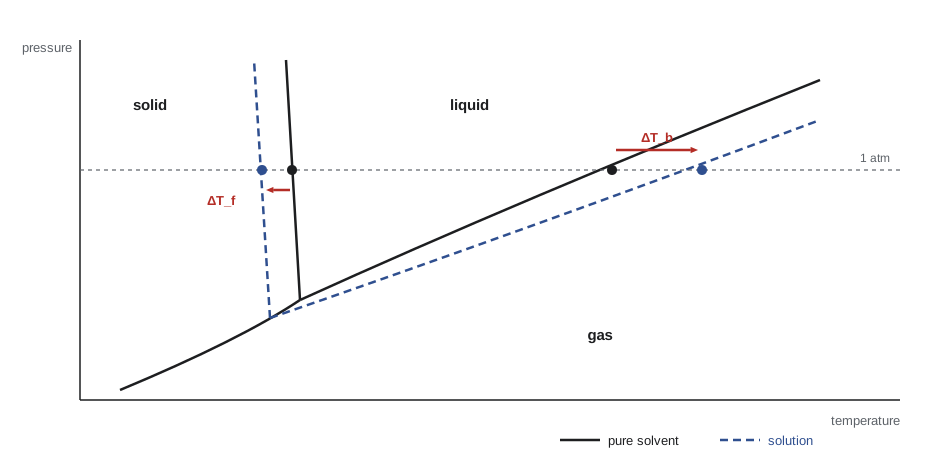
K_b and K_f are constants characteristic of the solvent: for water, K_b = 0.512 °C·kg/mol and K_f = 1.86 °C·kg/mol. The van 't Hoff factor, i, is the number of particles each formula unit produces in solution: 1 for sugar or ethylene glycol, which do not dissociate; ideally 2 for NaCl (Na⁺ and Cl⁻), 3 for CaCl₂ and MgCl₂. Real values of i are somewhat smaller than the ideal ones, because oppositely charged ions cluster as ion pairs, especially at higher concentrations; measured i for 0.05 m NaCl is about 1.9.
| Solvent | Normal b.p. (°C) | K_b (°C·kg/mol) | Normal f.p. (°C) | K_f (°C·kg/mol) |
|---|---|---|---|---|
| Water | 100.0 | 0.512 | 0.0 | 1.86 |
| Benzene | 80.1 | 2.53 | 5.5 | 5.12 |
| Ethanol | 78.4 | 1.22 | −114.6 | 1.99 |
| Cyclohexane | 80.7 | 2.79 | 6.6 | 20.0 |
| Camphor | — | — | 178.8 | 37.7 |
Worked problem
Antifreeze
What molality of ethylene glycol in water is needed to protect an engine down to −37 °C? What mass of glycol per kilogram of water is that?
Show solution
- ΔT_f = 37 °C; i = 1 for a non-electrolyte.
- m = ΔT_f/K_f = 37/1.86 = 19.9 mol/kg.
- Mass: 19.9 mol × 62.07 g/mol = 1,235 g of glycol per kilogram of water.
Answer: About 1.2 kg of glycol per kilogram of water, close to the 50 : 50 mixture recommended in cold climates. At such high concentrations the simple formula is only approximate, but the order of magnitude is right; commercial charts give the exact freeze points.
Worked problem
Road salt
Compare the freezing point of water containing 1.0 mol/kg of NaCl with water containing 1.0 mol/kg of CaCl₂, assuming ideal van ’t Hoff factors.
Show solution
- NaCl: i = 2, ΔT_f = 2 × 1.86 × 1.0 = 3.7 °C, so the solution freezes at −3.7 °C.
- CaCl₂: i = 3, ΔT_f = 3 × 1.86 × 1.0 = 5.6 °C, so it freezes at −5.6 °C.
Answer: Calcium chloride gives more particles per mole and, as lesson 2 showed, releases heat as it dissolves. Both properties make it the choice for very cold days, when sodium chloride works poorly; road crews in the Prairies and the northern US switch to calcium or magnesium chloride brines, or add them to rock salt, below about −10 °C.
Road salt has an environmental cost. Chloride runoff raises the salinity of streams and lakes; a federal assessment found road salts to be toxic as defined in the Canadian Environmental Protection Act, and a federal code of practice guides how municipalities manage them, and many US states run salt-reduction programs for the same reason.
Determining molar mass
Colligative properties were historically one of the main ways to find the molar mass of a new compound. Dissolve a known mass of the compound in a known mass of solvent, measure ΔT_f (cyclohexane and camphor, with their large K_f values, give big, easily measured changes), calculate the molality, and from it the moles and molar mass.
# Molar mass from freezing point depression in cyclohexane (Kf = 20.0 C kg/mol)
Kf = 20.0
mass_solute = 0.315      # g of an unknown non-electrolyte
mass_solvent = 25.00     # g of cyclohexane
Tf_pure, Tf_soln = 6.55, 3.82
dT = Tf_pure - Tf_soln
molality = dT / Kf
moles = molality * mass_solvent / 1000
M = mass_solute / moles
print(f"freezing point depression = {dT:.2f} C")
print(f"molality = {molality:.4f} mol/kg, moles = {moles:.3e} mol")
print(f"molar mass = {M:.0f} g/mol")freezing point depression = 2.73 C molality = 0.1365 mol/kg, moles = 3.413e-03 mol molar mass = 92 g/mol
A molar mass near 92 g/mol, combined with a combustion analysis giving the empirical formula, would identify the compound. Toluene, C₇H₈ (92.14 g/mol), would fit.
Osmosis and osmotic pressure
When a solution and pure solvent are separated by a semipermeable membrane, one that lets solvent molecules through but not solute particles, solvent flows into the solution. This net flow is osmosis. It continues until the pressure on the solution side is high enough to stop it; that pressure is the osmotic pressure, Π. For dilute solutions it follows an equation that looks like the ideal gas law.
Here M is the molarity. Osmotic pressures are large: a 0.10 M sugar solution at 25 °C has Π = 0.10 × 0.08206 × 298 = 2.4 atm, enough to support a column of water 25 m high. Because Π is so large even for small concentrations, osmometry is the method of choice for finding the molar masses of proteins and polymers, which give freezing point changes too small to measure.
Worked problem
Molar mass of a protein
A solution of 2.00 g of a protein in water to make 100.0 mL has an osmotic pressure of 0.0164 atm at 25 °C. What is the protein’s molar mass?
Show solution
- M = Π/(RT) = 0.0164/(0.08206 × 298.15) = 6.70 × 10⁻⁴ mol/L.
- Moles in 0.1000 L: 6.70 × 10⁻⁵ mol.
- Molar mass: 2.00 g ÷ 6.70 × 10⁻⁵ mol = 2.98 × 10⁴ g/mol.
Answer: About 30,000 g/mol, typical of a small protein. The same solution would lower the freezing point of water by only about 0.001 °C.
Osmosis matters throughout biology and medicine. Cells are surrounded by semipermeable membranes, and the fluid around them must be isotonic, with the same osmotic pressure as the cell contents, about 0.30 osmol/L. Intravenous fluids such as 0.9 % saline (often called normal saline) and 5 % dextrose are formulated to be isotonic. In a hypotonic solution cells swell and can burst (hemolysis); in a hypertonic solution they shrink (crenation). Salting and sugaring preserve food by drawing water out of bacteria osmotically.
Reverse osmosis
Applying a pressure greater than the osmotic pressure to the solution side forces solvent to flow backward, from the solution into pure solvent. Reverse osmosis is now the main technology for desalinating seawater, which has an osmotic pressure of roughly 27 to 28 atm, so plants run at 55 to 80 atm. Large reverse osmosis plants supply drinking water in California, Florida and the Middle East; in Canada the technology is used mostly for treating brackish groundwater, for industrial water and in household under-sink filters.
# Osmotic pressure of seawater and the minimum pressure for reverse osmosis
R = 0.08206   # L atm / (mol K)
T = 298.15
# seawater approximated as 0.55 M NaCl (i about 1.9 after ion pairing) plus other ions
ions_M = 0.55 * 1.9 + 0.10      # total osmolarity, osmol/L (approximate)
Pi = ions_M * R * T
print(f"osmolarity about {ions_M:.2f} osmol/L, osmotic pressure about {Pi:.0f} atm")

# fraction of fresh water that can be recovered before the brine reaches 70 atm
for recovery in (0.3, 0.4, 0.5, 0.6):
    brine_Pi = Pi / (1 - recovery)
print(f"recovery {recovery:.0%}: brine osmotic pressure = {brine_Pi:5.1f} atm")osmolarity about 1.15 osmol/L, osmotic pressure about 28 atm recovery 30%: brine osmotic pressure = 40.0 atm recovery 40%: brine osmotic pressure = 46.7 atm recovery 50%: brine osmotic pressure = 56.0 atm recovery 60%: brine osmotic pressure = 70.0 atm
As fresh water is removed, the remaining brine becomes more concentrated and its osmotic pressure climbs, which is why seawater plants typically recover only 40 to 50 % of the feed as fresh water. Disposing of the concentrated brine without harming marine life is one of the technology's main environmental challenges.
Common mistakes
MistakeColligative properties depend on what the solute is.
InsteadThey depend on the number of dissolved particles, not their identity.
MistakeUse molarity in ΔT_f = iK_f m.
InsteadUse molality (mol per kg of solvent), which does not change with temperature.
MistakeNaCl has i = 1 because it is one compound.
InsteadEach formula unit gives two ions, so i is ideally 2 (slightly less in practice).
MistakeGases dissolve better in warm water, like most solids.
InsteadGas solubility falls as temperature rises.
MistakeIn osmosis, solute moves through the membrane into the solvent.
InsteadSolvent moves through the membrane into the more concentrated solution; the solute cannot pass.
Summary and key terms
- Dissolving depends on the balance of intermolecular forces and the entropy gain of mixing: like dissolves like.
- Henry’s law: gas solubility is proportional to partial pressure; gases are less soluble in warm water.
- Molality (mol per kg solvent) and mole fraction do not change with temperature.
- Raoult’s law: P_solvent = χ_solvent P°; a nonvolatile solute lowers the vapour pressure.
- ΔT_b = iK_b m and ΔT_f = iK_f m; i is the number of particles per formula unit.
- Osmotic pressure Π = iMRT; it is large even for dilute solutions and is used to find molar masses of large molecules.
- Reverse osmosis applies a pressure greater than Π to purify water.
- colligative property
- A property that depends on the number of solute particles, not their identity.
- molality
- Moles of solute per kilogram of solvent.
- mole fraction
- Moles of a component divided by the total moles in the mixture.
- Henry's law
- The solubility of a gas is proportional to its partial pressure above the solution.
- Raoult's law
- The vapour pressure of a solvent equals its mole fraction times the vapour pressure of the pure solvent.
- van 't Hoff factor
- The number of particles produced per formula unit of solute.
- osmosis
- Net flow of solvent through a semipermeable membrane into a more concentrated solution.
- osmotic pressure
- The pressure needed to stop osmosis.
- isotonic
- Having the same osmotic pressure as another solution, such as the contents of a cell.
- azeotrope
- A mixture that boils without changing composition.
Practice problems
Work each problem on paper first, then reveal the answer to check.
What is the molality of 5.85 g NaCl in 250 g of water?
Show answer
0.100 mol ÷ 0.250 kg = 0.400 mol/kg.
Estimate the freezing point of that solution.
Show answer
ΔT_f = 2 × 1.86 × 0.400 = 1.49 °C; about −1.5 °C.
Which lowers the freezing point most at equal molality: glucose, NaCl or MgCl₂?
Show answer
MgCl₂ (i = 3).
What is the boiling point of 2.00 m sucrose in water?
Show answer
100.00 + 0.512 × 2.00 = 101.02 °C.
A solution has χ(water) = 0.950. What is its vapour pressure at 25 °C, where P°(water) = 3.17 kPa?
Show answer
0.950 × 3.17 = 3.01 kPa.
Calculate Π for 0.15 M NaCl at 37 °C (i = 1.9).
Show answer
1.9 × 0.15 × 0.08206 × 310 = 7.2 atm.
Why do carbonated drinks go flat faster when warm?
Show answer
Gas solubility falls as temperature rises.
A red blood cell is placed in 3 % NaCl. What happens?
Show answer
The solution is hypertonic; water leaves the cell and it shrinks.
Why is osmometry used for proteins instead of freezing point depression?
Show answer
Osmotic pressures are measurably large at concentrations where ΔT_f is tiny.
Why can distillation not make 100 % ethanol from water mixtures?
Show answer
Ethanol and water form an azeotrope near 95.6 % ethanol that boils without changing composition.
Lesson quiz · 5 questions
Score 60% or more to complete this lesson.
Create a free account to save your progress, take quizzes and earn a certificate.