
BIOL-340 · Lesson 9 of 12 · 34 min
Light, timing and environmental responses
A plant cannot walk into the sun or away from the cold, but it is far from passive. It senses the quantity, quality, direction and duration of light; it measures the length of the night to within minutes; it detects gravity, touch and temperature; and it keeps time with an internal clock that anticipates dawn and dusk. With this information it decides when to germinate, how tall to grow, which way to bend, when to flower and when to prepare for winter. This lesson describes the photoreceptors plants use, the tropisms by which they orient their organs, the circadian clock, and the photoperiodic and cold-sensing mechanisms that time flowering. These are among the best-understood signalling systems in biology, and they matter enormously in agriculture: the spread of crops to new latitudes, from soybean on the northern Prairies to winter wheat on the southern plains, has depended on understanding and breeding for them.
A family of photoreceptors
Plants carry several classes of photoreceptor, each tuned to a band of the spectrum. Phytochromes absorb mainly red and far-red light; cryptochromes, phototropins and the ZEITLUPE family absorb blue and ultraviolet-A light; and UVR8 absorbs ultraviolet-B. Together they let the plant read not just how bright the light is but its colour, its direction and the time of day at which it changes.
| Photoreceptor | Light absorbed | Chromophore | Main roles |
|---|---|---|---|
| Phytochromes (phyA–phyE in Arabidopsis) | Red and far-red | Phytochromobilin (a linear tetrapyrrole) | Germination, de-etiolation, shade avoidance, flowering, thermosensing |
| Cryptochromes (cry1, cry2) | Blue and UV-A | FAD | De-etiolation, inhibition of stem elongation, flowering, clock entrainment |
| Phototropins (phot1, phot2) | Blue and UV-A | FMN | Phototropism, chloroplast movement, stomatal opening, leaf flattening |
| ZEITLUPE family | Blue | FMN | Circadian clock and flowering time |
| UVR8 | UV-B | Tryptophan residues in the protein | UV protection, sunscreen pigments, DNA repair genes |
Phytochrome: a reversible switch
Phytochrome was discovered through lettuce seeds. In the 1930s and 1950s, scientists at the US Department of Agriculture in Beltsville, led by Harry Borthwick and Sterling Hendricks, found that red light (about 660 nm) stimulated germination of light-requiring lettuce seeds and that far-red light (about 730 nm) given afterwards reversed the effect. Seeds given alternating flashes germinated or not according to the colour of the last flash. They proposed a pigment that exists in two interconvertible forms, and in 1959 Warren Butler and colleagues detected it spectroscopically and named it phytochrome. The red-absorbing form, Pr, is made in darkness and is biologically inactive. Absorbing red light converts it to the far-red-absorbing form, Pfr, which is active; absorbing far-red light converts Pfr back to Pr. Pfr also reverts slowly to Pr in darkness.
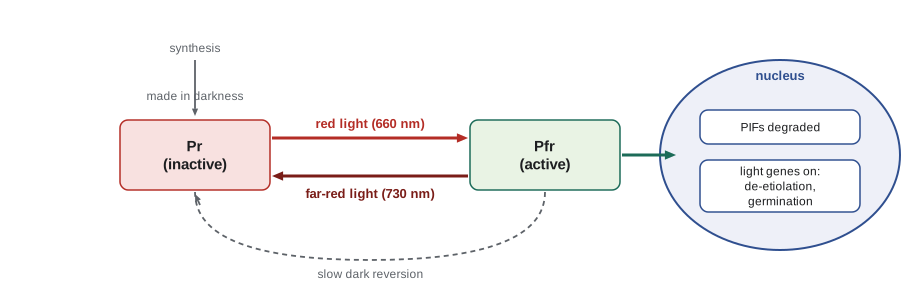
Because Pr and Pfr absorption spectra overlap, natural light never converts phytochrome entirely to one form; it sets a photoequilibrium, the fraction of phytochrome in the Pfr form, which depends on the ratio of red to far-red light. That ratio carries information. Sunlight has a red to far-red ratio of about 1.2. Green leaves absorb red light strongly but transmit and reflect far-red, so light under a canopy, or reflected from neighbouring plants, is rich in far-red, with ratios that can fall below 0.2. A seedling can therefore detect competitors before it is shaded, simply by the colour of the light around it.
import numpy as np

# Phytochrome photoequilibrium: fraction of total phytochrome present as Pfr
# k(Pr->Pfr) and k(Pfr->Pr) are photon flux times relative absorption cross-sections.
# Relative cross-sections at 660 nm (R) and 730 nm (FR) are illustrative.
sig = {"Pr": {"R": 1.00, "FR": 0.03}, "Pfr": {"R": 0.163, "FR": 0.62}}

def pfr_fraction(R, FR):
    k_on = R * sig["Pr"]["R"] + FR * sig["Pr"]["FR"]
    k_off = R * sig["Pfr"]["R"] + FR * sig["Pfr"]["FR"]
    return k_on / (k_on + k_off)

print(" light environment          R:FR   Pfr/Ptotal")
for name, ratio in (("pure red light", 100.0), ("open sunlight", 1.2), ("dawn and dusk", 0.8),
                    ("beside a neighbour", 0.6), ("under one leaf layer", 0.3),
                    ("deep canopy shade", 0.1), ("pure far-red light", 0.0)):
    R, FR = (ratio, 1.0) if ratio < 50 else (1.0, 0.0)
print(f" {name:25s} {ratio:6.1f} {pfr_fraction(R, FR):.2f}")light environment R:FR Pfr/Ptotal pure red light 100.0 0.86 open sunlight 1.2 0.60 dawn and dusk 0.8 0.53 beside a neighbour 0.6 0.47 under one leaf layer 0.3 0.33 deep canopy shade 0.1 0.17 pure far-red light 0.0 0.05
The calculation shows the main features of phytochrome as a sensor. Pure red light drives phytochrome to a maximum of about 86 per cent Pfr, not 100 per cent, because Pfr also absorbs some red light, and pure far-red light leaves a few per cent as Pfr because Pr absorbs a little far-red. Open sunlight gives about 60 per cent, while shade from leaves lowers it steeply, to below 20 per cent in deep canopy shade. A plant does not need to measure the ratio directly; the fraction of active phytochrome does it, and the plant responds to that fraction.
Active Pfr moves from the cytoplasm into the nucleus, where it binds a family of transcription factors called PHYTOCHROME-INTERACTING FACTORS (PIFs). PIFs promote the growth habit of seedlings in darkness, long stems and closed, pale cotyledons, and Pfr binding triggers their phosphorylation and degradation. Phytochrome also inhibits COP1, a ubiquitin ligase that in darkness destroys the transcription factor HY5 and other light-promoting proteins. The result is de-etiolation: a seedling emerging from the soil stops elongating, opens its apical hook, expands its cotyledons and makes chlorophyll within hours. Arabidopsis has five phytochromes with distinct roles. phyA is abundant in dark-grown seedlings, is destroyed in light and responds to very low light and to far-red; phyB is the main sensor of red light and of shade in established plants.
Shade avoidance shows how plants use this information. When the red to far-red ratio falls, phyB is converted to Pr, PIFs accumulate, auxin synthesis increases, and the plant elongates its stems and petioles, raises its leaves, reduces branching and flowers earlier, all strategies to outgrow neighbours or set seed before being overtopped. In crops planted at high density, shade avoidance diverts resources from grain to stems, and breeders have unknowingly selected maize and other crops for reduced shade avoidance, allowing the dense plantings that modern yields depend on. Phytochrome also measures temperature: in 2016 two groups showed that the rate at which Pfr reverts to Pr in the dark increases with temperature, so phyB acts as a thermosensor that helps explain why warm nights make Arabidopsis seedlings elongate, a response called thermomorphogenesis.
Blue light receptors
Cryptochromes resemble DNA photolyases, the bacterial enzymes that repair UV damage, but have lost the repair function. In plants they inhibit stem elongation under blue light, promote de-etiolation together with phytochromes, help entrain the circadian clock and, through cry2, promote flowering in long days. Animals have cryptochromes too, as components of their circadian clocks, a striking case of shared ancestry. Phototropins are blue light-activated protein kinases, with light-sensing LOV domains, that mediate phototropism, move chloroplasts toward weak light and away from strong light, and open stomata. UVR8, discovered in 2011, is a dimer that splits into monomers when tryptophan residues in its structure absorb UV-B. The monomers interact with COP1 and activate genes for UV-absorbing flavonoids and DNA repair, letting plants build their own sunscreen.
Tropisms: bending toward and away
Phototropism, the bending of shoots toward unilateral light, begins with phototropins. When light comes from one side, phototropin on the lit side is more activated, and through a chain of events that is still being worked out, auxin transport is redirected so that more auxin flows down the shaded side. Cells on the shaded side elongate faster through acid growth and the shoot curves toward the light. This is the Cholodny–Went hypothesis, proposed independently by Nikolai Cholodny and Frits Went in the 1920s, and modern auxin reporters show auxin accumulating on the shaded side of bending hypocotyls just before curvature begins.
Gravitropism, growth oriented by gravity, depends on statoliths: dense, starch-filled amyloplasts in specialized cells called statocytes, in the columella of the root cap and in the endodermis of shoots. When a root is turned on its side, the statoliths sediment within minutes to the new lower side of the cells. In ways not fully understood, this relocates PIN3 and PIN7 auxin efflux carriers to the lower side of the columella cells, so auxin flows to the lower flank of the root. Because high auxin inhibits elongation in roots, the lower flank grows more slowly and the root bends downward. In shoots, auxin accumulates on the lower side too, but there it stimulates elongation, so the shoot bends up. Starchless mutants respond to gravity weakly and slowly, supporting the starch–statolith hypothesis, and experiments on the International Space Station have shown that roots can sense accelerations far smaller than Earth’s gravity. LAZY proteins, named after maize mutants with sprawling, prostrate shoots, link statolith position to PIN placement; variants of LAZY and related genes control the angle at which branches and roots grow, an important trait in crop breeding because steeper roots reach deeper water.
Plants also respond to touch. Thigmotropism is directional growth in response to contact, as when a tendril coils around a support; thigmomorphogenesis is the slower change in form produced by repeated mechanical stimulation, such as the shorter, thicker stems of trees on windy ridges. Touching an Arabidopsis plant for a few seconds a day changes the expression of hundreds of genes within minutes and delays flowering. Roots also show hydrotropism, bending toward moist soil, through a mechanism that, unusually, does not seem to depend on polar auxin transport in the same way.
The circadian clock
In 1729 the French astronomer Jean-Jacques d’Ortous de Mairan noticed that the leaves of a Mimosa plant kept in a dark cupboard still opened and closed on a daily schedule. This was the first evidence of a circadian rhythm, an internal rhythm with a period of about a day that persists in constant conditions. Circadian clocks have three defining properties: they free-run with a period close to, but usually not exactly, 24 hours in constant conditions; they are entrained (reset) by environmental cues, chiefly light and temperature at dawn and dusk; and their period is temperature-compensated, staying nearly constant over a range of temperatures even though most biochemical reactions speed up with warming.
The plant clock is built from interlocking transcriptional feedback loops. In the morning, the transcription factors CCA1 and LHY peak; they repress evening genes, including TOC1. Through the day, a series of PSEUDO-RESPONSE REGULATOR proteins (PRR9, PRR7, PRR5) represses CCA1 and LHY in turn. In the evening, TOC1 and a protein complex called the evening complex (ELF3, ELF4 and LUX) accumulate and repress the morning and daytime genes, and as they decline in the night, CCA1 and LHY rise again. Light acts through phytochromes and cryptochromes to reset the phase each day. About a third of Arabidopsis genes are clock-regulated, including genes for photosynthesis, starch breakdown, stomatal opening, hormone signalling and defence. A clock that matches the external day improves fitness: in 2005, Antony Dodd and colleagues showed that Arabidopsis plants whose clock period matched the environmental cycle fixed more carbon and grew faster than mismatched plants, and changes in clock genes contributed to the adaptation of crops such as tomato, barley and soybean to new latitudes.
Photoperiodism: measuring the night
In 1920 Wightman Garner and Harry Allard, also at the USDA in Beltsville, studied a tobacco variety, Maryland Mammoth, that grew enormous in the field but would not flower in summer; it flowered only when moved to a greenhouse in winter. They showed that day length was the cue and coined the term photoperiodism. Plants are classified by their flowering response. Short-day plants, such as chrysanthemum, rice, soybean and poinsettia, flower when days are shorter than a critical length; long-day plants, such as wheat, barley, oats, canola, spinach and Arabidopsis, flower when days are longer than a critical length; and day-neutral plants, such as tomato, cucumber and many modern varieties of strawberry and soybean, flower regardless of day length.
Experiments in the 1930s and 1940s showed that what plants actually measure is the length of the night. A short-day plant grown under short days does not flower if the long night is interrupted by a brief flash of light in the middle, a night break; interrupting the day with darkness has no such effect. The most effective light for a night break is red, and its effect is reversed by far-red, which implicated phytochrome. Growers use this knowledge every year: poinsettias for the December market are kept in long nights from early autumn, and chrysanthemums are flowered year-round by controlling night length with blackout cloth and lights.
How does a plant compare the night length to a critical value? The modern answer, worked out in Arabidopsis, is the external coincidence model, first proposed by Erwin Bünning in 1936. The clock controls the daily rhythm of expression of a gene called CONSTANS (CO), so that its mRNA rises in the late afternoon. CO protein is unstable in the dark but stabilized by light, through phyA and cryptochromes. In long days, CO mRNA peaks while it is still light, CO protein accumulates and switches on the gene FLOWERING LOCUS T (FT) in the leaf phloem. In short days, CO is expressed after dark and its protein is destroyed. Flowering thus depends on the coincidence of an internal, clock-driven rhythm with an external signal, light.
FT protein is the long-sought florigen. In the 1930s Mikhail Chailakhyan proposed a flowering hormone made in leaves and transported to the apex, because grafting a leaf from an induced plant onto a non-induced plant could make it flower, even between species. In 2007 several groups showed that FT protein, made in companion cells of leaf phloem, moves through the phloem to the shoot apex, where it forms a complex with the transcription factor FD and switches on floral identity genes such as APETALA1 and LEAFY, converting the meristem from making leaves to making flowers (lesson 10). The rice equivalent, Hd3a, works the same way in short days, because in rice the CONSTANS equivalent, Hd1, activates Hd3a in short days and represses it in long days.
import math

# Day length (sunrise to sunset) from latitude and day of year,
# with the standard -0.833 degree solar altitude for refraction and the solar disc.
def day_length(lat_deg, doy):
    decl = math.radians(23.44) * math.sin(2 * math.pi * (284 + doy) / 365)   # solar declination
    lat = math.radians(lat_deg)
    h0 = math.radians(-0.833)
    cos_w = (math.sin(h0) - math.sin(lat) * math.sin(decl)) / (math.cos(lat) * math.cos(decl))
    if cos_w <= -1: return 24.0
    if cos_w >= 1: return 0.0
    return 2 * math.degrees(math.acos(cos_w)) / 15.0

places = [("Austin, Texas", 30.3), ("Kansas City", 39.1), ("Fargo, North Dakota", 46.9),
          ("Saskatoon, Saskatchewan", 52.1), ("Fort Vermilion, Alberta", 58.4)]
dates = [("Mar 21", 80), ("May 15", 135), ("Jun 21", 172), ("Aug 15", 227), ("Dec 21", 355)]
print(f"{'place':26s}" + "".join(f"{d:>9s}" for d, _ in dates))
for name, lat in places:
print(f"{name:26s}" + "".join(f"{day_length(lat, n):8.1f}h" for _, n in dates))place Mar 21 May 15 Jun 21 Aug 15 Dec 21 Austin, Texas 12.1h 13.7h 14.1h 13.2h 10.2h Kansas City 12.1h 14.3h 14.9h 13.7h 9.4h Fargo, North Dakota 12.1h 15.0h 15.9h 14.2h 8.5h Saskatoon, Saskatchewan 12.1h 15.7h 16.8h 14.6h 7.7h Fort Vermilion, Alberta 12.1h 16.7h 18.3h 15.4h 6.3h
The table explains much of the geography of crop varieties. On the summer solstice, Saskatoon has more than two and a half hours more daylight than Austin, and the farthest-north farms in Alberta’s Peace River country have more than 18 hours. A long-day crop such as wheat or canola flowers quickly in such long days, which helps it complete its life cycle in a short northern season. A short-day crop moved north faces the opposite problem: in long northern days it delays flowering until too late in the season. Soybean varieties are therefore grouped into maturity groups suited to bands of latitude, from group 000 for southern Manitoba and the northern Prairies to group VIII for the US Gulf Coast. The northward spread of soybean onto the Prairies in recent decades depended on breeding varieties with reduced sensitivity to day length, through mutations in genes such as E1 and the flowering repressors of the soybean photoperiod pathway.
Vernalization: remembering winter
Many plants of temperate regions will not flower until they have experienced a prolonged period of cold, a requirement called vernalization. Winter wheat, winter barley, winter canola and many biennials such as carrot and cabbage are sown in late summer or autumn, survive the winter as leafy plants and flower the next spring. If sown in spring, they stay vegetative all summer. The cold requirement ensures that plants do not flower before winter, when seeds would not mature, and lets them flower early the next spring. Spring wheat and spring canola, the dominant types on the Canadian Prairies and the northern US plains, lack the requirement and are sown in spring, because winters there are often too severe for winter types, although winter wheat is grown widely in the southern Prairies and dominates in Kansas and Oklahoma.
In Arabidopsis, the vernalization requirement depends mainly on FLOWERING LOCUS C (FLC), a MADS-box repressor that blocks flowering by repressing FT and other flowering genes. Prolonged cold progressively silences FLC: cold induces a protein called VIN3 and long non-coding RNAs (including COOLAIR), and these recruit Polycomb proteins that add repressive methyl marks (H3K27me3) to the FLC chromatin. The silencing is quantitative, so more weeks of cold silence FLC in more cells, and it is epigenetically stable: once established, it persists through many cell divisions after warm weather returns, which is how the plant remembers winter. FLC is reset in each generation during seed development, so seedlings start out requiring vernalization again. In cereals, vernalization works through different genes, mainly VRN1, VRN2 and VRN3 (the cereal FT); the spring habit of most spring wheats arises from mutations in the regulatory regions of VRN1 that let it be expressed without cold.
Worked problem
Interpreting a night-break experiment
Chrysanthemums (short-day plants with a critical night length of about 10 hours) are grown under 14-hour nights. Group A receives no treatment; group B receives a 10-minute red flash at the middle of each night; group C receives a red flash followed immediately by a far-red flash; group D receives a far-red flash followed by red. Which groups flower?
Show solution
- Group A experiences uninterrupted 14-hour nights, longer than the critical night, so it flowers.
- In group B, the red flash converts phytochrome to Pfr and breaks the night into two 7-hour periods, so the plants behave as if nights were short and do not flower.
- In group C, far-red after red reconverts Pfr to Pr, cancelling the night break, so the plants flower.
- In group D, red is the last flash, so Pfr is formed and the night break is effective; these plants do not flower.
Answer: Groups A and C flower; B and D do not. The response depends on the last flash, the hallmark of a phytochrome-mediated response. Commercial growers use night-break lighting to keep chrysanthemums vegetative until they are ready to induce flowering with long nights.
Common mistakes
MistakeSaying that short-day plants measure the length of the day.
InsteadExperiments with night breaks show that they measure the length of the uninterrupted night.
MistakeTreating Pfr as the inactive form because it is made by light.
InsteadPr is the inactive form made in darkness; red light converts it to active Pfr.
MistakeAssuming red light converts all phytochrome to Pfr.
InsteadOverlapping absorption spectra give a photoequilibrium of about 85 per cent Pfr in red light and a few per cent in far-red.
MistakeThinking that the circadian clock is driven directly by light.
InsteadThe clock is an internal oscillator that free-runs in constant conditions; light only resets its phase.
MistakeExplaining root gravitropism as auxin promoting growth on the lower side.
InsteadIn roots, auxin accumulating on the lower side inhibits elongation, so the root bends down.
MistakeAssuming vernalization is the same as cold hardiness.
InsteadVernalization is a cold requirement for flowering; cold hardiness is tolerance of freezing. A plant can have one without the other.
Summary and key terms
- Plants sense light with phytochromes (red and far-red), cryptochromes, phototropins and ZEITLUPE (blue) and UVR8 (UV-B).
- Phytochrome switches between inactive Pr and active Pfr; the red to far-red ratio sets their equilibrium and lets plants detect shade and neighbours.
- Pfr enters the nucleus, promotes degradation of PIF transcription factors and inhibits COP1, driving de-etiolation and suppressing shade avoidance.
- Phototropism and gravitropism result from lateral auxin redistribution (Cholodny–Went); statolith sedimentation relocates PIN carriers in root columella cells.
- The circadian clock free-runs, is entrained by light and temperature and is temperature-compensated; it is built from interlocking loops of CCA1/LHY, PRRs, TOC1 and the evening complex.
- Photoperiodic plants measure night length; in Arabidopsis, coincidence of clock-driven CONSTANS expression with light induces FT, the mobile florigen.
- Vernalization silences FLC epigenetically through Polycomb proteins in Arabidopsis and acts through VRN genes in cereals.
- phytochrome
- A red/far-red photoreceptor that interconverts between inactive Pr and active Pfr forms.
- photoequilibrium
- The steady-state fraction of phytochrome in the Pfr form under a given light environment.
- de-etiolation
- The transition of a dark-grown seedling to the light-grown form.
- shade avoidance
- Elongation and other responses triggered by a low ratio of red to far-red light.
- statolith
- A dense starch-filled amyloplast that sediments in response to gravity.
- Cholodny–Went hypothesis
- The explanation of tropisms by lateral redistribution of auxin.
- circadian rhythm
- An endogenous rhythm with a period of about 24 hours that persists in constant conditions.
- entrainment
- Resetting of the circadian clock by environmental cues such as light and temperature.
- photoperiodism
- Responses to the relative lengths of day and night.
- external coincidence model
- A model in which a photoperiodic response requires a clock-controlled internal rhythm to coincide with light.
- florigen
- The mobile flowering signal made in leaves, now identified as FT protein.
- vernalization
- The promotion of flowering by a prolonged period of cold.
Practice problems
Work each problem on paper first, then reveal the answer to check.
A light-requiring seed receives red, far-red, red, far-red flashes. Will it germinate?
Show answer
No; the last flash was far-red, leaving phytochrome mostly as inactive Pr.
Why does canopy shade lower the proportion of phytochrome in the Pfr form?
Show answer
Leaves absorb red light and transmit far-red, lowering the red to far-red ratio, which shifts phytochrome toward Pr.
Describe two responses of a plant to a low red to far-red ratio.
Show answer
Stem and petiole elongation and earlier flowering (also raised leaves and reduced branching).
How do statoliths lead to downward bending of roots?
Show answer
They sediment to the lower side of columella cells, PIN3/PIN7 relocate, auxin flows to the lower flank and inhibits elongation there.
Name the three defining properties of a circadian clock.
Show answer
Free-running period near 24 h, entrainment by environmental cues, and temperature compensation.
A long-day plant with a critical day length of 14 h is grown at latitude 30°N. Will it flower in late June?
Show answer
Day length at 30°N in late June is about 14 h, so it would be marginal; at higher latitudes it would flower readily.
Explain the external coincidence model for flowering in Arabidopsis.
Show answer
The clock makes CO mRNA rise in late afternoon; only in long days is it still light then, stabilizing CO protein, which induces FT.
What evidence showed that FT is florigen?
Show answer
FT protein made in leaf phloem moves to the shoot apex and triggers flowering there with FD, matching the grafting evidence for a mobile signal.
Why are winter wheat and spring wheat sown at different times?
Show answer
Winter wheat needs vernalization and is sown in autumn; spring wheat lacks the requirement and is sown in spring.
How does a plant remember that it has experienced winter?
Show answer
Cold triggers Polycomb-mediated silencing of FLC, which is epigenetically stable through cell divisions after warming.
Lesson quiz · 5 questions
Score 60% or more to complete this lesson.
Create a free account to save your progress, take quizzes and earn a certificate.