
BIOL-340 · Lesson 11 of 12 · 34 min
Plant defence and stress biology
Plants are surrounded by organisms that want to eat them, from viruses, bacteria, fungi and oomycetes to nematodes, insects and grazing mammals, and they face a changing physical environment of drought, heat, frost, salt and flood. They cannot flee, and they have no circulating immune cells or antibodies. Yet most plants are resistant to most pathogens most of the time, and plants survive conditions, from the winter cold of the boreal forest to the salt flats of the northern plains, that would kill an animal of comparable size. This lesson examines how plants detect and fight pathogens and herbivores, how defences are coordinated across the plant, how plants cope with abiotic stresses, and why disease and stress resistance are central concerns in agriculture, now more than ever with a changing climate.
Pathogens and their lifestyles
Plant pathogens are classified by how they feed. Biotrophs, such as rust and powdery mildew fungi and many oomycetes that cause downy mildews, feed on living cells, often through specialized feeding structures called haustoria, and keep their hosts alive. Necrotrophs, such as the grey mould fungus Botrytis cinerea and the bacterium Pectobacterium that causes soft rots, kill host cells with toxins and enzymes and feed on the remains. Hemibiotrophs, including the potato late blight oomycete Phytophthora infestans and many bacterial pathogens such as Pseudomonas syringae, begin as biotrophs and switch to necrotrophy. The distinction matters because the defences that work against them differ: killing infected cells starves a biotroph but helps a necrotroph.
The first line of defence is preformed. The waxy cuticle and the cell wall are barriers that many microbes cannot breach; wounds and natural openings such as stomata are common entry points, and plants close their stomata when they detect bacteria. Many plants also store antimicrobial compounds, called phytoanticipins, in inactive forms in vacuoles, ready to be released when cells are damaged; oats, for example, make saponins in their roots that protect them against the take-all fungus of wheat.
Two layers of immune recognition
Plants recognize pathogens with two classes of receptors. The first are pattern recognition receptors at the cell surface, mostly receptor kinases and receptor proteins with extracellular leucine-rich repeats or other binding domains. They detect microbe- or pathogen-associated molecular patterns (MAMPs or PAMPs), conserved molecules that microbes cannot easily change, such as bacterial flagellin, elongation factor Tu and fungal chitin, as well as damage-associated signals released from the plant’s own broken cells. The best-studied example is FLS2, which recognizes a 22-amino-acid fragment of flagellin, flg22, and signals together with the co-receptor BAK1, the same partner used by the brassinosteroid receptor (lesson 8). Recognition triggers pattern-triggered immunity (PTI): within minutes, ion fluxes, a burst of reactive oxygen species, activation of MAP kinase cascades, closure of stomata and callose deposition at the wall; within hours, expression of hundreds of defence genes and synthesis of antimicrobial compounds called phytoalexins.
Successful pathogens suppress PTI by delivering effector proteins into or around host cells. Bacterial pathogens such as Pseudomonas syringae inject dozens of effectors through a type III secretion system; fungi and oomycetes secrete effectors from haustoria and hyphae. Effectors target every step of PTI, from receptors to kinases to secretion. In response, plants evolved a second layer of recognition inside the cell: intracellular nucleotide-binding, leucine-rich repeat receptors (NLRs), the products of most disease resistance (R) genes. NLRs detect particular effectors, either directly or indirectly by monitoring host proteins that effectors modify, an arrangement called the guard model. Recognition triggers effector-triggered immunity (ETI), a faster and stronger version of PTI that often culminates in a hypersensitive response, the rapid death of cells at the infection site, which starves biotrophs. In 2019, Jizong Wang, Jijie Chai and colleagues showed that the Arabidopsis NLR ZAR1, when activated, assembles into a wheel-shaped pentamer, a resistosome, that inserts into the plasma membrane and forms a calcium-permeable channel, revealing at least one way NLRs trigger cell death.
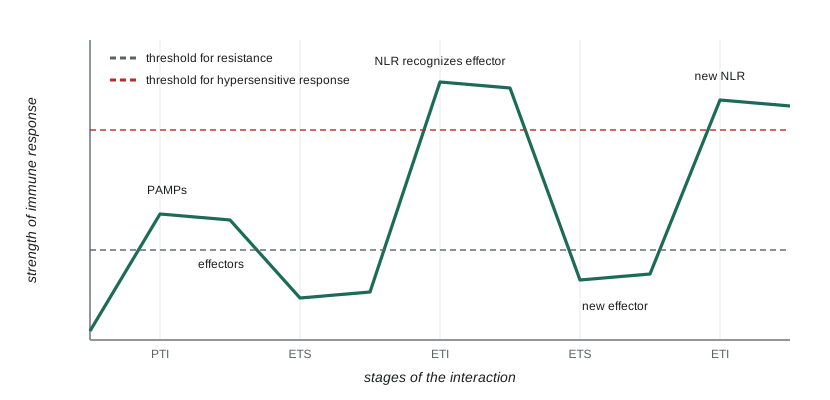
Jonathan Jones and Jeffery Dangl summarized these ideas in 2006 in the zigzag model, which describes plant–pathogen interactions as an arms race. Plants detect patterns, pathogens suppress the response with effectors, plants evolve NLRs that recognize effectors, and pathogens lose or alter recognized effectors and evolve new ones. Later work has shown that PTI and ETI are not as separate as the model suggests: each strengthens the other, and NLR activation depends on surface receptor signalling for full effect. But the arms-race logic explains why resistance genes deployed in crops often break down within a few years.
Gene-for-gene resistance and its breakdown
In the 1940s, Harold Flor, working in North Dakota on flax and the flax rust fungus, showed that for every resistance gene in the host there is a matching avirulence gene in the pathogen, and that resistance occurs only when a host carrying a particular resistance gene meets a pathogen carrying the corresponding avirulence gene. In modern terms, the avirulence gene encodes an effector that a particular NLR recognizes. A pathogen that loses or changes the effector escapes recognition and becomes virulent on hosts carrying that resistance gene.
# Gene-for-gene interactions: a host is resistant if it carries an R gene whose
# matching Avr gene is present in the pathogen race; otherwise disease develops.
hosts = {"cv. A (no R genes)": set(), "cv. B (Sr31)": {"Sr31"},
         "cv. C (Sr31, Sr24)": {"Sr31", "Sr24"}, "cv. D (Sr24, Sr36, Sr50)": {"Sr24", "Sr36", "Sr50"}}
# which R genes each race is still recognized by (it carries the matching Avr effector)
races = {"race 1": {"Sr31", "Sr24", "Sr36", "Sr50"},
         "race 2 (lost AvrSr31)": {"Sr24", "Sr36", "Sr50"},
         "race 3 (lost AvrSr31, AvrSr24)": {"Sr36", "Sr50"},
         "race 4 (lost AvrSr31, AvrSr24, AvrSr36)": {"Sr50"}}
print(f"{'':42s}" + "".join(f"{h.split(' (')[0]:>9s}" for h in hosts))
for race, recognized in races.items():
    row = ["R" if hosts[h] & recognized else "S" for h in hosts]
    print(f"{race:42s}" + "".join(f"{x:>9s}" for x in row))
print("\nR = resistant (at least one R gene recognizes the race), S = susceptible")cv. A cv. B cv. C cv. D race 1 S R R R race 2 (lost AvrSr31) S S R R race 3 (lost AvrSr31, AvrSr24) S S S R race 4 (lost AvrSr31, AvrSr24, AvrSr36) S S S R R = resistant (at least one R gene recognizes the race), S = susceptible
The table shows why breeders stack several resistance genes in one variety. A race that loses a single effector defeats every variety relying on the matching gene alone, but a variety with three effective genes stays resistant until the pathogen has lost all three matching effectors, which is far less likely to happen in one step. This has been the strategy against wheat stem rust since Ug99, a race first found in Uganda in 1998–1999, defeated the widely used gene Sr31 and threatened wheat across Africa and Asia. Rust surveillance laboratories in Canada and the United States monitor races every year, and much of the resistance in North American wheat today comes from stacks of genes and from adult-plant resistance genes such as Sr2 and Lr34, which give partial, broad and durable protection. Lr34 encodes a transporter rather than an NLR, and it has protected wheat against several rusts and powdery mildew for more than a century.
Systemic and induced resistance
Infection of one leaf often makes the whole plant more resistant to later attack, a phenomenon called systemic acquired resistance (SAR). SAR depends on salicylic acid, which accumulates in infected and then in distant leaves, and on mobile signals including the amino acid derivative N-hydroxypipecolic acid. Salicylic acid acts through NPR proteins, which control the expression of pathogenesis-related (PR) genes encoding antimicrobial proteins such as chitinases and glucanases. SAR is long lasting and effective against a broad range of biotrophic pathogens. Synthetic SAR activators such as acibenzolar-S-methyl are sold as crop protection products that prime defences without killing pathogens directly. Beneficial root bacteria trigger a different form, induced systemic resistance, which depends on jasmonate and ethylene signalling and protects mainly against necrotrophs and insects. Salicylic acid and jasmonate pathways often antagonize each other, so defences against biotrophs and necrotrophs trade off.
Plants defend against viruses largely by RNA silencing. Double-stranded RNA formed during virus replication is cut by Dicer-like enzymes into small interfering RNAs, which guide Argonaute proteins to destroy matching viral RNA; the silencing signal spreads through plasmodesmata and the phloem, immunizing tissues ahead of the virus. Viruses in turn encode suppressors of silencing. The discovery of RNA silencing owed much to plant biologists: attempts in 1990 to deepen petunia flower colour by adding extra copies of a pigment gene unexpectedly produced white flowers, because the extra copies triggered silencing of both transgene and endogenous gene.
Defence against herbivores
Insect herbivores face both constitutive and induced defences. Constitutive defences include thorns, trichomes, tough leaves, latex and an immense chemical arsenal: about 200,000 specialized metabolites are known from plants, including alkaloids such as nicotine and caffeine, terpenoids such as the pyrethrins of chrysanthemums, phenolics such as tannins, and cyanogenic glycosides. Many are stored as harmless precursors and activated only when tissue is damaged. In plants of the mustard family, including canola and cabbage, glucosinolates are stored separately from the enzyme myrosinase; when an insect chews the leaf, the two mix and release toxic isothiocyanates, the pungent compounds of mustard and horseradish, a system nicknamed the mustard oil bomb. Canola itself was created in Canada in the 1970s by breeding rapeseed low in both glucosinolates in the meal and erucic acid in the oil, making it suitable for food and feed; the name comes from Canadian oil, low acid.
Wounding by chewing insects triggers jasmonate synthesis within minutes, both locally and in distant leaves, through electrical and calcium signals that travel through the vasculature. Jasmonate induces proteinase inhibitors that block insect digestive enzymes, as well as polyphenol oxidases and toxic metabolites. Plants also release volatile compounds when attacked that attract the predators and parasitoids of the herbivores, an indirect defence; maize leaves attacked by caterpillars emit a blend of terpenes that guides parasitic wasps to the caterpillars, and maize roots attacked by rootworm larvae release a sesquiterpene that attracts insect-killing nematodes. Many North American maize varieties lost this root signal during breeding, an example of how domestication can weaken natural defences.
| Defence | Trigger | Main signal | Effective against |
|---|---|---|---|
| Pattern-triggered immunity | Conserved microbial patterns such as flagellin and chitin | Surface receptors, ROS, MAP kinases | Most potential pathogens |
| Effector-triggered immunity | Specific effectors recognized by NLRs | Ca²⁺, salicylic acid, hypersensitive cell death | Adapted biotrophs and hemibiotrophs |
| Systemic acquired resistance | Local infection | Salicylic acid, N-hydroxypipecolic acid | Broad range of biotrophs |
| Induced systemic resistance | Beneficial root microbes | Jasmonate and ethylene | Necrotrophs and some insects |
| Wound-induced defence | Chewing herbivores | Jasmonates, systemin (tomato) | Insect herbivores |
| RNA silencing | Viral double-stranded RNA | Small interfering RNAs | Viruses |
Epidemics in fields
Disease in a crop is a population process. Plant pathologist J. E. van der Plank showed in the 1960s that the spread of many polycyclic diseases, which go through several cycles of infection in a season, follows logistic growth: the proportion of tissue diseased increases at a rate proportional both to the amount already diseased, which supplies spores, and to the amount still healthy, which can be infected. The apparent infection rate, r, summarizes how fast an epidemic grows, and resistance and fungicides act mainly by reducing r or the initial inoculum.
import math

# Van der Plank logistic epidemic: x(t) = 1 / (1 + ((1 - x0)/x0) * exp(-r t))
def x(t, x0, r):
    return 1 / (1 + (1 - x0) / x0 * math.exp(-r * t))

def days_to(level, x0, r):
    return math.log(level / (1 - level) * (1 - x0) / x0) / r

scenarios = [("susceptible cultivar", 0.001, 0.25),
             ("partial resistance (r halved)", 0.001, 0.125),
             ("clean seed (inoculum / 10)", 0.0001, 0.25),
             ("both measures", 0.0001, 0.125)]
print(f"{'scenario':32s} disease at day 20   40    60   days to 5% severity")
for name, x0, r in scenarios:
    print(f"{name:32s} {100*x(20,x0,r):9.1f}% {100*x(40,x0,r):6.1f}% {100*x(60,x0,r):5.1f}%"
f" {days_to(0.05, x0, r):6.0f}")scenario disease at day 20 40 60 days to 5% severity susceptible cultivar 12.9% 95.7% 100.0% 16 partial resistance (r halved) 1.2% 12.9% 64.4% 32 clean seed (inoculum / 10) 1.5% 68.8% 99.7% 25 both measures 0.1% 1.5% 15.3% 50
The output shows the classic insight of plant disease epidemiology. Cutting the initial inoculum tenfold delays the epidemic by a fixed number of days, about nine at this infection rate, while halving the infection rate doubles the time needed to reach any given severity. In a season of limited length, combining both measures keeps disease low until the crop has matured. Partial, quantitative resistance of the Lr34 type acts on r, and clean seed, crop rotation and sanitation act on the starting inoculum.
Canada has its own pressing examples. Clubroot, a soil-borne disease of canola caused by the protist Plasmodiophora brassicae, was first found in Alberta canola fields in 2003 and has since spread across much of the province and into Saskatchewan and Manitoba. Its resting spores survive in soil for many years, so management relies on resistant varieties, longer rotations and cleaning soil from equipment; resistance based on single genes has already been overcome by new pathotypes in parts of Alberta. Fusarium head blight of wheat and barley, which contaminates grain with the mycotoxin deoxynivalenol, has moved westward from Manitoba across the Prairies, and the emerald ash borer, an invasive insect first detected near Windsor, Ontario, in 2002, has killed millions of ash trees in Ontario and Quebec.
Abiotic stress: drought, heat and cold
Drought is the most important abiotic stress for crops worldwide. Plants respond on several timescales. Within minutes, ABA closes stomata (lesson 8). Over hours to days, cells accumulate compatible solutes such as proline, glycine betaine and sugars, which lower solute potential without disrupting enzymes, a process called osmotic adjustment that helps maintain turgor and growth; ABA-responsive transcription factors and DREB2 proteins switch on genes for protective LEA proteins, dehydrins and antioxidant enzymes. Over weeks, plants grow deeper roots relative to shoots, shed older leaves and may hasten flowering to escape the drought. Plant ecologists distinguish drought escape (completing the life cycle before drought), avoidance (maintaining water status, for example with deep roots or closed stomata) and tolerance (surviving low water status, as in resurrection plants that can dry to a few per cent water and revive).
Heat damages membranes and denatures proteins, and plants respond by making heat shock proteins, molecular chaperones that refold or protect proteins, under the control of heat shock transcription factors. A moderate heat exposure induces thermotolerance against a later, more severe one. Reproduction is especially sensitive: in many crops, temperatures above about 32 to 35 °C during flowering reduce pollen viability and seed set, so a few hot days at the wrong moment can cut yields sharply. Maize yields in the US Corn Belt decline steeply with the number of hours above about 29 to 30 °C during the growing season, one of the clearest climate–yield relationships in agriculture.
Cold stress divides into chilling, damage at temperatures above freezing, and freezing. Tropical and subtropical plants such as maize, rice, tomato, cucumber and banana are injured by chilling below about 10 °C, partly because their membranes stiffen. Temperate plants survive freezing by a process called cold acclimation. Exposure to low but non-freezing temperatures for days to weeks induces the CBF (also called DREB1) transcription factors, which activate a regulon of more than a hundred cold-regulated genes. Cells accumulate sugars and protective proteins, membranes change their lipid composition, and ice forms preferentially in the apoplast, outside the cells. Extracellular ice draws water out of the cells, which then dehydrate rather than freeze internally; intracellular ice is almost always lethal. Some plants also make antifreeze proteins that bind ice crystals and slow their growth. Acclimated winter wheat survives crown temperatures of about −20 °C, while the hardiest boreal trees such as white birch, trembling aspen and the larches of the far north can withstand −40 °C and below when fully acclimated in midwinter, using extracellular freezing and, in some tissues, deep supercooling.
Salinity and flooding
Salt-affected soils limit crops in irrigated regions worldwide and in the dryland saline seeps of the northern Great Plains and the Canadian Prairies, where rising water tables carry salts to the surface. Salt harms plants in two phases. An osmotic phase begins immediately, because the low water potential of saline soil makes water harder to extract, slowing growth much as drought does. An ionic phase follows over days to weeks, as sodium and chloride accumulate to toxic levels in leaves. Plants limit sodium entry and move it out of the cytosol with several transporters. In the SOS (Salt Overly Sensitive) pathway, a calcium signal activates the kinase SOS2, which activates SOS1, a Na⁺/H⁺ antiporter in the plasma membrane that pumps sodium out of root cells and loads it into the xylem for controlled distribution. HKT transporters retrieve sodium from the xylem in roots, keeping it out of leaves; a wheat HKT gene introduced from an ancestral relative raised durum wheat yields on saline soils by up to about a quarter in field trials. NHX antiporters move sodium into vacuoles, where it contributes to osmotic adjustment without poisoning enzymes. Halophytes such as saltbushes, glassworts and the salt grass of prairie sloughs combine all these mechanisms, and some excrete salt through glands on their leaves.
Flooding deprives roots of oxygen, because oxygen diffuses about 10,000 times more slowly in water than in air. Roots switch to fermentation, which yields little ATP, and many species respond with ethylene-triggered aerenchyma and with adventitious roots near the surface, as lesson 8 described for rice. Waterlogging after heavy spring rains is a common cause of yield loss in canola, which is relatively sensitive, while crops such as rice and some forage grasses tolerate it well.
Reactive oxygen species: damage and signal
Almost every stress increases the production of reactive oxygen species, including superoxide, hydrogen peroxide and singlet oxygen, in chloroplasts, mitochondria and peroxisomes. At high levels they damage lipids, proteins and DNA, and plants maintain an extensive antioxidant system of enzymes (superoxide dismutase, catalase, ascorbate peroxidase and others) and small antioxidants (ascorbate, glutathione, tocopherols and carotenoids). But reactive oxygen species are also signals. The burst of ROS produced by NADPH oxidases in PTI and ABA signalling is deliberate, and waves of ROS travelling from cell to cell carry stress signals across the plant within minutes. Plants also show stress memory: a first exposure to drought, heat or pathogen attack can prime faster, stronger responses to later exposures, through changes in chromatin and in the levels of signalling components. Because defence and stress responses divert resources from growth, plants must balance growth against protection, a trade-off central to modern efforts to breed crops that are both productive and resilient.
Worked problem
Explaining a resistance breakdown
A canola variety with a single major gene for clubroot resistance remained disease-free for five years in a heavily infested Alberta field. In the sixth year, galls appeared on many plants. Spores from the galls cause disease on the resistant variety in the laboratory, whereas spores collected from the same field in year one did not. What happened, and what should the grower do?
Show solution
- The resistance gene recognized an effector present in the original pathogen population.
- Repeated planting of the same resistant variety strongly selected for rare pathotypes that lacked or had altered the recognized effector.
- Those pathotypes multiplied in the field until they were common enough to cause visible disease, a classic gene-for-gene breakdown.
- The grower should lengthen rotations to let spore numbers decline, rotate varieties with different resistance sources and limit soil movement on equipment.
Answer: The pathogen population shifted to a virulent pathotype that escapes recognition by the single resistance gene. Durable control combines diverse resistance genes, longer breaks from canola and sanitation, rather than relying on one gene.
Common mistakes
MistakeThinking that plants have no immune system.
InsteadPlants have innate immunity based on surface pattern receptors and intracellular NLR receptors in every cell, plus systemic signalling.
MistakeAssuming the hypersensitive response helps against all pathogens.
InsteadKilling infected cells starves biotrophs but can help necrotrophs, which feed on dead tissue.
MistakeTreating a single resistance gene as a permanent solution.
InsteadPathogens can lose or alter the recognized effector; resistance genes are best stacked and combined with management.
MistakeThinking freezing-tolerant plants prevent ice from forming at all.
InsteadMost tolerate ice in the apoplast and avoid intracellular freezing by dehydrating their cells.
MistakeSeeing reactive oxygen species only as damaging.
InsteadThey are also deliberate signals in immunity and stress responses.
MistakeTreating salt stress as purely a toxicity problem.
InsteadSalt first acts osmotically, like drought; ion toxicity follows as sodium and chloride accumulate.
Summary and key terms
- Pathogens are biotrophs, necrotrophs or hemibiotrophs; preformed barriers and stored compounds give the first line of defence.
- Surface receptors such as FLS2 detect conserved microbial patterns and trigger pattern-triggered immunity; effectors suppress it.
- Intracellular NLR receptors detect effectors and trigger effector-triggered immunity, often with a hypersensitive response; the zigzag model describes the arms race.
- Gene-for-gene interactions explain race-specific resistance and its breakdown; stacking genes and durable partial resistance prolong protection.
- Salicylic acid drives systemic acquired resistance against biotrophs; jasmonate and ethylene drive defences against necrotrophs and insects; RNA silencing fights viruses.
- Logistic epidemic models show that resistance slows the infection rate while sanitation reduces initial inoculum.
- Drought, heat, cold, salt and flooding responses involve ABA, chaperones, the CBF regulon, sodium transporters and ethylene; ROS act as both damage and signal.
- biotroph
- A pathogen that feeds on living host cells.
- necrotroph
- A pathogen that kills host cells and feeds on the dead tissue.
- PAMP
- A pathogen-associated molecular pattern, a conserved microbial molecule recognized by surface receptors.
- pattern-triggered immunity
- Defence triggered by recognition of conserved microbial patterns at the cell surface.
- effector
- A pathogen protein that manipulates host cells, often by suppressing immunity.
- NLR
- A nucleotide-binding, leucine-rich repeat intracellular immune receptor encoded by most resistance genes.
- hypersensitive response
- Rapid, localized death of plant cells at the site of infection.
- gene-for-gene model
- Flor’s model that resistance requires a host R gene matched by a pathogen avirulence gene.
- systemic acquired resistance
- Long-lasting, broad resistance throughout a plant after a local infection, dependent on salicylic acid.
- cold acclimation
- An increase in freezing tolerance after exposure to low, non-freezing temperatures.
- compatible solute
- A small organic molecule accumulated for osmotic adjustment without disrupting metabolism.
- SOS pathway
- A signalling pathway that activates the SOS1 Na⁺/H⁺ antiporter to remove sodium from the cytosol.
Practice problems
Work each problem on paper first, then reveal the answer to check.
Give an example of a PAMP and its receptor.
Show answer
The flagellin peptide flg22, recognized by the receptor kinase FLS2 with its co-receptor BAK1.
How do effectors and NLRs fit into the zigzag model?
Show answer
Effectors suppress pattern-triggered immunity; NLRs recognize effectors and trigger stronger effector-triggered immunity.
What is the guard model?
Show answer
NLRs detect effectors indirectly by monitoring host proteins that the effectors modify.
A wheat variety carries Sr24 and Sr36. A rust race has lost AvrSr24 but retains AvrSr36. Is the variety resistant?
Show answer
Yes; Sr36 still recognizes the race.
Why might the hypersensitive response be counterproductive against Botrytis?
Show answer
Botrytis is a necrotroph that feeds on dead cells, so host cell death can aid it.
In a logistic epidemic with r = 0.2 per day, how many days does a tenfold reduction in initial inoculum delay the epidemic?
Show answer
About ln(10)/0.2 ≈ 11.5 days.
How does the mustard oil bomb work?
Show answer
Glucosinolates and myrosinase are stored separately; tissue damage mixes them, releasing toxic isothiocyanates.
What is the role of the CBF regulon in cold acclimation?
Show answer
CBF transcription factors induced by cold activate many cold-regulated genes that increase freezing tolerance.
Why is extracellular ice tolerated but intracellular ice lethal?
Show answer
Ice in the apoplast dehydrates cells without damaging internal membranes; intracellular ice ruptures membranes and organelles.
Name three ways plants limit sodium damage under salinity.
Show answer
SOS1 efflux of Na⁺ from root cells, HKT retrieval of Na⁺ from the xylem, and NHX sequestration of Na⁺ in vacuoles.
Lesson quiz · 5 questions
Score 60% or more to complete this lesson.
Create a free account to save your progress, take quizzes and earn a certificate.