
BIOL-340 · Lesson 10 of 12 · 36 min
Reproduction: flowers, seeds and fruits
Flowering plants dominate most land ecosystems, with more than 300,000 species, and almost all of the food humans eat comes, directly or through livestock, from their seeds, fruits and the plants that grow from them. Their success owes much to their reproductive innovations: the flower, which uses animals and wind to move pollen with remarkable precision; double fertilization, which provisions each seed with a nutritive endosperm only when an embryo has formed; the fruit, which protects seeds and enlists animals to disperse them; and the dormant seed, which can wait in the soil for years or decades for the right moment to germinate. BIOL-108 introduced the angiosperm life cycle and alternation of generations. This lesson examines how a shoot becomes a flower, how floral organs get their identities, how pollen and ovules develop and meet, what happens at fertilization, and how seeds and fruits develop, become dormant and germinate. It ends with asexual reproduction and with how breeders exploit plant reproduction to produce hybrid seed.
Deciding to flower
Flowering is a commitment that cannot easily be undone, because a meristem that becomes a flower stops producing leaves and stems. Plants therefore integrate many cues before they flower. In Arabidopsis, which has served as the model for this decision, at least five pathways converge. The photoperiod pathway and the vernalization pathway, described in lesson 9, report day length and winter cold. The autonomous pathway, a set of genes that repress FLC independently of cold, lets plants flower eventually even without vernalization. The gibberellin pathway promotes flowering, especially in short days. The age pathway prevents very young plants from flowering: in juvenile plants a microRNA, miR156, is abundant and represses SQUAMOSA PROMOTER BINDING PROTEIN-LIKE (SPL) transcription factors; as the plant ages, miR156 declines, SPLs rise and the plant becomes competent to flower. Many trees have juvenile phases lasting years or decades, which slows the breeding of fruit and forest trees.
These pathways converge on a small set of floral integrator genes, chiefly FT, SOC1 and the SPLs, which in turn activate floral meristem identity genes, notably LEAFY and APETALA1, in the flanks of the shoot apex. Once these genes are switched on, new primordia develop as flowers rather than as leaves with buds. Plants with constitutively high LEAFY expression flower extremely early; poplar trees engineered to express LEAFY strongly flowered within months instead of years.
The ABC model of floral organ identity
A typical eudicot flower has four whorls of organs: sepals on the outside, then petals, stamens (the male organs, which make pollen) and, in the centre, carpels (the female organs, which contain ovules and develop into fruit). In the late 1980s, Elliot Meyerowitz and colleagues working on Arabidopsis and Enrico Coen and colleagues working on snapdragon independently studied homeotic mutants, in which one kind of floral organ develops in the place of another. They found that the mutants fell into three classes, each affecting two adjacent whorls, and proposed the ABC model in 1991.
In the model, three classes of genes act in overlapping domains. A-class genes (APETALA1 and APETALA2 in Arabidopsis) act in whorls 1 and 2; B-class genes (APETALA3 and PISTILLATA) act in whorls 2 and 3; C-class genes (AGAMOUS) act in whorls 3 and 4. Each organ identity is specified by a combination: A alone gives sepals, A plus B gives petals, B plus C gives stamens and C alone gives carpels. A and C repress each other, so when A is lost, C spreads into the outer whorls, and when C is lost, A spreads inward. The model predicts the mutant phenotypes exactly. A-class mutants have carpels, stamens, stamens and carpels; B-class mutants have sepals, sepals, carpels and carpels; C-class mutants have sepals, petals, petals and sepals, and because AGAMOUS is also needed to terminate the floral meristem, the flower keeps producing more whorls, giving the ‘double flowers’ prized by gardeners in roses and camellias.
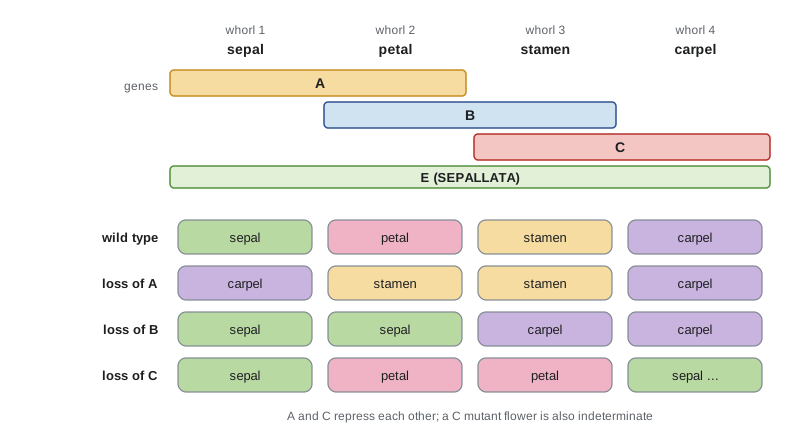
Later work added E-class genes, the SEPALLATA genes (SEP1 to SEP4), which are needed in all floral whorls; plants lacking all four SEP genes make flowers consisting entirely of leaf-like organs. This confirmed a prediction made by Goethe in 1790, that floral organs are modified leaves. A D class was also defined for ovule identity. Almost all ABC and E genes encode MADS-box transcription factors, and the floral quartet model proposes that they act as complexes of four proteins whose combination determines which target genes are activated: sepals require an A–A–E–E-type complex, petals A–B–B–E and so on. Strikingly, expressing A, B and E genes together in leaves converts them into petal-like organs, showing that these few genes are sufficient to specify organ identity. The model applies broadly across flowering plants, although the A function is less well conserved than B and C, and in some groups, such as tulips and lilies, B-class genes extend into the outer whorl, so sepals and petals look alike and are called tepals.
| Genotype | Whorl 1 | Whorl 2 | Whorl 3 | Whorl 4 |
|---|---|---|---|---|
| Wild type (A, B, C active) | Sepal (A) | Petal (A + B) | Stamen (B + C) | Carpel (C) |
| A-class mutant (ap2) | Carpel (C) | Stamen (B + C) | Stamen (B + C) | Carpel (C) |
| B-class mutant (ap3 or pi) | Sepal (A) | Sepal (A) | Carpel (C) | Carpel (C) |
| C-class mutant (ag) | Sepal (A) | Petal (A + B) | Petal (A + B) | Sepal, repeated (A); indeterminate |
| A, B and C all lost | Leaf-like | Leaf-like | Leaf-like | Leaf-like |
Making pollen and ovules
Flowering plants, like all land plants, alternate between a diploid sporophyte, the familiar plant, and a haploid gametophyte, which in angiosperms is reduced to a few cells. In the anthers, diploid microspore mother cells undergo meiosis to produce four haploid microspores. Each microspore divides once by mitosis to form a pollen grain containing a large vegetative cell and a small generative cell enclosed within it; the generative cell divides again, either before the pollen is shed or within the pollen tube, to form two sperm cells. The pollen wall has an outer layer of sporopollenin, one of the most resistant biological polymers known, which is why pollen grains survive in sediments for millions of years and are used to reconstruct past vegetation.
In each ovule, a megaspore mother cell undergoes meiosis to give four megaspores, three of which usually die. The survivor divides three times by mitosis, without cytokinesis at first, to form an embryo sac with eight nuclei, which then become organized into seven cells: an egg cell flanked by two synergids at one end, three antipodal cells at the other end, and a large central cell containing two polar nuclei. This Polygonum-type embryo sac, the female gametophyte, is found in about 70 per cent of flowering plants.
Pollination and self-incompatibility
Pollination, the transfer of pollen to the stigma, is carried out by wind in grasses, including all cereals, and in many temperate trees such as oaks, birches and conifers, and by animals in most other flowering plants. Animal-pollinated flowers offer rewards, chiefly nectar and pollen, and advertise them with colour, scent and shape. Flowers pollinated by bees tend to be blue, purple or yellow, often with ultraviolet nectar guides invisible to people; those pollinated by hummingbirds are often red and tubular with little scent; those pollinated by moths are often white and fragrant at night. About three quarters of the leading food crop types benefit from animal pollination, although wind-pollinated cereals provide most calories. Declines in wild and managed pollinators, from habitat loss, pesticides, pathogens and parasites, are a concern for both biodiversity and agriculture; North America has about 4,000 native bee species in addition to the introduced honeybee.
Many plants prevent self-fertilization, which would reduce genetic variation and expose harmful recessive alleles, through self-incompatibility, a genetic system that lets the pistil recognize and reject its own pollen. In gametophytic self-incompatibility, found in the nightshade, rose and plantain families, the pollen’s own haploid genotype at the S-locus determines its behaviour: in Solanaceae and Rosaceae, the style secretes S-RNases that enter pollen tubes and degrade their RNA, but pollen carrying a matching S-allele cannot detoxify its own S-RNase, so its tube stops growing. Apple and pear orchards must therefore be planted with compatible pollinizer varieties. In sporophytic self-incompatibility, found in the mustard family, the pollen’s behaviour is determined by the diploid genotype of the parent plant, because the pollen coat protein SCR (also called SP11) is deposited by the anther tissue; it binds the receptor kinase SRK on the stigma surface, and a match triggers rejection before the pollen tube even enters. This system is used to make hybrid seed in vegetable brassicas, though hybrid canola relies mainly on male sterility systems.
Double fertilization
A compatible pollen grain hydrates on the stigma and germinates a pollen tube that grows down through the style, guided by chemical signals, at speeds that can exceed a centimetre per hour, the fastest-growing plant cells known. As it nears the ovule, the tube is attracted by small cysteine-rich peptides called LUREs, secreted by the synergids. The tube enters the embryo sac through one synergid, which dies, and bursts, releasing its two sperm cells. One sperm fuses with the egg to form the diploid zygote. The other fuses with the two polar nuclei of the central cell to form a triploid primary endosperm nucleus. This double fertilization, discovered by Sergei Nawaschin in 1898 in lilies, is found in all flowering plants. The endosperm develops into a nutritive tissue that feeds the embryo, either during seed development, as in beans and peas, where the cotyledons absorb it, or during germination, as in cereals, where it makes up most of the grain. Because the endosperm forms only after fertilization, the mother plant invests resources in it only when an embryo exists, an economy that may have contributed to the success of angiosperms.
Endosperm also shows a phenomenon called genomic imprinting, in which some genes are expressed only from the maternal or only from the paternal copy. Imprinting in the endosperm is thought to reflect a conflict between parents over how much the mother should invest in each seed, and it creates a barrier to hybridization: crosses between plants of different ploidy often fail because the endosperm develops abnormally when the ratio of maternal to paternal genomes departs from 2:1.
Embryos and seeds
The zygote divides asymmetrically. The smaller apical cell gives rise to most of the embryo, and the larger basal cell forms a suspensor that pushes the embryo into the endosperm and supplies it with nutrients. In Arabidopsis, the embryo passes through recognizable globular, heart and torpedo stages, during which it establishes the shoot and root apical meristems, the cotyledons and the main axis of the plant, with auxin transport by PIN proteins setting up the apical–basal axis. The integuments of the ovule harden into the seed coat. As the seed matures, ABA drives the accumulation of storage reserves, the acquisition of desiccation tolerance and the onset of dormancy (lesson 8), and the seed dries until its metabolism nearly stops.
Seeds can remain viable for remarkably long periods. In 2005, a date palm was grown from a seed about 2,000 years old found at Masada in Israel, and in 2012 Russian scientists regenerated plants of the campion Silene stenophylla from fruit tissue buried by Arctic ground squirrels in Siberian permafrost about 32,000 years earlier. Seed banks exploit longevity to conserve crop and wild genetic diversity. The Svalbard Global Seed Vault in Norway, opened in 2008, stores duplicate samples of well over a million seed accessions from gene banks around the world at −18 °C, and national collections such as Plant Gene Resources of Canada in Saskatoon and the USDA’s National Laboratory for Genetic Resources Preservation in Fort Collins hold hundreds of thousands of samples.
Dormancy and germination
A dormant seed fails to germinate even under conditions that would normally allow it. Dormancy prevents seeds from germinating at the wrong time, for example during a warm spell in autumn before winter, and spreads germination across years so that a single bad season does not wipe out a population. Physical dormancy arises from a seed coat impermeable to water, as in many legumes, and is broken when the coat is scratched, abraded or cracked by heat; physiological dormancy arises within the embryo and is broken by after-ripening in dry storage, by moist chilling (stratification), or by light, nitrate or smoke. At the hormonal level, dormancy reflects a balance between ABA, which maintains it, and gibberellin, which promotes germination. Cold, light acting through phytochrome, and after-ripening all shift the balance by lowering ABA and raising gibberellin synthesis and sensitivity.
Germination of a non-dormant seed proceeds in three phases. In phase I, the dry seed takes up water rapidly by imbibition, driven by the very negative matric potential of its dry contents; membranes and enzymes are repaired, and respiration resumes within minutes. In phase II, water uptake plateaus while metabolism gears up, stored mRNAs are translated, and in cereals gibberellin from the embryo induces the aleurone layer to make α-amylase that mobilizes the endosperm starch (lesson 7). In phase III, the radicle emerges through the seed coat, which by definition completes germination, and water uptake rises again as the seedling grows. Germination speed depends strongly on temperature and on water availability, and seed scientists describe the effect of water with the hydrothermal time model.
import math

# Hydrotime model of germination: a seed in a population germinates at time t_g
# when (psi - psi_b) * t_g = theta_H, where its base water potential psi_b is normally
# distributed across the population. Values are illustrative for a crop seed lot.
theta_H = 40.0                 # MPa hours
mean_b, sd_b = -1.0, 0.25      # base water potential: mean and spread, MPa

def norm_cdf(x):
    return 0.5 * (1 + math.erf(x / math.sqrt(2)))

def frac_germinated(psi, t):
    # a seed has germinated by time t if psi_b <= psi - theta_H / t
    return norm_cdf((psi - theta_H / t - mean_b) / sd_b)

print(" soil psi (MPa)   % germinated at 24 h   48 h   96 h   200 h")
for psi in (0.0, -0.3, -0.6, -0.9):
    row = [100 * frac_germinated(psi, t) for t in (24, 48, 96, 200)]
    print(f"     {psi:5.1f}            {row[0]:5.1f}     {row[1]:6.1f} {row[2]:6.1f} {row[3]:6.1f}")
t50 = theta_H / (0.0 - mean_b)
print(f"time to 50% germination in pure water: {t50:.0f} h") soil psi (MPa) % germinated at 24 h 48 h 96 h 200 h
0.0 0.4 74.8 99.0 99.9
-0.3 0.0 29.7 87.1 97.7
-0.6 0.0 4.2 47.3 78.8
-0.9 0.0 0.2 10.3 34.5
time to 50% germination in pure water: 40 hThe model captures two effects of drying soil at once. Germination is slower, because the time each seed needs is inversely proportional to how far the water potential exceeds its base value, and the final percentage is lower, because seeds whose base water potential lies above the soil water potential never germinate. In pure water, half the seeds germinate in about 40 hours; at −0.6 MPa, germination is much slower, and at −0.9 MPa only a minority ever germinate. Seed technologists use these parameters to compare seed lots, to predict emergence in dry seedbeds and to design priming treatments, in which seeds are hydrated just short of radicle emergence and then dried, so that they germinate faster and more uniformly when sown.
Fruits and seed dispersal
A fruit is a mature ovary, sometimes with other floral parts attached. Fertilization triggers fruit set: developing seeds produce auxin and gibberellin that stimulate the ovary wall, which becomes the pericarp, to grow. Fruits that develop without fertilization are parthenocarpic; seedless cucumbers, bananas and navel oranges are examples, and gibberellin or auxin sprays can induce parthenocarpy in some crops. Botanists classify fruits by their origin. Simple fruits come from one ovary and may be fleshy, like berries (tomato, grape, blueberry) and drupes (cherry, peach), or dry, like legumes, capsules, grains and nuts. Aggregate fruits, such as raspberries, develop from many separate carpels of one flower. Multiple fruits, such as pineapples, develop from the ovaries of many flowers fused together. Accessory fruits include tissue other than the ovary: the flesh of a strawberry is an enlarged receptacle carrying the true fruits, the achenes, on its surface, and the flesh of an apple is derived mainly from the floral tube surrounding the ovary.
Fruits disperse seeds by wind (the winged samaras of maples and the plumed fruits of dandelions), by water (coconuts), by animals that eat the fruit and pass the seeds (cherries, blueberries), by animals that cache seeds (oaks and squirrels, whitebark pine and Clark’s nutcrackers), by hooks that catch fur (burdock, whose burrs inspired Velcro) and by explosive mechanisms (touch-me-nots and witch hazel). Domestication changed fruits and seeds dramatically. Wild cereals shatter, dropping their seeds as they ripen; early farmers unknowingly selected non-shattering mutants, such as those in the wheat Q and the barley Btr genes, because only seeds that stayed on the plant were harvested and replanted.
Asexual reproduction
Many plants also reproduce asexually. Vegetative propagation, from stems, roots, leaves, rhizomes, tubers, bulbs or runners, produces clones of the parent. Quaking aspen spreads by root suckers into clones that can cover tens of hectares; one clone in Utah, known as Pando, is estimated to contain tens of thousands of stems sharing a single root system. Agriculture relies heavily on clonal propagation: potatoes are grown from tubers, apples and grapes are propagated by grafting scions of named varieties onto rootstocks, and almost all export bananas belong to a single clone, Cavendish. Clonal uniformity has a cost: Cavendish replaced the Gros Michel variety in the mid-twentieth century after a soil fungus, Fusarium wilt, devastated it, and a new strain of the same fungus, Tropical Race 4, has been spreading through banana-growing regions, reaching Colombia in 2019 and Peru in 2021.
Some plants produce seeds asexually, a process called apomixis, in which an embryo develops from an unreduced cell of the ovule without fertilization. Dandelions, many blackberries and some grasses are apomictic. Because apomictic seeds are clones of the mother plant, introducing apomixis into crops could let farmers save and replant hybrid seed without losing hybrid vigour. In 2019, researchers achieved synthetic apomixis in rice by combining genome editing of meiosis genes with expression of an egg-cell gene, a proof of concept that is being developed further.
Hybrid seed
Crosses between genetically distinct inbred lines often produce hybrid offspring that grow more vigorously and yield more than either parent, a phenomenon called heterosis or hybrid vigour. Hybrid maize, introduced in the 1930s, roughly quadrupled US corn yields over the following decades, alongside improved management. Producing hybrid seed requires preventing self-pollination of the female parent. In maize, whose male flowers are in the tassel at the top of the plant and female flowers in the ear, seed companies once relied on teams of workers to pull tassels from female rows, and still do in part. In many crops, breeders instead use male sterility. Cytoplasmic male sterility is caused by mitochondrial genes that prevent pollen development; nuclear restorer genes in the male parent restore fertility in the hybrid. Canola hybrids, which now make up nearly all canola grown in Canada, are produced using male sterility systems such as the Ogura cytoplasmic system or engineered nuclear male sterility, and their higher yields helped make canola one of Canada’s most valuable crops.
from scipy.stats import chisquare

# F2 of a cross between two true-breeding Arabidopsis lines differing at two genes:
# AP3 (B-class; recessive ap3 gives sepals in whorl 2) and a seed-coat pigment gene (TT).
# Expected 9:3:3:1 if the genes assort independently. Counts are invented.
observed = {"normal petals, brown seed": 278, "normal petals, yellow seed": 101,
            "no petals (ap3), brown seed": 88, "no petals (ap3), yellow seed": 33}
n = sum(observed.values())
expected = [n * r / 16 for r in (9, 3, 3, 1)]
chi2, p = chisquare(list(observed.values()), expected)
for (k, o), e in zip(observed.items(), expected):
    print(f"{k:30s} observed {o:4d}  expected {e:6.1f}")
print(f"chi-square = {chi2:.2f} with 3 degrees of freedom, p = {p:.2f}")
print("consistent with independent assortment" if p > 0.05 else "reject independent assortment")normal petals, brown seed observed 278 expected 281.2 normal petals, yellow seed observed 101 expected 93.8 no petals (ap3), brown seed observed 88 expected 93.8 no petals (ap3), yellow seed observed 33 expected 31.2 chi-square = 1.05 with 3 degrees of freedom, p = 0.79 consistent with independent assortment
Segregation analysis of this kind, covered in depth in BIOL-201, is how the floral homeotic genes were first characterized: each behaves as a single recessive Mendelian gene, and double mutants reveal how genes interact. Combining ap3 with ag mutations, for example, gives flowers made entirely of sepals, whorl after whorl without end, exactly as the ABC model predicts when both B and C functions are lost and A activity fills the whole flower.
Worked problem
Predicting an ABC double mutant
Using the ABC model, predict the floral organs in each whorl of an Arabidopsis double mutant lacking both A-class (ap2) and B-class (ap3) function.
Show solution
- Without A, C activity spreads into whorls 1 and 2, because A normally represses C there.
- Without B, no whorl has B activity.
- So every whorl has C activity only.
- C alone specifies carpels.
Answer: Carpels in all four whorls. Observed ap2 ap3 double mutants have flowers made of carpel-like organs throughout, a striking confirmation of the model’s logic.
Common mistakes
MistakeThinking that the ABC genes are expressed only in the whorl where their organ forms.
InsteadEach class acts in two adjacent whorls; identity comes from combinations of overlapping activities.
MistakeSaying that the endosperm is diploid like the embryo.
InsteadIn most flowering plants the endosperm is triploid, from one sperm and two polar nuclei.
MistakeTreating dormancy and quiescence as the same.
InsteadA quiescent seed germinates once given water and suitable temperature; a dormant seed does not until dormancy is broken.
MistakeCalling a strawberry a berry in the botanical sense.
InsteadIt is an accessory fruit; the flesh is receptacle tissue and the true fruits are the achenes on its surface.
MistakeAssuming self-incompatibility always acts on the stigma surface.
InsteadSporophytic systems often act on the stigma, but gametophytic S-RNase systems act within the style as the pollen tube grows.
MistakeAssuming hybrid seed can be saved and replanted without loss.
InsteadThe next generation segregates, losing uniformity and much of the hybrid vigour, unless apomixis is introduced.
Summary and key terms
- Photoperiod, vernalization, autonomous, gibberellin and age pathways converge on floral integrators (FT, SOC1, SPLs) that activate LEAFY and APETALA1.
- The ABC(E) model explains floral organ identity: A + E sepals, A + B + E petals, B + C + E stamens, C + E carpels; A and C repress each other.
- Most floral identity genes encode MADS-box transcription factors that act as quartets; A, B and E genes together can convert leaves into petals.
- Pollen and the seven-celled embryo sac are reduced gametophytes; self-incompatibility systems reject pollen carrying matching S-alleles.
- Double fertilization produces a diploid zygote and a triploid endosperm; imprinting in the endosperm creates hybridization barriers.
- Seed dormancy, controlled by the ABA:GA balance, is broken by after-ripening, chilling, light and other cues; germination has three phases.
- Fruits are mature ovaries that protect and disperse seeds; clonal propagation, apomixis and male sterility are central to agriculture.
- floral integrator
- A gene, such as FT or SOC1, that combines signals from several flowering pathways.
- ABC model
- A model in which overlapping activities of three gene classes specify the four types of floral organ.
- MADS-box gene
- A family of transcription factor genes that includes most floral organ identity genes.
- embryo sac
- The female gametophyte of flowering plants, typically seven cells with eight nuclei.
- self-incompatibility
- A genetic system by which a plant rejects its own pollen.
- double fertilization
- Fusion of one sperm with the egg and another with the central cell, forming zygote and endosperm.
- endosperm
- The nutritive tissue of the seed, usually triploid, formed by fertilization of the central cell.
- genomic imprinting
- Expression of a gene from only the maternal or only the paternal copy.
- seed dormancy
- The failure of a viable seed to germinate under otherwise favourable conditions.
- stratification
- A period of moist chilling used to break seed dormancy.
- apomixis
- Production of seeds without fertilization, giving offspring that are clones of the mother.
- cytoplasmic male sterility
- Pollen failure caused by mitochondrial genes, used to produce hybrid seed.
Practice problems
Work each problem on paper first, then reveal the answer to check.
Name the five flowering pathways in Arabidopsis.
Show answer
Photoperiod, vernalization, autonomous, gibberellin and age pathways.
Predict the flower of a B-class mutant from outside to inside.
Show answer
Sepal, sepal, carpel, carpel.
Why does a C-class mutant produce flowers with many whorls?
Show answer
AGAMOUS is needed to terminate the floral meristem, so without it the flower keeps producing organs.
What evidence supports the idea that floral organs are modified leaves?
Show answer
Plants lacking SEPALLATA (or all ABC function) make leaf-like organs in every whorl; expressing A, B and E genes converts leaves into petals.
Describe the cells of a mature Polygonum-type embryo sac.
Show answer
An egg and two synergids, three antipodals and a binucleate central cell: seven cells, eight nuclei.
Contrast gametophytic and sporophytic self-incompatibility.
Show answer
Gametophytic: the pollen’s own haploid S-allele determines rejection, often in the style. Sporophytic: the diploid parent’s S-genotype, carried in the pollen coat, determines rejection on the stigma.
What are the products of the two fertilization events in angiosperms?
Show answer
A diploid zygote (sperm + egg) and a triploid endosperm (sperm + two polar nuclei).
A seed lot has θH = 40 MPa h and median base water potential −1.0 MPa. How long will the median seed take to germinate at −0.5 MPa?
Show answer
t = 40/(−0.5 − (−1.0)) = 80 h.
Classify a raspberry, a pineapple and an apple by fruit type.
Show answer
Raspberry: aggregate; pineapple: multiple; apple: accessory (pome).
How is cytoplasmic male sterility used to make hybrid seed?
Show answer
The female line carries sterility-causing mitochondria so it cannot self; the male line carries restorer genes so the hybrid is fertile.
Lesson quiz · 5 questions
Score 60% or more to complete this lesson.
Create a free account to save your progress, take quizzes and earn a certificate.